
In 1986, a thirty-three-year-old star at the investment bank First Boston watched his world come apart. Larry Fink had been a prodigy, one of the pioneers of the mortgage-backed securities market, a man widely seen as a future leader of the firm. Then his team made a bet on the direction of interest rates that went badly wrong, and lost something on the order of one hundred million dollars in a single stretch. The golden boy became a cautionary tale. He was, in effect, pushed out, his reputation in ruins.
Most people would have called it the end. Fink called it the beginning of an education. The thing that had destroyed him was that he and his team had not truly understood the risk they were carrying. They had been blindsided. He resolved that he would never be blindsided again, and that obsession, born of public humiliation, would become the founding principle of the largest investment firm the world has ever known.
This is the story of how a catastrophic failure became a superpower, how a bond shop started inside another company grew up to dwarf its parent, and how a single firm came to hold a piece of very nearly every public company on Earth.

📄 Free Download · Company Research Sheet
BlackRock Research Sheet (PDF)
The moat, the meltdown, the Legendary Scorecard, the timeline, and the Move, Money and Mind lessons from this story. Free, no email required.
Born Inside Blackstone
In 1988, Fink took his idea, an asset-management firm built from the ground up around managing risk, to the private equity firm Blackstone. Blackstone agreed, providing a five-million-dollar credit line and taking a fifty percent stake in the new venture, which was housed under its own roof and named Blackstone Financial Management. Fink brought seven partners with him, several from First Boston, the people who would help him build the firm: Robert Kapito, Susan Wagner, Barbara Novick, Bennett Golub, and others.
The new firm specialized in bonds, and from the very first day it was different in one crucial way. It treated risk management not as an afterthought but as the entire point. It built proprietary technology to x-ray a portfolio, to see the hidden exposures that had blindsided Fink at First Boston. That technology, refined over years, would eventually become a platform called Aladdin, and it would turn out to be the deepest part of the company’s moat. Within six years the firm was managing twenty-three billion dollars and employed about a hundred and fifty people.
The $240 Million Divorce
By 1994, Fink’s firm and its parent had fallen out over equity and direction. The two sides separated, and Blackstone sold its stake. The business, which had already been renamed BlackRock in 1992 (keeping the word black in a nod to its origins), was sold to the bank PNC for about two hundred and forty million dollars. Fink stayed at the helm, became chairman in 1998, and took the company public in 1999.
That two-hundred-and-forty-million-dollar price tag would become one of the most famous numbers in finance, because the thing being sold was about to become almost unimaginably more valuable. The parent had let go of the child for a sum that would one day look like a rounding error.

Aladdin: The Moat Nobody Sees. Most think BlackRock’s power is the trillions it manages. The deeper advantage is quieter. Aladdin, the risk platform Fink’s obsession produced, is licensed to other institutions and monitors a pool of assets across the industry far larger than BlackRock’s own. The loss that humiliated Fink in 1986 became the infrastructure much of finance now runs on.
The Two Deals That Built a Giant
BlackRock grew up as a bond manager, but two acquisitions transformed it into the largest investor on the planet. The first came in 2006, when Fink merged BlackRock with Merrill Lynch Investment Managers, more than doubling the firm and pushing its assets past a trillion dollars by the end of that year. The second, and far larger in consequence, came in 2009. In the wreckage of the financial crisis, Fink bought Barclays Global Investors for about thirteen and a half billion dollars. That deal brought with it iShares, the dominant business in exchange-traded funds, the low-cost index products that were about to explode in popularity.
The timing was masterful. Just as the world was souring on expensive active managers and embracing cheap index funds, BlackRock had bought the leading index and ETF franchise on Earth. As trillions of dollars flowed from active funds into passive ones over the following decade, they flowed disproportionately into BlackRock. The firm did not just ride the index revolution. It owned the road.

Decision Point
The Decision Point. It is 2009. The financial system is in ruins, fear is everywhere, and Barclays, desperate for capital, will sell its prized Barclays Global Investors unit, including the iShares ETF business, for about thirteen and a half billion dollars. You run BlackRock. The road forks.
A. Make the audacious bet, borrow heavily, and buy the world’s leading index and ETF business at the moment of maximum fear.
B. Play it safe, conserve capital, and remain a respected active bond manager.
C. Wait for clarity.
Fink chose to buy. It was the largest asset-management deal of its kind, made when few had the nerve, and it positioned BlackRock to capture the single biggest shift in modern investing. The lesson is not that boldness always wins. It is that the rare bet made well, at the moment of maximum fear, can define a company for a generation. This is a thought experiment about conviction under fear, not investment advice.
What Everyone Gets Wrong
Mistake #1: Saying BlackRock “owns” the companies in its funds. The headlines imply control. Reality: BlackRock mostly holds shares as a fiduciary on behalf of its clients, the millions of ordinary savers in its index funds. It votes those shares and wields real influence, but the economic ownership belongs to the investors, not to BlackRock.
Mistake #2: Thinking index investing makes BlackRock passive. Passive funds, active power. Reality: Because index funds must hold nearly every large company, BlackRock ends up a major shareholder in almost all of them, giving it a voice in corporate votes across the entire economy. The investing is passive; the influence is not.
Mistake #3: Believing assets under management are the moat. The trillions grab the attention. Reality: The harder-to-copy advantage is Aladdin, the risk platform the rest of the industry depends on, and the sheer scale that lets BlackRock run index funds at a cost almost no one can match.
Mistake #4: Treating BlackRock as just an investor. It looks like a fund manager. Reality: It is closer to financial infrastructure, a toll-taker on the flow of capital and a technology provider to its own rivals, more like a utility for global investing than a single fund.
The Offshoot Invades the Parent
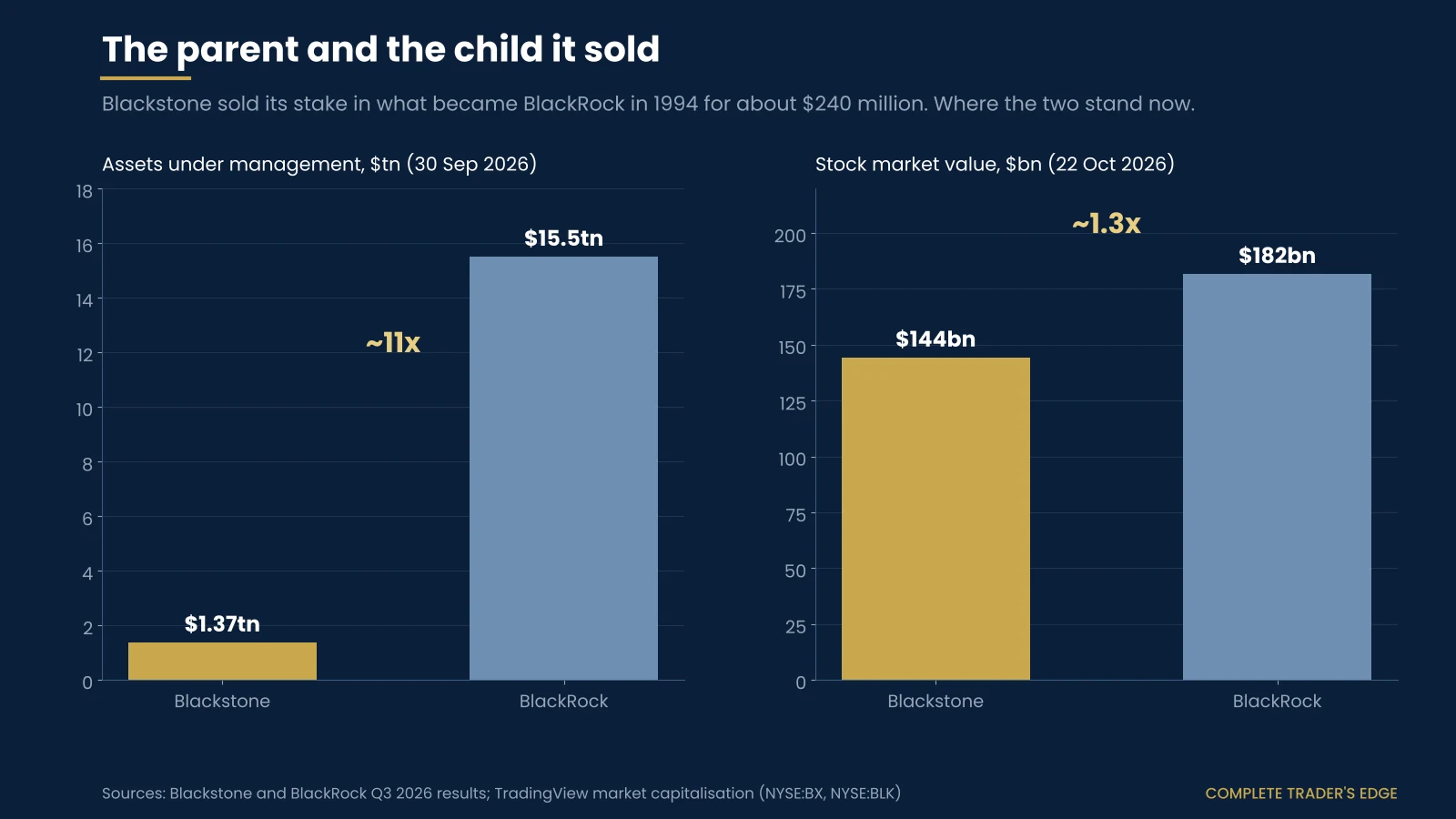
There is a final irony in the BlackRock story. Having grown vastly larger than the parent that birthed and then sold it, BlackRock has in recent years pushed hard into the very business Blackstone dominates: private markets. In 2024 it bought Global Infrastructure Partners, a major infrastructure investor, and it has moved into private credit and acquired specialist firms to deepen its reach into the private, alternative assets that were once Blackstone’s near-exclusive turf. The child that Blackstone sold for two hundred and forty million dollars is now competing with its former parent on the parent’s home ground, and doing so from a position of far greater size. It is one of the great role-reversals in the history of finance. Measured by assets, BlackRock is now about eleven times Blackstone’s size; measured by stock market value, the gap is much narrower, about 1.3 times.
The Honest Present
BlackRock today manages about fifteen and a half trillion dollars ($15.5 trillion at 30 September 2026), a sum larger than the annual economic output of almost every nation on Earth, making it the largest asset manager in history. Its Aladdin platform underpins a far larger pool of assets still. Larry Fink, the man who lost about a hundred million dollars and his reputation in 1986, remains its chairman and chief executive, and his annual letters to corporate chief executives are read as pronouncements from one of the most powerful figures in global capitalism.

And that power is precisely what makes the present complicated. BlackRock’s very size has made it a target, drawn into political fights over its influence and over how it votes the shares of the companies it holds for its clients. Critics across the political spectrum argue that no single firm should hold so large a piece of so many companies. BlackRock’s challenge now is not growth but legitimacy: managing the unprecedented power that comes from being, in effect, a part-owner of the entire market.
BlackRock and listed peers, 23 October 2026
| Company | Market value | Revenue (TTM) | P/E (TTM) | 2026 YTD | Dividend yield |
|---|---|---|---|---|---|
| BlackRock (BLK) | $182.1bn | $29.2bn | 26.2 | +4.6% | 2.0% |
| Blackstone (BX) | $144.8bn | $15.2bn | 26.1 | −24.4% | 4.4% |
| KKR (KKR) | $82.9bn | $23.5bn | 29.4 | −28.4% | 0.8% |
| Apollo (APO) | $67.3bn | $36.0bn | 43.1 | −21.4% | 1.9% |
| State Street (STT) | $45.8bn | $22.4bn | 13.7 | +30.4% | 2.0% |
| T. Rowe Price (TROW) | $22.2bn | $7.6bn | 10.4 | +1.4% | 5.0% |
| Franklin Resources (BEN) | $15.9bn | $9.4bn | 21.4 | +30.8% | 4.2% |
| Invesco (IVZ) | $12.6bn | $7.1bn | n/m (loss) | +7.9% | 3.0% |
Source: TradingView, intraday 23 October 2026. KKR and Apollo revenue includes their insurance businesses. Market data only, not investment advice.
Why This Matters to Investors
The Greatest Companies Thesis
Every legendary company begins with an idea that looks improbable.
Every one survives a stretch where failure looks inevitable.
Every one eventually reaches a point where success looks obvious.
The opportunity exists only in the space between the second and third.
BlackRock is the purest example in this collection of a moat built from scale itself. When a firm runs index funds large enough and cheap enough that no rival can match the cost, and when it also supplies the risk technology the rest of the industry runs on, its advantage compounds in a way that is extraordinarily hard to attack. The Greatest Companies thesis is that durable competitive advantage builds lasting wealth, and BlackRock’s advantage is close to structural. Tiny fees on enormous, ever-growing pools of money, plus a platform competitors depend on, produce a money machine that grows quietly and relentlessly. The investor’s lesson is to recognize the immense, underappreciated power of the toll-taker, the firm that earns a small, steady cut of a vast and rising flow, and to understand that in modern markets the deepest fortunes are often made not by the boldest bet but by owning the road that everyone else must travel. None of this is investment advice; it is a way of reading history.

Lessons in Order of Depth
Method: turn your worst failure into your core competency
BlackRock exists because Larry Fink was destroyed by a risk he did not understand, and then resolved to understand risk better than anyone alive. The entire firm, and its crown-jewel Aladdin platform, grew from that single humiliation. The method is to treat your most painful failure not as a wound to forget but as a syllabus, to build your greatest strength precisely on the spot where you were once weakest.
Money: the toll on the whole market
BlackRock charges tiny fees, often a fraction of a percent, but it charges them on more than fifteen trillion dollars, again and again, year after year. A minuscule slice of an almost unimaginable sum, collected continuously, is one of the most powerful money machines ever built. The lesson is the same one Visa teaches in payments: the firm that takes a small, steady cut of an enormous flow can quietly out-earn almost anyone betting on direction.
Mind: never be blindsided again
Fink’s defining trait is not greed or even ambition but a near-phobic refusal to be surprised by risk. That mindset, born in 1986, is wired into everything BlackRock does. The lesson for any investor is that the goal is not to predict the future but to never be destroyed by it, to know your exposures so completely that no single shock can take you out of the game.
The deepest question: is total scale a moat or a danger?
BlackRock now holds a piece of nearly every public company, on behalf of its clients, and supplies the risk platform much of finance depends on. That scale is an almost impregnable moat. But it is also a concentration of influence without real precedent, and it raises a question that goes beyond any single company. When one firm becomes part-owner of the entire market, is that the ultimate competitive advantage, or a systemic risk that society will eventually decide to limit? BlackRock has won so completely that its greatest threat is no longer a competitor. It is the question of whether the world will permit any one firm to be this powerful.
The Legendary Scorecard
| Founder Vision | 8 |
| Innovation | 9 |
| Execution | 9 |
| Moat | 9 |
| Capital Allocation | 8 |
| Wealth Creation | 9 |
| Durability | 9 |
| Historical Importance | 9 |
| Overall | 9.0 |
The overall figure is an editorial verdict, not a weighted average. BlackRock earns near-perfect marks for moat, durability, and historical importance, because its combination of index scale and the Aladdin platform is one of the most durable advantages in all of finance, and because it has reshaped how the world invests. It scores a touch lower on founder vision only because the firm was built less on a single dazzling idea than on relentless execution and two perfectly timed acquisitions.
At a Glance
| Founded | 1988, inside Blackstone, in New York |
| Founder | Larry Fink, with seven partners |
| Origin trauma | Fink’s roughly $100 million loss at First Boston in 1986 |
| Split | Sold to PNC for about $240 million in 1994 (renamed BlackRock in 1992) |
| Transforming deals | Merrill Lynch Investment Managers, 2006; Barclays Global Investors and iShares, 2009 |
| Secret weapon | Aladdin, the risk platform much of finance runs on |
| Defining trait | The world’s largest asset manager, with $15.5 trillion (30 September 2026) |
| Key leader | Larry Fink, chairman and CEO |
| Status | Operating, listed as NYSE: BLK |
Timeline
- 1986: Larry Fink’s team at First Boston loses about $100 million on a bad interest-rate bet, and he is pushed out
- 1988: Fink and seven partners found a bond business inside Blackstone, on a $5 million loan for a 50% stake
- 1992: the firm, still part-owned by Blackstone, is renamed BlackRock
- 1994: the firm splits from Blackstone and is sold to PNC for about $240 million
- 1999: BlackRock goes public
- 2006: BlackRock merges with Merrill Lynch Investment Managers and ends the year with $1.1 trillion in assets
- 2009: BlackRock buys Barclays Global Investors and its iShares ETF business for about $13.5 billion, becoming the world’s largest asset manager
- 2024: BlackRock buys Global Infrastructure Partners, pushing into private markets
- 2021: assets under management pass $10 trillion at year-end
- 2025: BlackRock ends the year with $14.0 trillion in assets, and its Aladdin platform underpins much of global finance
- 2026: assets reach $15.5 trillion at 30 September
Key Numbers
About $100 million the 1986 loss that set Fink on his path
$5 million Blackstone’s seed loan in 1988, for a 50% stake
About $240 million the 1994 sale price, for what became the world’s largest asset manager
About $13.5 billion the 2009 price for Barclays Global Investors and iShares
$15.5 trillion BlackRock’s assets under management at 30 September 2026
One firm a part-owner, through index funds, of nearly every large public company
Related Reading
BlackRock cannot be understood without the firm that birthed it. Read how Blackstone, its former parent, seeded it in 1988 and sold it in 1994 for about $240 million, a decision its co-founder calls a major regret. See how Berkshire Hathaway built a rival model of capital allocation, compounding inside one permanent company rather than across a stack of index funds. And study how Visa earns a tiny, relentless toll on every payment, the same toll-taker logic that powers BlackRock’s fees on the flow of the world’s savings. For the full collection, see our Greatest Companies of All Time hub.
Go Deeper
BlackRock is a study in turning failure into edge, in the quiet power of scale, and in the toll-taker’s logic that lets a firm earn a small, steady cut of an enormous flow. Those are the same forces that separate investors who survive their worst loss and compound from those who are destroyed by it, and the book teaches you the discipline to master your own risk, to respect the power of scale and patience, and to never be blindsided by the exposure you failed to see.
★ Now in Kindle, Paperback & Hardcover
Greatest Companies
This story is one of fifty-one. The full book reads every legendary company through a single lens — Moat, Meltdown, Machine — from Standard Oil to SpaceX. Fifty-one companies, eight kinds of moat, one framework.
Kindle · $9.99 →
Paperback · $24.99 →
Hardcover · $34.99 →
Explore the Book →
This article is part of the Greatest Companies series, adapted from the book Greatest Companies, now available on Kindle.
Frequently Asked Questions
When was BlackRock founded, and by whom?
BlackRock was founded in 1988 by Larry Fink and seven partners, including Robert Kapito and Susan Wagner, as a bond-focused asset manager built around risk management. It began inside the private equity firm Blackstone, which provided a $5 million loan and took a 50% stake, and was first called Blackstone Financial Management.
Why did Larry Fink start BlackRock?
In 1986, Fink’s team at First Boston lost about $100 million on a bad interest-rate bet, because they had not properly understood their risk, and he was effectively pushed out. That humiliation drove him to build a firm whose entire foundation was superior risk management, an obsession that produced BlackRock’s Aladdin platform.
How did BlackRock become the world’s largest asset manager?
Two deals were decisive. In 2006 BlackRock merged with Merrill Lynch Investment Managers, more than doubling in size. In 2009 it bought Barclays Global Investors and its iShares ETF business for about $13.5 billion, just as low-cost index investing was about to boom. Those moves made BlackRock the dominant force in index funds and the largest manager on Earth.
What is Aladdin?
Aladdin is BlackRock’s risk and portfolio-management technology platform. It grew out of the firm’s founding obsession with understanding risk and is licensed to many other financial institutions, where it is used to monitor a pool of assets across the industry far larger than BlackRock’s own. It is widely seen as BlackRock’s deepest competitive advantage.
Does BlackRock really own a piece of everything?
Through its index funds, BlackRock is a major shareholder in nearly every large public company, but it holds those shares as a fiduciary for its clients, the savers in its funds, rather than owning them outright. It votes those shares and so wields enormous influence, which is why its size has become a subject of political debate.
 The Complete Trader's Edge
The full Mind · Method · Money framework. 70 chapters.
View on Amazon →
 Market Mayhem
400 years of bubbles, crashes, and the pattern that keeps repeating.
Buy on Amazon →
 Greatest Companies
How the world's greatest companies were built — and what traders learn from them.
View on Amazon →
 Greatest Traders
Eighty-six lives that explain the markets — Livermore to Madoff, told with the losses left in.
View on Amazon →