


Nike reported its first quarter of fiscal 2027 on 1 October, and the stock fell for two straight sessions. Revenue fell 4% to $11.2 billion, gross margin improved to 42.8%, and earnings per share came in at $0.48, ahead of expectations (Nike). The quarter was not the problem. The outlook was: Nike now expects full-year revenue to fall by a high-single-digit percentage, while analysts had expected a gentler decline of about 2% (TheStreet, citing Reuters). The shares are down nearly 45% this year and sit at a 13-year low.
In Nike Stock Decline: Anatomy of a 79% Collapse we named this report as the next thing to watch. This is the follow-up: what the numbers showed, why the market sold an earnings beat, and what it teaches about buying a fallen giant.
The one-line version.
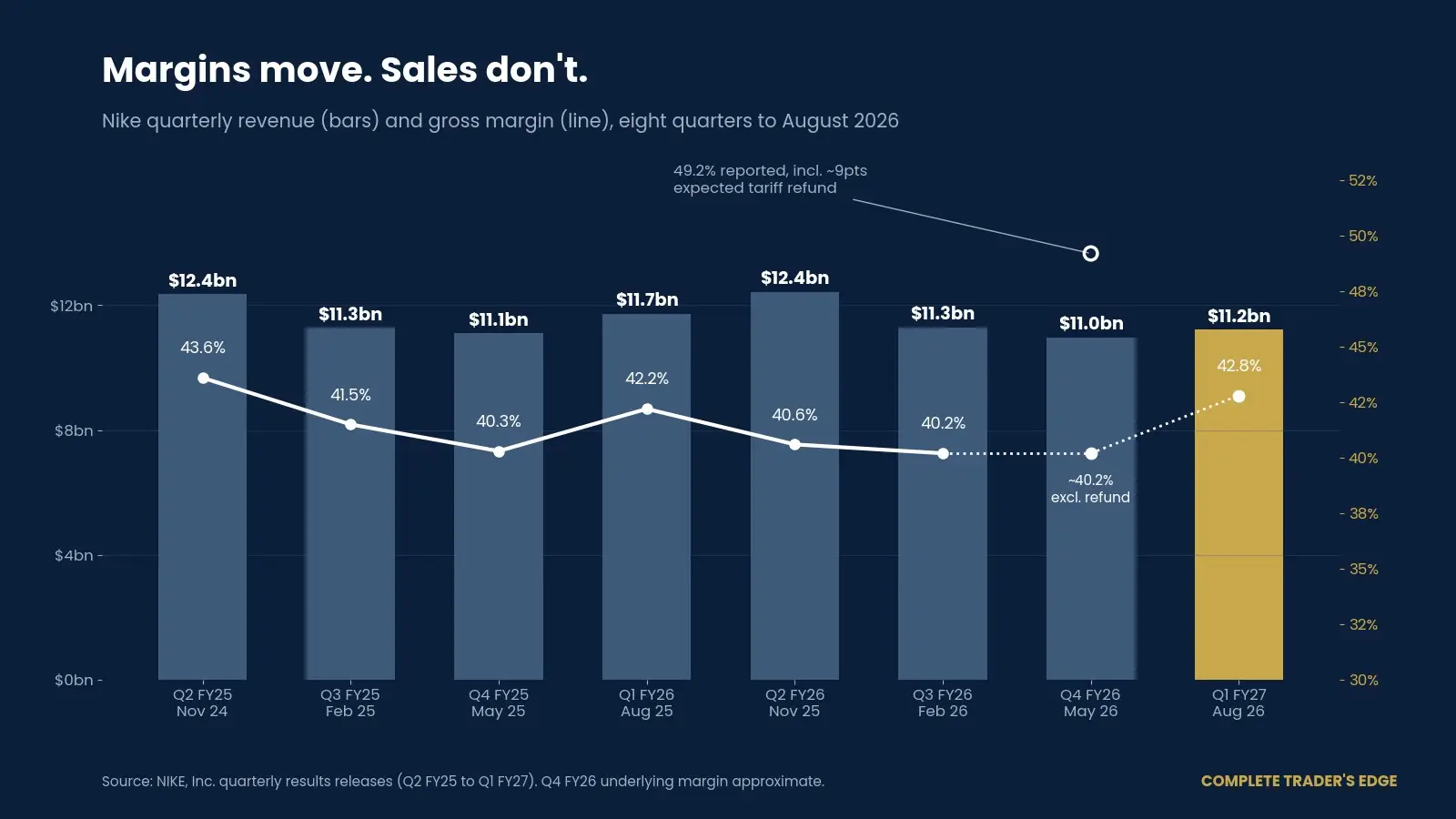
Nike beat on profit and missed on sales, then guided sales lower for the year and announced a $2.5 billion savings programme. Cost cuts can lift earnings. They cannot create demand. The market priced the second sentence, not the first.
Nike stock after earnings: the numbers
| Q1 FY27 (quarter to 31 Aug 2026) | Result |
|---|---|
| Revenue | $11.2bn, down 4% reported, down 5% currency-neutral |
| Consensus revenue | About $11.32–11.33bn (miss) |
| Gross margin | 42.8%, up 60 basis points |
| Diluted EPS | $0.48 (beat) |
| NIKE Direct | $4.1bn, down 8%; NIKE Brand Digital down 13% |
| Converse | $263m, down 28% |
| Greater China | Down 26% currency-neutral |
| Inventory | $7.8bn, down 3% |
| FY27 outlook | Revenue down high-single digits; adjusted EPS $1.15–1.35 |
Sources: Nike’s Q1 release; consensus from Yahoo Finance; China from Stocktwits via TradingView.
Three things stand out. North America grew, which is the strongest evidence the turnaround is working somewhere. Performance categories under CEO Elliott Hill’s “Sport Offense” are improving. And everything else, Sportswear, Jordan, China, digital and Converse, is still shrinking. Hill said as much in the release: “We have more work to do in NIKE Sportswear, Jordan Brand and Greater China.”
The gross margin gain came mainly from lower warehousing and logistics costs, and operating overhead fell 6%, largely on lower wage-related expense. Those are real improvements. They are also cost improvements, not sales improvements.
The price action
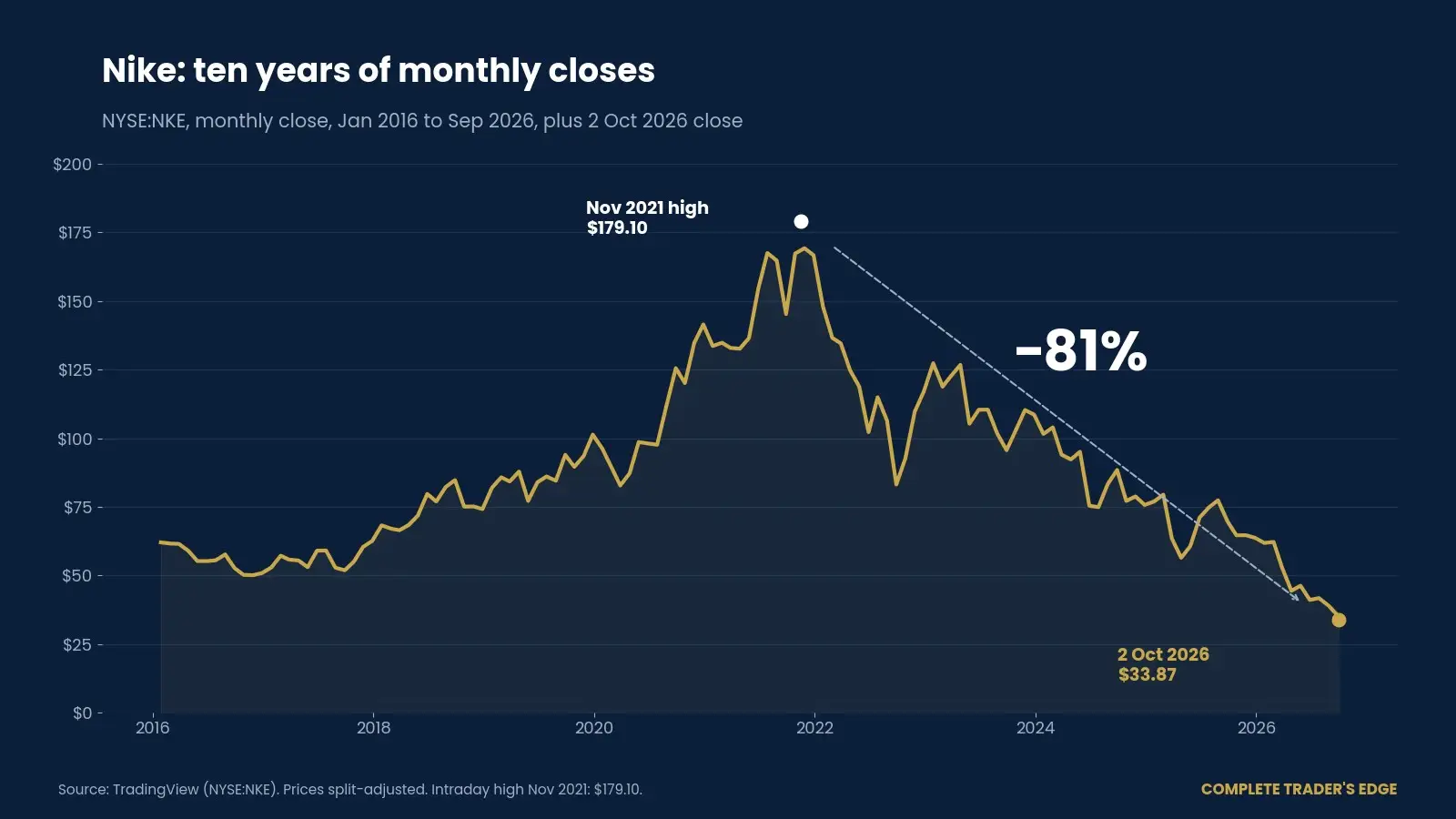
Nike closed at $35.15 on 1 October, with the results released after the bell. On 2 October it opened at $32.55, about 7% lower, and fell as far as $31.97, roughly 9% below the prior close, before recovering to close at $33.87, down 3.6% on the day. Around 142.7 million shares changed hands, nearly four times the daily average of the previous week. Against the November 2021 intraday high of $179.10, the stock is now down about 81%.

The gap with the wider market is just as stark. From the 9 January close to 2 October, NKE fell about 49% while the SPDR S&P 500 ETF (SPY) rose about 11%, on TradingView weekly data.
Pace: the restructuring
Alongside the results, Nike announced Pace, an operating model overhaul that includes modernising its supply chain, a new campus in India, a reorganisation into three geographies, and further streamlining to cut costs. Nike expects about $2.5 billion of cumulative savings through fiscal 2031, against roughly $1.0 billion of pre-tax charges, mostly employee-related (Nike).
That means more job losses. Nike has already cut staff twice this year, including 775 roles in the US, and decisions on further roles will begin in calendar 2027 (CNBC).
Why the market sold an earnings beat
Guidance outranks the quarter. A stock price is a bet on the future, so the forecast for the next twelve months matters more than the last three. Nike’s quarter was close to plan. Its year was not: a high-single-digit revenue decline against an expected 2%, and adjusted EPS guidance well below the roughly $1.69 analysts had expected, according to one market data summary (BigGo Finance). The market repriced the year.
Cost cuts are not demand. Citi put it bluntly in a note on 2 October: “Nike is turning into a cost-cutting story” (CNBC). Citi cut its price target to $32 and said the stock does not deserve a premium valuation relative to peers. Goldman Sachs cut to $30, saying weakness in Sportswear, Jordan and China more than offset healthy Performance growth. Bank of America, at Underperform, cut to $24.
The distinction matters because the market pays different multiples for different kinds of earnings. Profit that grows because customers want more of your product is worth a lot. Profit that grows because you employ fewer people is worth less, because it can only happen once and it does nothing for the top line.
The payoff is far away. Citi said Pace may not meaningfully affect Nike’s financial performance until 2029 (IBTimes, citing CNBC). Investors were being asked to wait years for savings, while sales fall in the meantime.
The beat may have borrowed from later. Morgan Stanley warned that the first quarter was likely the best of the year and that its channel checks pointed to a gap between what Nike sold to retailers and what shoppers actually bought. If shoes sit on shelves, retailers order less and discount more, which can damage the brand for years (TheStreet).
CFRA’s Zach Warring, who still rates the stock a Buy, summed up the frustration: “This is a quarter you’d expect from a new CEO three or four quarters in, but not two years in” (Yahoo Finance).
Four lessons for traders
1. A value trap looks cheapest just before it gets cheaper
Nike has looked “cheap” on the way down from its 2021 high many times. Each time, the earnings it was cheap against kept falling. A low price relative to past earnings means nothing if future earnings are heading lower. The test is not “is it down a lot?” but “has the thing that drove it down stopped?” For Nike, that means revenue, and revenue is still guided lower. (Mind.)
It is fair to ask whether this is simply a bad year for sportswear. Partly, yes: every major peer is down in 2026. But Nike has fallen further than all of them.

2. Catching a falling knife is a sizing decision, not a timing decision
Nobody reliably calls the bottom of a stock like this. If you want exposure, the honest approach is to size small enough that another 30% fall is survivable, add only as evidence improves, and decide in advance what would prove you wrong. Amazon fell 94% after the dot-com bubble and went on to become one of the great companies of the century; the investors who profited were the ones who could survive the drawdown. That story is in Amazon: The 94% Crash and the Cost of Being Right. (Money.)
Try it yourself. Pick an amount and a month to see what a Nike purchase would be worth now, and how much it was worth at its best before the fall.
Bought at the month-end close of the month you choose. Price return only: excludes dividends, fees and taxes. Split-adjusted monthly closes from TradingView, . Educational illustration, not investment advice.
3. Read the guidance before the headline
“Nike beats on earnings” was true and nearly useless. The useful numbers were in the outlook paragraph at the bottom of the release. A simple habit: on any earnings day, read the guidance first, compare it with consensus, and only then look at the quarter. (Method.)
4. Wait for evidence of demand, not promises of efficiency
Turnarounds are confirmed by customers, not by restructuring plans. The evidence that would genuinely change the picture for Nike is specific and measurable:
- Greater China declines narrowing quarter by quarter.
- NIKE Direct and digital returning to growth, showing people want the product at full price.
- Revenue guidance raised rather than cut.
- Retailer inventory staying clean, so wholesale sales reflect real sell-through.
None of those boxes are ticked yet. That does not mean they will not be. It means there is no hurry.
The honest counterweight. Nike still owns some of the strongest brands in sport, North America is growing, the performance business is improving, and gross margin is moving the right way. Jefferies and CFRA remain constructive. Turnarounds often look worst just before they turn. The case against buying now is not that Nike is finished. It is that the evidence of a demand recovery has not arrived, and the price you pay for waiting for it is likely to be small.
What to watch next: Investor Day
Nike’s Investor Day, its first since 2017, is scheduled for mid-November; management has pointed to 16–17 November. Citi expects more detail on the five-year strategy there, and Jefferies has argued it may matter more than this quarter’s report, because new CFO Dave Denton is not tied to previous targets. The question is whether management sets targets for fiscal 2027 and 2028 it can realistically meet or beat.
Our deeper history of the company, Nike: The Company That Almost Died of Success, publishes in the Greatest Companies series on 6 October. It covers the 1975 cash crisis, the Air Jordan bet and the brand moat now under strain.
Frequently asked questions
Why did Nike stock fall after earnings?
Because Nike guided full-year revenue to fall by a high-single-digit percentage, far worse than the roughly 2% decline analysts expected, and its EPS guidance also came in below forecasts. The quarterly earnings beat came from cost control, not stronger sales.
What is Nike’s Pace restructuring?
Pace is Nike’s new operating model programme, covering supply chain modernisation, a new campus in India, a three-region structure and further cost cuts. Nike expects about $2.5 billion in cumulative savings through fiscal 2031, with roughly $1 billion of pre-tax charges and further job cuts from 2027.
Is Nike stock a buy after the drop?
We don’t give investment advice. The analytical answer is that the stock is cheap against past earnings but revenue is still being guided lower, which is the classic profile of a value trap until demand evidence improves. Watch China, Direct sales and the revenue outlook at Investor Day.
How great companies are built, and how they nearly die.
Read 51 of them in Greatest Companies.
None of the above is investment advice. Figures from Nike’s fiscal 2027 first-quarter release and the published reports linked; share prices and volume from TradingView; as at 2–3 October 2026. Do your own work before risking capital.
 The Complete Trader's Edge
The full Mind · Method · Money framework. 70 chapters.
View on Amazon →
 Market Mayhem
400 years of bubbles, crashes, and the pattern that keeps repeating.
Buy on Amazon →
 Greatest Companies
How the world's greatest companies were built — and what traders learn from them.
View on Amazon →
 Greatest Traders
Eighty-six lives that explain the markets — Livermore to Madoff, told with the losses left in.
View on Amazon →