

You had a plan. You followed it for three trades. Then one loss arrived — clean, within your rules, nothing wrong with the execution — and something shifted. The next trade was entered before the setup was ready. The size was bigger. The analysis was thinner. By the end of the session, the original 1R loss had become a 5R disaster, and every trade after the first one was pure emotion dressed up as analysis.
Revenge trading, FOMO and overtrading are not character flaws. They are predictable psychological responses to specific market stimuli, and they destroy more accounts than bad strategies ever will. This guide explains the exact mechanism behind each one, why willpower alone never fixes them, and the specific systems that do.
Why These Three Patterns Are Linked
Revenge trading, FOMO and overtrading look like different problems but they share a single root: emotional state overriding analytical state. In each case, the trader knows what the correct action is, and takes a different action anyway because of how they feel in that moment.
| Pattern | The trigger | The lie it tells you | The actual cost |
|---|---|---|---|
| Revenge trading | A loss, especially one that feels unfair | “You can get it back right now if you just trade again” | Turns a 1R loss into a 5-10R disaster |
| FOMO | A move happening without you | “If you don’t enter now, you’ll miss the whole move” | Enters at the worst possible price, often the top or bottom |
| Overtrading | Boredom, recent loss, or winning streak | “Being active is the same as working hard” | Dilutes edge data, compounds transaction costs, exhausts focus |
Understanding what these patterns cost in real terms is the first step to taking them seriously. Most traders acknowledge them abstractly (“yes, I sometimes revenge trade”) without ever calculating the actual R-value damage they cause each month. Once you do that calculation, the urgency to fix them permanently becomes very real.
Revenge Trading: The Most Destructive Pattern in Retail Trading
Poker players call it “tilt.” The pinball machine that goes haywire when struck too hard. In trading, it looks like this: a loss triggers a hot, urgent need to recover immediately — not to analyse what went wrong, not to wait for the next qualified setup, but to get the money back right now from the same market with the next trade.
The next trade is entered without a complete setup. Or with a half-formed one. Or in the opposite direction of the original loss — not because the structure supports it, but because the original trade went down and surely the next one should go up. The position size is larger, not because risk parameters justify it, but because a bigger position will recover the loss faster. The trade is managed with the same feverish urgency that created it. It loses. The cycle accelerates.
Why willpower doesn’t fix it
The mistake most traders make is treating revenge trading as a discipline problem. They decide to “try harder” not to do it. This approach has roughly the same success rate as deciding to “try harder” not to feel hungry. You cannot willpower your way out of a neurochemical response.
When you take a loss that feels personal or unfair, the brain’s threat-response system activates. Cortisol rises. Analytical capacity drops. The prefrontal cortex — the part responsible for rational decision-making — is partially bypassed in favour of the limbic system, which is trying to neutralise the threat (the loss) as quickly as possible. This is the same mechanism behind fight-or-flight. It evolved to keep you alive in physical danger. In a trading context, it makes you take the worst possible action at the worst possible time.
You cannot think your way out of this state while you are in it. The only reliable fix is a structural one that activates before the emotional state takes hold.
The revenge trading prevention system
These are not suggestions. They are non-negotiable rules written in advance and treated as permanent operating constraints.
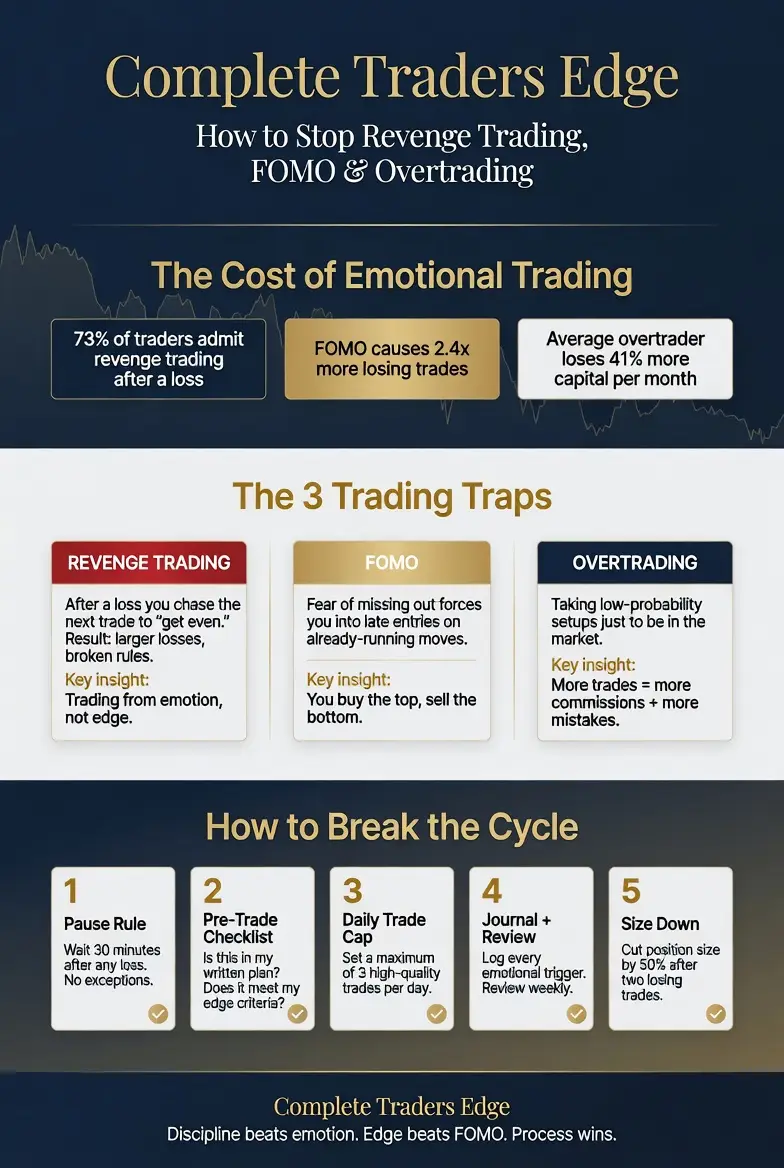
- The 30-minute rule. After any loss that produces a strong emotional reaction, you must wait a minimum of 30 minutes before you are permitted to look at the charts again. Not before entering another trade — before even looking. Step away physically. Leave the desk. The market will still be there.
- The daily loss limit. Set a maximum daily loss of 2% of your account. When you hit it, the session is over — not paused, not “almost over,” completely over. Close the platform. The practical implementation: many brokers allow you to set hard daily loss limits in the platform itself, which locks you out automatically. Use this feature. Do not rely on self-enforcement while you are emotionally activated.
- The written protocol. Before your next trading session, write out exactly what you will do the moment you feel the urge to revenge trade. Specific actions, in order. “I will close the chart. I will stand up and leave the room. I will not return for 30 minutes. I will not open the platform again until tomorrow if I have hit my daily limit.” A protocol written when you are calm and rational is your best version of yourself, available at the exact moment you need it most.
- The perspective shift. A 1R loss recovered over the next 20 disciplined trades at your strategy’s expectancy is not a problem. It is the maths working exactly as it should. A revenge trade that turns a 1R loss into a 6R disaster requires 60 good subsequent trades to recover. The war against the market is one no trader has ever won, because the market is not fighting. It is simply there, offering setups to those who approach it with clarity, and taking money from those who approach it in anger.
FOMO: Fear of Missing Out
FOMO is subtler than revenge trading because it feels like rational analysis. Gold is moving 200 points and you are not in it. Every minute you watch, the move continues. The internal voice says: “You identified this setup yesterday. You were right. The move is still going. Just get in now and ride the rest of it.”
This voice is not your analytical mind. It is your emotional mind performing an impersonation of your analytical mind, and it is very convincing.
What FOMO actually costs
The FOMO entry arrives late. The institutional move that created the impulse is already partially or fully delivered. You are entering at extended price, often at or near where the original setup would have had you taking profits. Your stop loss is now wider because the original structure is no longer valid. Your R:R is worse — sometimes inverted. You have taken a trade that looks like your setup but has none of the statistical properties that make your setup worth taking.
Beyond the individual trade cost, FOMO has a secondary effect that rarely gets discussed: it contaminates your edge data. If you enter some trades at the correct point and other trades under FOMO conditions, your journal shows a blended sample. The poor results from FOMO trades mask the genuine performance of your real setups, making it impossible to evaluate whether your strategy is actually working.
The FOMO elimination system
| Rule | What it does |
|---|---|
| “Missed entry = missed trade” | Write this rule in your trading plan verbatim. If your specific entry criteria were not met at the time of entry, the trade does not exist for you. Missing a move is not a loss. Taking a FOMO trade is. |
| Pre-session price alerts only | Set your key level alerts before the session begins. You only look at a chart when an alert fires. This removes the passive watching that feeds FOMO. |
| The 5-point entry checklist | Before every trade, you must verify all five criteria from your setup definition are met. If any box is unticked, there is no trade. No exceptions for “it’s close enough.” |
| Tag FOMO trades in your journal | If you take a trade you suspect was FOMO-driven, tag it. Review tagged trades separately every week. The data will show you the actual cost, which is more motivating than any principle. |
The most liberating belief you can build as a trader is this: there will always be another trade. Markets do not close. Opportunities recycle. The London session that just produced a 200-point Gold move will produce another one within a few days. The Nasdaq setup you missed on Tuesday will appear again in similar form within two weeks. Missing a trade is a non-event. Chasing it is a capital event.
Overtrading: Busyness Disguised as Work
Overtrading is the most socially acceptable of the three patterns because it looks like effort. The trader is active. They are analysing constantly. They are in the market. From the outside, they appear dedicated. Inside the account, the damage accumulates quietly.
Overtrading has two distinct forms, and each requires a different fix.
Boredom overtrading
This is the trader who has a strategy that produces two or three genuine setups per week but takes eight to twelve trades because the waiting is psychologically intolerable. Being flat feels like falling behind. Every 15-minute candle that forms without a trade feels like a missed opportunity. So trades get taken on marginal setups, during low-probability sessions, on instruments outside the plan, with reduced confirmation requirements.
The fix is recognising that patience is not passive. Pre-session preparation, chart reading, journaling and strategy review are all productive activities that fill session time without requiring trades. A trader who does 45 minutes of quality pre-session analysis and then takes zero trades on a day with no valid setups has performed excellently. The journal entry should reflect that.
Emotional overtrading
This is the pattern described in the revenge trading section but extended across longer time periods. A losing streak triggers urgency to “get it back.” The trader starts taking trades faster, with less confirmation, at larger size. Each loss adds to the urgency. The overtrading cycle can compress weeks of careful capital building into a single catastrophic session.
The circuit breaker for emotional overtrading is mechanical, not psychological. Set a maximum number of trades per session in advance — typically two or three for a day trader. When you reach that number, the session is over regardless of what the chart shows. Set this rule before you need it. When you are in the overtrading spiral, you will not set it.
The overtrading cost in real numbers
| Scenario | Trades taken | High-quality trades | Marginal trades | Monthly result |
|---|---|---|---|---|
| Disciplined trader | 10/month | 10 (60% win rate, 1:2 R:R) | 0 | +4R |
| Mild overtrader | 20/month | 10 | 10 (40% win rate, 1:1 R:R) | +4R – 2R = +2R |
| Heavy overtrader | 40/month | 10 | 30 (35% win rate, 1:0.8 R:R) | +4R – 7R = -3R |
The strategy did not change. The edge did not change. The only variable was how many non-qualifying trades were added to the sample. Overtrading can turn a profitable strategy into a losing one without a single change to the core setup criteria.
Building the Complete Emotional Control System
The three patterns above are addressed together because the prevention architecture overlaps significantly. Here is the complete system to implement before your next trading session.
Rule 1: Daily loss limit of 2%. When hit, session ends. No exceptions. Platform closes. This single rule prevents the majority of revenge trading and emotional overtrading escalation.
Rule 2: Maximum trades per session. Write the number in your trading plan. For most day traders, two to three per session is appropriate. Five is the absolute maximum even on active days. When you reach your limit, you are done regardless of what you see on the chart.
Rule 3: Pre-trade checklist with all criteria mandatory. Every single criterion from your setup definition must be confirmed before entry. “Almost” is not a tick. “Close enough” is not a tick. Either all criteria are met or there is no trade.
Rule 4: The 30-minute post-loss rule. After any loss that produces a noticeable emotional response, you leave the screens for a minimum of 30 minutes before reviewing charts again.
Rule 5: Journal every deviation. Any trade taken outside your defined criteria gets tagged in the journal as a rule violation. Review these weekly. The cumulative data will be more persuasive than any principle about why the system matters.
Frequently Asked Questions
How do I know if I am revenge trading or just taking a valid trade after a loss?
Ask one question: does this trade meet every criterion on my pre-trade checklist, exactly as I defined those criteria before today’s session began? If yes, it is a valid trade regardless of the emotional context. If no — or if you are not completely sure — it is a revenge trade. The distinction is not about how you feel. It is about whether the setup criteria are fully met. A valid trade after a loss is normal professional trading. A trade taken to recover a loss is revenge trading regardless of how justified it feels in the moment.
Is some FOMO normal, or does it mean my psychology is broken?
FOMO is universal. Every trader who watches a large move develop without a position experiences the pull to enter. The difference between a developing trader and a professional is not the absence of the feeling — it is the existence of a rule that overrides the feeling before it becomes an action. Feeling FOMO and not acting on it is good psychological management. The goal is not to eliminate the emotion, which is not possible, but to ensure that rules, not feelings, determine whether you enter a trade.
What is a realistic maximum number of trades per day?
For a day trader focused on high-probability setups, two to three per session is typically the right range. A session with zero trades because no qualifying setups appeared is a perfect session from a process perspective. A session with five or more trades almost always contains overtrading. The number varies by strategy and instrument, but if you are consistently taking more trades than your strategy’s setup frequency justifies, you are overtrading by definition.
My losses are within 1% risk per trade, so is overtrading really that harmful?
Yes, for two reasons beyond the direct loss cost. First, marginal trades dilute your edge data, making it impossible to accurately evaluate your strategy’s true performance. Second, overtrading exhausts your cognitive and emotional resources, which degrades the quality of your analysis on the genuinely high-probability setups you take later in the session. Decision fatigue is real. A trader who has taken six marginal trades by noon will make worse decisions on the 3 PM setup than a trader who has been patient and selective all morning.
I have the rules but I keep breaking them in the moment. What actually works?
Three things have the most reliable track record. First, platform-level enforcement: set hard daily loss limits directly in your broker platform so the system locks you out, removing self-enforcement entirely. Second, accountability: a trading partner or community who reviews your journal weekly creates social accountability that individual willpower cannot match. Third, tagging and reviewing rule violations weekly: seeing the cumulative cost of rule violations in your own data, in your own journal, over your own trades, is the most motivating feedback available. Principles fade. Your own numbers do not.
▶ ▶ ▶ Continue Reading
Build the complete psychological framework
The Complete Trader’s Edge
The full psychology framework is in the book
Chapters 7 through 12 cover revenge trading, FOMO, overtrading, overconfidence and every other psychological pattern that destroys trading accounts — with the exact systems to fix each one permanently. Available on Amazon in Kindle, paperback and full-colour editions.
 The Complete Trader's Edge
The full Mind · Method · Money framework. 70 chapters.
View on Amazon →
The Complete Trader's Edge
The full Mind · Method · Money framework. 70 chapters.
View on Amazon →
 Market Mayhem
400 years of bubbles, crashes, and the pattern that keeps repeating.
Buy on Amazon →
Market Mayhem
400 years of bubbles, crashes, and the pattern that keeps repeating.
Buy on Amazon →
 Greatest Companies
How the world's greatest companies were built — and what traders learn from them.
View on Amazon →
Greatest Companies
How the world's greatest companies were built — and what traders learn from them.
View on Amazon →
 Greatest Traders
Eighty-six lives that explain the markets — Livermore to Madoff, told with the losses left in.
View on Amazon →
Greatest Traders
Eighty-six lives that explain the markets — Livermore to Madoff, told with the losses left in.
View on Amazon →