

COMPLETE TRADER’S EDGE
Trading FAQ
Honest, practical answers to the questions every trader asks. From your first demo account to prop firm funding, drawdown management, and building a trading career.
Getting Started
How much money do I need to start trading?
You can open most forex and CFD accounts with $100 to $500, but realistically you need at least $1,000 to $5,000 to trade with meaningful position sizes while keeping risk at 1% per trade. With a $500 account, 1% risk means $5 per trade, which limits what instruments you can trade effectively.
More important than your starting capital is what you do before trading real money. Spend at least three to six months on a demo account, following the same rules, journalling the same way, and building the same habits you would with real capital. Most blown accounts happen because the trader went live before they were ready, not because the capital was too small.
If you have skill but limited capital, proprietary trading firms offer funded accounts of $10,000 to $200,000+ to traders who pass evaluation challenges, typically for a fee of $50 to $200.
Is trading forex or stocks better for beginners?
Forex has practical advantages for beginners: 24-hour access five days a week, the ability to start with micro lots and small capital, and extremely tight spreads on major pairs like EUR/USD. The risk is high leverage. Forex brokers routinely offer 1:100 or more, which can amplify losses dramatically if you do not manage position size carefully.
Stocks are more intuitive for most people because you are buying ownership in businesses you can understand. In the US, the Pattern Day Trader rule requires $25,000 to day trade stocks, which actually protects beginners by limiting overtrading. If your capital is under $25,000 and you want to day trade, forex or futures are the practical options.
Our recommendation: start with forex majors using micro lots and low leverage (1:10 maximum initially) if you want to day trade with smaller capital. Choose stocks or ETFs if you prefer swing trading over days and weeks.
How long does it take to become a profitable trader?
Honest answer: one to three years of consistent, structured effort. This assumes you are actively learning, trading a demo account, keeping a trading journal, reviewing your performance weekly, and treating it like a professional skill rather than a hobby.
The traders who progress fastest share specific habits: they follow a structured learning path (not random YouTube videos), they practice deliberately on a single instrument, they journal every trade, and they are willing to fail forward rather than quit after a losing streak. Those who try to shortcut the process by trading large size early almost always extend their learning curve through costly mistakes.
The foundational concepts, including price action, support and resistance, risk management, and trading psychology, are not mystical. They can be learned. The challenge is developing the emotional discipline and pattern recognition that comes only from thousands of hours of screen time.
What should I learn first as a beginner trader?
Start with the foundations in this order: first, learn to read a chart and understand candlestick patterns. Second, study market structure, which is the single most important concept in technical analysis. Third, learn position sizing and risk management before you place a single trade. Fourth, build a simple trading plan.
Resist the temptation to jump straight to strategies and entry signals. The Mind, Method, Money framework exists for a reason: psychology and risk management determine long-term survival far more than any entry technique. Most traders fail because they skipped the foundation, not because they chose the wrong indicator. Start with our Start Here page for a structured learning path.
Why do most traders lose money?
Studies consistently show that 70% to 90% of retail traders lose money. The reasons are well documented: overleveraging (trading too large relative to account size), no trading plan, emotional decision-making, strategy hopping after losses, and ignoring risk management. None of these are knowledge problems. They are execution problems driven by psychology.
The uncomfortable truth is that most losing traders have seen enough strategies to be profitable. What they lack is the discipline to follow one system consistently, the patience to wait for valid setups, and the emotional resilience to accept losing trades without deviating from the plan. Read our full breakdown: Why Most Traders Fail Before They Begin.
Should I use a demo account or go straight to live trading?
Always start on demo. No exceptions. A demo account lets you learn the mechanics of your platform, test your strategy, build a track record, and develop execution habits without financial risk. Treat it exactly as you would a live account: same position sizing rules, same journalling discipline, same daily routine.
The catch is that demo trading cannot replicate the emotional pressure of real money. Once you can demonstrate three to six months of consistent, plan-adherent trading on demo, transition to a small live account. “Small” means an amount you could genuinely lose without it affecting your life. This bridges the gap between simulated and real performance while keeping the financial stakes low enough to learn from mistakes affordably.
Trading Psychology
Why do I keep making emotional trading decisions even when I know better?
Because knowing and doing are controlled by different parts of the brain. Your prefrontal cortex handles rational analysis. Your amygdala fires threat responses when money is on the line and bypasses rational thought entirely. This is not a character flaw. It is human neuroscience, and every trader experiences it.
The practical solutions: trade smaller until the financial stakes are genuinely inconsequential. Write your rules before the session starts, not during a trade. Use a physical pre-trade checklist you go through before every entry. Review your trades daily so patterns become visible. And accept that emotional control is built through hundreds of correctly executed trades, not through willpower alone. Read more: Fear in Trading.
What is revenge trading and how do I stop it?
Revenge trading is taking impulsive, oversized trades specifically to recover money after a loss. It is driven by frustration rather than analysis, and it is one of the most destructive patterns in trading because you are entering the market in an emotionally compromised state with zero edge.
To stop it, implement hard mechanical rules that remove the decision-making in the moment when your emotions are highest. Rule one: after two consecutive losses, stop trading for the rest of the session. Walk away. Rule two: set a maximum daily loss limit (2% of account) that automatically ends your trading day. Rule three: if you feel the urge to “make it back,” that feeling is the signal to stop, not to trade. Full guide: Revenge Trading: The Cycle That Destroys Accounts.
How do I deal with a losing streak without quitting?
First, understand that losing streaks are a mathematical certainty for every strategy, no matter how good. A system with a 55% win rate will regularly produce runs of five to eight consecutive losses. This is statistics, not strategy failure. The question is whether you have a protocol for surviving them.
During a drawdown, ask four diagnostic questions: Is this drawdown within my strategy’s historical range? Have market conditions changed structurally, or just temporarily? Are there process violations in my recent journal? Is my emotional state distorting my perception? The honest answers will almost always point toward patience rather than strategy changes. Reduce position size by 50%, increase structure (checklists, mandatory pauses), and focus exclusively on process quality. Read: Managing Drawdowns Professionally.
How important is a trading journal?
It is the single most important tool in your trading, above any strategy or indicator. This is not an exaggeration. The journal is where patterns become visible: which setups perform best, which sessions produce your worst results, which emotional states correlate with process violations. Without it, you are repeating mistakes you cannot even identify.
A proper trading journal records your pre-trade analysis, the entry and exit, the emotional state before, during, and after the trade, and whether you followed your rules. The weekly review is where the real value is extracted: turning raw data into actionable insights. Most traders skip journalling because it requires honesty about uncomfortable truths. The ones who do not skip it are the ones who improve. Full system: Trading Journal: The Complete System.
How do I overcome the fear of pulling the trigger on a trade?
Fear of entry is almost always caused by one of three things: position size is too large for your comfort level, you lack a clear pre-defined plan for the trade, or you do not have enough track record data to trust your setup. The fix is different for each.
If the size feels uncomfortable, cut it in half until entering feels mechanical. If you are hesitating because the plan is vague, write the entry, stop, and target before the session opens. If you lack conviction in your setup, backtest it across 100+ historical occurrences to build statistical confidence. Fear decreases with familiarity. Every properly executed trade, win or lose, adds evidence that your process works. Over time, the fear does not disappear, but its volume decreases relative to your trust in the process. Read: The Professional Trader Mindset.
Risk Management
What percentage of my account should I risk per trade?
The professional standard is 1% of your total account per trade. For beginners or during drawdown periods, 0.5% is more appropriate. Here is why the math matters: at 1% risk per trade, twenty consecutive losses cost you roughly 18% of your account. At 5% risk, the same streak wipes out 64%. The difference is survivability.
The position sizing formula is straightforward: (Account Balance × Risk Percentage) ÷ (Stop Loss Distance × Point Value) = Position Size. Calculate this before every single trade. Never adjust your stop loss further away to avoid being stopped out, and never increase size based on how confident you feel about a setup. The formula, not your feelings, determines the correct size.
What is a good risk-to-reward ratio?
A minimum of 1:2, meaning you risk $1 to make $2, is the professional standard. With a 1:2 R:R, you only need to win 34% of your trades to break even and 40% to be consistently profitable. Many professional traders target 1:3 or higher.
The key insight is that win rate and risk-to-reward are two sides of the same equation. A strategy with a 40% win rate and 1:2 R:R is more profitable than a strategy with a 60% win rate and 1:1 R:R. Stop chasing high win rates. Focus on the maths. Full breakdown: Risk-to-Reward: How to Make Money Even When You’re Wrong Half the Time.
What is risk of ruin and why should I care about it?
Risk of ruin is the probability that you will lose enough capital to stop trading. It is the single most important number in your trading career, and most retail traders have never calculated it. A trader risking 5% per trade with a 45% win rate has a substantially higher probability of blowing their account than a trader risking 1% with the same win rate.
The formula takes into account your win rate, average winner versus average loser, and risk per trade. What it reveals is uncomfortable: even a strategy with positive expectancy can destroy an account if risk per trade is too high. Small changes in risk percentage produce dramatic changes in survival probability. This is why 1% risk is not conservative; it is mathematically optimal. Full explanation: Risk of Ruin: The Mathematics Every Trader Must Understand.
Should I use a stop loss on every trade?
Yes. No exceptions. A trade without a stop loss is a trade with unlimited downside risk. It does not matter how confident you are in the setup, how well the analysis looks, or how many confirmations you have. Markets can gap, flash-crash, or move violently against you in seconds. A stop loss is not optional; it is the mechanism that keeps a single trade from ending your career.
Place your stop at a level where your trade thesis is invalidated, not at a round dollar amount or a random pip distance. If your analysis says the setup fails below a specific swing low, the stop goes below that swing low. Then calculate your position size based on that distance. Full guide: Stop Losses: Why They Are Non-Negotiable.
What is expectancy and how do I calculate it?
Expectancy is the one number that tells you whether your trading strategy actually makes money over time. The formula: (Win Rate × Average Win) minus (Loss Rate × Average Loss) = Expectancy. A positive number means you have an edge. A negative number means you are losing money per trade on average, regardless of how the last few trades went.
For example, if you win 45% of trades with an average win of $200 and lose 55% with an average loss of $100, your expectancy is (0.45 × $200) minus (0.55 × $100) = $90 minus $55 = $35 per trade. You need at least 50 to 100 trades of data to calculate a meaningful expectancy. Anything less is noise, not signal. Read more in The 10 Commandments of Risk Management.
Technical Analysis & Strategy
What is the best trading strategy for beginners?
The best strategy for a beginner is the simplest one you can follow consistently. Complexity is the enemy at the start. A straightforward trend-following approach will outperform a complex system you do not fully understand. Identify the trend on the daily chart. Wait for price to pull back to a key level (support zone, moving average, or order block). Look for a confirmation candle on the 4-hour or 1-hour chart. Enter with a stop below the key level. Target a minimum of 2x your risk.
This simple framework, applied consistently with proper position sizing, is essentially what most professional traders use in some form. The advanced versions add confluence layers (Volume Profile, Fibonacci, liquidity mapping), but the core logic does not change. Master the basics before adding complexity. Guide: How to Build a Trading Strategy That Actually Works.
Do trading indicators actually work?
Indicators work as supplementary tools. They do not work as standalone trading systems. The most common mistake is indicator overload: stacking RSI, MACD, Stochastic, Bollinger Bands, and three moving averages on one chart, then being paralysed by conflicting signals. Every indicator is derived from price. If you can read price action directly, you are seeing the information before the indicator processes it.
The professional approach is minimalism. Use one or two indicators maximum, only for confirmation of setups you have already identified through price action and market structure. Moving averages (20/50/200 EMA) and volume are universally useful. RSI and MACD can identify momentum divergences. But none of them should be the primary basis for entering a trade. Full breakdown: Trading Indicators Explained.
What is multi-timeframe analysis and why does it matter?
Multi-timeframe analysis means reading the same market across different timeframes simultaneously to gain a complete picture before committing to a trade. No timeframe exists in isolation. The 15-minute chart is embedded within the 1-hour, which sits inside the 4-hour, which lives inside the daily. Trading a setup on the 15-minute without knowing what the daily chart is doing is like navigating a city with only a street-level map.
The professional approach: use the higher timeframes (daily and 4-hour) to establish directional bias, then use the lower timeframes (1-hour and 15-minute) for precise entries. A buy setup on the 15-minute chart that aligns with a bullish daily structure is a fundamentally different trade from one that fights the daily trend. Full framework: Multi-Timeframe Analysis: The Professional’s Complete Framework.
How do I backtest a trading strategy properly?
Backtesting means applying your trading rules to historical price data to see how the strategy would have performed. Done correctly, it builds statistical confidence in your approach before you risk real money. Done incorrectly, which is how most retail traders do it, it produces dangerously misleading results.
The most common backtesting error is curve fitting: optimising rules to match historical data so perfectly that they fail completely on new data. Other pitfalls include survivorship bias, ignoring spread and slippage, testing too few trades (you need at least 100), and unconscious forward-looking bias (seeing data you would not have had at the time). Manual backtesting, where you scroll chart-by-chart and make decisions in real time without seeing what comes next, is more reliable than automated backtesting for most retail traders. Full guide: Backtesting: How to Validate Your Strategy.
Is swing trading or day trading better?
Neither is inherently better. They require different personalities, schedules, and psychological makeups. Day trading requires dedicated screen time during active sessions, fast decision-making, and comfort with rapid-fire execution. Swing trading requires patience to hold positions for days or weeks, tolerance for overnight risk, and the ability to resist micromanaging trades.
If you have a full-time job, swing trading is almost certainly the better fit. You analyse charts in the evening, set orders, and check once or twice daily. Day trading demands presence during Kill Zones (London open, New York open), which means specific hours blocked out of your schedule. Choose the style that matches your life first, your personality second, and your capital third. Detailed comparison: Swing Trading vs Day Trading: Which Is Right for You?
ICT & Smart Money Concepts
What is ICT trading and Smart Money Concepts?
ICT (Inner Circle Trader) is a trading methodology developed by Michael Huddleston that focuses on how institutional traders, the “smart money,” move markets. Rather than following lagging retail indicators, ICT teaches you to read the market the way banks and hedge funds operate: through liquidity, order flow, and time-based price delivery.
Key concepts include Order Blocks (zones where institutions placed large orders), Fair Value Gaps (imbalances left by aggressive institutional moves), Liquidity (where retail stop losses cluster, which institutions target), Kill Zones (specific time windows with the highest probability), and Market Structure Shifts. The methodology has gained massive popularity because it explains why certain price patterns repeat with consistency across all markets.
What are Order Blocks and Fair Value Gaps?
An Order Block is the last candle (or small group of candles) moving in the opposite direction before a significant impulsive price move. It marks the zone where institutional traders likely placed their bulk orders. When price returns to this zone, the theory is that unfilled institutional orders are still waiting there, creating a high-probability reaction point.
A Fair Value Gap (FVG) is a three-candle pattern where the middle candle moves so aggressively that a gap is left between the wicks of the first and third candles. This gap represents a price imbalance, an area where one side dominated so completely that efficient price discovery did not occur. FVGs have a well-documented tendency to attract price back to fill them, making them powerful entry zones.
What are liquidity sweeps and stop-hunts?
A liquidity sweep occurs when price moves through a level where a cluster of stop losses are resting, triggers those stops, and then reverses. This is not random. Institutional traders need liquidity (willing counterparties) to fill their large orders, and retail stop losses provide exactly that. When price sweeps below equal lows or above equal highs, it is often engineered to unlock this liquidity.
Understanding this changes how you trade. Instead of placing stops at obvious levels where everyone else does, you learn to anticipate the sweep and position yourself to enter after it occurs, trading in the same direction as the institutions rather than against them. This is one of the most powerful shifts in ICT methodology. Full guide: The Stop-Hunt Explained.
What are Kill Zones and when should I trade?
Kill Zones are specific time windows within each trading session where institutional activity is highest and your setups have the best probability of working. The three primary Kill Zones are the London Open (2:00 to 5:00 AM EST), the New York Open (7:00 to 10:00 AM EST), and the London Close (10:00 AM to 12:00 PM EST). There is also an Asian session window (7:00 to 10:00 PM EST) relevant for JPY and AUD pairs.
Trading outside Kill Zones means operating when institutional order flow is thin. Spreads widen, ranges narrow, and setups are far more likely to fail. Building a trading schedule around Kill Zones, rather than trading whenever you feel like it, is one of the simplest changes that produces the biggest improvement in results. Full breakdown: ICT Killzones: Trading the Highest Probability Sessions.
What is the Power of 3 (AMD) in ICT?
The Power of 3, also called AMD (Accumulation, Manipulation, Distribution), describes the three-phase sequence that virtually every significant price move follows. During accumulation, institutional traders quietly build positions in a tight range. During manipulation, price is pushed in the opposite direction to sweep liquidity and trigger retail stops. During distribution, price moves aggressively in the intended direction as institutions release their positions at a profit.
Recognising this sequence in real time transforms how you interpret price action. What looks like a breakout to retail traders is often the manipulation phase, designed to trap them on the wrong side. Learning to wait for the manipulation to complete before entering is one of the highest-value skills in ICT. Full guide: The ICT Power of 3.
Tools & Platforms
What is the best trading platform for beginners?
TradingView is the most accessible charting platform for beginners. It runs in your browser, has an intuitive interface, supports every major market, and has a free tier that covers most needs. For forex and CFD execution, MetaTrader 4 or MetaTrader 5 remain the industry standards, supported by virtually every broker. Many traders use TradingView for analysis and MT4/MT5 for execution.
As you advance, platforms like TrendSpider (automated technical analysis), Quantower (order flow and multi-broker), and ATAS (professional volume analysis) offer more powerful tools. But start simple. The platform does not make the trader. Browse all our reviews: Trading Tools & Resources.
Can AI and algorithmic trading replace manual trading?
Algorithmic trading accounts for 70% to 80% of volume in major markets. But this does not make manual trading obsolete. Retail algorithmic trading (automated bots, EAs) has an extremely high failure rate because most retail traders lack the data science, infrastructure, and risk management to compete with institutional algorithms.
What AI tools excel at is assisting the manual trader: screening for setups, automating journal analysis, backtesting strategy parameters, and researching macro conditions. The best approach for most traders is to use AI for analysis and preparation while retaining human judgment for the actual trading decisions. Full guide: The Ultimate Guide to AI for Traders.
How do I use the economic calendar in my trading?
The economic calendar is one of the most underused tools in retail trading. Most beginners either ignore it entirely, trading into major news events without realising the risk, or they avoid trading around any release. Both approaches cost money.
The professional approach: check the calendar before every session. For red-folder events (NFP, CPI, FOMC, central bank rate decisions), either close positions before the release or reduce size significantly. For medium-impact events, widen your awareness but do not necessarily sit out. Never enter a new position within 15 minutes of a major release. The calendar does not tell you what to trade; it tells you when not to trade. Full guide: How to Read a Forex Economic Calendar.
Prop Firms & Funded Trading
What is a prop firm and how does funded trading work?
A proprietary trading firm (prop firm) provides traders with their capital in exchange for a share of the profits, typically 70% to 90% going to the trader. To access this capital, you need to pass an evaluation challenge where you demonstrate you can hit a profit target while staying within drawdown limits. Challenge fees typically range from $50 to $500 depending on account size.
Prop firms have become popular because they let skilled traders access $50,000 to $200,000+ in trading capital for a fraction of what it would take to build that capital personally. The trade-off is strict rules: maximum daily drawdown limits, maximum total drawdown, and sometimes restrictions on holding trades over weekends or through news. These rules are non-negotiable, and breaking them means losing the account. Full guide: Prop Firm Trading: The Complete Guide.
Which prop firm should I choose?
The prop firm industry changes rapidly, and not all firms are trustworthy. Prioritise firms with a verified track record of paying traders, transparent rules, reasonable drawdown limits, and positive community reputation. Always verify payout proof from real traders before paying for an evaluation.
Key factors to evaluate: profit split percentage, drawdown rules (daily and total), challenge structure (one-phase vs two-phase), time limits, allowed instruments, news trading restrictions, and withdrawal process. Firms that offer unusually aggressive terms (very low fees, very high profit splits) with no track record should be treated with extreme caution. We review specific firms in detail: The5ers Review and FundedNext & FundingPips Review.
How do I pass a prop firm challenge?
The biggest mistake traders make with prop firm challenges is treating them as a sprint rather than a business. The challenge profit target (typically 8% to 10%) needs to be hit without violating daily drawdown (usually 5%) or total drawdown (usually 10%). The maths demands patience: you cannot rush an 8% target without taking outsized risk that will eventually trigger a drawdown violation.
The winning approach: trade your normal strategy at your normal risk. If you cannot pass a challenge at 1% risk per trade within the time limit, you are not yet ready for funded trading. Treat the challenge like a live account, not a lottery ticket. Prop firms amplify both good habits and bad ones. The traders who pass consistently are the ones who would be profitable anyway. Read: How to Trade Prop Firms Like a Casino.
Have prop firm rules changed in 2026?
Yes, significantly. In 2026, many prop firms have tightened their rules in response to regulatory pressure and the high failure rate of funded traders. Common changes include stricter consistency rules (requiring profits to be spread across multiple trading days rather than concentrated in a few big wins), reduced leverage, mandatory stop losses, and more restrictive drawdown calculations.
These changes are not necessarily bad for serious traders. They penalise gambling behaviour and reward consistent, disciplined execution, which is exactly what a real trading business looks like. The key is to read the specific rules of your chosen firm carefully and adapt your strategy before starting the evaluation. Full analysis: 2026 Prop Firm Rule Changes: How to Adjust Your ICT Strategy.
The Business of Trading
Can I trade full time for a living?
Yes, but the bar is higher than most people realise. To trade full time, you need at minimum: 12 months of consistent profitability on a live account, enough capital (or funded accounts) to generate income that covers your living expenses with a comfortable margin, 12 months of living expenses saved as a buffer, and a track record that proves your strategy works across different market conditions.
The financial maths needs to be honest. If your monthly expenses are $4,000 and you average 5% per month on a $50,000 account, that is $2,500 per month before taxes, not enough. Many traders go full time too early, and the financial pressure destroys the calm, disciplined mindset that made them profitable in the first place. Build the income first, then leave the job. Full honest assessment: How to Become a Full-Time Trader: The Honest Guide.
How should I treat trading for tax purposes?
Trading is a business. It has tax obligations that vary significantly by country, instrument type, and trading style. In many jurisdictions, spread betting is tax-free while CFD profits are taxable. Capital gains treatment differs from income treatment. Loss carry-forward rules vary. Getting this wrong can cost you thousands.
The practical steps: separate your trading capital from personal finances completely. Keep meticulous records of every trade, deposit, withdrawal, and expense from day one. Consult a tax professional who specifically understands trading income, not a general accountant. The cost of an annual consultation is almost always justified by potential tax savings and protection against non-compliance. Read more: Building a Trading Business.
What is a trading plan and do I really need one?
A trading plan is a written document that defines everything about how you trade: your markets, strategy rules, risk limits, daily routine, entry and exit criteria, and what to do when things go wrong. It is not a strategy document; it is the operating system your strategy runs on. And yes, you absolutely need one.
Without a written plan, every decision becomes discretionary, which means emotional. The plan removes improvisation from the equation. When a setup forms, you check it against the plan. If it qualifies, you take it. If it does not, you pass. No debate, no second-guessing, no negotiating with yourself in the heat of the moment. The traders who succeed over years are the ones with written plans they follow religiously. Build yours: How to Build a Trading Plan: The Complete Template.
How do I achieve consistency in trading?
Consistency comes from systems, not willpower. It requires six things working together: a written trading plan, a fixed daily routine, consistent risk per trade (never varying based on confidence), a trading journal with weekly reviews, a drawdown protocol for losing periods, and the discipline to take only setups that meet all your criteria.
The biggest enemy of consistency is boredom. When the market is not providing valid setups, the consistent trader waits. The inconsistent trader invents trades to fill the time. Build a routine strong enough to carry you through the boring days and the emotionally difficult ones. That routine, compounded over hundreds of trading sessions, is what produces consistent results. Full framework: How to Achieve Consistency in Trading.
The Book & Resources
What is The Complete Trader’s Edge?
The Complete Trader’s Edge is a 70-chapter book by Louw van Riet that covers every aspect of trading in a single, structured framework. It is built on the Mind, Method, Money model: psychology and discipline (Mind), technical analysis and strategy (Method), and risk management and business structure (Money). Most trading books cover one piece of the puzzle. This book connects all three.
The book is available on Amazon in Kindle ($9.99), black-and-white paperback ($24.99), and full-colour paperback ($39.99). A companion Trading Journal is also available. Every chapter ends with a key lesson, a practical exercise, and a summary. It is designed to be read as a 70-day programme, one chapter per day. See all formats and details here.
What is the Mind, Method, Money framework?
Mind is the psychology, habits, identity, and emotional discipline that determine whether you can execute what you know. Method is the technical analysis, price action, and strategy-building frameworks that give you an edge in the market. Money is the risk management, position sizing, and business structures that ensure you survive long enough for the edge to compound.
Most trading education focuses almost exclusively on Method. The Complete Trader’s Edge gives equal weight to all three because that is what the evidence shows actually produces consistent, sustainable results. Remove any one pillar and the structure collapses: the best strategy in the world fails without the psychology to execute it, and even perfect execution fails without risk management to protect the account. Learn more: The Three Pillars: Mind, Method, and Money.
Where should I start on this site?
Head to the Start Here page. It provides a structured learning path based on your experience level, with links to the most important articles in the right order. If you are a complete beginner, start with the foundations: chart reading, market structure, and risk management. If you are intermediate, focus on ICT concepts, multi-timeframe analysis, and advanced psychology.
You can also browse by topic: Psychology, Technical Analysis, ICT & Smart Money, Risk Management, or Legendary Traders. And if you want everything in one structured system, the book covers all 70 chapters in a single learning path.
Ready to Build Your Edge?
Explore our full library of trading education or get the complete framework in one book.
 The Complete Trader's Edge
The full Mind · Method · Money framework. 70 chapters.
View on Amazon →
The Complete Trader's Edge
The full Mind · Method · Money framework. 70 chapters.
View on Amazon →
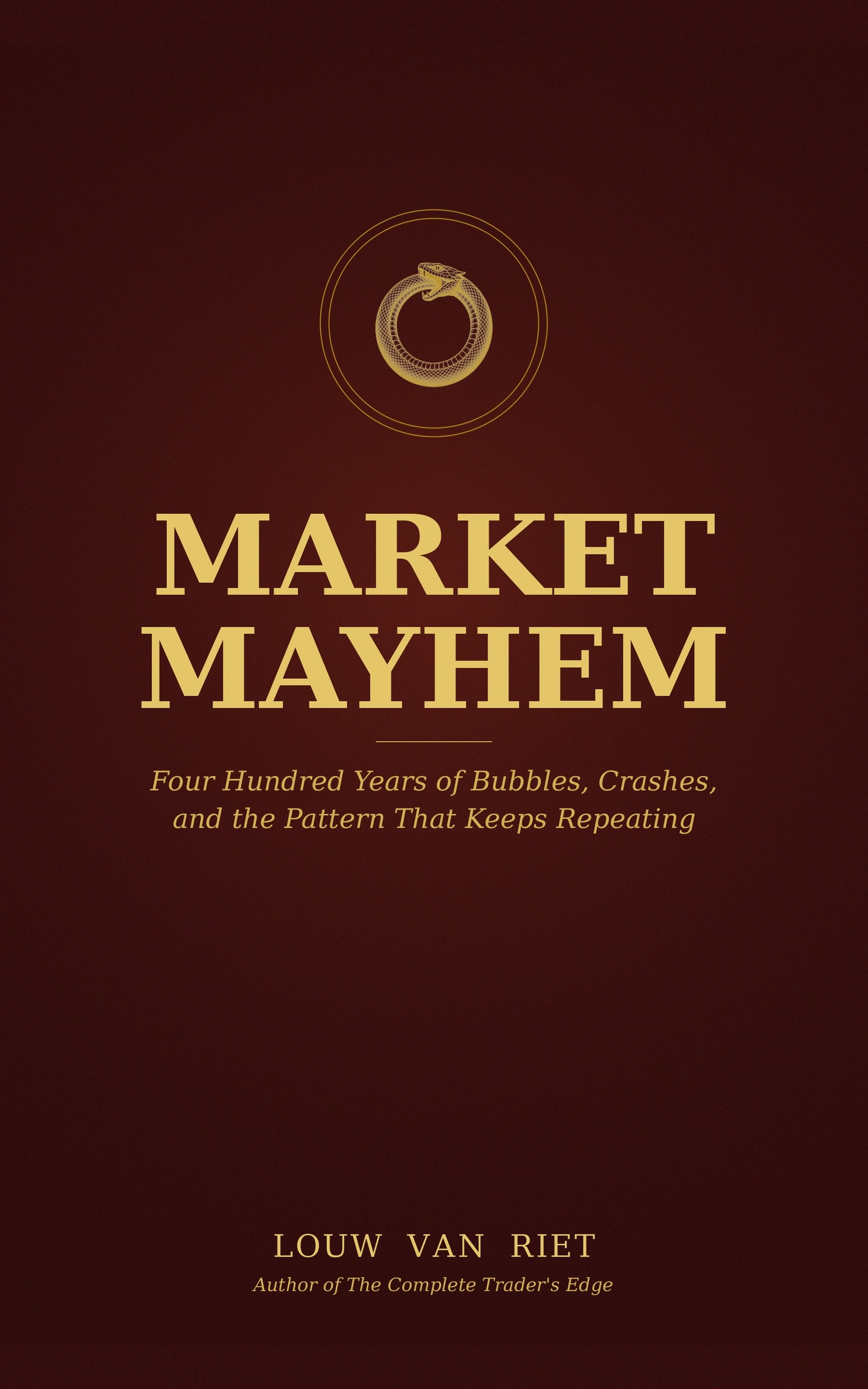 Market Mayhem
400 years of bubbles, crashes, and the pattern that keeps repeating.
Buy on Amazon →
Market Mayhem
400 years of bubbles, crashes, and the pattern that keeps repeating.
Buy on Amazon →
 Greatest Companies
How the world's greatest companies were built — and what traders learn from them.
View on Amazon →
Greatest Companies
How the world's greatest companies were built — and what traders learn from them.
View on Amazon →
 Greatest Traders
Eighty-six lives that explain the markets — Livermore to Madoff, told with the losses left in.
View on Amazon →
Greatest Traders
Eighty-six lives that explain the markets — Livermore to Madoff, told with the losses left in.
View on Amazon →