

The single most important mental shift in a trader’s development has nothing to do with a strategy, an indicator, or a new concept. It is the moment they stop treating trading like a hobby and start running it like a business. Not metaphorically. Operationally — with proper infrastructure, written processes, performance metrics, defined operating hours, and a professional approach to both costs and capital.
Every consistently profitable trader you will study, from Jesse Livermore to Paul Tudor Jones to Ed Seykota, describes their approach in business terms: operating procedures, performance metrics, research budgets, and risk controls. This is not coincidence. The business framework provides the structure that makes consistency possible.
This guide covers everything that shift requires: the conceptual framework, the workspace setup, the operating hours, the daily routine, the financial structure, the performance metrics that replace “did I make money today?” as the primary measure of success, and the seven professional beliefs that separate traders who last from those who don’t.
The Trading Business Infrastructure
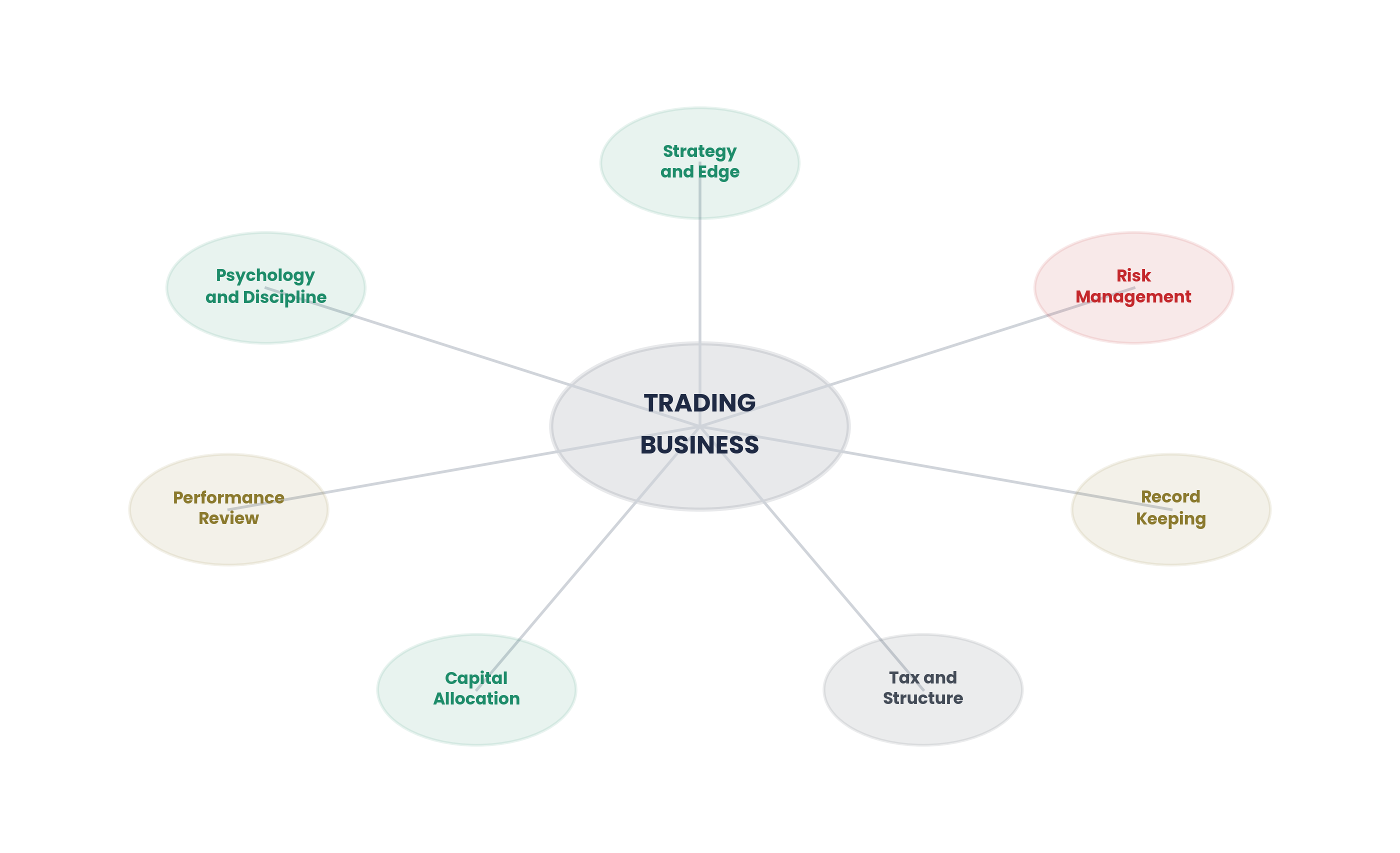
A trading business has the same structural components as any other business. The analogy is precise, not metaphorical. Map each business element to its trading equivalent and the operational gap becomes obvious:
| Business Component | Trading Equivalent | Why It Matters |
|---|---|---|
| Business plan | Trading plan: strategy, rules, risk parameters, goals | Forces clarity. Creates accountability. Prevents drift. |
| Operating hours | Trading routine: pre-session, in-session, post-session | Structure carries you when motivation fails. |
| Financial statements | Trading journal + monthly KPI review | Data-driven decisions replace emotional ones. |
| Cost control | Risk management: 1% per trade, drawdown protocol | Controls the downside. Ensures survival. |
| R&D budget | Continuous education, backtesting, strategy refinement | Compounds skill over time. Prevents stagnation. |
| Performance reviews | Weekly, monthly, and quarterly reviews of journal data | Identifies what is working, what is not, and what to change. |
The Mindset Shift: Hobby vs Business
A trader who approaches markets as a hobby takes positions based on how they feel, reviews results emotionally, and has no systematic process connecting one session to the next. A trader who approaches markets as a business has written operating procedures, defined hours, measurable KPIs, and treats losses the same way any business treats operating costs — as an expected, budgeted expense rather than a personal failure.
| Business element | Trading equivalent | Most retail traders have… |
|---|---|---|
| Standard operating procedures | Trading plan, entry checklist, risk rules | Preferences and vague intentions |
| Performance metrics (KPIs) | Expectancy, win rate, profit factor, process compliance % | Only: did I make money this week? |
| Quality control system | Trading journal with structured weekly and monthly review | No journal, or a basic win/loss log |
| Defined operating hours | Specific Kill Zone windows only | Whenever the market is open |
| Dedicated workspace | Separate, distraction-free trading environment | Laptop on the sofa between tasks |
| Separated business finances | Dedicated trading account, separate from personal savings | Trading capital mixed with living expenses |
| Long-term orientation | Statistical thinking over hundreds of trades | Focused on whether today was profitable |
The transition from the right column to the left column is not a strategy change. It is an operational change — and it is available to every trader regardless of their current level of technical skill.
The Workspace: Your Performance Infrastructure
Your trading environment is not just furniture. It is the physical infrastructure of your decision-making process. The quality of the decisions you make during a session is directly affected by the environment in which you make them.
Physical setup
A dedicated trading space — physically and psychologically separate from your living space — creates a powerful conditioned association between entering that space and shifting into focused, deliberate trading mode. The minimum viable physical setup:
- Ergonomics: Monitor at eye level, chair supporting the lower back, keyboard and mouse at a comfortable height. Physical discomfort during sessions creates a background of distraction that degrades decision quality without you being aware of it.
- Screens: Two monitors is the practical minimum — one for your primary chart, one for the economic calendar, watchlist and journal. Three monitors is comfortable. Beyond three there are diminishing returns for most retail strategies. More screens do not produce better decisions.
- Internet: Wired ethernet, not wifi, for your trading platform. A disconnection during an open position is not a minor inconvenience — it is a risk management failure waiting to happen.
- Lighting: Natural light where possible. Good artificial lighting that reduces eye strain during extended sessions.
Digital environment
Your chart should contain only what your strategy requires. A clean chart with key levels marked is a decision tool. A busy chart with overlapping indicators is a confusion tool. Remove everything that does not directly inform your trade decisions.
Social media during trading hours is one of the highest-cost habits in retail trading, and almost universally underestimated. One bearish post from a popular analyst can introduce hesitation on a valid long setup. One bullish comment can provide false confidence to ignore your stop. Use app blockers, phone silent mode, or a separate device for trading with no social applications installed.
Your Operating Hours: The Kill Zone Schedule
Professional businesses have defined operating hours. Professional traders have defined trading windows. The Kill Zone schedule is your operating hour definition.
| Session window | GMT | ET | SAST | Best for |
|---|---|---|---|---|
| London Kill Zone | 07:00–10:00 | 02:00–05:00 | 09:00–12:00 | Gold, EUR/USD, GBP/USD |
| New York Kill Zone | 12:00–15:00 | 07:00–10:00 | 14:00–17:00 | NQ, ES, Gold, GBP/USD |
| London Close | 15:00–17:00 | 10:00–12:00 | 17:00–19:00 | Profit-taking, position squaring |
Outside these windows, the trading business is not open. The discipline of not trading outside your scheduled hours is as valuable as the discipline of trading well within them.
The Daily Operating Routine
Every trading day follows the same sequence. Not similar. The same. Consistency converts the pre-session routine from a cognitive effort into an automatic process — freeing mental resources for the analysis itself.
Pre-session (30 minutes before the Kill Zone opens)
- Review Daily and 4H charts on all primary instruments. Confirm directional bias: bullish, bearish or range.
- Mark key levels — Order Blocks, Fair Value Gaps, pivots, liquidity levels — before any price action occurs in the session.
- Check the economic calendar. Note all red-folder events during the session window.
- Write two scenarios (bullish and bearish) for the primary instrument. Pre-commit to which specific conditions would activate each.
- Assess emotional and physical state honestly. If you are tired, stressed, or distracted, consider whether to reduce size or sit out entirely.
- Confirm risk parameters: risk per trade today, daily loss limit, maximum trade count.
During the session
- Execute against the pre-session plan only. No new analysis, no chart changes, no spontaneous instruments.
- Entry checklist before every trade — every criterion ticked before position is opened.
- Hard stop loss order placed immediately on entry. Never adjusted against the trade.
- When the daily loss limit is hit or maximum trade count is reached, the session ends. Platform closes.
Shutdown ritual (within 30 minutes of session close)
The shutdown ritual creates a clean psychological boundary between trading mode and the rest of your day — and prevents the creep of “just one more check” that leads to off-hours monitoring and emotional decision-making.
- Journal every trade taken: instrument, setup type, entry/stop/target, actual exit, outcome in R, process compliance score (1–5), one lesson.
- Close all chart tabs and the trading platform completely.
- Write one sentence about the key lesson from today’s session — before you forget it.
- Step away from the trading desk. Trading is done for the day.
The Financial Structure
Running trading like a business requires treating trading capital like business capital — ring-fenced, separate, and managed with the same seriousness you would apply to any financial asset.
Separate the capital
Trading capital should live in a dedicated account, entirely separate from your personal savings, emergency fund, and living expenses. This separation is not just practical — it is psychological. Trading money that is also needed for rent creates the financial pressure that is one of the single greatest causes of rule violations and poor decisions. Your trading account should contain only capital you can afford to lose entirely without material impact on your lifestyle.
Define your capitalisation target
At 1% risk per trade and a realistic 4% monthly return target, a $10,000 account produces approximately $400 per month. A $50,000 account produces $2,000. Match your capitalisation to your income goals, or use the prop firm route to access meaningful capital without funding it yourself.
Track trading as a business expense
Platform subscriptions, data feeds, educational resources, hardware, and the spread/commission costs of trading are all legitimate business expenses. Track them separately from P&L. Understanding your true cost of doing business gives you an accurate picture of actual net profitability.
Have a withdrawal policy
Define in advance how and when you withdraw profits. Many traders withdraw aggressively during good months and then lack capital during drawdown periods. A sustainable approach: withdraw a percentage of profits (typically 30–50%) monthly after the account has grown to a target size, while leaving the compounding base intact. Write this policy as a business rule, not an ad-hoc decision.
Key Performance Indicators
Businesses are managed by metrics. Your trading KPIs should include: win rate, average reward-to-risk ratio, expectancy per trade, maximum drawdown, profit factor (total gross profit divided by total gross loss), and process adherence score. Review these monthly, not daily. Daily P&L is noise. Monthly KPIs are signal.
Process compliance percentage is the most important non-financial metric — it tells you whether you are actually running your business according to its own operating procedures. A 90% compliance rate with a marginal strategy will outperform a 50% compliance rate with an excellent one.
The Seven Professional Beliefs
Professional traders do not necessarily have better strategies than retail traders. They have fundamentally different beliefs about how trading works — beliefs that drive the behaviours that produce consistent results over time.
| Professional belief | What retail traders believe instead |
|---|---|
| Uncertainty is normal and manageable | “I need to be more certain before I enter” — paralysis or late entries |
| Losses are a cost of doing business | “Every loss is a mistake I made” — revenge trading and emotional distortion |
| Process matters more than outcome | “A winning trade was a good trade” — reinforces rule-breaking behaviour |
| Every trade is statistically independent | “I’m on a hot streak, the next will also win” — overconfidence and sizing up |
| Edge only shows up over a large sample | “My strategy is broken after 5 losing trades” — strategy switching destroys edge |
| Position sizing protects the account | “I can risk more because this setup is obvious” — one trade should never threaten the account |
| The market owes me nothing | “After all this work, I deserve to win” — entitlement leads to overtrading |
These beliefs are not innate. They are built through consistent experience — taking losses without revenge trading, following the process through drawdowns, reviewing data rather than reacting to feelings. Every time you close a losing trade cleanly, journal it, and move on without emotional response, you are building the professional belief that losses are a cost of doing business.
Continuous Education as R&D
Businesses invest in research and development. Your equivalent is continuous education: reading trading literature, reviewing your journal for patterns, studying market history, and periodically testing new ideas in demo before committing capital. Budget at least 2 to 3 hours per week for education outside of active trading. This investment compounds into an increasingly refined edge that no course or mentor can provide.
Professional Accountability
Many professional traders have accountability partners, coaches, or peer groups: other traders who review performance, challenge rationalisations, and provide perspective. This external accountability is difficult to replicate alone. If you do not have a trading peer group, your journal serves as a partial substitute: it holds you accountable to your own rules by creating a written record that you cannot revise or rationalise away.
The Complete Setup Checklist
Use this as your implementation roadmap. Each item is a concrete action, not a concept.
- Workspace: Dedicated space, two monitors minimum, wired internet, social media blocked during sessions, consistent platform layout saved as a template.
- Capital: Separate trading account, funded with money you can afford to lose entirely, withdrawal policy written as a rule.
- Operating hours: Kill Zone schedule written and posted. Hard rule: no trading outside these hours.
- Pre-session routine: Written checklist covering HTF bias, key levels, news events, scenario planning, and emotional state — completed before every session without exception.
- Trading plan: Written document covering instrument selection, entry criteria (checklist format), risk rules (specific numbers), and the drawdown protocol.
- Journal: Every trade recorded same day. Process compliance score on every trade. Weekly review every Sunday. Monthly review at month end.
- Shutdown ritual: Specific post-session sequence that closes the trading day cleanly and psychologically.
- Performance KPIs: Expectancy, profit factor, process compliance %, win rate, and average R tracked monthly and compared to prior months.
Key Lessons
- A written business plan creates clarity and accountability. It is the foundation of a professional operation.
- Manage by monthly KPIs, not daily P&L. Daily results are noise; metrics are signal.
- Separate trading capital from personal finances completely. This removes the fear that destroys performance.
- Continuous education is R&D. Budget time and resources for it consistently.
- The business framework does not improve your analysis. It creates the conditions under which good analysis can actually be executed consistently.
Frequently Asked Questions
Do I need a dedicated room for trading?
A dedicated room is ideal but not essential. What is essential is a consistent, defined physical space used exclusively for trading during session hours. A desk in a bedroom that is used only for trading, with a clear physical boundary separating it from other activities, produces much of the same psychological conditioning as a separate room. What does not work is trading from the sofa, kitchen table, or any space associated with non-trading activities.
How much capital do I need before treating trading as a business?
The business framework applies regardless of account size. A $1,000 account traded with written rules, a journal, defined hours, and separated from personal finances is trading as a business. A $100,000 account traded on impulse, from the sofa, with no journal, is not. The infrastructure comes first. The capital scales into the infrastructure as your documented track record grows.
How do I handle tax on trading income?
Tax treatment of trading income varies significantly by country, instrument, account type, and whether the activity is classified as capital gains, income, or spread betting. Consult a tax professional who specifically understands financial markets in your jurisdiction. What every trader should do from day one: maintain complete records of every trade, all platform costs, hardware expenses, and educational materials. Clean records make tax reporting straightforward and ensure you can claim legitimate deductions.
Is it possible to trade professionally while still employed full-time?
Yes — and it is the recommended approach during the development phase. Most traders who rush to quit their jobs to trade full-time before having a documented profitable track record face the compounded pressure of needing the trading income to cover living expenses. The optimal sequence: build the business framework while employed, trade during available Kill Zone windows, document the track record, and transition to full-time only once the documented results justify the financial decision. Swing trading on the daily chart works well for full-time workers — 30 to 60 minutes per evening is enough.
What is a good profit factor?
A profit factor above 1.0 means the strategy is profitable. A profit factor of 1.5 is good. Above 2.0 is excellent. Below 1.0 means the strategy is losing money. Many professional fund managers target a profit factor of 1.5 to 2.5 over full market cycles. If your profit factor is below 1.0 over 100+ trades, the strategy needs revision, not just more discipline.
Continue Reading
▶ How to Become a Full-Time Trader
▶ Trading Journal: The Complete System
From The Book
The complete professional operating system is in Chapters 15–22 and Chapter 63 of The Complete Trader’s Edge.
 The Complete Trader's Edge
The full Mind · Method · Money framework. 70 chapters.
View on Amazon →
The Complete Trader's Edge
The full Mind · Method · Money framework. 70 chapters.
View on Amazon →
 Market Mayhem
400 years of bubbles, crashes, and the pattern that keeps repeating.
Buy on Amazon →
Market Mayhem
400 years of bubbles, crashes, and the pattern that keeps repeating.
Buy on Amazon →
 Greatest Companies
How the world's greatest companies were built — and what traders learn from them.
View on Amazon →
Greatest Companies
How the world's greatest companies were built — and what traders learn from them.
View on Amazon →
 Greatest Traders
Eighty-six lives that explain the markets — Livermore to Madoff, told with the losses left in.
View on Amazon →
Greatest Traders
Eighty-six lives that explain the markets — Livermore to Madoff, told with the losses left in.
View on Amazon →