

Ask any consistently profitable trader what separates them from the majority who fail, and almost none of them will say “a better indicator” or “a secret strategy.” They will say: routine. The daily structure, pre-session preparation, and post-session review — these habits, compounded over hundreds of trading days, build genuine edge.
“Strategy is what you do. Routine is who you are as a trader. Without a routine, even a profitable strategy will be executed inconsistently.”
Why Routine Matters More Than Strategy
Most traders spend 90% of their time searching for better strategies and 10% on execution. Professional traders do the opposite. Any strategy — even one with genuine positive expectancy — will produce poor results if executed inconsistently or emotionally. Routine is the infrastructure that allows your strategy to perform. It is also what carries you on the days you are tired, distracted or emotionally compromised: the routine does the work when motivation fails, and motivation will fail.
Routines work because they reduce cognitive load. Every decision made during a session draws on the same limited mental energy. A trader who starts the day deciding when to trade, what to look for and how to manage risk has spent part of that energy before price has moved. A trader whose routine has already answered those questions arrives with full capacity for one job: executing the plan.
Component 1: The Evening Preparation (Night Before)
Professional traders do most of their analytical work the night before — not during the session. When the market is open, emotions run high and analysis is compromised.
- Review the economic calendar — mark all high-impact events for the next session
- Mark key levels on your watchlist: daily highs/lows, weekly levels, key structure
- Identify the higher timeframe bias — what does the daily chart favour?
- Set price alerts so you don’t miss key levels during the session
- Prepare your trading journal template for the next day
Component 2: The Pre-Session Ritual (30–60 Minutes Before Open)
The pre-session ritual is about preparing your mind and body, not just your charts. A trader who sits down stressed, tired, or distracted will make different decisions than one who is calm and focused.
- Physical: Get up, move, eat. Never trade within 30 minutes of waking.
- Mental check-in: If your emotional state is compromised, trade reduced size or not at all.
- Read your rules: A brief read of your written rules keeps them front of mind.
- Set your daily loss limit: Define it now. If you hit it, you stop — no exceptions.
Write Your If-Then Scenarios
Turn your levels and bias into pre-committed decisions. For example: “If price sweeps the Asian low and reclaims above the FVG at 2,340, I enter long with a stop below 2,335 and a target at 2,355.” Written calmly before the open, these scenarios mean you are implementing a plan during the session, not reacting to the market.
Define Your No-Trade Conditions
Some days the right decision is not to trade. Write the conditions that keep you flat: “No trades if daily structure is unclear.” “No trades after two losses.” “No trades within 15 minutes of NFP.” If a red-folder release (NFP, CPI, FOMC, a central bank rate decision) falls inside your Kill Zone, decide now whether to trade around it or sit the session out. No-trade conditions stop you forcing setups on days when your edge is absent.
Component 3: The Trading Session
During the session, your job is to execute the plan — not create a new one. The analysis was done last night.
- Only take setups that match your pre-defined criteria — do not improvise
- After a loss, pause 5 minutes before considering the next trade
- Keep real-time notes: entry, exit, rationale, emotional state
- If your daily loss limit is hit, close the platform immediately and walk away
“During the session, your only job is to execute the plan you made when the market was closed. If there is no plan, there is no trade.”
Use an entry checklist. When an if-then condition triggers, run four questions: Does this meet my criteria? Is my position size calculated? Is my stop defined? Is the R:R at least 1:2? If all four are yes, enter. The checklist does the thinking; you do the clicking.
Manage according to plan. Do not move your stop further away. Do not take profit early out of fear. If the plan says trail to breakeven at 1R, do that; if it says hold to target, hold. Deviation during trade management is where most edge leaks out.
Stay off the chart between setups. Compulsive chart-watching adds emotional noise without improving outcomes. If you trade from the 15-minute chart, check in every 15 minutes and step away in between.
Respect your trade limit. If the plan allows three trades per session, close the platform after the third. This stops the overtrading spiral that turns a good session into a bad one.
Component 4: The Post-Session Review
This is the most neglected part of most traders’ routines — and the one with the highest return on time invested.
- Record every trade: entry, exit, size, P&L, setup type
- Screenshot each trade and annotate it — what went well? What went wrong?
- Note your emotional state — did it influence any decisions?
- Rate your discipline for the day: Did you follow your rules?
- Identify one specific improvement for tomorrow
The Shutdown Ritual
Finish the review with a deliberate end to the trading day:
- Close any position you do not intend to hold overnight. No “I will check it later” trades left open.
- Write a short emotional debrief: were there moments of fear, revenge impulses or greed, and did you manage them? Writing it down stops the emotion carrying into tomorrow.
- Close the platform: charts, broker and TradingView. The trading day is over.
Mental separation between trading and the rest of your life is what makes this sustainable. Traders who check charts at 11 PM are not dedicated; they are burning out.
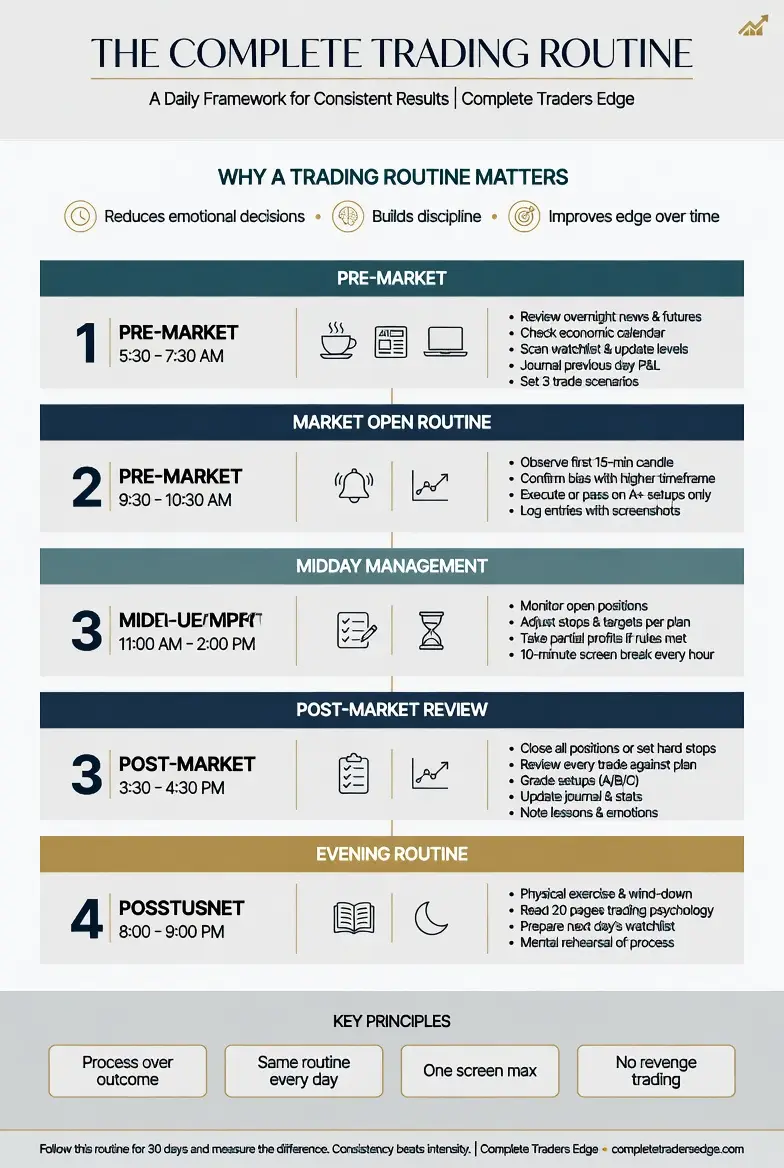
The Complete Routine at a Glance
| Phase | When | Time Required | Key Focus |
|---|---|---|---|
| Evening Prep | Night before | 20–45 mins | Levels, bias, calendar |
| Pre-Session Ritual | 30–60 mins before open | 15–30 mins | Mental state + plan review |
| Active Session | During market hours | Varies | Execution only — no new analysis |
| Post-Session Review | Within 1 hour of close | 20–30 mins | Journal, screenshots, lessons |
| Weekly Review | Sunday morning | 45–60 mins | Stats, patterns, weekly bias |
Table 3: The Complete Professional Trading Routine
Building the Routine: Starting Small
- Week 1: Evening preparation only — make it automatic before adding anything
- Week 2: Add the post-session journal — 10 minutes, one screenshot per trade
- Week 3: Add the pre-session mental check-in and daily loss limit
- Week 4: Begin weekly reviews — look at the data you’ve accumulated
“Consistent routines compound. Six months of daily review produces a fundamentally different trader.”
Conclusion
The trading routine is the infrastructure for consistent, professional execution. Build it before you need it. By the time you are in a drawdown, the routine should already be automatic. Learn more about the psychological foundation in our Trading Psychology Complete Guide.
Frequently Asked Questions
How long should a trading routine take?
Pre-session: 30-45 minutes. In-session: the duration of your Kill Zone (2-4 hours for day traders). Post-session: 15-30 minutes. For swing traders, the entire routine compresses to 30-60 minutes of evening analysis.
What is the most commonly skipped part of the routine?
The post-session review. Traders are exhausted or emotionally charged after the session. This is the most destructive skip because the review is where learning consolidates. Without it, mistakes are repeated indefinitely. If you can only do one part, do the post-session journal review.
What if I trade multiple sessions, such as London and New York?
Each session gets its own mini-routine. Do a 10-minute pre-session reset before New York even if you already traded London. Conditions change between sessions: new levels form and news releases shift the picture. The reset makes sure you trade the current market, not this morning’s.
Should I have a routine on days I do not trade?
Yes, a lighter one. Spend 15-20 minutes reviewing charts to maintain pattern recognition. The weekend is for your weekly review: 30-60 minutes analysing the week’s data, identifying patterns, and setting action items.
Can I build a routine around a full-time job?
Absolutely. Swing trading routines require only evening analysis (20-30 min). Mark levels, set orders, review journal. The market works while you work. Many successful traders maintain full-time careers with an evening-only routine.
What should my pre-session routine include?
Five elements: (1) Economic calendar check, (2) key level marking on HTF, (3) directional bias from daily structure, (4) if-then scenario writing, (5) no-trade conditions. Total: 30-45 minutes. This preparation determines the quality of everything that follows.
From The Book
This article covers concepts from Chapter 16 of The Complete Trader’s Edge.
 The Complete Trader's Edge
The full Mind · Method · Money framework. 70 chapters.
View on Amazon →
The Complete Trader's Edge
The full Mind · Method · Money framework. 70 chapters.
View on Amazon →
 Market Mayhem
400 years of bubbles, crashes, and the pattern that keeps repeating.
Buy on Amazon →
Market Mayhem
400 years of bubbles, crashes, and the pattern that keeps repeating.
Buy on Amazon →
 Greatest Companies
How the world's greatest companies were built — and what traders learn from them.
View on Amazon →
Greatest Companies
How the world's greatest companies were built — and what traders learn from them.
View on Amazon →
 Greatest Traders
Eighty-six lives that explain the markets — Livermore to Madoff, told with the losses left in.
View on Amazon →
Greatest Traders
Eighty-six lives that explain the markets — Livermore to Madoff, told with the losses left in.
View on Amazon →