

One of the most practical concepts in the ICT (Inner Circle Trader) framework is the killzone — a specific time window within each major trading session when institutional order flow is at its most active, price seeks and sweeps liquidity most aggressively, and the highest-probability setups tend to form. Understanding and trading within killzones dramatically filters trade quality compared to trading at random times throughout the day.
Why Time Matters in Trading
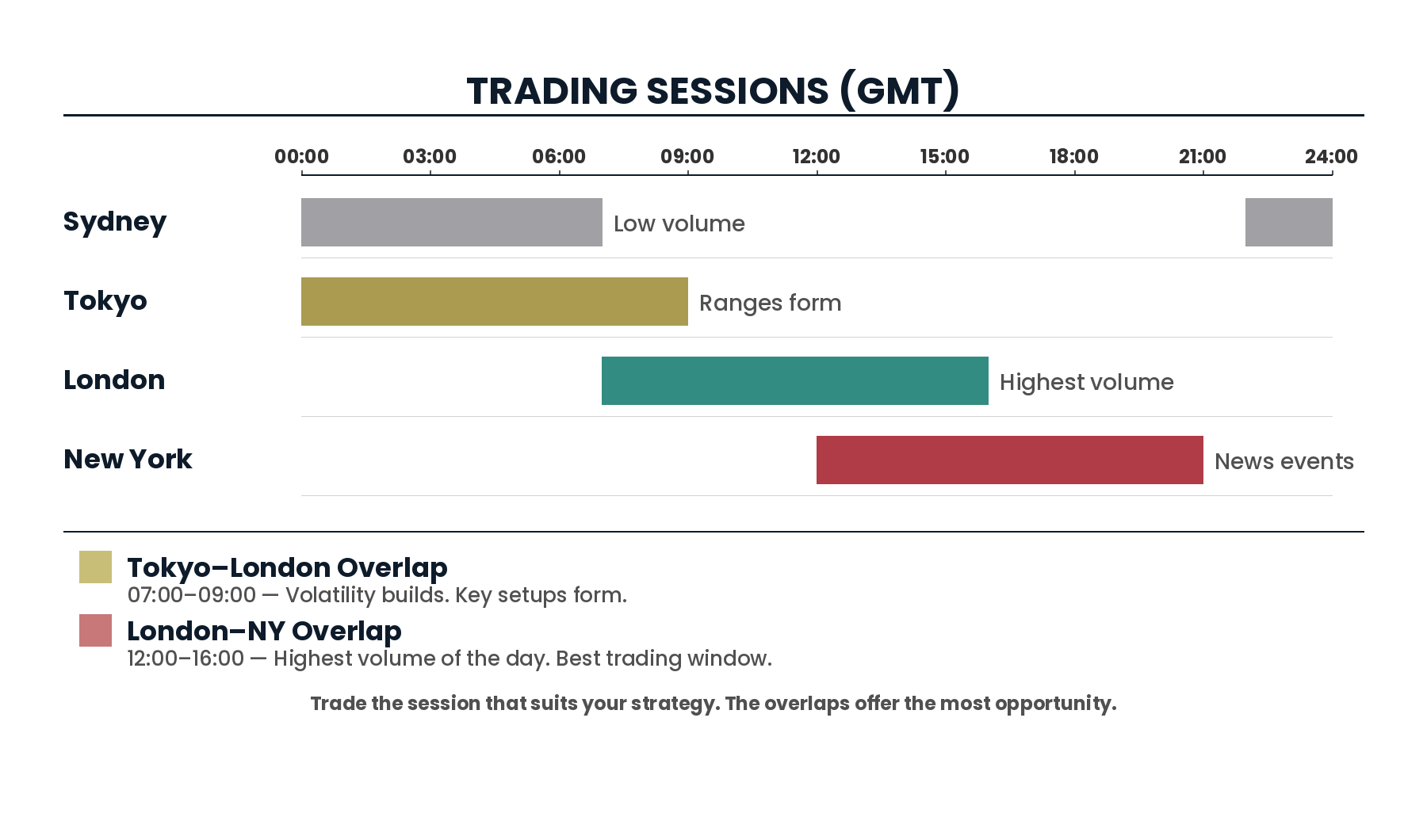
Not all hours of the trading day are equal. During the Asian session, major institutional participants in London and New York are offline. Volume is lower, ranges are tighter, and price often consolidates or sets up the liquidity that will be targeted in the next session. During peak session overlaps, institutional volume floods in and produces the directional moves that create tradeable setups. Time-based filtering is a form of edge.
The Four ICT Killzones
Asian Killzone (8pm–11pm New York time). Sets the Asian range — the high and low that often become the liquidity targets for London and New York sessions. Not typically a trading session for most ICT traders; rather a reference period.
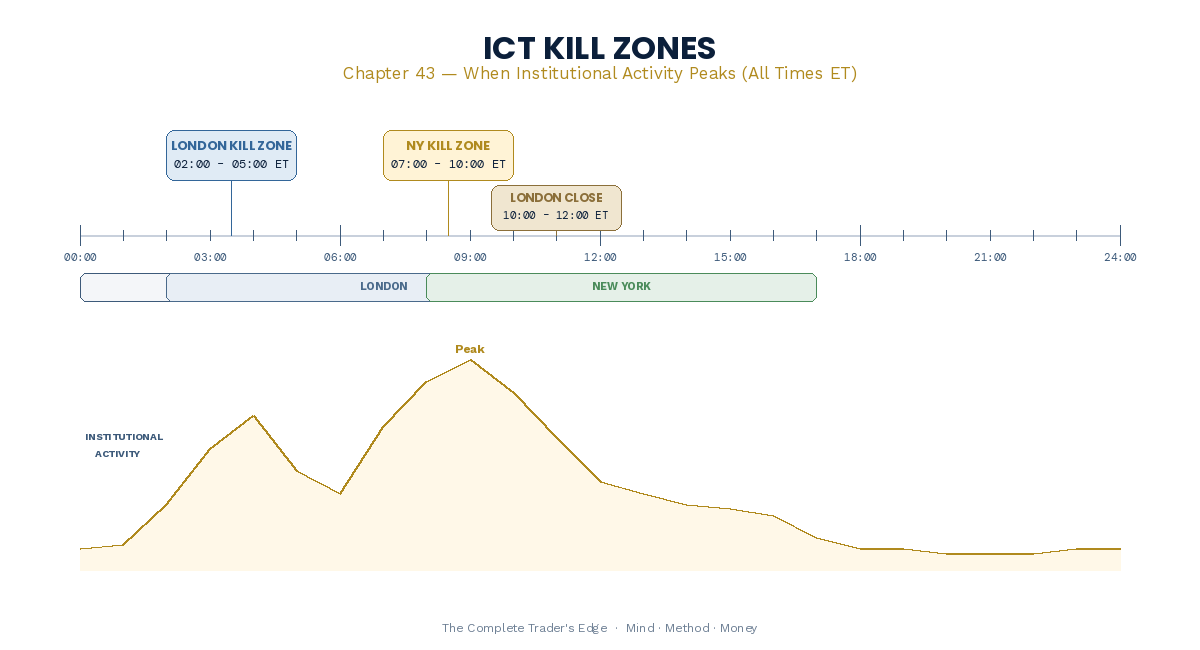
London Open Killzone (2am–5am New York time). One of the highest-probability windows. London is the world’s largest forex trading centre. The open frequently involves a liquidity sweep of the Asian range high or low before establishing the London directional move.
New York Open Killzone (7am–10am New York time). The second major high-probability window. Often continues or reverses the London move. The overlap between London and New York (7am–11am NY) is the highest-volume period in forex markets.
New York Lunch/PM Session (1pm–3pm New York time). Lower probability; often used to close morning trades rather than initiate new ones.
Practical Application
Focus your analysis and active trading on the London and New York Open killzones. Mark the Asian range high and low each day. Watch for liquidity sweeps of those levels during the killzone windows, followed by a market structure shift on the lower timeframe — this sequence is the core ICT entry model.
Key Lessons
- Killzones identify specific time windows of peak institutional activity — trading outside them reduces probability.
- London Open (2am–5am NY) and New York Open (7am–10am NY) are the two primary high-probability windows.
- The Asian range high and low are the key liquidity targets for the killzone sessions.
- Look for liquidity sweeps followed by lower-timeframe structure shifts within killzone windows.
Kill Zone Quick Reference
| Kill Zone | Time (New York / EST) | Primary Purpose | What to Look For |
|---|---|---|---|
| Asian | 8 PM – 11 PM | Range formation (reference, not for trading) | Mark the Asian high and low as next session’s liquidity targets |
| London Open | 2 AM – 5 AM | Primary directional move of the day | Liquidity sweep of Asian range then reversal |
| New York Open | 7 AM – 10 AM | Continuation or reversal of London move | OB / FVG entries during London-NY overlap |
| NY Lunch / PM | 1 PM – 3 PM | Close and manage, rarely initiate | Lower probability. Use for trade management, not new entries. |
Kill Zone Quick Reference
| Kill Zone | Time (EST) | Purpose | What to Look For |
|---|---|---|---|
| Asian | 8 PM – 11 PM | Range formation (reference) | Mark Asian high/low as liquidity targets |
| London Open | 2 AM – 5 AM | Primary directional move | Sweep of Asian range then reversal |
| New York Open | 7 AM – 10 AM | Continuation or reversal of London | OB/FVG entries during overlap |
| NY Lunch/PM | 1 PM – 3 PM | Close and manage | Lower probability. Manage, not initiate. |
Frequently Asked Questions
What is the best ICT Kill Zone for beginners?
The New York Open Kill Zone (7:00 AM to 10:00 AM Eastern) is generally the best starting point for beginners. It offers the highest volume due to the London-New York overlap, the widest range of tradeable instruments, and produces the clearest directional moves. Most ICT educators recommend mastering one killzone before adding others, and New York gives you the most opportunities per session to learn from.
Do ICT Kill Zones work on crypto?
Yes, but with an important caveat. Cryptocurrency markets trade 24/7, so the session structure is less rigid than forex. However, the London and New York killzone windows still produce the highest volume and largest moves in Bitcoin and major altcoins because institutional crypto desks operate on the same schedules as traditional finance. The Asian session is also significant for crypto because major exchanges like Binance and OKX see peak activity during those hours. Apply the same killzone logic, but expect slightly more activity outside traditional windows compared to forex.
What time is the London Kill Zone in EST?
The London Kill Zone runs from 2:00 AM to 5:00 AM Eastern Standard Time (EST). During Eastern Daylight Time (EDT), which applies from March to November, the London Kill Zone runs from 3:00 AM to 6:00 AM EDT. The most active window within the London killzone is typically the first 60 to 90 minutes after the London open, when institutional algorithms execute their opening programs and sweep the Asian session range for liquidity.
Should I trade every Kill Zone?
No. Most ICT traders specialise in one or two Kill Zones maximum. Trading all sessions leads to overtrading, fatigue, and reduced quality. Choose the Kill Zone that fits your schedule and timezone. If you are in the US, the New York Open is natural. If you are in the UK or Europe, the London Open is optimal. If you are in Asia or Australia, the Asian session provides reference levels and the London Open (evening your time) may be tradeable. One Kill Zone, executed with full routine preparation, outperforms three Kill Zones traded with split attention.
How do Kill Zones connect to the AMD cycle?
The Accumulation, Manipulation, Distribution (AMD) cycle typically plays out within each Kill Zone. The Asian session is accumulation (range forms, liquidity builds on both sides). The first 30 to 60 minutes of the London or New York Kill Zone is manipulation (price sweeps one side of the Asian range, triggering stops). The remainder of the Kill Zone is distribution (the real directional move unfolds). Understanding this sequence within the Kill Zone time window gives you a precise framework for when to watch, when to wait, and when to enter.
Continue Reading
▶ The ICT Power of 3: AMD Cycle
▶ Order Blocks: Identifying Institutional Footprints
▶ The Economic Calendar: Your Most Important Fundamental Tool
From The Book
This article covers concepts from Chapter 30 of The Complete Trader’s Edge.
Should I trade every Kill Zone?
No. Most ICT traders specialise in one or two Kill Zones. Trading all sessions leads to overtrading and fatigue. Choose the Kill Zone that fits your schedule. One Kill Zone with full routine preparation outperforms three traded with split attention.
How do Kill Zones connect to the AMD cycle?
The AMD cycle plays out within each Kill Zone. Asian session is accumulation (range forms, liquidity builds). The first 30-60 minutes of London or New York is manipulation (price sweeps one side, triggering stops). The remainder is distribution (the real directional move). This gives you a precise framework for when to watch, wait, and enter.
Continue Reading
From The Book
This article covers concepts from Chapter 30 of The Complete Trader’s Edge.
 The Complete Trader's Edge
The full Mind · Method · Money framework. 70 chapters.
View on Amazon →
The Complete Trader's Edge
The full Mind · Method · Money framework. 70 chapters.
View on Amazon →
 Market Mayhem
400 years of bubbles, crashes, and the pattern that keeps repeating.
Buy on Amazon →
Market Mayhem
400 years of bubbles, crashes, and the pattern that keeps repeating.
Buy on Amazon →
 Greatest Companies
How the world's greatest companies were built — and what traders learn from them.
View on Amazon →
Greatest Companies
How the world's greatest companies were built — and what traders learn from them.
View on Amazon →