


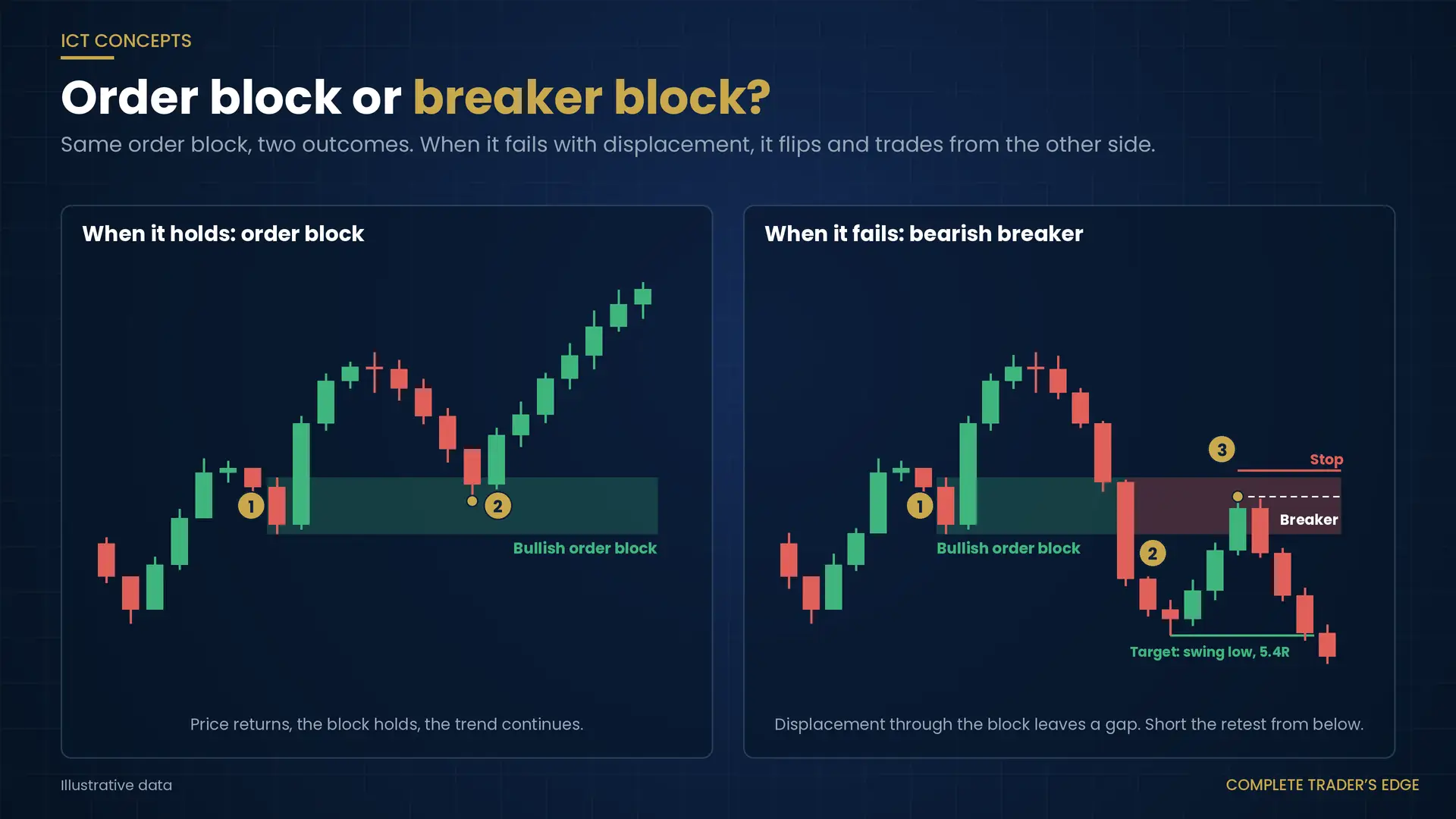
You marked a bullish Order Block. Price returned to it exactly. And then, instead of bouncing, it sliced straight through — stopped you out and kept going lower. Sound familiar? What you experienced was not a failed trade. It was a Breaker Block in the making. The Order Block did not lie to you. It told you precisely what the market intended — you just did not yet know how to read the message.
Understanding the difference between Order Blocks and Breaker Blocks — and knowing how to identify which one you are dealing with before price arrives — is one of the highest-value skills in the ICT framework. This guide covers both concepts in full, explains exactly why and when Order Blocks fail, and shows you how to trade from Breaker Blocks with precision.
Order Blocks: A Brief Recap
An Order Block is the last opposing candle before a significant impulsive move away from a price level. A bullish Order Block is the last bearish candle before a strong rally. A bearish Order Block is the last bullish candle before a sharp decline. The logic: institutional participants placed their orders at that candle’s price level to create the subsequent move, and when price returns, those unfilled orders may still be waiting to be executed. For the full breakdown of how to identify, validate, and trade Order Blocks, see the complete Order Blocks guide.
Order Blocks are powerful because they identify where institutions entered. When price retraces to a valid, unmitigated Order Block aligned with the higher timeframe trend, the probability of a reaction is high — because the same participants who entered there have an incentive to defend that level to protect their position.
But not every Order Block holds. And when they fail, they do not simply become neutral ground. They flip — and become a Breaker Block, a level that now actively works against the direction it originally supported.
What Is a Breaker Block?
A Breaker Block is a failed Order Block that has been broken through with displacement and has subsequently inverted its directional bias. A bullish Order Block that price breaks below becomes a bearish Breaker Block — a resistance level on future visits. A bearish Order Block that price breaks above becomes a bullish Breaker Block — a support level on future visits.
The change of polarity principle underpins both concepts: former support becomes resistance, and former resistance becomes support. Breaker Blocks are simply the ICT-specific application of this universal principle to institutional order flow levels.
Why Order Blocks fail and create Breakers
An Order Block fails when the institutions who originally placed orders there have been flushed out or have repositioned. This happens for several reasons:
- The higher timeframe bias has changed. A bullish Order Block on the 1H chart is irrelevant if the 4H structure has broken bearish. When the HTF structure shifts, lower timeframe levels that were previously defended become abandoned.
- Stop losses accumulated above/below the Order Block. When retail traders all place stops just beyond an Order Block, that cluster of stops becomes a liquidity target. Institutions sweep through the Order Block, collect those stops, and use the resulting liquidity to build a position in the opposite direction.
- The Order Block was invalidated by time. Very old Order Blocks — levels from months ago — carry progressively less weight as institutional activity at that level ages and those orders are filled or cancelled.
Order Block vs Breaker Block: Side-by-Side Comparison
| Feature | Order Block | Breaker Block |
|---|---|---|
| Definition | Last opposing candle before an impulsive move | A failed Order Block that has been broken with displacement and inverted |
| Origin | Forms when institutions enter positions, creating the impulse away | Forms when price returns to an OB, sweeps through it, and continues |
| Directional bias | Supports the direction of the original impulse (bullish OB = support) | Inverted: bullish OB becomes bearish Breaker (resistance) |
| How to trade it | Enter when price retraces to the OB zone in trend direction | Enter when price rallies back to the Breaker zone — now trading against it |
| Reliability signal | Higher when unmitigated, aligned with HTF trend, at discount/premium | Higher when the break was impulsive with displacement and a Fair Value Gap |
| Stop placement | Beyond the far edge of the Order Block zone | Beyond the far edge of the Breaker zone (above for bearish Breaker) |
How to Identify a Valid Breaker Block
Not every failed Order Block becomes a tradeable Breaker. The following conditions must be met for the level to carry genuine Breaker status:
Condition 1: The original Order Block must have been valid. A level that was never a genuine OB cannot become a Breaker. The original level must have shown the correct structure — last opposing candle before a significant impulsive move that created a structural break.
Condition 2: The break must show displacement. Price must move through the Order Block with a strong, impulsive candle — not a slow grind. A slow chop through the OB level does not create a Breaker with meaningful institutional significance. Displacement suggests institutional orders drove the break, not random retail flow.
Condition 3: A Fair Value Gap must be left on the break. When institutions break through an Order Block, the speed and size of the move typically leaves a FVG behind. This FVG is often the same zone as the Breaker Block — the ideal entry point for when price returns. If no FVG is present on the break, the Breaker carries less weight.
Condition 4: The break must be supported by the higher timeframe bias. A bearish Breaker Block forming on the 1H chart carries high weight when the 4H and Daily are also bearish. A bearish Breaker on the 1H chart going against a bullish 4H trend is a counter-trend setup with lower probability.
Trading the Breaker Block: The Entry Setup
Once a valid Breaker Block is identified, the trade setup is straightforward. The Breaker becomes the entry zone when price returns to it — now trading in the inverted direction.
Bearish Breaker Block setup (most common)
- Identify a bullish Order Block that price breaks below with displacement, leaving a FVG.
- Note the full zone of the original OB: its high and low, and the FVG left on the break.
- Wait for price to rally back up into this zone from below.
- Look for a bearish reaction candle or a lower timeframe Change of Character within the zone.
- Enter short at the upper portion of the Breaker zone.
- Stop loss: above the highest point of the Breaker zone (above the original OB high).
- Target: the most recent swing low, or the next significant liquidity level below.
Bullish Breaker Block setup
The exact mirror: a bearish Order Block that price breaks above with displacement. Price subsequently pulls back into that former OB level from above, which now acts as support. Entry long at the lower portion of the Breaker zone, stop below the zone, target at the next swing high or liquidity level above.
Mitigation Blocks: The Related Concept
Closely related to Breaker Blocks is the Mitigation Block — a concept often confused with Breakers but with a distinct mechanism. Where a Breaker Block forms when an Order Block is violated, a Mitigation Block forms when institutions return to close losing positions from a previous trade before the real continuation move begins.
| Concept | What it represents | How it behaves on return |
|---|---|---|
| Order Block | Where institutions initially entered a position | Acts as support/resistance in original direction (if unmitigated) |
| Breaker Block | A failed OB — institutions exited and repositioned in the opposite direction | Acts as resistance/support in the INVERTED direction |
| Mitigation Block | Where institutions return to close losing trades before continuing in the intended direction | Acts as a brief pause or reversal zone before the original direction continues |
In practice: a Mitigation Block is where price returns to “mitigate” (partially fill) an unfilled Order Block before continuing in the original direction. It is not a level that has flipped direction — the original directional intent is still valid. The mitigation is the market completing unfinished business before resuming.
Practical Decision Framework: OB, Breaker or Mitigation?
When price returns to a previously significant level, the question to ask is:
Did price originally move away from this level and has NOT yet returned? → Unmitigated Order Block. Trade in the original direction.
Did price break through this level with displacement and is now returning from the other side? → Breaker Block. Trade in the inverted direction.
Did price partially return to this level without fully breaking through, then move back in the original direction? → Mitigated Order Block (partially filled). Reduced reliability but still tradeable in the original direction if the HTF bias holds.
Frequently Asked Questions
How do I know in real time if an Order Block is going to become a Breaker?
You cannot know with certainty before the break occurs — that is the nature of probabilistic trading. What you can do is watch for warning signs: the HTF bias has shifted against the Order Block’s direction; price approaches the OB without creating a liquidity sweep first (suggesting institutions are not interested in defending it); the OB was formed on a lower timeframe that conflicts with the higher timeframe structure. When these factors are present, treat the Order Block entry with reduced confidence and use a tighter stop that would quickly confirm whether it is becoming a Breaker.
Can a Breaker Block also fail and become a valid entry in the original direction again?
In theory yes — if price breaks back through the Breaker zone with displacement in the original direction, the polarity could flip again. In practice, multiple-flip scenarios are uncommon on higher timeframe Breakers and should be approached with extreme caution. For most traders, a level that has flipped twice is a compromised level best avoided. Focus on clear, first-time Breakers where the polarity shift is unambiguous.
What is the difference between a Breaker Block and a Supply/Demand zone flip?
Supply and demand zone flips are a classical technical analysis concept where a broken support level becomes resistance and vice versa. Breaker Blocks are the ICT-specific refinement of this concept, applied specifically to institutional Order Block levels and requiring the additional conditions of displacement and FVG formation on the break. A Breaker Block is a more precisely defined version of a supply/demand flip, anchored to specific institutional order flow mechanics rather than general support/resistance theory.
Should I trade Breaker Blocks differently depending on the timeframe?
Yes. Higher timeframe Breaker Blocks (Daily, 4H) carry significantly more institutional weight than lower timeframe ones. A 4H Order Block that breaks and flips to a Breaker is a level to watch for weeks as a significant resistance zone. A 15M Breaker is relevant for the current session only. Match the weight you assign to a Breaker to the timeframe it formed on, and always ensure the break aligns with the higher timeframe direction rather than opposing it.
How do I mark Breaker Blocks on my chart?
Once an Order Block has been broken with displacement, redraw the zone in a different colour (many traders use red for bearish Breakers and a lighter green for bullish Breakers, distinct from their Order Block colours). The zone boundaries remain the same as the original Order Block — high and low of the OB candle. Add a note to indicate it is a Breaker. Then watch for price to return to the zone from the opposite direction. When it does, that is the trade zone.
▶ ▶ ▶ Continue Reading
Complete the advanced Smart Money toolkit
The Complete Trader’s Edge
Breaker Blocks are covered in Chapter 32
The complete advanced Smart Money framework — Order Blocks, Breaker Blocks, Mitigation Blocks, OTE, premium/discount filtering and inducement — all in Chapter 32, alongside 30+ Method chapters covering the full blended approach. Available on Amazon in Kindle, paperback and full-colour editions.
 The Complete Trader's Edge
The full Mind · Method · Money framework. 70 chapters.
View on Amazon →
The Complete Trader's Edge
The full Mind · Method · Money framework. 70 chapters.
View on Amazon →
 Market Mayhem
400 years of bubbles, crashes, and the pattern that keeps repeating.
Buy on Amazon →
Market Mayhem
400 years of bubbles, crashes, and the pattern that keeps repeating.
Buy on Amazon →
 Greatest Companies
How the world's greatest companies were built — and what traders learn from them.
View on Amazon →
Greatest Companies
How the world's greatest companies were built — and what traders learn from them.
View on Amazon →
 Greatest Traders
Eighty-six lives that explain the markets — Livermore to Madoff, told with the losses left in.
View on Amazon →
Greatest Traders
Eighty-six lives that explain the markets — Livermore to Madoff, told with the losses left in.
View on Amazon →