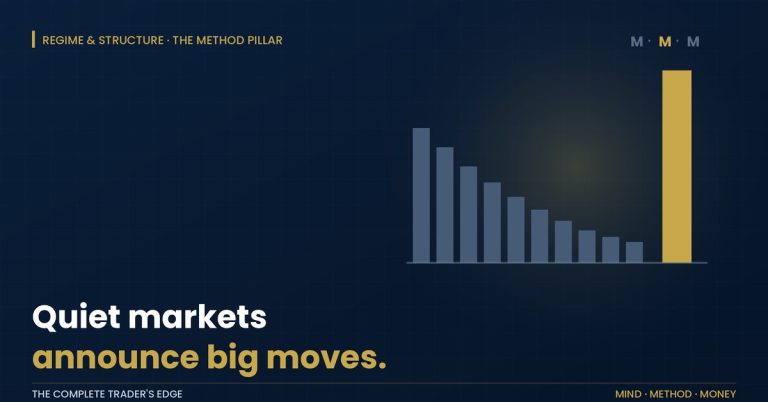


Most traders scan charts looking for patterns they were taught to recognise. Head and shoulders, double tops, flags. Fair Value Gaps are different. They are not a pattern you look for. They are a structural event the market creates when it moves too fast for normal two-sided trading to occur – and understanding why they form, and why price so reliably returns to fill them, changes how you read every chart you will ever look at.
This is the complete guide to Fair Value Gap trading: what they are, the three-candle structure that creates them, the different types, how to grade them by quality, and the exact entry techniques used to trade them with precision. This is Chapter 29 of The Complete Trader’s Edge put into practical application.
A Fair Value Gap is not just a gap in price. It is evidence of institutional urgency, and institutions have a habit of returning to finish what they started.
What Is a Fair Value Gap?
A Fair Value Gap (FVG) – also called an imbalance or inefficiency – is a three-candle pattern that reveals a moment when price moved so quickly that normal two-sided trading activity was bypassed. In a normally functioning market, every price level should have both buyers and sellers actively transacting. An FVG is a zone where only one side was trading: either only buyers, creating a bullish gap, or only sellers, creating a bearish gap.
The term comes from the concept of market efficiency. Markets are constantly seeking a fair price – a level where both buyers and sellers are willing to transact. When price moves too aggressively in one direction, it leaves behind areas of unfilled orders and one-sided activity. The market’s inherent drive toward efficiency means it frequently returns to these zones before continuing.
The three-candle structure
A bullish FVG forms across three consecutive candles where the high of candle one is lower than the low of candle three, with a large bullish impulse candle two in between. The gap between the high of candle one and the low of candle three is the FVG – a zone of pure buying with no overlapping selling activity.
A bearish FVG is the mirror: the low of candle one is higher than the high of candle three, with a large bearish impulse candle in between. The gap represents a zone of pure selling with no overlapping buying.
Visually, these appear as areas on the chart where the wicks of adjacent candles do not overlap. On any clean, liquid market, every price area should show two-sided participation. An FVG violates this, leaving a visible single-sided void.

Why Price Fills Fair Value Gaps
The fill tendency is one of the most consistently observable behaviours across every liquid market. Three mechanisms drive it:
Algorithmic efficiency seeking. Algorithmic systems now account for the significant majority of daily trading volume. These systems are programmed to operate at prices where two-sided liquidity exists. Areas of imbalance – where only one side traded – represent inefficient pricing from an algorithmic standpoint, creating a mechanical pull back toward the gap.
Institutional limit orders. Professional traders frequently place limit orders within FVGs, anticipating the fill. When many participants place orders at the same levels, that concentration of resting orders itself attracts price back to the area – a self-reinforcing mechanism.
Unfilled participant orders. When price moves aggressively, some participants who wanted to transact at those prices had orders that did not fill. When price returns, those orders are waiting. This is particularly true of institutional participants managing large order flow who could not get filled during the impulse move.
Not every FVG gets filled immediately, and some never fill at all. But the tendency is consistent enough across timeframes and instruments to make FVGs one of the most reliable structural concepts in modern price action analysis.
The Five Types of Fair Value Gap
Standard FVG
The three-candle structure described above. The most common form. Valid on all timeframes, though higher timeframe FVGs carry significantly more weight than lower timeframe ones. A Daily FVG that price returns to on the 1-hour chart is a high-priority area. A 5-minute FVG carries minimal structural significance.
Balanced Price Range (BPR)
A special case where a bullish FVG and a bearish FVG overlap at the same price area. This creates a zone of maximum inefficiency – two consecutive imbalances in opposite directions occupying the same price space. Balanced Price Ranges are among the highest-probability reaction zones available, because the overlapping inefficiencies concentrate resting orders to an unusual degree.
Consequent Encroachment (CE)
The Consequent Encroachment is the 50% midpoint of the Fair Value Gap. Price frequently reacts at the CE before continuing in the original direction, rather than filling the entire gap. Many traders use the CE as their primary entry level within an FVG – it offers a tighter entry than the full gap boundary, better R:R, and still captures the institutional reaction that the gap zone represents.
Inversion Fair Value Gap
When price breaks through an FVG without filling it – trading through the imbalance and continuing – the gap is said to have inverted. An inverted bullish FVG can become a resistance level on future visits. An inverted bearish FVG can become support. This reflects the change of polarity principle: former inefficiency zones that price has traded through become reference levels in the opposite direction.
Nested FVG
A Nested FVG is a smaller Fair Value Gap that forms inside a larger one, usually revealed when you drop to a lower timeframe within a higher timeframe gap. A 15-minute FVG sitting inside a 4H FVG is a nested structure. The overlap concentrates institutional interest at the same price, so nested gaps offer higher-confluence entries and let you refine risk: use the higher timeframe gap to define the zone and the nested lower timeframe gap for a tighter stop.
Grading FVG Quality: Not All Gaps Are Equal
One of the most important skills in FVG trading is distinguishing high-quality gaps from low-quality ones. Treating every FVG identically produces inconsistent results. The following table shows the key quality filters.
| Quality factor | High quality | Low quality |
|---|---|---|
| Timeframe | Daily, 4H, 1H | 5M, 1M (scalping context only) |
| HTF trend alignment | FVG direction matches higher timeframe bias | Counter-trend FVG in strong opposing structure |
| Session of formation | Formed during London or New York Kill Zone | Formed during Asian session or dead hours |
| Confluence | FVG aligns with Order Block, Volume Profile level, or Fibonacci zone | Standalone FVG with no additional structural support |
| Impulse that created it | Strong displacement candle, clear break of structure | Average-sized move, no structural break |
| Status | Unmitigated (price has not returned to it) | Previously tested or partially filled |
A bullish FVG formed on the 4H chart during the London Kill Zone, aligned with the Daily uptrend, sitting at the same level as a Volume Profile Value Area High, with an unmitigated Order Block just below it – this is the highest-quality FVG setup available. A bearish FVG on the 15-minute chart formed during the Asian session, going against the Daily structure, with no additional confluence – this barely warrants attention.
The Three FVG Entry Techniques
There are three approaches to entering FVG trades, each with different risk and reward characteristics.
Aggressive entry: at the gap boundary
Enter a limit order at the nearest edge of the FVG as soon as price begins retracing toward it. For a bullish FVG, this is a buy limit at the top of the gap (the low of candle three). This gives the best entry price and the widest potential R:R, but the lowest confirmation. Some traders use this on higher timeframe FVGs where the structural context is very clear.
Stop placement: Below the bottom of the FVG (the high of candle one). If the gap fails entirely, the trade thesis is invalidated.
Best for: Strong HTF alignment, Daily/4H FVGs, limit order trading style.
Conservative entry: confirmation within the gap
Wait for price to enter the gap, then look for a lower timeframe reaction: a rejection candle, an Order Block forming on the 15-minute or 5-minute chart, or a Change of Character on the entry timeframe. This sacrifices some entry quality for higher confirmation and probability.
Stop placement: Beyond the opposite boundary of the gap.
Best for: Traders who prefer confirmation before committing capital, 1H FVGs used with 15M entries.
CE entry: at the 50% midpoint
Enter at the Consequent Encroachment – the exact midpoint of the gap. The logic: if institutions are defending the gap, they are most likely to do so around the equilibrium level. Many traders find this the best balance between entry quality and confirmation.
Stop placement: Below the full gap for bullish, above for bearish. Slightly wider than the aggressive entry but tighter than the full gap range.
Best for: Most trading styles; the default recommendation for developing traders.
| Entry style | Entry level | Stop location | R:R potential | Confirmation level |
|---|---|---|---|---|
| Aggressive | Gap boundary (nearest edge) | Beyond far edge of gap | Highest | Lowest |
| CE entry | 50% midpoint of gap | Beyond far edge of gap | High | Medium |
| Conservative | LTF confirmation within gap | Beyond far edge of gap | Medium | Highest |
How to Trade a Fair Value Gap: Step by Step
The entry techniques above describe where to enter. This is the full sequence from chart to execution.
Step 1 — Establish higher timeframe bias. Only trade FVGs aligned with the Daily and 4H structure. A bullish FVG is a setup only when the higher timeframe is bullish; taken against it, the same gap is a low-probability counter-trend gamble.
Step 2 — Find a significant FVG in your bias direction. Look for a gap left by an impulsive displacement candle, ideally one that broke structure. Mark the zone: the high of candle one and the low of candle three (for a bullish FVG) are your boundaries.
Step 3 — Wait for price to return. Never chase the move away. Many FVGs are never retested; price runs and does not look back. Those are not trades. Only a gap that price actually returns to qualifies.
Step 4 — Enter at the CE or on confirmation inside the gap. Take the Consequent Encroachment at the 50% midpoint, or wait for a rejection candle, a lower timeframe Change of Character, or an engulfing candle within the zone. The zone gives you location; the signal gives you timing.
Step 5 — Stop beyond the gap, target the next structural level. Place the stop just past the far boundary of the gap. Target the next liquidity pool or opposing institutional zone. If the setup does not offer at least 1:2, skip it.
The FVG is not the trade. The trade is the reaction when price returns to equilibrium. The patience to wait for that return is what separates profitable FVG traders from those who chase.
FVG Targets: Where to Take Profit
Your target on an FVG trade should always be the next significant structural level in the direction of the trade. Never set a profit target as a fixed distance from entry without referencing the structure. The relevant target levels, in order of priority:
- Next liquidity level – the nearest swing high (for longs) or swing low (for shorts) where stop losses are likely clustered.
- Opposing Order Block or FVG – the next area of institutional activity in the opposite direction, which often acts as natural resistance or support.
- Daily or weekly pivot level – objective intraday and swing reference levels that frequently cause reactions.
- Volume Profile levels – VAH, VAL, or a naked VPOC acting as a magnet for price.
Minimum acceptable R:R on any FVG trade: 1:2. The gap gives you a precise entry zone with a logical, tight stop – use that structural precision to demand at least two units of reward for every unit of risk. Many high-quality FVG trades offer 1:3 or better when the target is at a distant liquidity level.
FVG + Confluence: The Highest-Probability Setups
A standalone FVG is a valid setup. An FVG stacked with additional confluence is a significantly higher-probability setup. These are the combinations to watch for:
| Confluence combination | Why it strengthens the setup |
|---|---|
| FVG + Order Block | The OB shows where institutional orders were placed. The FVG shows the imbalance created by the move away. Together they mark the same institutional zone from two different angles. |
| FVG + Volume Profile level (VAH/VAL/VPOC) | Volume Profile shows where real volume transacted. An FVG at a high-volume node has institutional interest confirmed by both imbalance and volume. Particularly powerful at VAL (bullish) and VAH (bearish). |
| FVG + Fibonacci Golden Pocket (61.8-70.2%) | The Golden Pocket is where institutional accumulation tends to concentrate on retracements. An FVG sitting within this zone combines two independent reasons to expect a reaction at the same level. |
| FVG + Liquidity sweep | Price sweeps a prior low/high (collecting stop losses), then retraces into an FVG before continuing. The sweep confirms institutional activity. The FVG provides the precise entry zone after the sweep. |
| Balanced Price Range (two overlapping FVGs) | Maximum inefficiency zone. Two consecutive opposite imbalances at the same price level create a magnetic zone where institutional limit orders concentrate heavily. |
Fair Value Gap vs. Order Block: What Is the Difference?
Fair Value Gaps and Order Blocks are the two most-confused ICT concepts, and they answer different questions. An Order Block shows you where institutions placed orders: the last candle before an impulsive move. An FVG shows you the imbalance that move left behind. They are two views of the same institutional operation.
| Feature | Fair Value Gap | Order Block |
|---|---|---|
| What it is | A price imbalance zone | The last candle before the move |
| What it shows | An incomplete, one-sided auction | The institutional entry zone |
| Fill tendency | High: the market seeks equilibrium | Variable: context dependent |
| Precision | A tight, precise zone | A broader zone |
| Best combined with | Order Blocks, BOS, liquidity | FVGs, structure, liquidity |
They are strongest together. An FVG that sits inside an Order Block is a high-confluence zone: institutional level plus imbalance, marking the same price from two angles. That overlap is one of the highest-probability entries in the entire framework.
Common FVG Trading Mistakes
Trading every FVG regardless of quality. Not all gaps are worth trading. Apply the quality filters above – timeframe, trend alignment, session, confluence – before entering. Trading low-quality FVGs inflates your trade count while dragging down your expectancy.
Ignoring the higher timeframe bias. A bullish FVG in a bearish market structure is a counter-trend trade. It may fill, but the probability of a meaningful continuation after the fill is low. Always establish your Daily and 4H bias before looking for FVG entries on lower timeframes.
Waiting too long for confirmation on high-quality gaps. The aggressive entry at a Daily FVG aligned with strong trend structure does not require 15-minute confirmation. Over-filtering high-quality setups means missing the cleanest entries while taking the marginal ones.
Not accounting for the time the gap formed. FVGs formed during the London or New York Kill Zone carry significantly more institutional weight than gaps formed during the Asian session. A gap formed at 3 AM UTC with no volume behind it is structurally different from a gap formed during the NY open. Always note the session when marking FVGs.
Frequently Asked Questions
What is a Fair Value Gap in simple terms?
It is a price zone where the market moved so fast that only one side got to trade. The market tends to come back to let the other side participate before continuing. Think of it as an IOU the market leaves behind and usually returns to settle.
What percentage of Fair Value Gaps actually get filled?
Studies of liquid markets consistently show that the majority of Daily and 4H FVGs get at least partially filled within a relatively short period – often within the next 5 to 15 candles on the timeframe they formed on. Lower timeframe FVGs have lower and less consistent fill rates. The key nuance is that “filled” does not always mean price reaches the far edge of the gap; many FVGs see price react at the CE (50% midpoint) before continuing, which is why the CE is often the preferred entry level rather than waiting for a complete fill.
Is a Fair Value Gap the same as a price gap on a traditional chart?
No. A traditional price gap (where a candle opens significantly above or below the previous close, leaving blank space on the chart) is a different phenomenon caused by overnight or weekend session gaps. An FVG is a three-candle imbalance where the wicks of the first and third candles do not overlap – it is visible on continuous charts including forex and crypto, which trade without overnight gaps. They share the concept of an “unfilled” price area but are identified and traded differently.
Which timeframe FVGs are most reliable?
Daily and 4-hour FVGs are the most reliable for both fill rate and trade probability. These gaps form during periods of genuine institutional activity and carry significant structural weight. A Daily FVG retraced into on the 1H or 15M chart, aligned with the higher timeframe trend, is one of the highest-probability trade setups available in the ICT framework. 1-hour FVGs are useful for intraday entries. 15-minute and below are primarily useful as entry precision tools once a higher timeframe FVG has been identified as the target zone.
How do I set up Fair Value Gaps on TradingView?
TradingView has a built-in “ICT Fair Value Gaps” indicator (search “FVG” in the indicators panel). You can also identify them manually: look for three consecutive candles where the high of candle one does not overlap with the low of candle three (bullish FVG) or the low of candle one does not overlap with the high of candle three (bearish FVG). Many traders mark the full gap zone as a box and add a horizontal line at the CE (midpoint). Tools like TrendSpider offer automated FVG scanning and alerting across multiple instruments and timeframes.
Should I wait for price to return to the FVG, or enter immediately when I spot one?
FVGs are entry zones for when price retraces, not signals to enter immediately at the current price. The correct process: identify the FVG after it forms, note the entry level (full gap boundary, CE, or confirmation within the gap), set a limit order or alert at that level, and wait for price to return. Entering immediately after a large impulse candle creates the FVG means you are entering at extended price – the opposite of the FVG concept, which is about entering when price returns to the imbalance zone.
How do Fair Value Gaps relate to other ICT concepts?
They are one link in a chain. The sequence runs: a liquidity sweep lets institutions fill orders, then an impulsive displacement forms the FVG, then the Order Block at the origin marks the institutional entry point. When price retraces, the FVG and the Order Block often overlap, forming the entry zone. Reading them as connected parts of a single institutional operation, rather than isolated signals, is what makes each one more powerful.
▶ ▶ ▶ Continue Reading
Build the complete ICT framework
The Complete Trader’s Edge
Fair Value Gaps are covered in full in Chapter 29
The complete ICT and Smart Money framework across 30+ Method chapters – Order Blocks, FVGs, liquidity sweeps, Kill Zones, AMD cycles, OTE entries and the full blended approach. Available on Amazon in Kindle, paperback and full-colour editions.
 The Complete Trader's Edge
The full Mind · Method · Money framework. 70 chapters.
View on Amazon →
The Complete Trader's Edge
The full Mind · Method · Money framework. 70 chapters.
View on Amazon →
 Market Mayhem
400 years of bubbles, crashes, and the pattern that keeps repeating.
Buy on Amazon →
Market Mayhem
400 years of bubbles, crashes, and the pattern that keeps repeating.
Buy on Amazon →
 Greatest Companies
How the world's greatest companies were built — and what traders learn from them.
View on Amazon →
Greatest Companies
How the world's greatest companies were built — and what traders learn from them.
View on Amazon →