The break and retest is the most misunderstood pattern in price action trading. Most traders who attempt it lose money on it — not because the concept is wrong, but because they apply it the wrong way. They enter at the breakout candle. They chase price as it extends. They buy the retest of a level that was never genuinely broken in the first place. And when the trade fails, they conclude the pattern doesn’t work.
The break and retest pattern works. It works because it reflects a fundamental truth about how institutional order flow operates. This guide explains that truth, the exact conditions that make a valid setup, the two entry approaches that professional traders use, and the integration with volume, structure, and the Smart Money framework that separates consistent traders from the ones who lose on this pattern repeatedly.
What Is the Break and Retest Pattern?
The break and retest is a price action setup where a significant support or resistance level is broken with conviction, price extends away from the break, then returns to retest the broken level — which has now changed polarity from resistance to support (or support to resistance) — before continuing in the direction of the break.
The pattern is built on the change of polarity principle: former resistance becomes support on a successful break, and former support becomes resistance. When institutional participants break a significant level, they often do not enter their full position immediately. Instead, they wait for price to return to the broken level — now acting as support — before adding to their position. This institutional demand at the retested level is what creates the reaction and drives the continuation move.
Why Most Traders Get This Pattern Wrong
The three most common mistakes that turn this high-probability pattern into a losing one:
Mistake 1: Entering at the breakout candle. The most emotionally compelling moment in a breakout — when price accelerates through a resistance level — is almost always the worst time to enter. Price is extended. The institutional participants who drove the break are already in their positions. Stop losses are wide. R:R is poor. Entering at the breakout candle means chasing a move that is already partially delivered.
Mistake 2: Entering on any touch of the broken level. Not every return to a broken level is a valid retest. The level must show clear rejection — a reaction candle, a wick, reduced volume on the return — that confirms institutional interest in defending the new polarity. A price that slowly drifts back through the broken level without rejection is not a retest; it is a failed break.
Mistake 3: Trading broken levels without structure context. A resistance level on a 15-minute chart that breaks while the 4H structure is still bearish is not a valid break and retest setup. The break must align with the higher timeframe directional bias to carry genuine institutional backing.
The Anatomy of a Valid Break and Retest
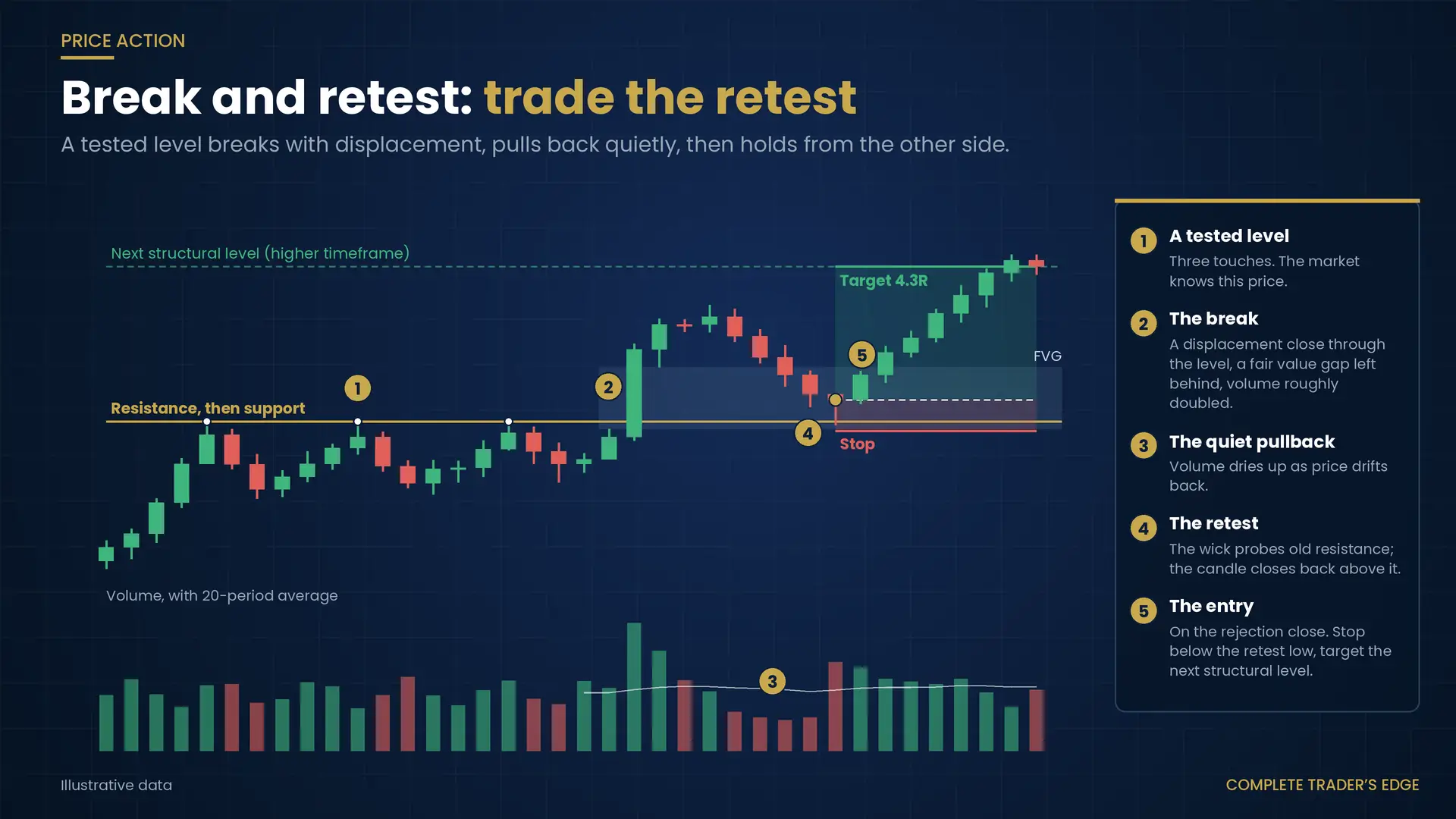
Five elements must be present for a break and retest to be a high-probability setup:
| Element | What valid looks like | What invalid looks like |
|---|---|---|
| 1. The level | Significant, well-tested support/resistance with multiple prior touches. Daily or 4H swing level, round number, Order Block boundary. | Minor intraday level with only one or two touches. Random horizontal line with no structural significance. |
| 2. The break | Impulsive candle close beyond the level with clear displacement. Ideally leaves a Fair Value Gap. Volume expands on the break. | Wick-only move that closes back inside the level. Slow, gradual grind through with no displacement candle. No FVG left. |
| 3. The pullback | Orderly, lower-volume retracement back toward the broken level. Price does not retrace more than 50% of the break candle’s range. | Aggressive, high-volume retrace that fully fills the break candle and continues through the broken level. |
| 4. The retest reaction | Clear rejection at or near the broken level. Rejection candle, wick, or lower timeframe Change of Character confirming polarity. | Price drifts through the broken level without any reaction. No confirmation of polarity change. |
| 5. HTF alignment | Break direction aligns with Daily and 4H structural bias. Price is at a logical premium or discount level. | Break opposes the higher timeframe trend. Counter-trend setups at mid-range levels. |
Two Entry Approaches
Entry 1: Limit order at the broken level
Once a valid break is confirmed, place a limit order at the broken level (or slightly inside it) before price retraces. This is the aggressive approach — you are anticipating the retest before it occurs. The advantage is optimal entry price and maximum R:R. The risk is that the retest may not occur, or may be a failed retest where the level does not hold.
When to use it: Strong HTF trend, very clean displacement break, clear FVG left on the break. The structural evidence strongly supports that the break is genuine and the level will hold as new support/resistance.
Entry 2: Wait for confirmation on the retest
Allow price to return to the broken level, then wait for a confirmation signal — a rejection candle, a lower timeframe Change of Character, or a 15-minute Order Block forming at the retest zone — before entering. This approach sacrifices some entry quality for significantly higher confirmation that the polarity has genuinely held.
When to use it: Developing traders building confidence in the pattern, setups with moderate (not strong) HTF alignment, levels that have been tested multiple times and may be more contested.
Break and Retest Through the Smart Money Lens
The break and retest pattern becomes significantly more powerful when viewed through the ICT/Smart Money framework rather than classical technical analysis. The key insight: the “broken level” in a genuine institutional break and retest is almost always an Order Block boundary, a Fair Value Gap boundary, or a volume-significant level (VAH/VAL). Classical TA draws horizontal lines at “previous highs and lows.” Smart Money analysis identifies why those levels exist and what institutional activity they represent.
This distinction matters for two reasons:
First, it helps you identify which breaks are genuine (backed by institutional order flow that created a displacement candle and left an FVG) versus fake breaks (choppy moves through a level with no institutional backing). Genuine institutional breaks almost always leave a Fair Value Gap. Fake breaks do not.
Second, it tells you exactly what the retest zone is. The retest of a broken Order Block boundary has a specific entry zone: the OB itself, now acting as support/resistance in the new direction. This is more precise than “somewhere near the broken level” — it gives you a defined entry, a defined stop, and a defined invalidation level.
Using Volume to Confirm the Setup
Volume is one of the most reliable confirmation tools for break and retest setups. The pattern produces specific volume signatures that, when present, significantly increase probability:
| Stage | Volume signature indicating genuine institutional break |
|---|---|
| The break candle | Volume expands significantly above the recent average — 1.5x to 2x or more. This confirms institutional participation drove the break, not retail speculation. |
| The pullback to retest | Volume contracts — below the 20-period average. Low-volume pullback indicates the retracement is corrective (few participants want to sell the new support), not a reversal. |
| The retest reaction | Volume expands again as price rejects the broken level. Confirms institutional buying/selling defending the new polarity. |
| The continuation | Volume remains elevated as price continues in the direction of the break, confirming trend continuation rather than a false reversal. |
When the volume signature aligns with the price action pattern, the probability of a successful continuation increases materially. When volume contradicts the pattern — high volume on the pullback, low volume on the break — treat the setup with significantly reduced confidence or skip it entirely.
Stop Placement and Target Setting
Stop loss: Below the broken level for bullish setups (specifically, below the lowest point of the retest reaction candle, or below the full OB/FVG zone that represents the retest area). If price closes back through the broken level in the wrong direction, the polarity has failed and the trade thesis is invalid.
Target: The next significant structural level. For bullish break and retests, this is the next swing high, prior resistance level, or liquidity zone above price. The Fibonacci extension from the break candle (1.272 or 1.618) provides a mathematical target to complement the structural analysis.
Minimum R:R: 1:2. The break and retest, when entered at the retest zone rather than the breakout candle, typically provides a tight entry with a logical stop just beyond the broken level — which creates the conditions for 1:3 to 1:5 R:R on strong continuation moves.
Break and Retest vs Fakeout: The Critical Distinction
The fakeout — where price breaks a level, triggers a wave of entries, then reverses sharply back through — is the break and retest trader’s primary enemy. These four signals distinguish a genuine break from a fakeout in real time:
- Displacement candle with FVG. A genuine institutional break leaves a Fair Value Gap. A fakeout typically does not — the move through the level is slow or lacks a strong impulsive candle.
- Volume on the break. Genuine breaks show volume expansion. Fakeouts often occur on thin volume, particularly outside Kill Zones.
- Session timing. Breaks occurring during Kill Zones (London or NY open) carry institutional backing. Breaks during the Asian session or dead zones are far more likely to be fakeouts.
- HTF context. If the break is against the higher timeframe trend, it is much more likely to be a fakeout (or more precisely, a liquidity sweep before the real move in the opposite direction).
Frequently Asked Questions
How long should I wait for the retest after a breakout?
There is no fixed time limit, but a retest that occurs within the same or next trading session is generally more valid than one that occurs days later. Institutional interest in defending a broken level diminishes over time as the market establishes new structure above or below it. A retest within 10 to 20 candles on the entry timeframe is ideal. A retest that arrives several days after the break on a lower timeframe setup often carries less institutional weight. For swing setups on the Daily chart, retests that occur within 3 to 5 candles (trading days) are most reliable.
What is the difference between a break and retest and a false breakout?
A false breakout (fakeout) is a move through a significant level that immediately reverses without the retest pattern developing. The distinguishing factors are primarily the break candle’s character and session timing. A genuine break shows a displacement candle with a FVG, occurs during a Kill Zone, and has volume expansion. A fakeout typically has no FVG, occurs in a low-volume session, and is often engineered as a liquidity sweep before the real move in the opposite direction. Learning to distinguish the two before committing capital is the most valuable skill in break and retest trading.
Can break and retest setups be traded on any timeframe?
Yes, but the significance of the broken level scales with the timeframe. A daily level broken and retested is a major event that can drive moves of 50 to 200+ pips or points. A 15-minute level broken and retested is relevant for intraday moves of 10 to 30 points. The setup mechanics are the same — displacement break, low-volume pullback, rejection at the retest — but the trade size, stop distance, and target all scale with the timeframe. Always use the higher timeframe to select which levels are worth watching, then use the lower timeframe for entry precision.
Should I enter on the close of the rejection candle or use a limit order?
Both approaches are valid with different trade-offs. A limit order placed at the broken level in advance gives you the best entry price but requires confidence that the retest will hold. Entering on the close of a rejection candle at the retest zone gives you confirmation but means your entry is slightly worse (a few pips/points above/below the ideal level). For developing traders, waiting for the rejection candle close provides the best learning experience because it forces you to observe whether a genuine polarity confirmation is occurring. As you develop pattern recognition, limit order entry becomes more natural.
How is the break and retest different from trading Order Blocks?
They are closely related but not identical. An Order Block is the last opposing candle before an impulsive move — the zone where institutional orders were placed. A broken level retest is the return to a structural level that has changed polarity. The overlap: when a level breaks, the area of that broken level is often also an Order Block or Breaker Block. In practice, the highest-quality break and retest setups occur when the broken level aligns with an Order Block or Breaker Block, giving you both classical technical confluence (broken support becomes resistance) and institutional order flow confirmation (the OB/Breaker zone has resting orders at that level).
▶ ▶ ▶ Continue Reading
Build the complete price action framework
The Complete Trader’s Edge
The complete price action and SMC framework is in the book
30+ Method chapters covering break and retest, Order Blocks, FVGs, Breaker Blocks, volume analysis, chart patterns, and the full blended approach that combines institutional Smart Money concepts with classical technical analysis. Available on Amazon in Kindle, paperback and full-colour editions.
 The Complete Trader's Edge
The full Mind · Method · Money framework. 70 chapters.
View on Amazon →
The Complete Trader's Edge
The full Mind · Method · Money framework. 70 chapters.
View on Amazon →
 Market Mayhem
400 years of bubbles, crashes, and the pattern that keeps repeating.
Buy on Amazon →
Market Mayhem
400 years of bubbles, crashes, and the pattern that keeps repeating.
Buy on Amazon →
 Greatest Companies
How the world's greatest companies were built — and what traders learn from them.
View on Amazon →
Greatest Companies
How the world's greatest companies were built — and what traders learn from them.
View on Amazon →
 Greatest Traders
Eighty-six lives that explain the markets — Livermore to Madoff, told with the losses left in.
View on Amazon →
Greatest Traders
Eighty-six lives that explain the markets — Livermore to Madoff, told with the losses left in.
View on Amazon →