

Consistency is what separates professional traders from the majority of retail participants. Not spectacular single months. Not a handful of home-run trades. Consistent, repeatable performance across different market conditions, through drawdown periods, and across time. This is what institutional investors pay for. This is what allows compounding to work. And it is achievable through a specific set of practices.
The six pillars below are not theoretical ideals. They are the concrete habits that every consistently profitable trader has built, often through years of trial and error. Implementing all six does not guarantee immediate profitability, but it guarantees that your performance is as good as your strategy allows, which is the foundation of improvement.
The Six Pillars at a Glance
| Pillar | What It Provides | Without It |
|---|---|---|
| 1. Tested strategy | A proven edge to execute consistently | No foundation. You are gambling. |
| 2. Written rules | Precision and accountability under pressure | Rules morph when emotions rise. |
| 3. Consistent risk | Same risk per trade removes sizing variance | One oversized trade wipes out ten disciplined ones. |
| 4. Daily routine | Structure that survives emotional and external variability | Quality fluctuates with mood, energy, and life events. |
| 5. Trading journal | Data-driven feedback loop for improvement | Repeating mistakes invisibly. No learning mechanism. |
| 6. Self-awareness | The ability to recognise and act on compromised states | Revenge trading, overtrading, emotional spirals. |
Pillar 1: A Defined, Tested Strategy
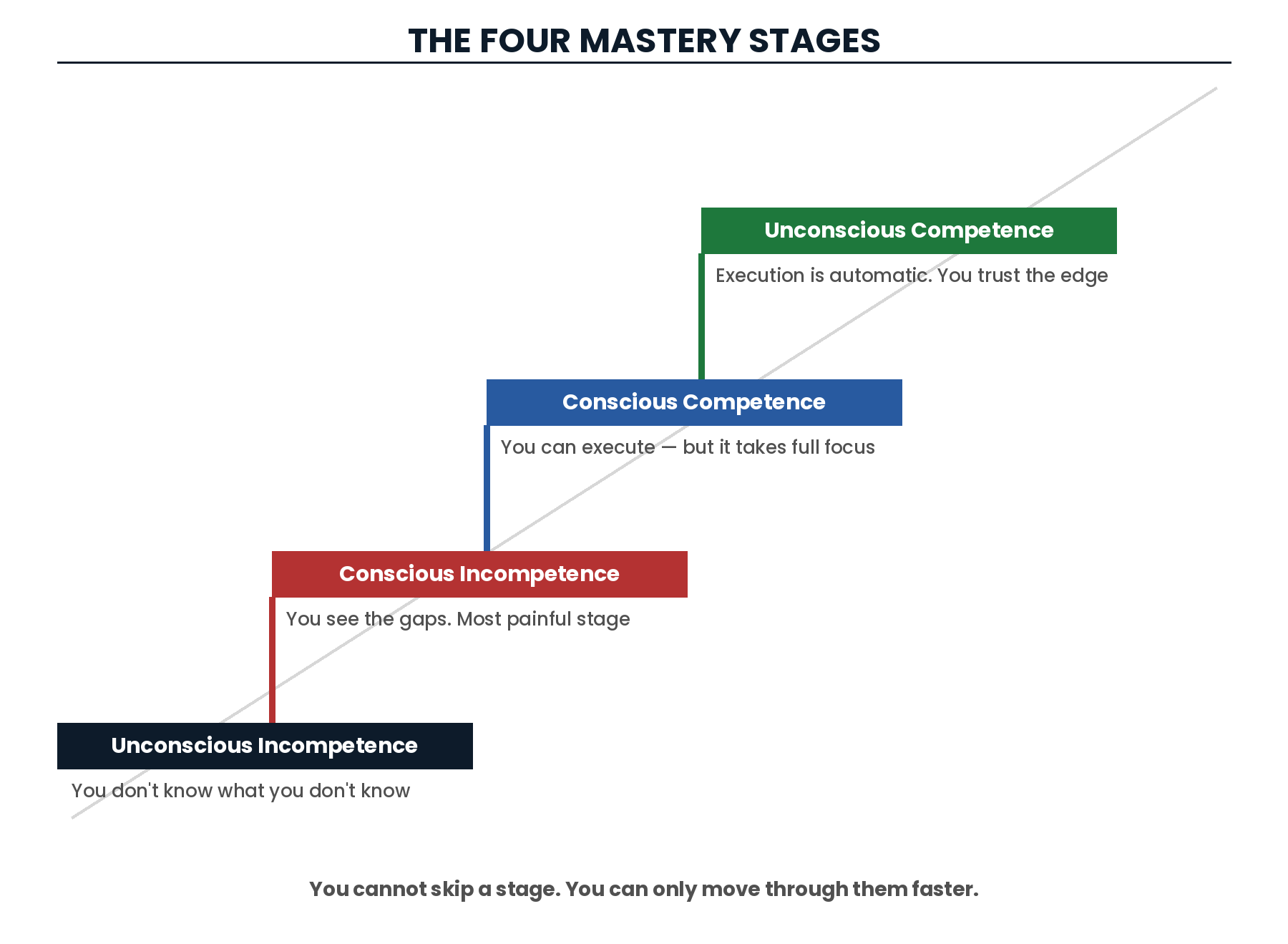
Consistency begins with a strategy that has been tested across a sufficient sample: not a collection of loosely defined preferences, but a written set of rules that specify entry criteria, stop placement, target methodology, and position sizing. You need at least 100 backtested trades and 50 forward-tested trades to have confidence that the edge is real. Without a tested strategy, there is nothing to be consistent to.
Pillar 2: Written Trading Rules
Your rules must be written. Not remembered. Not assumed. Written, reviewed before each session, and referenced when decisions need to be made. The act of writing forces precision and reveals ambiguity. Rules that exist only in your head will morph under emotional pressure: “the Order Block was close enough” becomes acceptable when it should not be.
Pillar 3: Consistent Risk Management
The same risk percentage on every trade, every session, regardless of how confident you feel. 1% risk when you are feeling great. 1% risk when you are coming off three losses. 1% risk on your “best setup ever.” Varying position size based on emotional state is one of the most reliable ways to produce inconsistent results from a consistent strategy.
Pillar 4: A Structured Daily Routine
Pre-session preparation, defined session hours, post-session review. The same process every day. Routine removes the variability introduced by mood, external circumstances, and decision fatigue. A professional trading day has three phases (pre-session, in-session, post-session) and each phase has specific tasks. The routine carries you when motivation fails.
Pillar 5: A Trading Journal
Ongoing documentation of every trade: entry rationale, emotional state, execution quality, outcome, and lessons. The journal is the feedback mechanism that drives improvement. Without it, you are repeating experience rather than learning from it. With it, every trade, win or loss, contributes data that reveals patterns, identifies weaknesses, and guides refinement.
Pillar 6: Psychological Self-Awareness
The ability to recognise when your emotional state is compromising decision quality and to act on that recognition by reducing size, stepping away, or ending the session. The most technically skilled trader will produce inconsistent results without this self-awareness. Practical implementation: rate your emotional state 1 to 5 before each trade. If you are at 4 or 5, do not trade. This simple check prevents the majority of emotional trading errors.
The Power of Compounding Consistency
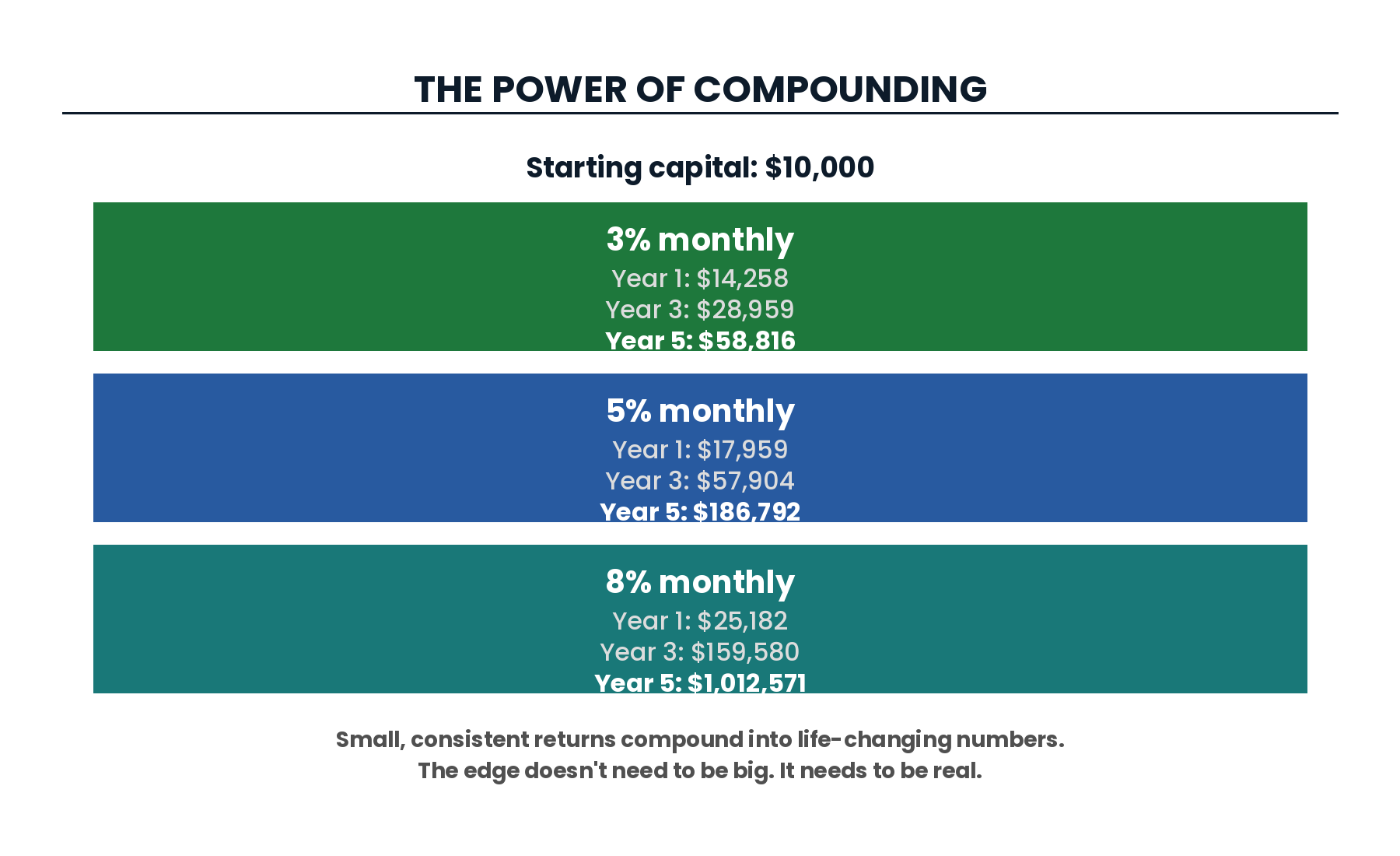
Consistency unlocks compounding. A trader who makes 2% per month consistently for 12 months grows their account by 26.8%. A trader who makes 10% one month, loses 8% the next, and averages 2% monthly but with high variance may only grow 15% over the same period because the mathematics of drawdown recovery penalise inconsistency. Consistency is not just a psychological goal. It is a mathematical advantage.
Key Lessons
- Consistency comes from six specific pillars, not talent, not luck, not a special strategy.
- Written rules are non-negotiable. Rules that exist only in memory morph under emotional pressure.
- Consistent risk sizing (1% every trade) is as important as consistent strategy execution.
- The journal is your feedback mechanism. Without it, there is no learning loop.
- Self-awareness is the failsafe: the ability to recognise and act on compromised psychological states.
- Consistency unlocks compounding. Smooth equity curves grow faster than volatile ones.
Frequently Asked Questions
How long does it take to become a consistent trader?
Most traders who eventually achieve consistency report that the transition took 2 to 4 years of serious, structured practice. The first year is typically learning and losing. The second year is testing and refining. The third year is where consistent execution begins to produce consistent results. Traders who journal, backtest, and follow all six pillars tend to reach consistency faster than those who rely on screen time alone.
Can I be consistent while still learning?
Yes. Consistency of process and consistency of results are different things. You can consistently follow your rules (process consistency) from day one, even while your strategy is still being refined. Focus on process adherence first. The results consistency follows as the strategy matures. A trader with 90% process adherence and a mediocre strategy will outperform a trader with 50% process adherence and a good strategy.
What is the biggest threat to consistency?
Emotional override. Specifically, the moments when you know what your rules say but choose to deviate because of fear, greed, or revenge. The six pillars are designed to make emotional override harder: written rules provide clarity, consistent risk removes sizing temptation, the routine provides structure, and self-awareness catches deviations before they escalate.
Should I aim for the same P&L every day?
No. Daily P&L varies naturally based on how many setups appear and whether they win. What should be consistent is your process: the same preparation, the same criteria, the same risk, the same review. Aiming for a fixed daily P&L creates pressure to force trades on quiet days and to stop trading on good days before the session is complete. Aim for consistent process. Accept variable daily outcomes.
How do I measure consistency?
Three metrics: (1) Process adherence score: percentage of trades that followed all rules. Target: 85%+. (2) Equity curve smoothness: compare your actual equity curve to a theoretical straight-line growth. Less deviation = more consistency. (3) Win rate stability: does your win rate remain within a narrow range (e.g., 50-60%) month to month, or does it swing wildly (30% one month, 70% the next)? Stable metrics indicate genuine consistency.
Continue Reading
▶ Patience: The Rarest Trading Skill
▶ The Professional Trader Mindset
From The Book
This article covers concepts from Chapter 17 of The Complete Trader’s Edge.
 The Complete Trader's Edge
The full Mind · Method · Money framework. 70 chapters.
View on Amazon →
The Complete Trader's Edge
The full Mind · Method · Money framework. 70 chapters.
View on Amazon →
 Market Mayhem
400 years of bubbles, crashes, and the pattern that keeps repeating.
Buy on Amazon →
Market Mayhem
400 years of bubbles, crashes, and the pattern that keeps repeating.
Buy on Amazon →
 Greatest Companies
How the world's greatest companies were built — and what traders learn from them.
View on Amazon →
Greatest Companies
How the world's greatest companies were built — and what traders learn from them.
View on Amazon →
 Greatest Traders
Eighty-six lives that explain the markets — Livermore to Madoff, told with the losses left in.
View on Amazon →
Greatest Traders
Eighty-six lives that explain the markets — Livermore to Madoff, told with the losses left in.
View on Amazon →