

Fear is the emotion traders talk about least and experience most. It sits behind many of the most costly trading mistakes: missing valid setups, exiting winning trades too early, sizing down so far the edge barely registers, and freezing at the moment of execution. Understanding fear in trading is not a philosophical exercise. It is a practical necessity that directly affects your P&L.
The challenge is that fear in trading is not a single emotion. It is a family of related but distinct fears, each with different triggers, different behavioural signatures, and different solutions. Treating “fear” as one undifferentiated problem is why most traders never solve it. This article breaks fear into its component parts and gives you specific protocols for each.
The Neuroscience: Why Your Brain Sabotages Your Trading
Before discussing types of fear, you need to understand why fear is so powerful in the first place. Your brain processes potential financial loss through the same neural circuitry that handles physical threats. The amygdala, the brain’s threat detection centre, fires a stress response before your prefrontal cortex (rational thinking) has time to evaluate the situation.
This is why you can know intellectually that a 1% loss is completely manageable, yet your body floods with adrenaline when you see the trade moving against you. The amygdala does not understand percentages or risk-to-reward ratios. It understands threat and non-threat. Financial loss registers as threat.
The practical implication: you cannot think your way out of fear responses in real time. By the time you feel the fear, the amygdala has already hijacked your decision-making. The solution is to build systems that make the correct decision before fear arrives, so that execution becomes automatic rather than deliberative.
The Four Types of Trading Fear
1. Fear of Loss
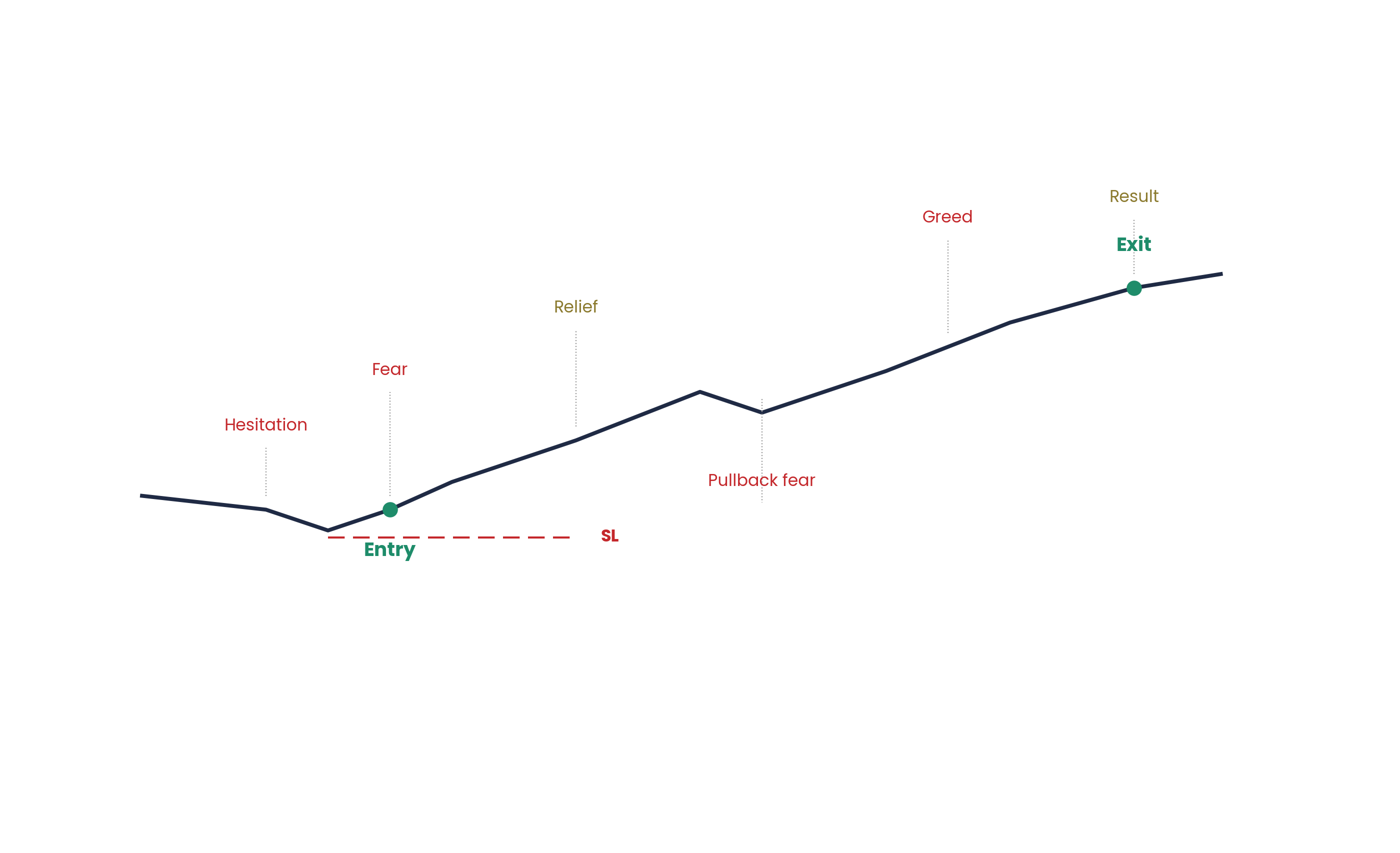
The most common form. The anticipation of financial loss triggers the same neural pathways as physical threat. This is why pulling a stop loss feels like survival behaviour even though it almost always makes things worse. Fear of loss causes traders to move stops further away (“giving the trade more room”), reduce position size to the point where winners are meaningless, or avoid entering altogether.
The paradox: avoiding loss is the fastest way to guarantee it. The trader who skips three valid setups because of fear and then enters the fourth in frustration has turned a systematic edge into an emotional gamble.
2. Fear of Missing Out (FOMO)
Paradoxically also a fear: the fear that the move will happen without you. FOMO drives late entries, overtrading, and chasing markets that have already moved. The price is running, and your brain screams that this is your only chance. It never is. Markets provide setups every single session. The setup you miss today will appear in a similar form tomorrow or next week.
FOMO is particularly dangerous because it feels like conviction. The trader experiencing FOMO believes they are making a rational decision to capture a move. They are not. They are responding to social comparison (“others are profiting and I am not”) and loss aversion applied to opportunity rather than capital.
3. Fear of Being Wrong
For many traders, particularly those with perfectionist tendencies, being wrong about a trade triggers shame and ego damage. This creates a reluctance to take valid setups that could fail. It also causes the most dangerous behaviour of all: holding losing trades to avoid the confirmation that the analysis was wrong. As long as the trade is open, the loss is not “real.” Closing it makes the failure concrete.
This fear is often rooted in identity. If you equate being wrong with being stupid or incompetent, every losing trade becomes a threat to your self-image. The fix is reframing: being wrong on individual trades is a statistical certainty, not a personal failure. Even a 60% win rate strategy is wrong 40% of the time.
4. Fear of Success
Less discussed but real. Some traders unconsciously self-sabotage when accounts grow because larger balances raise the emotional stakes and trigger a fear of losing what has been gained. A trader who feels comfortable with a $5,000 account may become anxious and reckless when the account reaches $15,000, taking outsized risks or deviating from the plan until the balance returns to the comfort zone.
This is the identity thermostat at work. The trader’s self-image includes a specific financial setpoint, and the subconscious works to maintain it.

How Fear Disguises Itself
Fear does not always announce itself. It disguises itself as rational analysis. Learning to distinguish genuine analytical caution from fear-driven hesitation is a core psychological skill.
| What It Sounds Like | Genuine Caution | Fear in Disguise |
|---|---|---|
| “I’ll wait for one more confirmation” | Setup genuinely lacks confluence; waiting improves probability | Setup meets all plan criteria but you are delaying because losing feels threatening |
| “The position size feels too big” | You calculated 1% risk and it genuinely exceeds your psychological comfort level | The size is within your plan but recent losses have made any risk feel excessive |
| “I’ll wait for a better entry” | Price has not reached your pre-defined entry zone; discipline to wait is correct | Price is at your level but you keep moving the goalposts because pulling the trigger feels scary |
| “The market looks choppy today” | Volatility is genuinely outside your strategy parameters; sitting out is correct | You are rationalising avoidance after yesterday’s losing session |
The diagnostic question that separates the two: “Does my written trading plan say I should take this trade?” If yes, and you are not taking it, fear is the reason. If your plan genuinely says the criteria are not met, caution is appropriate.
The Five-Step Protocol for Trading Through Fear
The antidote to fear in trading is not the absence of fear. It is a process robust enough that you can execute despite it.
Step 1: Reduce size until trades feel emotionally neutral. If you are trading 1% risk and every trade feels like a threat, drop to 0.25%. Trade at this level until entries and exits feel mechanical. The goal is not profit at this stage. The goal is building the neural pathway that connects seeing a setup to executing without hesitation.
Step 2: Pre-commit to every trade before the session. During your pre-session preparation, identify your levels, your setups, and your exact execution plan. Write it down. When the setup triggers, you are executing a decision you already made calmly, not making a new decision under pressure.
Step 3: Use a physical checklist at the point of entry. Before every trade, go through a printed checklist: Does this meet my entry criteria? Is my stop defined? Is my size calculated? Is the R:R minimum 1:2? If all boxes are checked, you enter. No thinking required. The checklist does the thinking for you.
Step 4: Journal the fear, not just the trade. After every session, write down what you felt before, during, and after each trade or missed trade. “I felt fear at the entry because I had two losses this morning. I hesitated for 3 candles and missed the entry.” This data is goldmust. Over weeks, patterns emerge. You discover that your fear spikes on Mondays, after news events, or after a specific number of consecutive losses. Once the pattern is visible, you can build rules around it.
Step 5: Build an evidence file. Create a document or spreadsheet that records every trade where you felt fear, executed anyway, and the trade worked. Over time, this file becomes your most powerful psychological tool. When fear strikes, review the file. The evidence of past courage producing positive outcomes counteracts the amygdala’s narrative that taking action equals danger.
Key Lessons
- Fear in trading takes multiple forms: loss, FOMO, being wrong, and success. Each requires a different response.
- The amygdala fires faster than rational thought. You cannot think your way out of fear in real time.
- Fear disguises itself as analysis and caution. The diagnostic question is whether your written plan says to take the trade.
- The antidote is a robust process (checklists, pre-session planning, reduced size), not the elimination of fear.
- Size down until trades feel emotionally neutral, then rebuild from that baseline as confidence grows.
- An evidence file of successful fear-based executions is one of the most powerful psychological tools you can build.
Frequently Asked Questions
Will fear ever go away completely?
No, and that is fine. Professional traders still experience fear. The difference is that their fear is proportional to the actual risk (a 1% loss feels like a 1% loss, not a catastrophe) and their systems execute regardless of how they feel. Fear decreases with experience and evidence, but it never disappears entirely. The goal is to make fear irrelevant to execution, not to eliminate it from your emotional repertoire.
How do I know if I need professional help with trading anxiety?
If trading fear is causing physical symptoms (sleep disruption, elevated heart rate outside of trading hours, panic attacks), affecting your relationships, or making you unable to function during sessions despite having a tested plan, consider working with a psychologist who understands performance psychology. Trading fear that extends beyond the trading session into your daily life is no longer a trading problem. It is an anxiety problem that happens to involve trading.
Is it better to trade through fear or wait until I feel confident?
Trade through it at reduced size. Waiting for confidence before trading creates a paradox: confidence comes from evidence of successful execution, but you cannot build that evidence without executing. The solution is to trade small enough that the fear is manageable, execute your plan, and let the evidence accumulate. Each correctly executed trade, win or lose, deposits confidence into your psychological account.
Does meditation or breathing help with trading fear?
Box breathing (4 seconds in, 4 hold, 4 out, 4 hold) can reduce acute stress responses and is used by military personnel in high-pressure situations. Some traders find a 5-minute breathing exercise before their session helpful for entering a calmer state. However, these techniques are supplements to a systematic approach, not replacements for it. If your fear is caused by trading too large or trading without a plan, breathing exercises will not solve the root problem.
My fear got worse after a big loss. How do I recover?
A significant loss creates a trauma response that amplifies fear on subsequent trades. The recovery protocol is: first, stop trading live for at least one week. Second, journal the loss in detail, identifying exactly what happened and what you will do differently. Third, return to demo or tiny size and trade your plan for 20 to 30 trades. The goal is to rebuild the neural association between “taking a trade” and “following a process” rather than “taking a trade” and “experiencing pain.” Once you have 20 to 30 clean executions at small size, gradually increase back to normal risk. Full guide: The Psychology of Losing.
Continue Reading
▶ Greed, Overtrading and the Dopamine Loop
▶ Revenge Trading: The Cycle That Destroys Accounts
From The Book
This article covers concepts from Chapter 6 of The Complete Trader’s Edge.
 The Complete Trader's Edge
The full Mind · Method · Money framework. 70 chapters.
View on Amazon →
The Complete Trader's Edge
The full Mind · Method · Money framework. 70 chapters.
View on Amazon →
 Market Mayhem
400 years of bubbles, crashes, and the pattern that keeps repeating.
Buy on Amazon →
Market Mayhem
400 years of bubbles, crashes, and the pattern that keeps repeating.
Buy on Amazon →
 Greatest Companies
How the world's greatest companies were built — and what traders learn from them.
View on Amazon →
Greatest Companies
How the world's greatest companies were built — and what traders learn from them.
View on Amazon →