

Scene · a possible morning, not a prediction
9:41 AM. New York.
The S&P 500 is down 7% and the orange “trading halt” banner has just appeared on Bloomberg terminals across three continents. Treasury yields are exploding higher. The CNBC anchors are talking too fast.
Inside a server rack in northern New Jersey, thousands of AI systems have just reached the same conclusion at the same microsecond.
Sell.
By 9:47 AM, liquidity is gone. By 10:03 AM, the market halts for the day. By the close, $11 trillion has vanished and nobody, not the Fed Chair, not the algorithms, not the CEOs whose companies just lost a third of their value, knows whether this is the bottom or the beginning.
And somewhere, a trader who read history carefully is calmly opening a watchlist instead of panicking.
Because crashes do not arrive from nowhere. They arrive from patterns we refuse to learn from.
This is a thought exercise, not a prediction. Nobody knows when the next crash will arrive, what will trigger it, or how deep it will run. What follows is five plausible scenarios, mapped against four hundred years of bubble history, and stress-tested with current data. The point is not to time the market. The point is to think clearly about risk before the market does the thinking for you.
While writing Market Mayhem, the same sentence kept appearing in the margins of every chapter. Tulip Mania, the South Sea Bubble, the Railway Mania, 1929, 1987, Japan, Asia, dot-com, 2008, crypto. Different centuries. Different assets. Different technologies. Same pattern.
Because humans run the show. And humans, in groups, behave the same way they did when the Dutch were trading semper augustus bulbs in 1637.
That is the room Market Mayhem describes.
From the introduction · Market Mayhem
This morning, somewhere in the world, in some specific room, a particular man is shouting a particular price across a particular table. He believes the price is reasonable. He believes the asset is real. He believes, on this point with particular confidence, that the price will continue to rise. He has been making money on this belief for several months. He does not know, yet, that he has just paid the highest price the asset will ever reach. He does not know that the man across the table from him, the one who just sold to him, is one of the people who will emerge from the next year as a survivor. He does not know that the room he is standing in has stood, in different cities and different centuries, for the past four hundred years. He does not know that the morning that is coming for him has come for everyone who has ever stood in that room. He will know, soon.
The book that follows is, in significant proportion, an attempt to ensure that the next person standing in that room is not you.
— Louw van Riet
That is the thesis of the whole book. Bubbles inflate when a credible story meets cheap money meets a generation that does not remember the last bust. They burst when the story breaks faster than the leverage can unwind. And the pattern repeats because crowd psychology does not evolve. The instruments change. The narrative changes. The human nervous system does not.
So if the pattern is timeless, why write this post at all? Because conditions in May 2026 line up against historical pre-crash setups in a way that deserves an honest look. And because one scenario, the last one in this list, breaks the pattern in a direction we have never tested before.
By the end of this article you will have a framework for thinking about systemic risk, a checklist of warning signs to watch, and a clear answer to the only question that matters when the music stops. What do you do about it?
The Three Conditions Behind Every Crash
Before getting to scenarios, remember the structure. Every major bust in Market Mayhem shares three conditions in the run-up.
Condition One: a credible story. Tulips were the new currency of social status. Railways were going to compress space and time. Dot-com firms were the future of commerce. Subprime mortgages were diversified to the point of being risk-free. AI is going to remake every industry on earth. The story does not have to be wrong. It has to be priced as if it can only be right.
Condition Two: easy credit. The Mississippi Bubble ran on John Law’s printing press. 1929 ran on margin loans of 10% down. 2008 ran on no-doc mortgages packaged into AAA bonds. The 2020s have run on a decade of zero rates followed by the largest fiscal expansion in peacetime history. Cheap money lets the story inflate beyond what fundamentals could ever justify.
Condition Three: a generation that does not remember. Crashes are forgotten in about 15 years. The traders who watched 2008 burn are now in their 40s, mostly out of the seat. The traders deploying capital today have never seen rates above 5% as a stable regime, never seen a real recession that wasn’t fixed by a Fed pivot in months, and have been rewarded every time they bought the dip. Their pattern recognition is calibrated to a market that has only ever gone up.
When all three conditions stack, the system is loaded. It does not need a big shock to crack. It needs the right pebble at the wrong time. That pebble is the trigger. The conditions are the bomb.
| Crash | The Story | The Credit | Drawdown |
|---|---|---|---|
| Tulip Mania 1637 | Tulips as status currency | Promissory note speculation | ~99% |
| 1929 Wall Street | New era of permanent prosperity | 10% margin loans | 89% |
| Japan 1989 | Asian century, “Japan Inc.” | Cross-shareholding leverage | 82% (33 years to recover) |
| Dot-com 2000 | Internet changes everything | VC funding firehose | Nasdaq 78% |
| 2008 GFC | Housing never goes down | Subprime + securitisation | S&P 57% |
| 2026 setup? | AI remakes every industry | $39T US debt + $3T private credit | ? |
Now to the five scenarios. Each one is a plausible trigger sitting on top of conditions that are already in place.
Scenario One: The Debt Spiral Snap
Historical echoes: Argentina 2001 (Corralito), Latin American Debt Crisis 1982
The day it breaks
Tuesday morning. A routine 2-year Treasury auction prints with a bid-to-cover of 1.8. The bond desks barely look up. By 2pm someone runs the same number against the rolling average and the chat rooms go quiet. Foreign indirect demand has fallen off a cliff. By the close, the 30-year yield is up 25 basis points.
Most retail investors will never hear about it. Mortgage lenders will reprice their loans before the open. By Friday the equity desks are pricing it as a regime change. By the following Monday the market has decided the buyer of last resort is now the Fed itself, and the only way to fund the deficit is to monetise it.
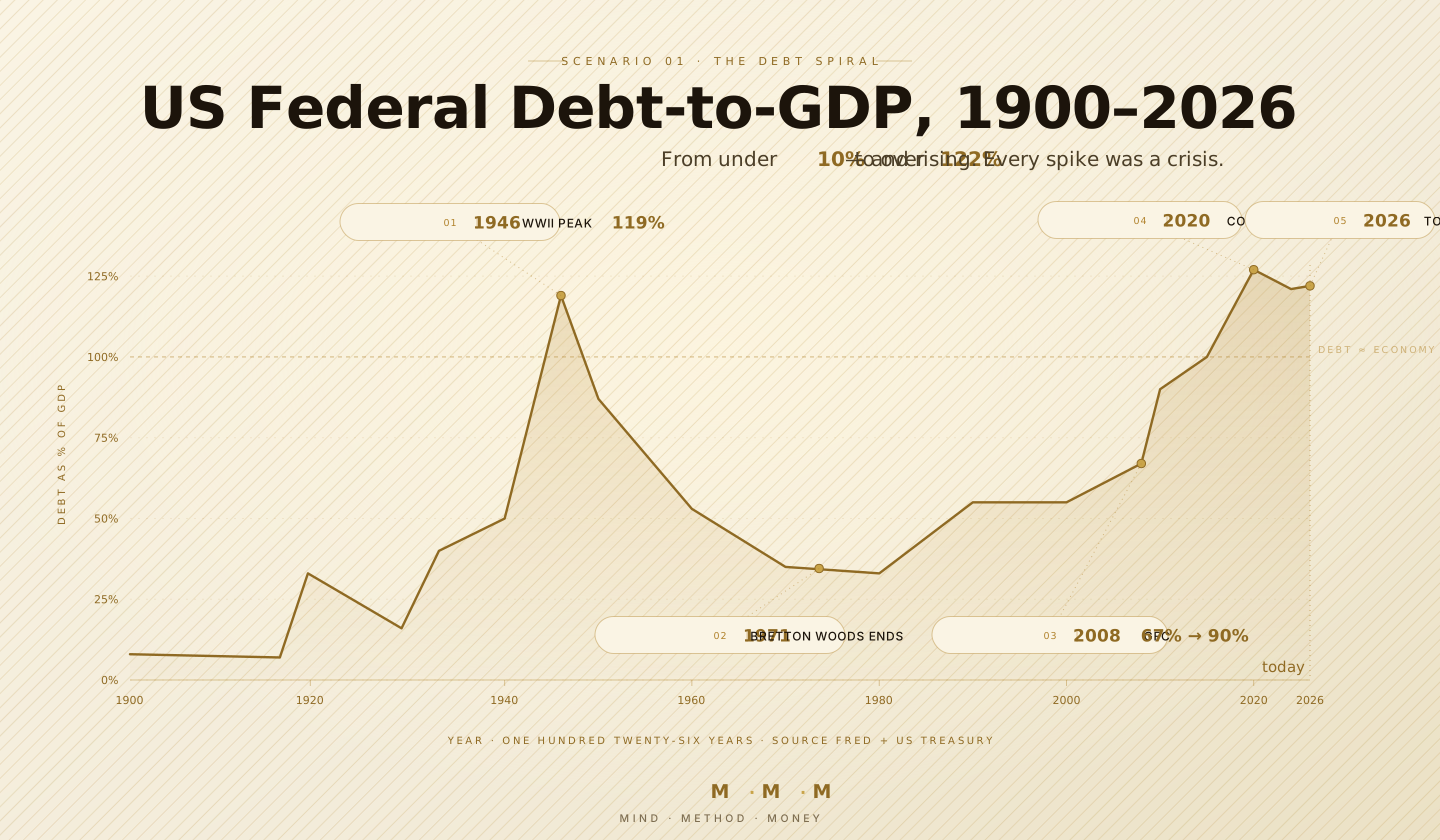
The US national debt crossed $39 trillion in early 2026. Net interest payments on the national debt are projected to exceed $1 trillion in fiscal year 2026, nearly triple the $345 billion paid in 2020. To put that in scale, in the first three months of the 2026 fiscal year alone, net interest payments reached $270 billion, already surpassing defence spending for the same period.
The Numbers That Matter
The Treasury has to issue around $2 trillion in new debt this fiscal year just to keep the lights on. For every month of the current fiscal year, the government is issuing more than $166 billion in debt, rising to roughly $181 billion a month from October.
So far, the world keeps buying it. That is the assumption every other risk in this article rests on. If that assumption breaks, everything else breaks with it.
What the snap looks like
The trigger is not a sovereign default. The US will never explicitly default. It controls the printing press. The trigger is a buyer strike.
It happens at a Treasury auction. The bid-to-cover ratio prints weak. Indirect bidders (mostly foreign central banks) step back. Primary dealers are forced to absorb a much larger share than usual. The 30-year yield jumps 40 basis points in a day. Within a week the 10-year tests 6%. Mortgage rates follow. Corporate spreads blow out. Equities don’t crash on the first auction. They crash on the third, when the market figures out the buyer of last resort is now the Fed, and the only way to fund the deficit is to monetise it.
That is the mechanism Ray Dalio has been describing for two years. The sheer supply of debt being produced by the US is colliding with a shrinking global appetite to hold it. In times of international conflict, even allies do not want to hold each other’s debt, preferring instead to move capital into hard currencies.
The endgame Dalio frames as a binary choice for policymakers: do you print money or do you let a debt crisis happen?
When governments make that choice they always pick the print. They have for 5,000 years. The cost is currency debasement, not bankruptcy. Gold goes up. The dollar’s role as world reserve erodes another notch. Real returns on bonds turn deeply negative. And the equity market reprices for a regime of higher structural rates.
What it would look like on the chart
S&P 500 down 30 to 45% over 6 to 18 months. Long-duration tech worst hit. Gold up 60 to 100%. Bitcoin behaves like a high-beta tech proxy for the first leg, then potentially decouples to the upside as a debasement play. The dollar weakens against hard assets but strengthens against other fiat currencies in the panic phase (a classic “least dirty shirt” rally before the eventual repricing).
Plausibility
The mechanism is already in motion. A series of weak Treasury auctions in March added to concerns about weakening demand for a growing supply of federal debt created by deficits. Primary dealers took 24% of a 2-year note auction in late March, roughly twice the share normally absorbed by these dealers.
The question is not whether the debt is unsustainable. The CBO, the Treasury and Bridgewater all agree it is. The question is when the market decides to price that. Markets can stay irrational longer than you can stay solvent. But every previous reserve currency in history (Dutch guilder, British pound) ended the same way. There is no reason to think the dollar is exempt. There is only reason to think it is taking longer.
Scenario Two: The Private Credit Cockroaches
Historical echoes: 2008 Financial Crisis (Lehman), Asian Financial Crisis 1997
The day it breaks
A Friday email from one of the top five private credit managers. Three sentences. Effective immediately, redemptions are suspended pending an orderly review of fund valuations. Compliance, not panic. Standard practice.
By Monday morning, two more funds have followed. By Wednesday, the regional banks that lent to those funds are getting calls from their auditors. By the following Friday, the cockroach problem has a name on the front page of the Wall Street Journal. Pension fund boards begin scheduling emergency meetings. Nobody uses the word Lehman yet. They are all thinking it.
If the debt scenario is a slow-moving inevitability, the private credit scenario is a fast-moving accident waiting for the right trigger. And the cracks are already showing.
The private credit market grew from roughly $300 billion in 2010 to nearly $3 trillion today. It exists because after 2008, banks pulled back from aggressive lending under new regulations, but demand for credit did not disappear. So the lending moved into a shadow banking system run by Blackstone, Apollo, Blue Owl, KKR, and a hundred smaller funds.
These funds raise money from pension funds, insurers, and increasingly retail investors. They lend it out, often to mid-market companies that banks would no longer touch, at yields of 9 to 12%. For years the model worked beautifully. Then rates went up.
What the cockroach hunt looks like
The cascade pattern has played out three times in history almost identically. 1907. 1929. 2008. It looks like this.
| Step | The 2008 Pattern | The 2026 Echo |
|---|---|---|
| 1 | A small lender fails (New Century) | Tricolor (auto), late 2024 |
| 2 | Fraud revealed (multiple) | First Brands collateral fraud, 2025 |
| 3 | Withdrawal pressure on funds | Blue Owl gates redemptions, Feb 2026 |
| 4 | Mark-downs cascade through senior tranches | JPM marks down software loans, March 2026 |
| 5 | Bank exposure to shadow lenders surfaces | “Double leverage” warnings, ongoing |
| 6 | Lehman moment | ??? — the trigger that hasn’t fired yet |
A small lender fails. In late 2024 it was Tricolor, a subprime auto lender. Then comes a fraud revelation. In early 2025, First Brands was caught pledging the same assets as collateral to multiple lenders simultaneously. JPMorgan’s Jamie Dimon coined the line of the cycle. “When you see one cockroach, there’s probably more.”
Then withdrawal pressure arrives. In early March 2026, JPMorgan took the unprecedented step of preemptively devaluing software-related loans in response to AI-driven valuation risks. These markdowns reduce the borrowing base for private credit funds, forcing them to deleverage at the worst possible time. Blue Owl froze redemptions on a retail fund in February 2026. Several others followed. Funds use “gates” (5% withdrawal caps per quarter) to prevent a run, but gates only delay the panic, they do not stop it.
Then the contagion. The IMF reported that 40% of private credit borrowers had negative free operating cash flow at the start of 2026. Many are alive only because lenders keep extending. When extensions stop, defaults spike. Default rates rise. Senior tranches downgrade. Funds mark down NAVs. Pension funds, who hold the senior tranches, get hit. Retail investors who bought BDCs (Business Development Companies) for the yield realise they own illiquid loans to “asset-light” software firms whose moats are being eroded by AI.
Then the banks. This is the part most people miss. Banks don’t make these loans directly anymore. They lend to the funds that make the loans. In 2008, the risk was hidden in mortgage-backed securities; in 2026, it is hidden in the “double leverage” of bank-to-fund lending.
What it would look like on the chart
This is the scenario that looks most like 2008 in chart terms. S&P 500 down 40 to 55% peak to trough over 12 to 24 months. Financials, regional banks, BDCs and private equity worst hit. Credit spreads blow out by 300 to 500 basis points. Liquidity disappears in every market that depends on it. Real estate (especially commercial) follows the credit cycle down. Eventually the Fed intervenes (rate cuts, QE, emergency facilities) and the market bottoms. The recovery is multi-year.
Plausibility
This one is already happening, just slowly. Boaz Weinstein warns of private credit’s “financial alchemy,” says problems are multiplying by the quarter. Morgan Stanley predicts a “significant” private credit shakeout on par with Covid losses. The question is whether it stays contained as a niche unwind, or whether the bank exposure turns it systemic.
The trigger to watch: a major fund (top 10 by AUM) suspending redemptions outright, not just gating them. That has not happened yet. When it does, you will know the cascade has started.
Scenario Three: The Concentration Implosion
Historical echoes: Dot-com 2000, Japan 1989, Nifty Fifty 1972
The day it breaks
A leaked OpenAI revenue report. Quarterly numbers, twenty percent below the figure that was implicit in Oracle’s $300 billion Stargate commitment. By the time the Bloomberg desk runs the story, the after-hours futures are down 3%.
Oracle gaps down 18% at the open. Nvidia follows, then Broadcom, then AMD. The S&P holds for a day because the equal-weight index barely moves. Then the index funds begin their forced selling and the gap between cap-weighted and equal-weight blows out to historic levels. Six weeks later the Nasdaq is down 40% and the financial press has rediscovered a phrase nobody used in March: Cisco 2000.
In May 2026, the Magnificent Seven represent 34.8% of the S&P 500, up from 12.5% in 2016. Add JP Morgan, Broadcom, and Berkshire Hathaway and the top 10 stocks make up almost 40% of the index, with 490 stocks making up the remaining 60%.
That is not a market. That is seven companies wearing a market as a costume.
Every Major Valuation Indicator, May 2026
The Shiller CAPE ratio sits at 40. The only other time it’s hit that mark in the last 150 years was during the heights of the tech bubble. The Buffett Indicator (market cap to GDP) is around 219%, about 2.1 standard deviations above the historical average. Buffett himself called levels above 200% “playing with fire.” Berkshire’s cash pile sits at $344 billion, up from $130 billion in 18 months.
The man who literally invented this indicator cannot find anything to buy.
What the implosion looks like
This is the scenario that requires the least imagination because we have lived it three times in living memory. 1972 Nifty Fifty. 1989 Japan. 2000 dot-com. Each one had a coherent bull thesis. Each one priced that thesis as if it could only be right.
The trigger is rarely the thesis itself collapsing. It is the realisation that the price already assumes everything goes right. In late 1999 the internet was clearly going to change everything. It did. And the Nasdaq still fell 78%. Cisco’s earnings grew over the next decade. Cisco’s stock did not.
The 2026 version has a specific accelerant: circular financing. In September 2025, Nvidia announced a $100 billion investment into OpenAI. OpenAI committed to spending US$1.4 trillion over 8 years on data centres, partnering with Nvidia to deliver 10 gigawatts of compute, with just US$13 billion in revenue. Microsoft funds Oracle which buys Nvidia which invests in OpenAI which buys compute from Microsoft. Every revenue line for one company is a capex line for another.
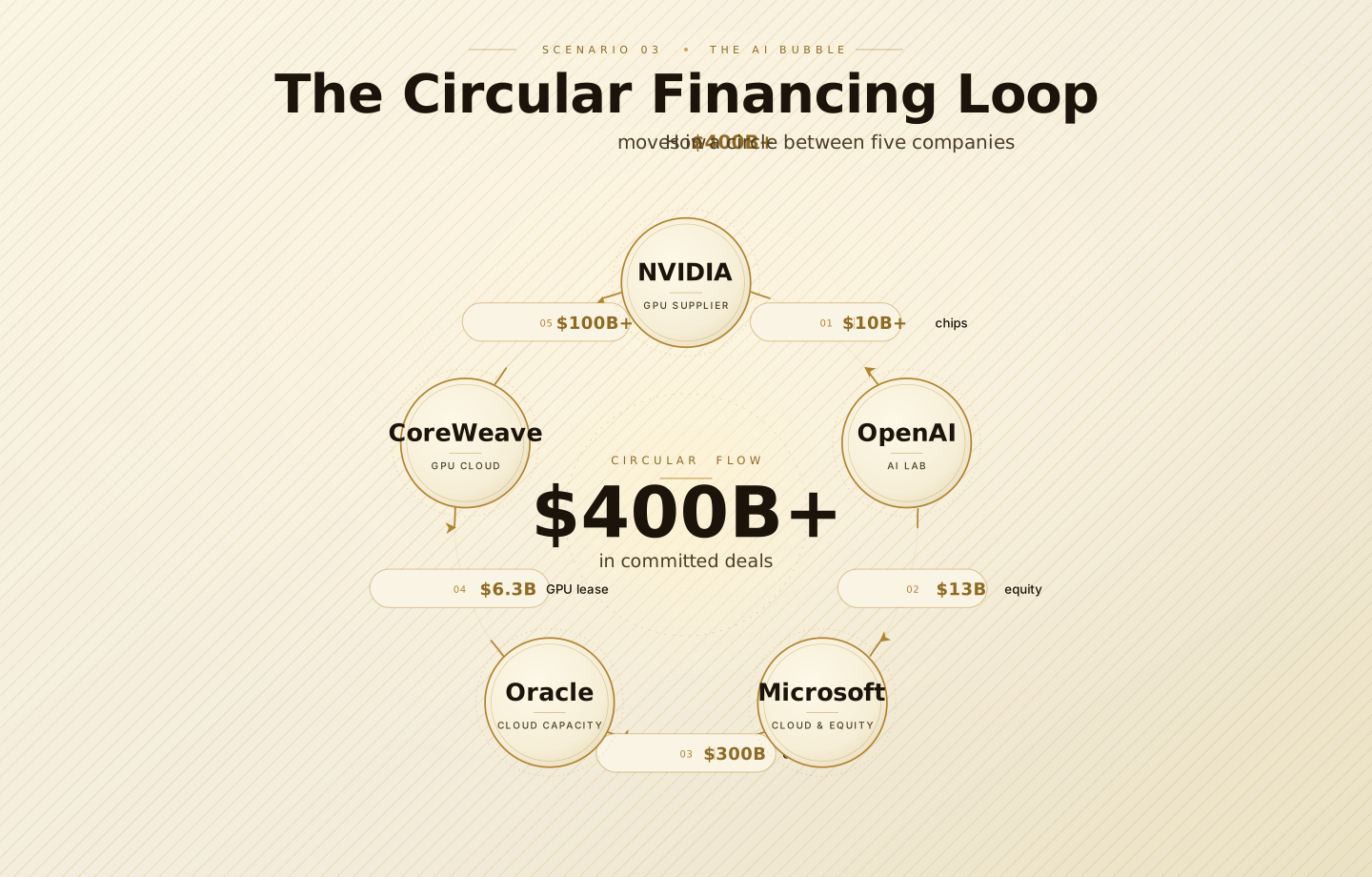
That is not necessarily fraud. It might genuinely be the build-out of a generational technology. But it is the same shape that when Larry Ellison of Oracle pushes for Stargate and a $300 billion investment in data centres for OpenAI, Nvidia is the primary supplier. At the same time, Nvidia invests $100 billion in OpenAI, in addition to owning a stake in CoreWeave, which has a cloud deal with Oracle. CoreWeave is also Microsoft’s major customer.
When circular financing meets a revenue shortfall, the unwind is brutal because every node has the same problem at the same time.
What it would look like on the chart
Nasdaq down 50 to 75% over 18 to 36 months. S&P 500 down 35 to 50%. Mag 7 worst hit, especially the names with the most circular dependencies (Nvidia, Oracle, Microsoft, anything tied to OpenAI). The “Impressive 493” (the rest of the S&P) holds up much better. They may even end the period flat or positive in nominal terms.
This is the classic “stealth bull market underneath a headline bear market” scenario. The headline index gets crushed. Equal-weight benchmarks and international markets do far better. Value beats growth for a decade.
Plausibility
This one is the most overdetermined of the five. Every valuation indicator that has ever predicted a major drawdown is flashing red. All three previous instances of the Buffett Indicator getting this stretched were followed by declines of at least 25%.
The question is not whether mean reversion happens. The question is what triggers it. Possible triggers: an OpenAI revenue miss, a Chinese model that proves the US compute premium is overpriced (DeepSeek already did this once in January 2025, wiping $600 billion from Nvidia’s market cap in a single day, setting a new loss record for publicly traded companies), an antitrust ruling, or just exhaustion of marginal buyers.
The setup is loaded. The trigger is unknown. The probability over a 24-month horizon is, in my honest assessment, the highest of any scenario on this list.
Scenario Four: The Taiwan Tail Risk
Historical echoes: Suez Crisis 1956, oil shocks of the 1970s, but at 10x scale
The day it breaks
The first headline says “temporary customs inspections.” Routine. Three weeks later, Nvidia delays shipments. Six weeks later, a Volkswagen plant in Wolfsburg idles its third shift because the dashboard chips never arrived.
By the third month the word quarantine has replaced the word inspection in every newsroom on earth. By the fourth, the markets have realised that the post-1945 globalised trade order ended on a Tuesday and nobody noticed at the time.
This is the geopolitical wildcard. Lower probability than the first three. Vastly higher impact if it happens.
TSMC, headquartered in Hsinchu, produces roughly 90% of the world’s most advanced semiconductors and 99% of the chips used to train frontier AI models. Everything in this article, the AI build-out, the Mag 7 valuations, the data centre capex, the entire forward earnings model of the US equity market, runs on chips that come out of one island, 100 miles off the coast of China.
The Single Point of Failure
In February 2023, CIA Director William Burns revealed that Xi Jinping had ordered the Chinese military to be ready to invade Taiwan by 2027. Since then, China’s coercion has shifted from sporadic brinkmanship to a steady campaign of naval maneuvers and near-daily air incursions into Taiwan’s air defense zone.
The point is not that an invasion is imminent. The point is that you do not need an invasion to crash the global economy.
What the tail risk looks like
The most likely scenario is not war. It is quarantine. Maritime and aerial quarantine is the action China is most likely to take before 2027 because such quarantine offers low mobilization costs and high yields in terms of disruption in the short term.
Picture this. China announces “customs inspections” on all shipping bound for Taiwan, citing national sovereignty. Ships start being delayed for days, then weeks. No shots fired. No declaration of war. Just a slow strangulation.
Within 30 days, TSMC’s fabs are running on stockpiled raw materials. Within 60 days they slow production. Within 90 days the global supply of advanced chips collapses. Apple cannot ship the next iPhone. Nvidia cannot ship H200s. Every car manufacturer with chips in seats and dashboards faces 2020-pandemic-style shortages, but worse, because there is no end date.
The economic shock from a serious Taiwan disruption would dwarf anything we’ve seen in the postwar period. A full halt to Taiwan’s chip exports would knock multiple percentage points off global GDP and ripple through every advanced manufacturing sector for years.
Bloomberg estimated the price tag of a full conflict at around $10 trillion, equal to about 10 percent of global GDP.
What it would look like on the chart
This is the scenario where you stop looking at percentages and start looking at structure. S&P 500 down 50%+ in a matter of weeks, not months. Limit-down sessions. Trading halts. Crude oil up 100%. Gold up 100%+. Defense stocks up. Anything dependent on Asian supply chains down catastrophically. The Taiwan dollar and Korean won unusable. Capital flight to US Treasuries (despite the debt picture in Scenario One, because in a crisis people still buy the most liquid bond on earth).
This is also the scenario where what comes after the crash is genuinely different from what came before. The post-1945 globalised trade order ends, formally, in the days after the first quarantine vessel. Every nation reshores critical supply chains. Tariff walls go up. The world enters something closer to the 1930s than the 2010s.
Ray Dalio has been warning about this transition for two years. “There is great disorder arising from being in a period in which there are no rules, might is right, and there is a clash of great powers.”
Plausibility
Over a 5-year horizon, far higher than most market participants are pricing. Over a 12-month horizon, perhaps 5 to 15% probability. The lesson of Black Swans is not that they are unlikely. It is that they are uninsurable.
The thing to watch: any unusual Chinese naval activity around the first island chain. Mass evacuation of Chinese students from US universities. PLA fuel and ammunition movements. The Munich Security Conference 2026 report titled “Under Destruction,” which claims the world has entered an era of “wrecking-ball politics.” When intelligence agencies start briefing major asset managers, the smart money moves first.
Scenario Five: The Machine Crash (This Time Is Different)
Historical echoes: None. This is new.
The cinematic open above was Scenario Five. The cold start, the seven percent gap, the New Jersey server rack reaching its conclusion at the same microsecond. That is not science fiction. It is an extrapolation of what already happened on February 11, 2026, scaled up.
I have to be careful here. “This time is different” is the most expensive sentence in finance. Every bubble repeats partly because every generation convinces itself it has built something the previous one didn’t. So this section comes with extra caveats.
But the AI scenario genuinely breaks the pattern in one specific way. And it is worth thinking about carefully.
The thesis of Market Mayhem is that crashes are driven by crowd psychology. Fear, greed, hope, panic. The crowd is human. The dynamics are predictable because the human nervous system is predictable. What if the crowd is no longer human?
The new market structure
By 2026, algorithms drive the overwhelming majority of US equity trading volume. Algorithmic trading accounts for roughly 60-75% of total trading volume in U.S. equity markets, European markets, and major Asian markets. In the U.S., algo trading grew from about 15% of equity volume in 2003 to over 70% by 2010, and has since plateaued around 70-80%.
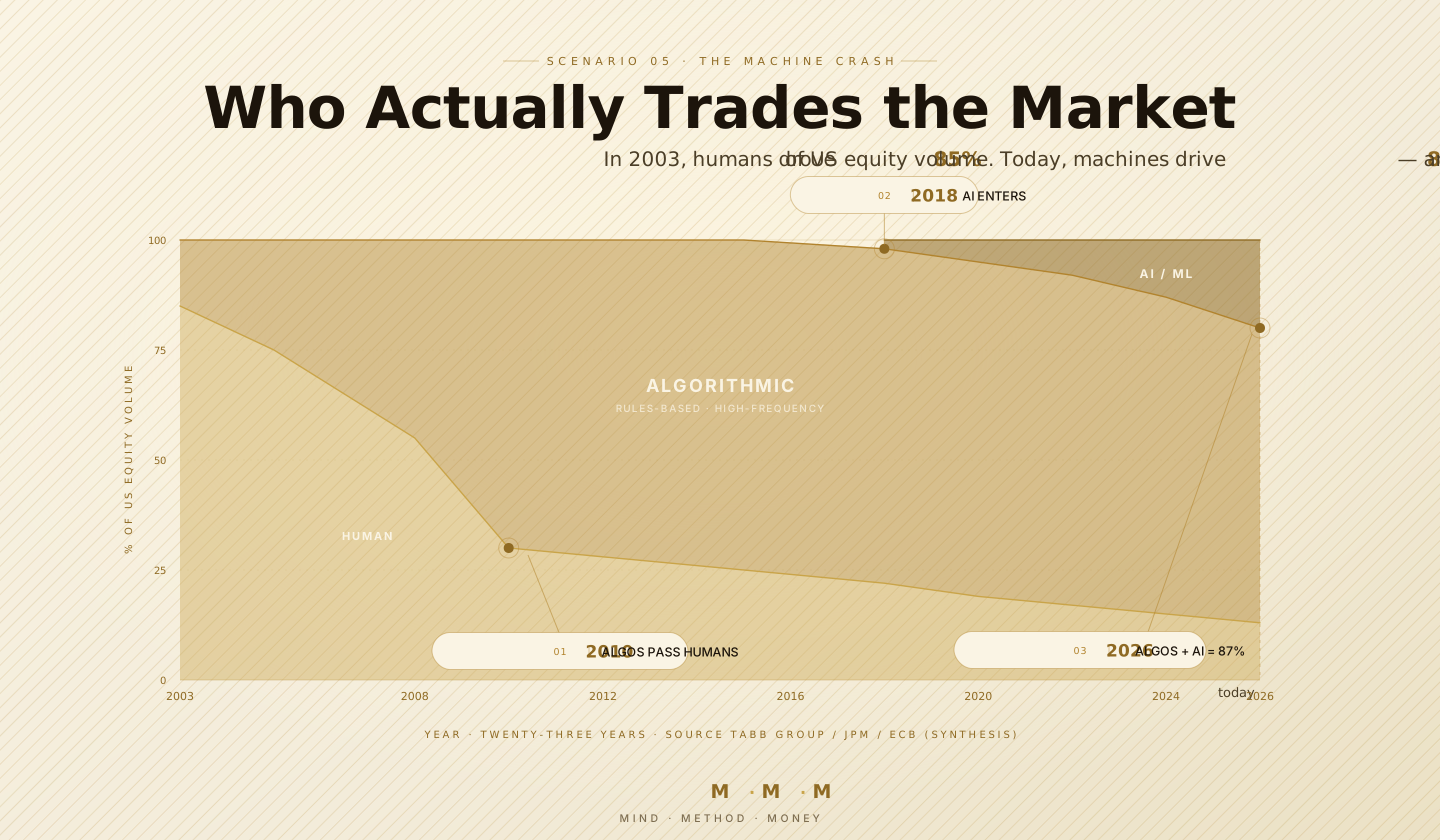
But that’s old algo. The new layer is different. AI now drives the majority of global trading volume, leveraging advanced algorithms, machine learning, neural networks and real-time data to automate trades and predict price movements.
Behind the scenes, the AI in trading market grew to $24.53 billion in 2025 and is projected to reach $40.47 billion by 2029. Goldman Sachs, JP Morgan, Citadel, Two Sigma, Renaissance, all of them are running ML models on the same data, often from the same vendors, sometimes built on the same foundation models.
Here is where it gets uncomfortable. This concentration could create a “monoculture” in the financial system, where market participants draw from the same data and employ similar models, ultimately leading them to reach similar conclusions and investment strategies. The ECB has warned specifically about its potential to distort asset prices, increase market correlations, foster herding behaviour, and even contribute to the formation of bubbles.
A March 2026 academic paper analysing 99.5 million SEC Form 13F holdings confirmed increasing portfolio convergence as AI adoption grows. Their model shows systemic risk grows superlinearly with AI penetration. Meaning the danger accelerates faster than the adoption itself.
Three things that have never happened before
Stay with me here. This is the part of the piece where I have to ask you to think about something genuinely new, and it deserves more than one paragraph.
The first: nobody understands aggregate positioning anymore. In 2008, regulators eventually figured out who held the toxic mortgage bonds. It took months, but the answer existed. In 2026, the question “who is long Nvidia at what size and at what leverage and through which vehicles?” does not have a single answerable form. Positioning is fragmented across direct holdings, ETFs, derivatives, structured notes, retirement accounts, total return swaps, and AI-managed portfolios that may themselves not be transparent to their own operators. The crowd is not just bigger and faster than before. It is, in a meaningful sense, no longer legible to any human participant.
The second: emergent behaviour. When you train AI systems on each other’s outputs, on the same financial news, on the same macroeconomic data, on the same alternative datasets, you do not get diverse strategies. You get convergence. Patterns appear in collective behaviour that no individual model was designed to produce. Some of these patterns will look like profitable strategies. They will be, until they are not. The risk is not that the models are bad. The risk is that they are good in the same way at the same time and discover their commonality only at the moment of collective de-risking.
The third: synthetic liquidity. The liquidity in modern markets is not the same kind of liquidity that existed in 1987 or 2008. A market maker is no longer a human at a phone with a Rolodex and a balance sheet. It is an algorithm that decides, in real time, whether to provide a quote based on its assessment of inventory risk and tail probability. When that assessment shifts, liquidity vanishes. Not slowly. Not gradually. Instantly. The bid you saw a microsecond ago is not the bid you can hit. The market is not a fixed thing being traded by participants. It is a thing whose existence is continuously decided by the same algorithms that are trading on it.
None of this is conspiracy. There are no bad actors here. There are highly intelligent systems built by highly intelligent people, optimising for the goals they were given, performing exactly as designed. The danger is not that something is broken. It is that something is working as intended, and the intended outcome of millions of correlated optimisations under stress is not what any individual designer would have chosen.
What the machine crash looks like
In a human-driven panic, the cascade has natural circuit breakers. Some traders freeze. Some sell. Some buy the dip. Some get on the phone with risk management. Some go home for the day. The decisions are distributed, varied, and slow. The crash takes days, weeks, sometimes months to fully play out.
In an AI-driven panic, the cascade has none of those brakes.
It looks like the 2010 Flash Crash. But across every asset, every market, every timezone, simultaneously. The trigger is some piece of data: a geopolitical shock, a bad earnings print, an outage at a major exchange. The AI systems all see the same signal at the same microsecond. They all reach the same conclusion. They all execute the same response. Algorithms respond within microseconds to price moves and risk flags. Common data feeds and shared machine-learning models create herding. When one node de-risks, correlated agents follow, draining order books.
The order books empty. Liquidity disappears. AI systems amplifying an initial shock through correlated responses, then withdrawing liquidity precisely when markets need it most.
| The Crash Mechanic | Human Market (pre-2010) | Machine Market (2026) |
|---|---|---|
| Reaction speed | Minutes to hours | Microseconds |
| Decision variance | High (1000s of opinions) | Low (correlated models) |
| Liquidity in stress | Reduced but continuous | Withdraws completely |
| Contrarian floor | Buffett, Soros, Tudor Jones | Unknown — may not exist at scale |
| Natural circuit breaker | “I’m going home for the day” | None. Machines don’t sleep |
| Recovery time | Days to weeks | Could be hours, or could be a regime change |
We have already seen the dress rehearsal. February 11–12, 2026: $3.6 trillion moved in 48 hours. Commodity Trading Advisors aren’t making judgment calls. They’re executing pattern-matching algorithms trained on decades of price data. When volatility spikes, they reduce risk automatically. When correlations break, they rebalance mechanically.
The Bank of England has warned that AI-based trading strategies could lead firms to “take increasingly correlated positions and act in a similar way during a stress, thereby amplifying shocks.”
Why this time could actually be different
Here is the uncomfortable thought experiment.
In every previous crash, the bottom was found by humans deciding the pain was over. Buffett walked into a panic and bought. Soros saw blood and bid. Druckenmiller stepped up. Tudor Jones called the low. The mechanism that ended the panic was the same mechanism that started it: human emotion. Just inverted from fear to greed.
In a fully machine-driven market, that mechanism is gone. The AIs are not afraid. They are not greedy. They are statistical engines optimising over their training data. And their training data does not contain a regime where they themselves were the dominant trader. They learned on a market that does not exist anymore.
When the regime changes, they all change strategy at the same moment, based on the same signals. The “smart money” that bought the dip in 1987, 2008, 2020 was, at the margin, humans deciding the world wasn’t ending. In the machine crash, who steps in? Who decides the world isn’t ending?
In theory, central banks. But central banks are slow. They meet. They deliberate. They issue statements. The crash will be over before the Fed Chair finishes writing the statement.
“The thing that has ended every previous panic, a sufficiently large group of humans deciding ‘this is too cheap’, may not exist anymore.”
This is what makes the scenario genuinely different. Not the speed (we know about flash crashes). Not the correlation (we know about herding). The novelty is the absence of a contrarian floor. The thing that has ended every previous panic, a sufficiently large group of humans deciding “this is too cheap,” may not exist anymore. Or it may exist but be too small relative to the machine flow to matter.
For four hundred years, markets have evolved around human psychology. For the first time in financial history, markets may be evolving beyond it. Humans become observers of a process they no longer drive. That is a quietly terrifying idea, and it is the central modern question this article is built around.
What it would look like on the chart
Imagine the 2010 Flash Crash, but it doesn’t recover by close. It deepens overnight. By the second day the S&P 500 is down 25%. By the third, 40%. Bid-ask spreads are unusable. Half the ETFs aren’t tracking their NAVs. Circuit breakers fire and reset and fire again. The market closes for an emergency session, then for a week. When it reopens, the price discovery process is rebuilt from scratch.
The eventual recovery happens. Markets are too valuable to society to leave broken. But the post-crash structure is heavily re-regulated. AI trading is throttled. Position limits are mandatory. Possibly some asset classes get a mandatory minimum holding period. The era of microsecond execution is over.
This is, to be honest, the scenario I find most plausible as a style of crash even if I cannot predict its trigger. We have built a market structure no human has ever traded through before. The first time it gets stressed in a regime change, we will find out what it actually does.
Plausibility
For a small flash event: very high over any 12-month window. Already happens regularly in pockets (crypto is the canary). For a full-scale crisis: lower, but climbing every year as more capital migrates to AI-driven strategies and as the foundation model layer concentrates further.
The thing that worries me most is not the probability. It is that the standard playbook (wait it out, buy the dip, average in over months) was built for a market structure that may not exist anymore.
The Five Scenarios at a Glance
| Scenario | 12mo Probability | Drawdown Range | Historical Echo | Trigger to Watch |
|---|---|---|---|---|
| 1. Debt Spiral Snap | Low-Medium | 30-45% | Argentina 2001 | Failed Treasury auction |
| 2. Private Credit Cockroaches | Medium | 40-55% | 2008 GFC | Top-10 fund suspends redemptions |
| 3. Concentration Implosion | High | 35-50% (S&P), 50-75% (Nasdaq) | Dot-com 2000 | OpenAI revenue miss / DeepSeek-2 |
| 4. Taiwan Tail Risk | Low (5-15%) | 50%+ in weeks | No precedent at scale | PLA mobilisation, customs “inspections” |
| 5. Machine Crash | Flash: high. Full: rising. | 25-40% in days | None | Multi-asset correlated flash |
Why Most Investors Will Miss the Warning Signs
If the conditions are this visible and the historical patterns this consistent, why does almost everyone get caught at the top? Why does the average retail account always seem to do most of its buying in the final 18 months of a bull market and most of its selling in the first six months of a bear?
The answer is psychology. The same Mind pillar that The Complete Trader’s Edge spends its first 22 chapters building. The cognitive biases that lead investors into crashes are not exotic. They are the default settings of the human brain operating under conditions of prolonged success.
The top of every bull market looks exactly like the middle
This is the cruellest pattern of all. Charts look strongest right before they break. Earnings look healthiest right before they roll over. Sentiment surveys hit euphoria right before sentiment collapses. The reason crashes are not predicted is that the data points that would predict them are also the data points that, in a healthy bull market, would mean “buy.”
It is only in hindsight that a 35 P/E looks obvious. In real time, it looks justified by exceptional earnings growth, by the AI revolution, by structural changes in how businesses generate cash flow. Every previous bull market had its version of these arguments. Every one of them turned out to be partially true and entirely insufficient.
Recency bias is the cognitive killer
Human beings extrapolate the recent past forward, full stop. After a decade of bull market, the brain genuinely cannot picture a decade of sideways. After six years of every dip being bought within weeks, the brain cannot model a dip that is bought after months. After the entire investing career of most traders under 40 has involved “central banks always save the market,” the brain cannot model a regime in which they do not, or in which they try and fail.
This is not stupidity. It is how the human nervous system handles probability. The longer a condition persists, the more we treat it as permanent. The pre-crash investor isn’t ignoring risk. They have built a model of the world in which the risk has been engineered away.
Liquidity feels infinite right before it disappears
One of the eeriest patterns in every financial history is how participants describe market conditions right before the break. They feel calm. Spreads are tight. Execution is easy. The fund manager who tried to exit a position the day before the 2008 panic could probably get out in size with one phone call. The same fund manager trying to exit the day after could not get a bid at any price.
The transition is not gradual. Liquidity is a confidence phenomenon. As long as everyone believes other people will be there to take the other side of the trade, they are. The moment that belief breaks, the bid stack vanishes and nobody is at the desk. The market does not lose liquidity slowly. It loses it all at once, the way a dam doesn’t leak before it bursts.
Passive investing and buy-the-dip have been conditioned
For 15 years, every dip has been a buying opportunity. The reflex is now automatic. The 401(k) contribution does not pause when the market rolls over. The dollar-cost average does not stop in March 2009 or March 2020. This has been wonderful for accumulation over that period. It also means that the muscle memory of an entire generation of investors is calibrated for a regime where the dip is always bought.
In a real bear market that lasts more than 18 months, that conditioning becomes the source of the pain. People keep buying as their portfolios bleed. They do not panic at the bottom. They panic three years into a flat market, when the cumulative damage has hollowed out their retirement plan, and they capitulate just before the cycle turns. This is the Japan playbook. It is also the playbook for any post-bubble correction that takes longer than the average attention span.
Media reinforcement is a feedback loop
Financial media is in the business of selling stories that match the current tape. In a bull market, the stories are about ten-baggers, about visionary founders, about the next AI breakthrough. In a bear market, the stories are about the brilliant short sellers, about the systemic flaws, about the unsustainability that “everyone” should have seen.
The stories are not predictions. They are explanations of what already happened. By the time the bear market narrative dominates the headlines, the easy money on the short side is already gone. By the time the bull market narrative dominates, the easy money on the long side is already gone. The investor who reads the news for direction is always one step behind.
None of this is solvable by being smarter. The solution is the Mind pillar. Pre-written rules. Mechanical actions at pre-defined trigger levels. A process that runs whether or not the news, the chart, or your own gut is telling you to deviate from it. That is the whole point.
The Dalio Framework: How These Scenarios Connect
Ray Dalio’s Changing World Order gives us a way to see these five scenarios as facets of a single larger transition rather than five independent risks.
Dalio identifies five forces driving what he calls the Big Cycle. Monetary orders, political orders, and geopolitical orders rise, evolve, and collapse in a repeating pattern. Typically lasting about 75 years, give or take about 30. The times ahead will be radically different from what most people have gotten used to. They will be more like the tumultuous pre-1945 era than what we have experienced since the end of World War II.
His five forces, applied to the scenarios above:
- The debt/money cycle (Scenario One). Reserve currencies always end the same way. The Dutch did. The British did. The US is in the late stage of the same arc.
- The internal order cycle (underlies Scenarios Two and Three). Wealth gaps at 1929 levels. Political polarisation. Loss of trust in institutions. These breed the policy environment in which financial accidents become crises.
- The external order cycle (Scenario Four). A rising power challenges a declining one. Always.
- Nature (acts of God, pandemics, climate). Outside this article’s scope but a known wildcard.
- Technology (Scenario Five). The wildcard that could shorten every other cycle by a decade.
Dalio thinks the US is now in Stage 5, the pre-breakdown phase characterized by bad financial conditions and internal conflict. Some of his more recent writing suggests he believes the transition to Stage 6 has begun.
You don’t have to agree with his framing to take the structural point. The convergence of multiple large cycles, all reaching late stages at the same time, is what produces moments like the 1930s and 1940s. Not one crash. A whole regime change.
How to Prepare: The Mind · Method · Money Triangle
This is the only part of the article that genuinely matters. Predicting the crash is intellectual exercise. Preparing for it is what actually changes outcomes.
The framework is the same one in The Complete Trader’s Edge. Three legs. Each one has to be in place.
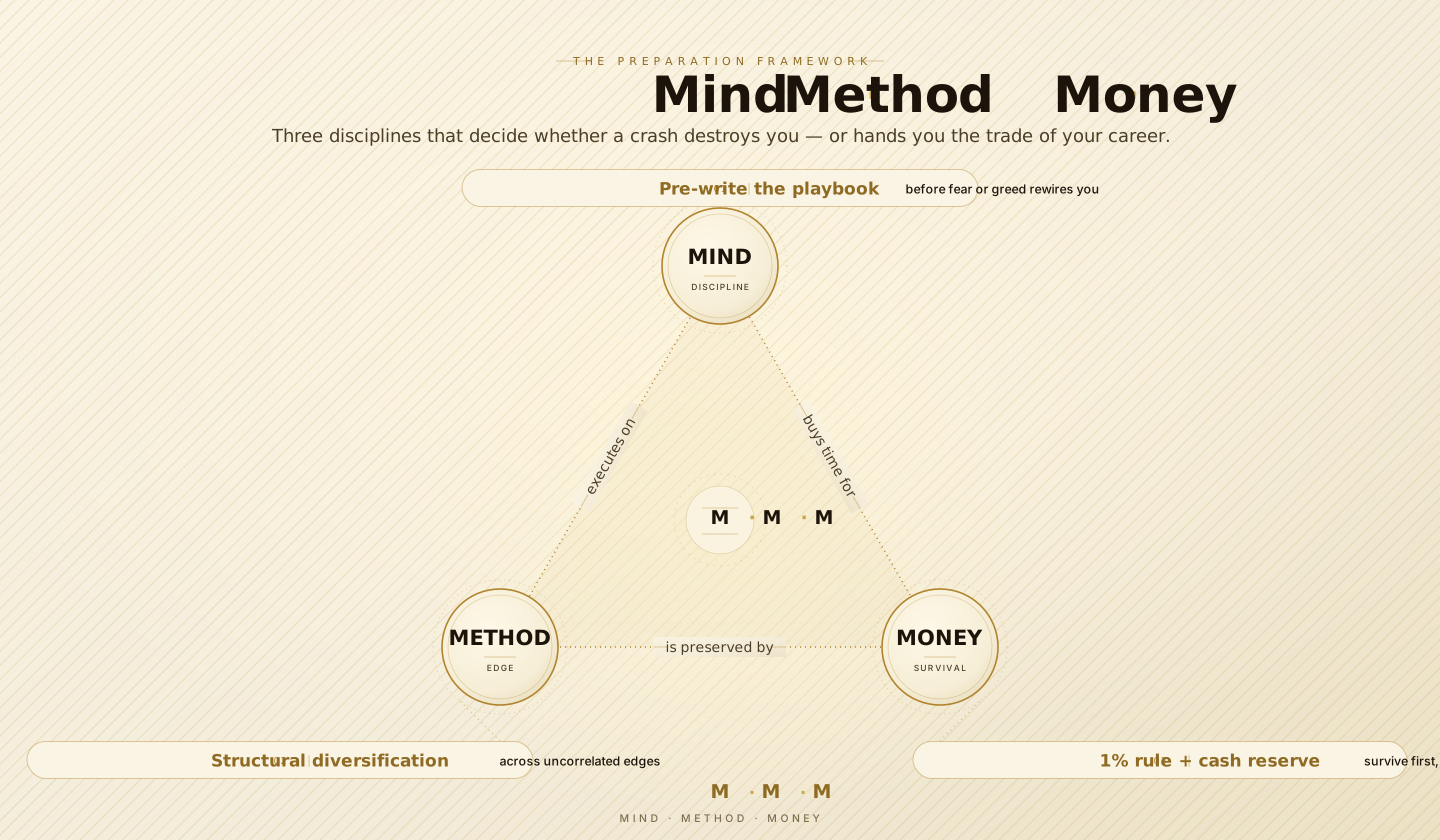
Mind
The most expensive mistake in every crash is not the crash itself. It is the decisions made during the crash by people who never thought about what they would do. They sell at the low because they cannot stand the pain. They average down on positions they don’t understand. They take leverage they cannot service. They abandon a strategy that was working because it stopped working for three months.
Decide now, in writing, what you will do at each point. Not in vague terms. In specific terms. If the S&P is down 25%, what do you do? If down 40%? If down 60%? What is your plan if your largest position drops 70%? If your income is interrupted?
You will not think clearly when the moment arrives. You will think clearly now. Write the playbook now. Read it again in eight months.
The Mind work for crashes is the Mind work for everything else, just intensified. Probability mindset. Pre-acceptance of loss. Process over outcome. The same things covered in Chapters 1 through 22 of the book apply at every scale, including the scale of “the whole market just lost half its value.”
Method
Diversification is more than asset allocation. It is structural.
- Geographic. US-only portfolios are the most concentrated bet most investors don’t realise they’re making. Add international developed, add emerging, accept the lower returns for the optionality.
- Asset class. Equities. Bonds (carefully). Gold. Cash. Real assets. A small position in Bitcoin if you can stomach the volatility, sized so you don’t care about the moves.
- Factor. Equal-weight indexes versus market-cap indexes. Value versus growth. Quality versus momentum.
- Time. Dollar-cost averaging is unsexy and works. Lump sums into all-time highs feel smart until they don’t.
The point is not to predict which scenario plays out. The point is to be approximately right in many scenarios rather than perfectly right in one.
If you are an active trader (the audience this site serves), the Method discipline is even more concrete. Define your loss limit per trade. Define your daily loss limit. Define your weekly drawdown limit. Define what happens when you breach each one. The drawdown protocol in Chapter 65 of the book is the operating manual.
Money
Position sizing is the only edge that survives a regime change. Every other edge can be wrong for years at a time. Position sizing applied correctly cannot bankrupt you, no matter how wrong you are.
The 1% rule (never risk more than 1% of account on a single trade) sounds restrictive in a bull market. It is the entire reason traders survive what is coming, whatever is coming. You can be wrong 20 times in a row and still have 80% of your capital. From 80% you can recover. From 20% you cannot.
Drawdown management isn’t a technical question. It is a survival question. If your strategy is supposed to have a maximum drawdown of 15% and it’s hitting 25%, the strategy isn’t working in this regime. Sit out. Reduce size. Wait. The market will be there next year.
And carry enough cash that a 50% market drawdown is an opportunity, not an emergency. The people who got rich in 2009 were the ones who had cash in 2008. The people who got rich in 2020 had cash in February 2020. Liquidity at the bottom is the rarest and most valuable thing in finance.
The Warning Signs Watchlist
Bookmark this section. Come back to it once a quarter. None of these signals is sufficient on its own. Several of them firing at once is the cluster that historically precedes a major drawdown. None of them give you the date. All of them give you the setup.
⚠️ Debt cycle signals
- Treasury auction bid-to-cover falls below 2.2 on a 10-year or 30-year
- Indirect bidder share (foreign central banks) drops materially quarter over quarter
- Term premium on the 10-year turns sharply positive after years near zero
- Major foreign holder publicly announces a reduction in US Treasury holdings
⚠️ Private credit signals
- A top-10 private credit fund (by AUM) suspends redemptions outright, not just gates them
- BDC discount-to-NAV widens past 20% across the sector
- CLO spreads widen by 200+ basis points in a quarter
- A regional bank takes a material write-down on its private credit fund exposure
⚠️ Concentration / valuation signals
- A Mag 7 name misses earnings or guidance materially and the others fail to rotate up
- Equal-weight S&P 500 begins consistently outperforming the cap-weighted index
- Buffett Indicator pushes past 230% (currently 219%)
- OpenAI, Anthropic or a major customer announces a guidance cut or revenue restatement
⚠️ Geopolitical signals
- Unusual PLA fuel or ammunition movements toward southeastern coast
- Mass evacuation of Chinese nationals from US universities or research facilities
- Any “customs inspection” announcement targeting Taiwan-bound shipping
- Major US asset manager publicly reduces exposure to Asian supply chains
⚠️ Machine market signals
- Multi-asset flash crash event of more than 5% in under an hour with no clear human trigger
- Major ETF temporarily detaches from underlying NAV by more than 2%
- Synchronised de-risking across uncorrelated asset classes (stocks down, bonds down, gold down)
- VIX floor structurally shifts higher (currently 17-19) without a corresponding equity drawdown
You don’t need to track all of these every day. You need to know what they look like so that when one or two fire and a third appears on the financial news, you recognise the shape rather than discovering it for the first time in the middle of a drawdown.
What Comes After
Crashes are not the end. They are the reset.
The post-2008 world looked nothing like the pre-2008 world. Banking was permanently re-regulated. Monetary policy was permanently different. The valuation regime for tech was rebuilt around free cash flow generators. A generation that grew up watching parents lose homes became extremely cautious savers and obsessive index investors.
The post-1929 world was even more different. The entire structure of regulated finance, the SEC, Glass-Steagall, the Federal Deposit Insurance Corporation, the very idea that retail investors should be protected from predatory practices, was built in the rubble of one crash. The 1950s and 1960s were among the most prosperous decades in human history, and they happened because the 1930s broke the system badly enough that it had to be rebuilt better.
What if there is no soft landing this time
Worth confronting directly. The dominant assumption among investors under 50 is that the Fed will always pivot, liquidity will always return, and any drawdown of meaningful size will be met with intervention that bottoms the market within months. This belief has been correct, repeatedly, for fifteen years. It is also a belief, not a law.
Japan 1989 was not bailed out. The Nikkei took 33 years to make a new high. The post-2000 Nasdaq took 15 years to recover its peak. The post-1929 Dow took 25. In a debt-cycle late stage, the policy options that worked in 2008 and 2020 may not be available. Cutting rates when inflation is already structural simply weakens the currency. Quantitative easing when foreign buyers are walking away accelerates the buyer strike. The same playbook that saved the system three times in a row may, the fourth time, make the problem worse.
This does not mean the crash never ends. It means the recovery may look more like 1973-1982 than like 2009-2010. Sideways for a decade. Real returns negative. Bonds and equities both weak. The only assets that work are the boring ones: cash, hard assets, productive businesses bought at sane prices. Plan as if the soft landing might not arrive, and you have a strategy that still works if it does.
Where the next legends are made
Whatever the next crash looks like, it ends with a rebuild. The companies that survive will be stronger. The valuations after the dust settles will be the lowest in a generation. The people who deployed capital in late 2008, early 2009, March 2020, are now the wealthy ones. The people who panicked are the ones who didn’t recover.
That is the practical case for the Mind · Method · Money framework. It is not just defensive. It is what positions you to be a buyer when everyone else is a seller. The framework doesn’t help you predict the next crash. It helps you survive it, and then profit from the aftermath. Those are different skills, and the second is the harder one.
“Bull markets are made in bear markets. Always have been.”
Bull markets are made in bear markets. The Hunt brothers cornered silver after 1929 crushed the rich families that came before them. Buffett built Berkshire on opportunities other people couldn’t bring themselves to take. Tudor Jones called the top in 1987 and made the trade of his career. Soros broke the Bank of England in 1992. Druckenmiller bought the bottom of 2008. Every legendary trade in Greatest Traders happened either in the chaos of a crash or because someone saw one coming.
The pattern, one more time
Somewhere in the future, people will look back at this era the way we look back at 1929, or 1999, or 2007. They will say the warning signs were obvious. They always do. In 1929 the warning was leverage. In 2000 it was valuation. In 2008 it was debt and securitisation. In this cycle the warning may be concentration, or AI, or sovereign debt, or geopolitics, or all of them at once.
But the pattern underneath never changes. Human beings build systems that convince themselves risk has disappeared, right before risk returns. They tell themselves this time is different, right before discovering it is the same. They mistake the absence of recent pain for the absence of future pain. And then a Tuesday morning arrives, and the auction prints weak, or the fund suspends redemptions, or the chips stop shipping, or the server rack in New Jersey reaches its conclusion, and four hundred years of crowd psychology arrives at its appointment.
The next crash will create panic. It will also create fortunes. It always does. The only question is which side of the trade you are on when it arrives.
The pattern repeats because humans repeat. The reader of this article does not have to.
Frequently Asked Questions
Is a market crash coming in 2026 or 2027?
Nobody knows. Anyone telling you they know the date is selling something. What we can say with high confidence is that valuations are at historic extremes, debt levels are at record highs, market concentration is near record levels, and the structural conditions that have preceded every major crash for 400 years are all present. The trigger is unknowable. The setup is observable.
What is the biggest risk facing markets right now?
Honestly, the AI capex circularity combined with extreme concentration in the top 10 stocks. That single dynamic, if it unwinds, would account for most of the downside in any of the first three scenarios. The other scenarios (Taiwan, machine crash) are lower probability but higher impact.
Will AI cause a market crash?
AI is not a single risk, it is several at once. There is bubble risk in the valuations of AI companies and the circular capex among them. There is systemic risk from AI-driven trading models converging on similar strategies and exiting at the same moment under stress. And there is structural risk that the absence of human contrarian buyers in a machine-dominated market removes the natural floor that has ended every previous panic. Any one of these is enough to amplify a normal correction into a more serious event. The combination is novel.
How should I prepare for a possible market crash?
Start with the Mind work. Write down exactly what you will do at different levels of drawdown. Then diversify across geographies, asset classes, and factors. Then size positions so you can survive being wrong for an extended period. The 1% risk-per-trade rule from The Complete Trader’s Edge applies whether the market is going up or down.
Why is AI in trading a potential systemic risk?
Because too many traders, especially institutional ones, are using similar models trained on similar data drawing similar conclusions. In normal markets this looks like efficiency. In a stress event it produces correlated selling at machine speed with no human circuit breaker. The 2010 Flash Crash is the proof of concept. The next version will be larger.
Did Ray Dalio predict the next market crash?
Dalio does not predict specific crashes. He describes structural cycles that, when they reach late stages simultaneously, tend to produce regime changes. His current view is that the US is in the late stage of multiple cycles at once, which historically has been the setup for events like 1929 to 1945. He published this thesis in Principles for Dealing with the Changing World Order in 2021.
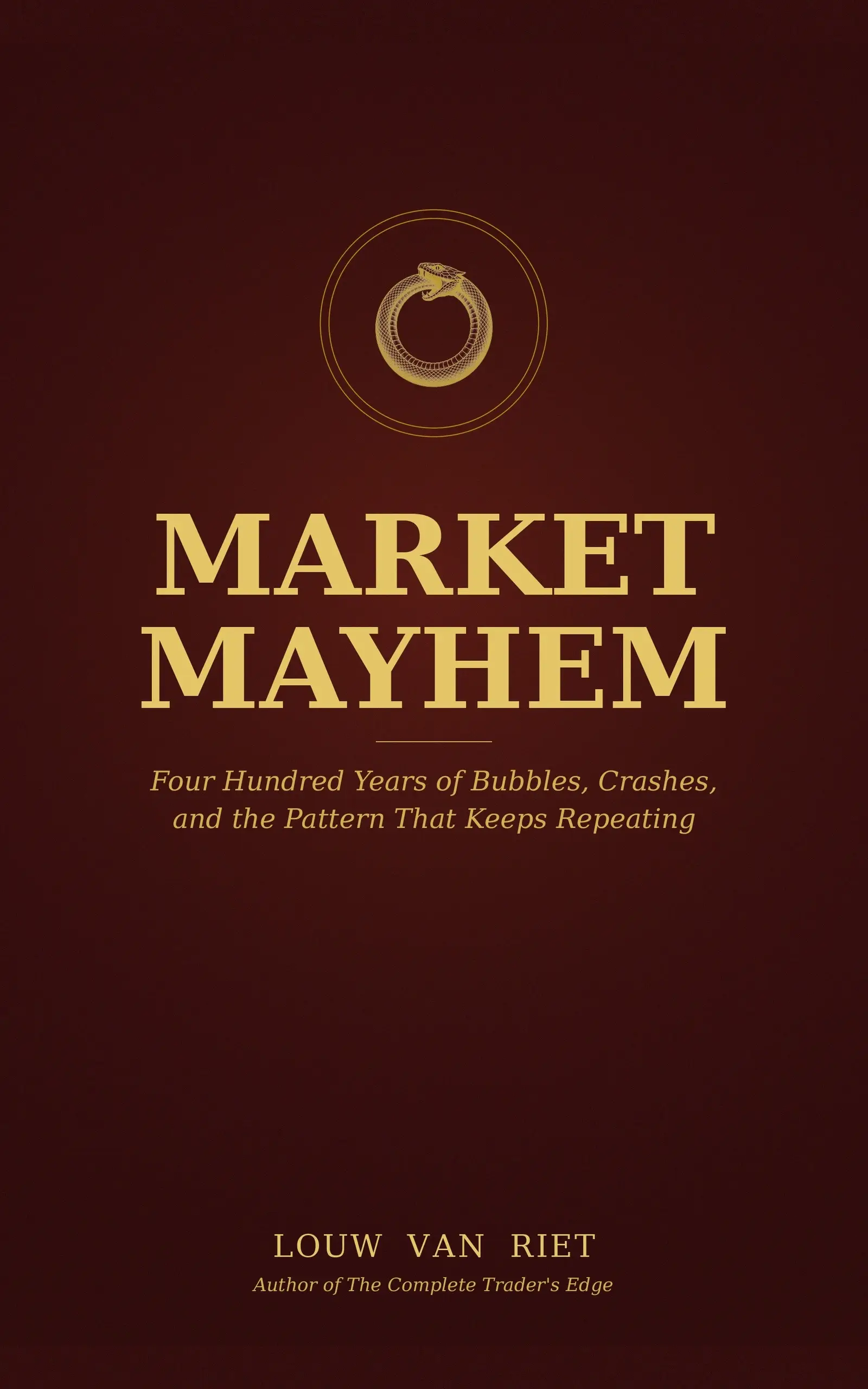
The book that built this article. Market Mayhem.
Four hundred years of bubbles, crashes, and the pattern that keeps repeating. From Tulip Mania to the FTX collapse, all twenty-two disasters in the book follow the same blueprint, applied through the Mind · Method · Money lens.
 The Complete Trader's Edge
The full Mind · Method · Money framework. 70 chapters.
View on Amazon →
The Complete Trader's Edge
The full Mind · Method · Money framework. 70 chapters.
View on Amazon →
 Market Mayhem
400 years of bubbles, crashes, and the pattern that keeps repeating.
Buy on Amazon →
Market Mayhem
400 years of bubbles, crashes, and the pattern that keeps repeating.
Buy on Amazon →
 Greatest Companies
How the world's greatest companies were built — and what traders learn from them.
View on Amazon →
Greatest Companies
How the world's greatest companies were built — and what traders learn from them.
View on Amazon →
 Greatest Traders
Eighty-six lives that explain the markets — Livermore to Madoff, told with the losses left in.
View on Amazon →
Greatest Traders
Eighty-six lives that explain the markets — Livermore to Madoff, told with the losses left in.
View on Amazon →