
There is a book by Dan Sullivan and Dr. Benjamin Hardy with a title that reads like a typo: 10x Is Easier Than 2x. The claim is that growing your results tenfold is actually easier than doubling them, because 2x lets you keep doing everything you already do, just more of it. 10x forces you to throw most of it away and become a fundamentally different operator.
Sit with that for a second, because it might be the most valuable sentence a stuck trader ever reads.
Most traders are trying to 2x. More screens. More indicators. More setups. More markets. More hours in the chair. And most of them stay exactly where they are, or slowly bleed out. If you want to know why most traders fail, this is the quiet reason underneath all the others: they are trying to grind their way to results the market only hands to a different kind of trader.
The ones who actually change gears, who go from breakeven to serious, do not add. They subtract. This is the story of how the greatest market operators in history 10x’d their results by doing less, what the seventy-plus legends we have profiled all quietly share, and how you can steal the blueprint.
Why 2x is the trap that keeps traders stuck
The 2x mindset feels responsible. Results are flat, so you work harder. You add a third indicator to confirm the first two. You watch four markets instead of one so you never “miss” a move. You take the B-grade setup because the A-grade one did not show up today and you cannot bear to do nothing.
Every one of those additions feels like progress. Every one of them is quietly making you worse. More inputs means more decisions, and more decisions under pressure means decision fatigue. That is the road to analysis paralysis, where you have so many reasons to act and not act that you freeze, or click out of sheer discomfort. It is also the engine of overtrading, the dopamine loop that turns a strategy into a slot machine.
The 2x trader is busy. The 10x trader is selective. That is the entire difference, and it is enormous.
THE 2x TRAP
Do more of everything. More indicators, more setups, more markets, more hours. Confuse activity with edge. Stay chained to the 80% of behaviour that produces almost none of your profit, because cutting it feels like giving up.
THE 10x MOVE
Find the 20% of what you do that produces 80% of your results, then apply the same lens again to that 20%. One market. One edge. Fewer, higher-conviction trades. Ruthless risk rules. Then delete the rest without apology.
The 10x rule applied to your trading results
The heart of Sullivan and Hardy’s book is that 10x is a subtraction game disguised as a growth goal. You do not get to ten times the outcome by doing ten times the work. You get there by identifying the vital few things that actually move your number and letting go of everything else, including things that are comfortable, familiar, and even mildly profitable.
For a trader, the exercise is brutally concrete. Pull your last hundred trades. You will almost always find that a small cluster of setups, in one or two sessions, on one or two instruments, produced the vast majority of your green. The rest is noise, boredom, and ego dressed up as opportunity. To 10x your trading results, you protect and multiply that vital cluster, and you fire everything else.
That is the whole game. Now let us break down the arenas where the work actually happens, because a great trader is built across four of them at once.
The four arenas of a 10x trader
A complete trader is not just a chart reader. They are an integration of four things: a stable mind, a defined method, an unbreakable relationship with money, and a body that can carry the load. Our entire teaching philosophy, the Mind, Method, Money framework, exists because most traders obsess over one arena and neglect the other three. The 10x leap comes from raising the floor on all four.
Here is the same idea as a scorecard. Read the middle column and you will recognise the trader you are on your worst days. Read the right column and you will see the one the market actually pays.
| Arena | The 2x trader (adds) | The 10x trader (subtracts) |
|---|---|---|
| Mind | Chases certainty, needs each trade to be right, trades to feel busy. | Thinks in probabilities, stays neutral on any one trade, waits without flinching. |
| Method | Ten indicators, five markets, a new strategy every month. | One tested edge, one market, executed until it is boring. |
| Money | Sizes by emotion, moves stops, doubles down to get even. | Fixed 1% risk, 1:2 minimum, a written drawdown protocol, no exceptions. |
| Body & mind | Under-slept, over-caffeinated, glued to the screen for hours. | Rested, regulated, runs the same calm pre-session routine daily. |
Mind: master the inner game so you can do less
Psychology is arena one, and it is first for a reason. Without a stable mind, even a perfect strategy gets sabotaged in real time. The 10x move here is not to feel more confident. It is to become so emotionally neutral that you can sit on your hands through ninety boring minutes and strike once, cleanly, without needing the trade to validate you.
This is where you learn to think in probabilities rather than predictions. A great trader does not “know” what happens next. They know that if they take their edge a hundred times with disciplined risk, the math pays them. That single reframe removes the sting from any one loss. It is also the foundation of real patience, the ability to wait for the setup instead of manufacturing one out of boredom, and of discipline, the willingness to follow the plan on the day it feels wrong.
The trader most people credit for this arena is Mark Douglas, whose entire life’s work was teaching that consistency lives in the mind, not the chart. But look wider and the pattern repeats. Warren Buffett and Charlie Munger built empires on temperament over IQ, on staying inside a circle of competence and doing nothing for years at a time. Ray Dalio survived and thrived by systematising his own principles so that emotion never got a vote. Marty Schwartz went from years of losing to winning a national investing championship, and credited the turnaround to discipline and routine, not a new indicator. The lesson is consistent across all of them: the inner game is the game.
“The stock market is a device for transferring money from the impatient to the patient.”
— Warren Buffett
Method: one edge, executed relentlessly
Arena two is method, the technical and strategic side, and this is where the 2x instinct does the most damage. Traders collect strategies like trophies. The 10x trader owns one genuine trading edge and executes it until it is boring.
An edge is not a secret indicator. It is a repeatable, tested pattern where the odds are quietly in your favour. Building one means understanding real market structure, learning to read where price is likely to react and why, and stacking a small number of confluences rather than smothering the chart in ten. It means trading a short list of high-probability setups instead of forcing a trade on every candle. And it means keeping a trading journal, because you cannot improve an edge you have never actually measured.
History proves method can be almost anything, as long as it is defined and repeated. Ed Seykota compounded a small stake into a fortune by doing one thing, following trends and cutting losers, and automating it so his emotions could not interfere. Richard Dennis settled a bet by teaching a mechanical system to complete beginners, the famous Turtles, who then went on to make millions, proving that a defined method is teachable and that the edge lives in the rules, not the genius. George Soros and Paul Tudor Jones ran discretionary macro playbooks that looked nothing alike, yet both won by pressing hard only when their specific edge appeared. Jim Simons built one of the greatest track records ever recorded on pure data, refusing to trade on stories at all. Different methods, one principle: find your edge, then execute it with monastic consistency.
“Everybody gets what they want out of the market.”
— Ed Seykota
Money: survive long enough to compound
Arena three is risk, and it is the one amateurs treat as an afterthought and professionals treat as the actual strategy. You do not 10x your results by hunting bigger wins. You 10x them by refusing to die, so that a good edge has enough time to compound.
The mechanics are unglamorous and non-negotiable: risk a small fixed fraction per trade, usually around one percent, so no single loss can hurt you. Demand a minimum risk-to-reward ratio of 1:2 so your winners outweigh your losers even at a modest hit rate. Understand the mathematics of risk of ruin, which shows that blowups come from position sizing, not bad luck. And run a drawdown protocol that forces you to step down size or stop entirely when you are cold, instead of doubling up to “make it back.”
Paul Tudor Jones is famous for saying his first job every day is defence, not offence. The traders who lasted decades, the ones who survived crash after crash, were almost boring about capital preservation. And the flip side proves the rule with terrifying clarity. Nick Leeson sank Barings Bank, a 233-year-old institution, with hidden unhedged bets. Bill Hwang’s Archegos vaporised tens of billions on concealed leverage. Long-Term Capital Management collapsed in 1998 despite two Nobel laureates on staff, because leverage does not care how smart you are. Same skill, one violated pillar, total ruin. Money management is not the boring part of trading. It is the part that decides whether you get to keep playing.
“Don’t focus on making money; focus on protecting what you have.”
— Paul Tudor Jones
Body and mind: your P&L is downstream of your nervous system
Arena four is the one almost nobody talks about, and it quietly caps everyone who ignores it. Trading is a performance activity run by a biological machine. When you are sleep-deprived, wired on caffeine, and marinating in stress, your prefrontal cortex, the part that follows the plan, goes offline, and the reactive, impulsive part takes the wheel. Chronically elevated cortisol makes you fearful at exactly the wrong moments and reckless at others.
The 10x move is to treat your body as trading infrastructure. Sleep, movement, breathwork before the session, and a fixed pre-market trading routine that puts you in the same calm state every day. This is not wellness fluff. It is the difference between executing your edge and self-sabotaging it, and it is why we built an entire series around the trader’s physical edge. You can have the best method in the world, but if your nervous system is dysregulated, you will not follow it.
What history’s greatest traders all quietly share
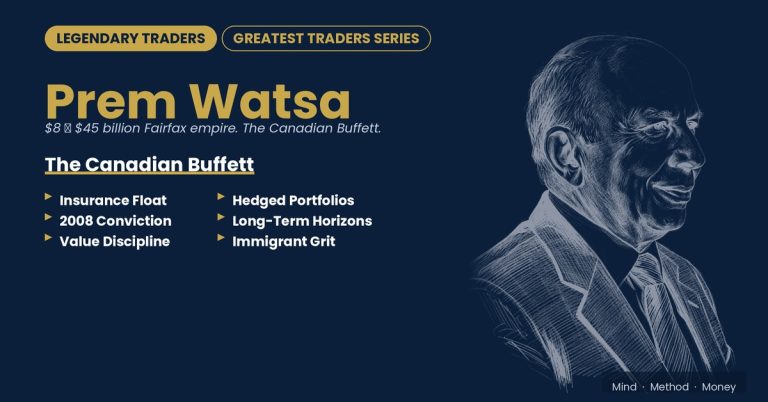
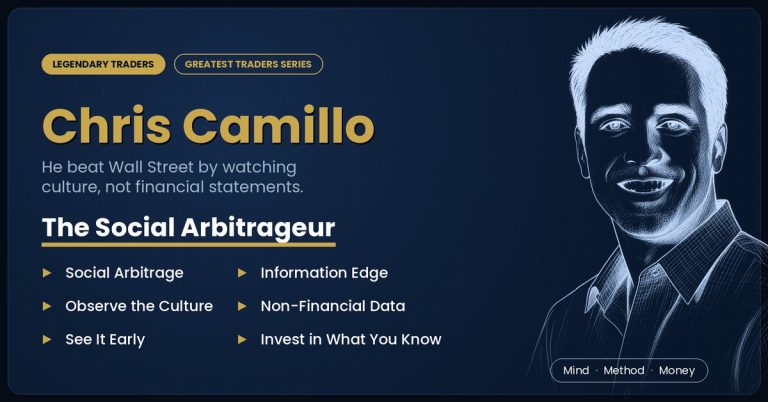
We have now studied dozens of the greatest market operators in history for the Greatest Traders series, organised deliberately around Mind, Method, and Money. They traded different instruments, in different eras, with wildly different styles. A trend-follower and a deep-value contrarian could not look more different on the surface. And yet, when you line them all up, the same handful of traits appear again and again. These are your 10x levers, because you can adopt every one of them without a bigger account or a smarter indicator.
If you skim one thing in this piece, skim this. Nine traits, a legend who embodied each, and the exact move you can copy today.
| Shared trait | A legend who lived it | Your 10x move |
|---|---|---|
| Ruthless focus | Ed Seykota, Warren Buffett | Trade one setup on one market until it is second nature. |
| Capital preservation first | Paul Tudor Jones | Risk 1% or less; never let a single trade wound you. |
| Probabilistic thinking | Ray Dalio | Judge your process over 100 trades, not the last one. |
| A written, repeatable process | Richard Dennis & the Turtles | Put your edge into rules so it survives a bad mood. |
| Temperament over IQ | Buffett & Munger | Get calm and honest before you try to get clever. |
| Conviction sizing | Soros & Druckenmiller | Press hard only when the edge screams; otherwise do nothing. |
| Cut losers, ride winners | Jesse Livermore | Take small losses fast; give a correct trade room to breathe. |
| Independent thinking | Michael Burry | Do your own work; comfort is rarely where the edge is. |
| The long game | Buffett, John Templeton | Optimise to still be trading, and winning, in twenty years. |
- They subtracted ruthlessly. Almost every legend specialised to an extreme. Seykota followed trends. Simons trusted data. Buffett stayed inside his circle. They did not chase everything. They found the narrow thing they did better than the field and did it over and over. Focus is the trait, and focus is free.
- They protected capital above all. Survival was the non-negotiable. The greats obsessed over defence and drawdown, which is precisely why they were still standing decades later to enjoy compounding. The rogues who ignored this arena were often more talented, and they are gone.
- They thought in probabilities, not certainties. None of them believed they could predict the next tick. They played edges across large samples, sized for the chance of being wrong, and stayed emotionally flat on any single outcome.
- They ran a written, repeatable process. The Turtles proved that a defined set of rules, handed to a beginner, can print money, while brilliance without a process eventually blows up. Great traders externalise their edge into rules and routines so it does not depend on how they feel that morning.
- They valued temperament over intelligence. The very first lesson in our own framework is that intelligence does not predict trading success. Buffett, Munger, Douglas and Dalio all say a version of the same thing. Calm, patient, honest self-awareness beats raw IQ every time.
- They sized to conviction. When their specific edge was screaming, Soros and Stanley Druckenmiller bet heavily, and when it was not, they did almost nothing. Most amateurs invert this, betting the same size on a coin flip as on a genuine setup.
- They cut losers fast and let winners run. This is the oldest wisdom on Wall Street, embodied by Jesse Livermore, who understood that the big money was made not in the frantic trading but in the patient sitting on a correct position, while the small losses were cut without ego.
- They thought independently. Michael Burry researched his way to a contrarian bet against the entire financial world and held it through ridicule. Templeton bought at the point of maximum pessimism. The crowd is comfortable, and comfort is rarely where the edge is.
- They played the long game. Almost without exception, the true greats were compounders. They were not trying to get rich this week. They were trying to still be trading, and winning, in twenty years. That patience is the multiplier that dwarfs every other one.
And then there is the shadow side, which teaches just as loudly. The cautionary tales in our series, from Leeson to Hwang to the fraud of Madoff and the FTX collapse, all had genuine skill in one or two arenas. Every one of them violated a single pillar, usually Money, occasionally the Mind’s honesty, and it erased everything. Greatness and ruin are built from the same materials. The difference is whether all three pillars hold at once.
“It’s not whether you’re right or wrong that’s important, but how much money you make when you’re right and how much you lose when you’re wrong.”
— George Soros
Your 10x trading blueprint
Here is the uncomfortable, liberating truth: you almost certainly already know enough to 10x your results. You do not need another course, another indicator, or another market. You need to subtract your way down to the vital few and defend them like your account depends on it, because it does.
- Cut your setups to one. Trade only your single highest-expectancy pattern for the next hundred trades. Log every one.
- Cut your markets to one. Master one instrument’s behaviour completely before you ever add a second.
- Cut your risk to a rule, not a feeling. One percent per trade, a 1:2 minimum, a written drawdown protocol. No exceptions on a bad day.
- Cut the noise. Close the extra charts, mute the social feeds, and stop confusing information with edge.
- Protect the machine. Sleep, move, and run the same calm pre-session routine every day so you actually execute the plan.
Notice that every single item on that list is a subtraction. That is not an accident. That is the whole thesis. The 2x trader adds until they drown. The 10x trader removes until only the edge remains, and then repeats it with the patience and discipline of the legends. Ten times the results, from a fraction of the activity. It really is easier than 2x, once you are brave enough to let go.
“It was never my thinking that made the big money for me. It was always my sitting.”
— Jesse Livermore
Tools to 10x each arena (all free)
You do not have to build any of this from scratch. There is a free tool for every arena, no signup required. Start with the one that matches your weakest pillar.
| Arena | Free tool | What it does |
|---|---|---|
| Mind | M·M·M Assessment | Find your weakest pillar in three minutes. |
| Method | Best Trading Tools | The charting, research and order-flow stack we actually use. |
| Money | Trading Calculators | Position size, R:R, drawdown and expectancy, before the trade. |
| Money | Prop Firm Simulator | 1,000 simulations of your stats before you pay a challenge fee. |
| Body & mind | Trading Routine Guide | Build the pre-session routine that keeps you executing. |
| The legends | Legendary Traders Explorer | Meet every trader in this article, one card at a time. |
 Free Companion App
Run the blueprint every day
The free Edge Companion app puts the whole Mind, Method and Money framework on your phone, so subtraction becomes a daily habit, not a one-time read.
Mind — a daily discipline check-in.
Method — a fast trade journal.
Money — position size and R:R, built in.
Edge score — see which setups actually pay.
Frequently asked questions
What does it actually mean to 10x your trading results?
It does not mean ten times the effort or ten times the risk. It means a jump to a different kind of trader: one who has stripped their process down to a single edge, defends capital with fixed rules, and executes calmly. The tenfold improvement comes from removing what does not work, not from piling on more.
Is 10x really easier than 2x for a trader?
In the sense the book means, yes. Chasing 2x usually means doing more of everything, including the low-value activity that quietly loses money. 10x forces you to identify the vital few behaviours that actually produce results and cut the rest. Fewer moving parts is easier to execute, not harder. The genuinely hard part is emotional: letting go.
Which arena should I fix first, Mind, Method or Money?
Mind first, because a shaky mind sabotages even a perfect system in real time. Then Method, so you have a defined edge to execute. Money runs alongside both from day one, because it is what keeps you in the game long enough for the other two to compound. The order of the framework is deliberate.
Do I need a bigger account to 10x my results?
No. Every lever in this article is about process, not capital. A trader with strict risk rules and one well-executed edge on a small account is in a far stronger position than one over-trading a large one. This is education rather than a promise of returns, and trading always carries the risk of loss, but the quality of your process is the part you fully control.
What is the single fastest 10x lever?
Protecting your capital. Most traders do not have an edge problem, they have a survival problem. Lock in a fixed 1% risk, a 1:2 minimum, and a step-down drawdown protocol, and you remove the account-ending mistakes that erase years of progress. Survival is what lets a decent edge compound into something remarkable.
How long does the 10x shift take?
It is a rewiring, not a weekend. Measure it by the consistency of your process, not by a single month of profit and loss. When you can follow your plan through a losing streak, sit out a day with no valid setup, and journal every trade without flinching, the results tend to follow.
Build a different kind of trader
10x is not a bigger account or a busier day. It is a system built across Mind, Method, and Money, executed with the calm of the greats. Start with the framework, then meet the legends who lived it.
 The Complete Trader's Edge
The full Mind · Method · Money framework. 70 chapters.
View on Amazon →
The Complete Trader's Edge
The full Mind · Method · Money framework. 70 chapters.
View on Amazon →
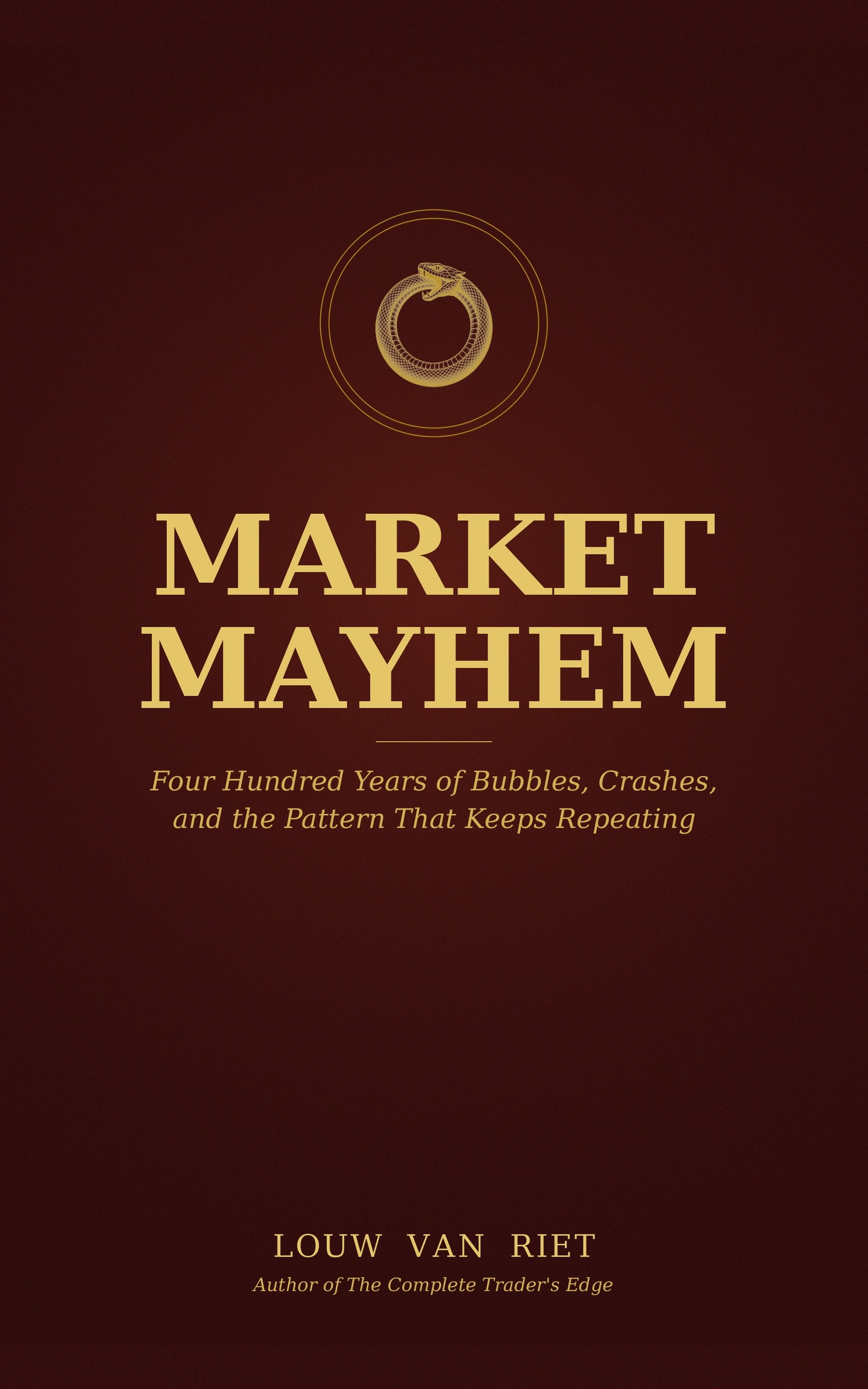 Market Mayhem
400 years of bubbles, crashes, and the pattern that keeps repeating.
Buy on Amazon →
Market Mayhem
400 years of bubbles, crashes, and the pattern that keeps repeating.
Buy on Amazon →
 Greatest Companies
How the world's greatest companies were built — and what traders learn from them.
View on Amazon →
Greatest Companies
How the world's greatest companies were built — and what traders learn from them.
View on Amazon →