

Consistent profitability in trading does not come from any single skill or insight. It comes from the integration of three distinct disciplines that must all function well simultaneously. Weakness in any one of them will undermine the other two. This framework calls them Mind, Method, and Money, and together they form the complete architecture of a professional trading approach.
Most trading education focuses almost exclusively on Method: strategies, setups, indicators, entries. That leaves two-thirds of the puzzle unsolved. The result is a generation of traders who know exactly what to do but cannot do it when money is on the line. The Mind, Method, Money framework exists to fix that structural gap.
Mind: The Foundation Everything Rests On
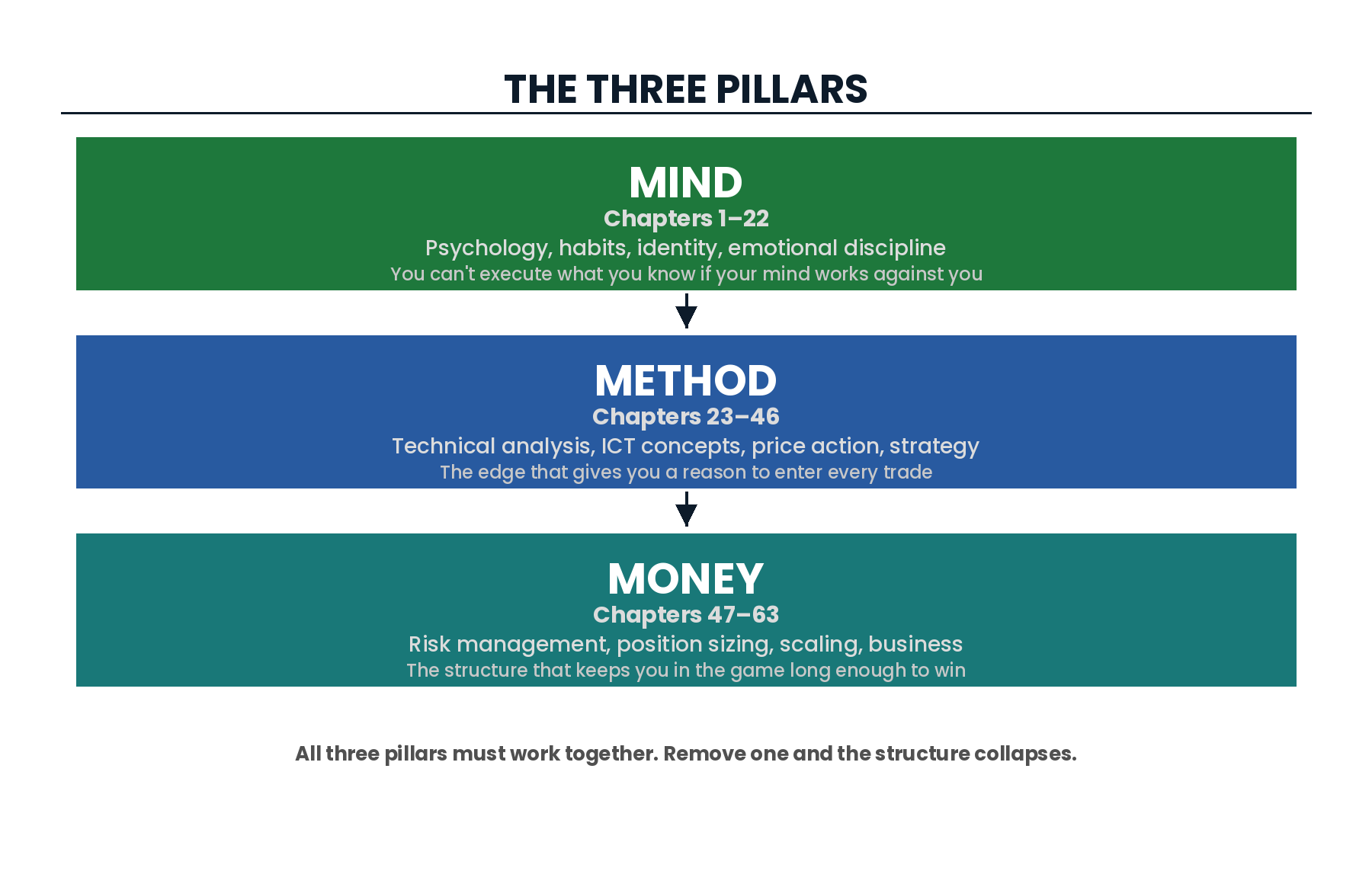
Your psychology is the operating system your trading runs on. A brilliant strategy executed poorly because of fear, greed, or impulsive decisions will produce worse results than a mediocre strategy executed with perfect discipline.
Mind covers everything from how you respond to losses, to how you manage winning streaks, to the beliefs you hold about money, risk, and your own capabilities. It includes your ability to follow your rules under pressure, to sit in a trade without interference, and to walk away from the screen when there is nothing to do.
The specific skills within the Mind pillar include:
Emotional regulation. Recognising when fear or greed is driving a decision and having a protocol to pause before acting. The trader who can identify “I am about to revenge trade” and choose not to has developed the single most valuable psychological skill in trading.
Identity work. Your beliefs about who you are as a trader directly shape your behaviour. A trader who identifies as disciplined will find it easier to follow rules than one who identifies as impulsive. Building your trader identity is foundational, not optional.
Process focus. The shift from judging yourself by outcomes (did the trade win?) to judging yourself by process (did I follow my plan?) is the single most important cognitive shift a developing trader can make. This is the probability mindset in practice.
Patience and discipline. The ability to wait for valid setups, avoid trading out of boredom, and maintain standards when the market is not giving you what you want. Patience is a skill that can be trained, not an innate trait.
Method: The Edge You Execute
Method is your strategy: the specific conditions under which you take trades, manage them, and exit them. A good method has a genuine statistical edge, clearly defined rules, and has been tested across enough sample sizes to give you confidence in its long-run expectancy.
The Complete Trader’s Edge teaches a blended technical approach that draws from multiple frameworks rather than relying on any single system. The core components include:
Market structure for establishing directional bias. Higher highs and higher lows for bullish structure, lower highs and lower lows for bearish. This is the foundation that every other tool sits on top of.
ICT concepts for precision entries. Order Blocks, Fair Value Gaps, liquidity sweeps, and Kill Zones give you a framework for understanding institutional order flow and timing entries when smart money is most active.
Volume Profile for context. Value Area High, Value Area Low, and Point of Control reveal where the market has accepted and rejected price, adding a layer of objective data to every setup.
Fibonacci and AVWAP for confluence. When multiple independent tools point to the same price level, the probability of a reaction at that level increases meaningfully.
Method without Mind means you have a system you cannot follow. Method without Money management means a single bad run can wipe you out before the edge pays off. The strategy is necessary but not sufficient.
Money: The Engine of Survival and Growth
Money management, which includes position sizing, risk per trade, drawdown limits, and account structure, determines whether you survive long enough to let your edge work. It also determines the rate at which your account grows when things go well.
The core principles of the Money pillar are:
Fixed risk per trade. Never risk more than 1% of your account on a single trade. This is not conservative. It is mathematically optimal. At 1% risk, a 20-trade losing streak costs roughly 18% of your account. At 5% risk, the same streak costs 64%. One is recoverable. The other is catastrophic.
Minimum 1:2 risk-to-reward. Every trade should offer at least twice the potential profit relative to the risk. With a 1:2 R:R, you only need a 34% win rate to break even. This gives your strategy massive room to be wrong and still make money over time.
Non-negotiable stop losses. Every trade has a defined maximum loss before you enter. The stop goes at the level where your trade thesis is invalidated, not at a round number or a comfortable distance.
Drawdown protocols. Written rules for what to do when you hit 5%, 10%, or 15% drawdown. Reduce size, increase structure, and focus on process quality. The traders who survive drawdowns are the ones who planned for them in advance.
Why All Three Must Work Together
The three pillars are not independent. They are deeply interconnected, and weakness in any one creates a cascade that damages the other two.
| Missing Pillar | What Happens | Real-World Example |
|---|---|---|
| Mind missing | You have a strategy and risk rules but cannot execute them under pressure | Trader removes stop loss during NFP because fear of loss overrides the plan |
| Method missing | You are disciplined and manage risk but have no actual edge | Trader follows every rule perfectly but takes random entries with no statistical basis |
| Money missing | You have a winning strategy and the discipline to trade it, but poor sizing destroys the account | Trader risks 10% per trade, hits a normal losing streak, and blows the account before the edge can express |
The goal of the framework is to build all three simultaneously so that they reinforce rather than undermine each other. Strong psychology allows consistent method execution. A proven method builds psychological confidence. Sound money management reduces emotional pressure, which supports both discipline and clear-headed analysis.
How to Self-Assess: Which Pillar Is Your Weakest?
Most traders already know which pillar needs the most work, even if they have not framed it in these terms. Ask yourself these diagnostic questions:
Mind check: When you review your last 20 trades, how many were taken outside your plan rules? If more than 20% were off-plan, psychology is your primary gap. You have a system but cannot follow it.
Method check: Can you articulate your complete entry criteria in three sentences? Have you backtested it across at least 100 historical setups? If the answer to either is no, your method is underdeveloped.
Money check: Do you calculate position size before every trade using a formula? Is your risk consistently at 1% or below? If you are sizing by feel or regularly risking more than planned, money management is the weak link.
Start with the weakest pillar. Get it to a functional baseline. Then strengthen the others. The compounding effect of all three working together is what separates professional traders from the rest.
Key Lessons
- Consistent profitability requires all three pillars: Mind, Method, and Money.
- Psychology is the operating system. Everything else runs on top of it.
- Method is your edge, but only if you can execute it consistently.
- Money management determines survival and growth rate.
- The three pillars are interdependent: weakness in one damages the others.
- Self-assessment across all three pillars reveals where to focus your development effort.
Frequently Asked Questions
Which pillar is most important for a beginner?
Money management. Beginners should focus on survival above all else. Set risk at 1% per trade, use stop losses on every position, and calculate position size with a formula before every entry. You can develop your strategy and psychology over months and years, but only if you are still in the game. Poor money management ends careers before they start.
Can I be profitable with just one pillar?
Not sustainably. A trader with a great strategy but no emotional control will break their own rules during drawdowns. A trader with perfect discipline but no edge will execute losing setups flawlessly. A trader with great risk management but no method will survive indefinitely while going nowhere. All three must reach at least a functional baseline for consistent results.
How long does it take to develop all three pillars?
Method (learning to read charts and identify valid setups) typically takes six to twelve months of deliberate practice. Money management can be implemented immediately by following the 1% risk rule and using a position sizing calculator. Mind (developing the emotional regulation and discipline to execute under pressure) takes the longest and is an ongoing process. Most traders reach consistent profitability within one to three years of structured effort.
How does the Mind, Method, Money framework differ from other trading approaches?
Most trading education focuses 80% or more on Method (entries, strategies, indicators) and barely touches psychology or risk management. This framework gives equal weight to all three because the evidence consistently shows that strategy alone is not the limiting factor for most traders. The reasons traders fail are overwhelmingly psychological and risk-related, not strategic.
Where should I start reading on this site?
Head to the Start Here page for a structured learning path. If you want to go deep on one pillar immediately: for Mind, start with Fear in Trading. For Method, start with Market Structure. For Money, start with Position Sizing Mastery.
Continue Reading
▶ Why Most Traders Fail Before They Begin
▶ Building Your Trader Identity
From The Book
This article covers concepts from Chapter 1 of The Complete Trader’s Edge.
 The Complete Trader's Edge
The full Mind · Method · Money framework. 70 chapters.
View on Amazon →
The Complete Trader's Edge
The full Mind · Method · Money framework. 70 chapters.
View on Amazon →
 Market Mayhem
400 years of bubbles, crashes, and the pattern that keeps repeating.
Buy on Amazon →
Market Mayhem
400 years of bubbles, crashes, and the pattern that keeps repeating.
Buy on Amazon →
 Greatest Companies
How the world's greatest companies were built — and what traders learn from them.
View on Amazon →
Greatest Companies
How the world's greatest companies were built — and what traders learn from them.
View on Amazon →
 Greatest Traders
Eighty-six lives that explain the markets — Livermore to Madoff, told with the losses left in.
View on Amazon →
Greatest Traders
Eighty-six lives that explain the markets — Livermore to Madoff, told with the losses left in.
View on Amazon →