

Most traders lose money. This is not a secret. Depending on the study and the market, anywhere from 70% to 90% of retail traders end up with a net loss over any given year. The question worth asking is not whether this is true but why it keeps happening despite the enormous amount of trading education now available online.
The answer is uncomfortable: most traders fail not because they lack a strategy, but because they misunderstand what trading actually demands. They approach it as a prediction game when it is actually a risk management game. They focus on entries when the real edge lives in exits, position sizing, and emotional discipline. They study charts for hundreds of hours and spend zero hours studying themselves.
This article breaks down the real reasons traders fail, backs them with data, and gives you a specific framework for avoiding each one.
The Strategy Trap
The most common assumption is that traders fail because they have the wrong strategy. So they search for a better one. They buy courses, join Discord groups, follow signal providers, and cycle through indicator combinations in search of the setup that will finally make everything click. The strategy becomes the obsession.
But here is what the data actually shows: most traders who blow accounts and start again with a new strategy blow that account too. The strategy changed. The result did not. This is the first major clue that strategy is not the core problem.
Consider this scenario. Two traders sit down with the exact same strategy: trade Order Block rejections during the New York Kill Zone, risk 1% per trade, target 1:2 R:R. After 100 trades, Trader A is up 12%. Trader B is down 30%. Same strategy, same market, completely different results. The difference is not the entry signal. It is everything that happens after the signal: how size is calculated, whether the stop is honoured, whether revenge trades are taken after losses, and whether the plan is followed when the pressure mounts.
What Actually Causes Failure
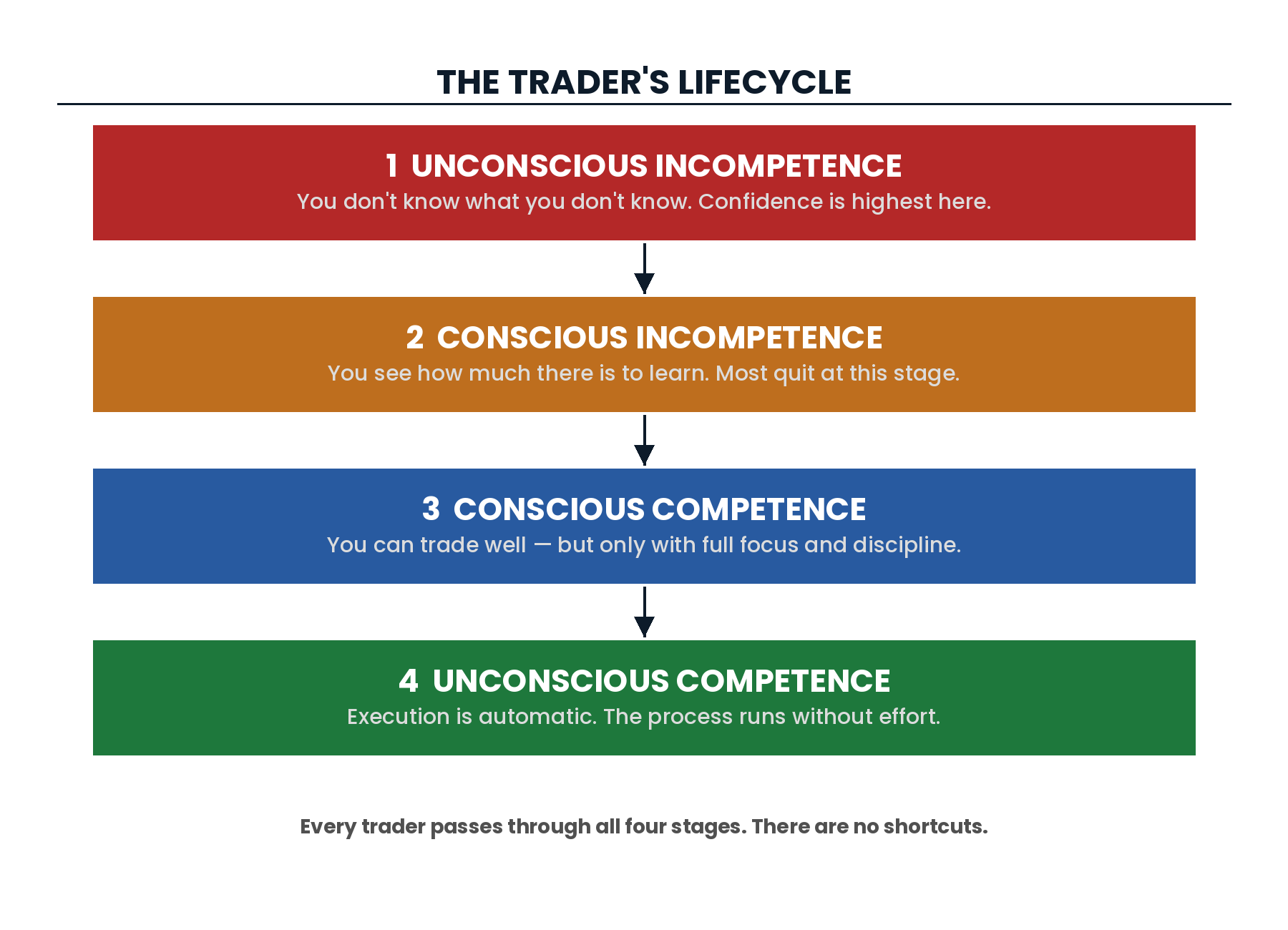
Consistent losing comes from a cluster of interconnected problems that have nothing to do with entry signals. Research from brokers who are required to publish their client profitability data shows remarkably consistent patterns across regions and timeframes.
Undercapitalisation
Trading an account too small to survive the normal drawdowns of any strategy. A 10-trade losing streak, which will happen to every trader eventually, wipes out an undercapitalised account before the edge has time to express itself. With a $500 account and 1% risk per trade, each trade risks $5. That is not enough to trade most instruments with a meaningful stop loss distance. The trader compensates by overleveraging, which accelerates the blowup.
No Genuine Edge
Trading patterns that feel like setups but have no statistical basis. Confirmation bias makes random wins feel like skill and random losses feel like bad luck. The trader who has never backtested their approach across 100+ trades has no idea whether their strategy has positive expectancy. They are gambling with a theory, not trading with evidence.
Risk Mismanagement
Risking too much per trade, averaging down into losing positions, removing stop losses, and letting losers run while cutting winners short. Position sizing is the single most important variable in long-term trading performance. A trader risking 5% per trade with a 45% win rate has a risk of ruin above 80%. The same strategy at 1% risk has a risk of ruin below 1%. Same strategy, different survival odds, determined entirely by the sizing decision.
Emotional Decision-Making
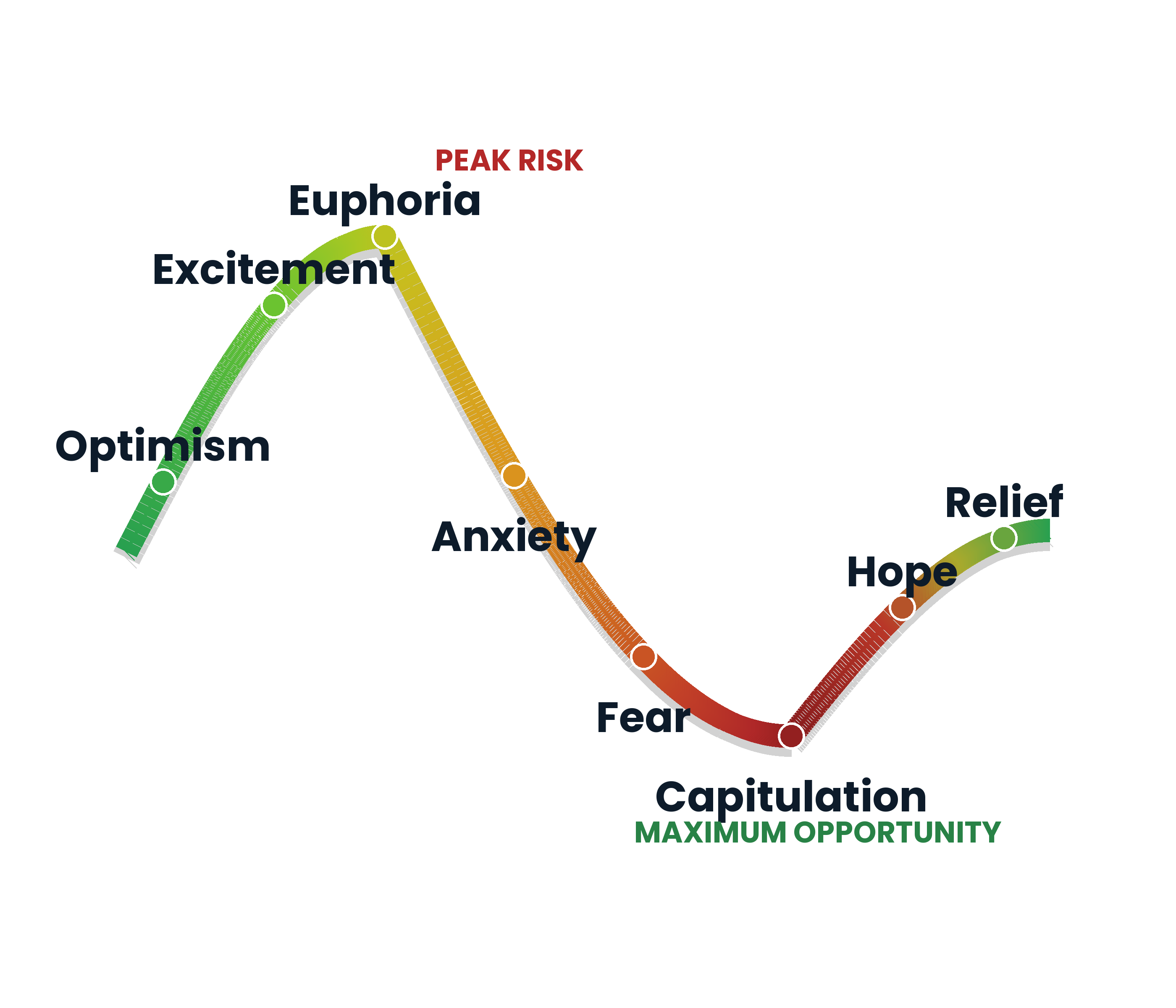
Trading based on how you feel rather than what your rules say. Fear, greed, boredom, and the need to make back a loss drive most of the worst decisions a trader makes. The amygdala fires threat responses faster than the prefrontal cortex can reason through the situation. This is why traders know their rules but break them in the moment.
No Written Plan
Entering trades without clear criteria and exiting based on real-time emotion rather than pre-defined rules. A trading plan is not a suggestion. It is the operating system that prevents every other failure mode from taking hold. Without it, every decision is improvised, and improvisation under financial pressure almost always leads to poor outcomes.
The Failure Cascade: How One Problem Creates All the Others
These failure modes are not independent. They compound. A trader without a written plan trades emotionally. Emotional trading leads to oversizing. Oversizing leads to large drawdowns. Large drawdowns trigger revenge trading. Revenge trading leads to account blowup. The trader then blames the strategy and starts the cycle again with a new one.
Understanding this cascade is critical because it means you cannot fix the problem by addressing symptoms. You fix it by building a complete system that addresses all five failure modes simultaneously. That is exactly what the Mind, Method, Money framework is designed to do.
| Failure Mode | Root Cause | Fix | Framework Pillar |
|---|---|---|---|
| Undercapitalisation | Starting with too little capital for the risk model | Demo first, then minimum viable capital or prop firm | Money |
| No genuine edge | Trading untested patterns with no statistical basis | Backtest 100+ trades before risking real capital | Method |
| Risk mismanagement | Oversizing, moving stops, averaging down | Fixed 1% risk, hard stop losses, position sizing formula | Money |
| Emotional decisions | Fear, greed, revenge, boredom driving trades | Pre-session planning, checklists, journal reviews | Mind |
| No written plan | Improvised entries and exits under pressure | Complete written trading plan with rules for every scenario | All Three |
What the Research Actually Says
The numbers behind retail trader failure are well documented. European and Australian regulators require brokers to publish the percentage of retail accounts that lose money. The figures are consistent across firms and jurisdictions: between 70% and 85% of retail CFD accounts lose money in any given quarter. Studies from Taiwan, Brazil, and the US show similar patterns across different instruments and regulatory environments.
But the data also reveals something that rarely gets discussed: among the traders who survive their first year, profitability rates improve dramatically. The attrition is front-loaded. Most traders who fail do so within their first six months. The ones who survive that initial period, typically because they respected risk management from the start, gradually develop the skills and psychological resilience that compound into consistency.
This means the primary job of a beginning trader is not to be profitable. It is to survive. Survival gives you the time to learn. Learning, applied consistently through a journal and review process, eventually produces the pattern recognition and emotional control that generate an edge.
The Good News: Every Failure Mode Is Fixable
Every one of these failure modes is correctable. None of them require genius-level intellect or access to institutional information. They require structure, self-awareness, and the discipline to build a process rather than chase outcomes.
The traders who move from losing to consistently profitable do not typically find a secret strategy. They fix their relationship with risk, develop genuine self-awareness about their emotional triggers, and build a rules-based system they can actually follow.
Here is the practical starting point:
Step 1: Write a trading plan before you trade another day. Include your markets, timeframes, entry criteria, exit criteria, risk per trade, and daily loss limit.
Step 2: Fix your risk. Set it at 1% per trade maximum. Use a position sizing calculator before every trade. No exceptions.
Step 3: Start a trading journal. Record every trade, including the emotional state that drove the decision. Review weekly.
Step 4: Trade a demo account or a small live account for three months while following these rules. The goal is not profit. The goal is process adherence.
Step 5: After three months of consistent plan adherence, evaluate your results. If your process is clean and your expectancy is positive, scale up gradually. If not, adjust the plan and repeat.
Key Lessons
- 70 to 90% of retail traders lose money, and strategy is rarely the primary cause.
- The same trader with a new strategy usually gets the same result. The problem is the trader, not the system.
- Failure clusters around undercapitalisation, no real edge, poor risk management, emotional decisions, and no written plan.
- These failure modes compound in a cascade. Fixing one alone is not enough.
- Every failure mode is correctable through process, structure, and self-awareness.
- The primary job of a beginner is survival. Profitability follows consistent process adherence over time.
Frequently Asked Questions
What percentage of traders actually make money?
Broker disclosures and academic studies consistently show that 10% to 30% of retail traders are profitable in any given year. The percentage improves significantly among traders with more than two years of experience who use written trading plans and risk management systems. The key variable is not talent or strategy. It is whether the trader survived long enough for their edge to compound.
Is it possible to learn trading on your own without a mentor?
Yes, but the learning curve is longer without structured guidance. Self-taught traders typically take two to four years to reach consistency, versus one to two years with a structured framework. The critical requirement for self-taught success is a rigorous trading journal and weekly review process. Without external feedback, the journal becomes your primary teacher.
How much money do I need to start trading?
You can open most forex and CFD accounts with $100 to $500, but you realistically need $1,000 to $5,000 to trade with meaningful position sizes while keeping risk at 1% per trade. If capital is limited, prop firms offer funded accounts of $10,000 to $200,000 to traders who demonstrate consistent profitability in evaluation challenges.
Should I quit if I am losing money in my first year?
Losing in the first year is normal, not a signal to quit. The relevant question is whether you are losing less than you were six months ago and whether your process is improving. If your journal shows improving plan adherence, fewer emotional trades, and better risk management, you are on the right trajectory even if the P&L is still negative. If nothing is improving after twelve months of active effort, reassess your approach and learning structure.
What is the single most important thing a beginner trader should focus on?
Risk management. Specifically, position sizing at 1% or less per trade. Every other skill, from reading market structure to identifying Fair Value Gaps, requires time and screen hours to develop. Risk management can be implemented on day one. It is the one skill that keeps you in the game long enough to learn everything else.
Continue Reading
▶ The Three Pillars: Mind, Method, and Money
▶ How to Build a Trading Plan: The Complete Template
▶ Position Sizing Mastery: Never Risk the Wrong Amount Again
▶ Trading Journal: The Complete System for Building Your Edge
From The Book
This article covers concepts from Chapter 2 of The Complete Trader’s Edge.
 The Complete Trader's Edge
The full Mind · Method · Money framework. 70 chapters.
View on Amazon →
The Complete Trader's Edge
The full Mind · Method · Money framework. 70 chapters.
View on Amazon →
 Market Mayhem
400 years of bubbles, crashes, and the pattern that keeps repeating.
Buy on Amazon →
Market Mayhem
400 years of bubbles, crashes, and the pattern that keeps repeating.
Buy on Amazon →
 Greatest Companies
How the world's greatest companies were built — and what traders learn from them.
View on Amazon →
Greatest Companies
How the world's greatest companies were built — and what traders learn from them.
View on Amazon →
 Greatest Traders
Eighty-six lives that explain the markets — Livermore to Madoff, told with the losses left in.
View on Amazon →
Greatest Traders
Eighty-six lives that explain the markets — Livermore to Madoff, told with the losses left in.
View on Amazon →