

An edge in trading is a set of conditions under which your probability of a profitable outcome is meaningfully above 50% — or where your average winning trade is large enough relative to your average loser that even a sub-50% win rate produces profits. Finding, testing, and validating a genuine edge is the foundational work of strategy development. Without it, you are gambling with a neutral or negative expectancy.
Step 1: Observe and Hypothesise
Edge development begins with observation. Spend significant time on charts — ideally hundreds of hours across multiple instruments and timeframes — simply observing how price behaves. Where does it tend to reverse? What patterns precede trending moves? How does price behave after liquidity sweeps? What happens at session opens? These observations become hypotheses: “Price frequently reverses at the first test of a daily order block during the London killzone.”
Step 2: Define the Rules Precisely
Convert your hypothesis into an objective, testable rule set. Every element of the setup must be defined precisely enough that you and another trader reading the same rules would identify the same trades. Ambiguity is the enemy of testing. “Strong level” is ambiguous. “A swing high or low that was tested at least twice on the daily chart before the current setup” is precise.
Step 3: Historical Validation
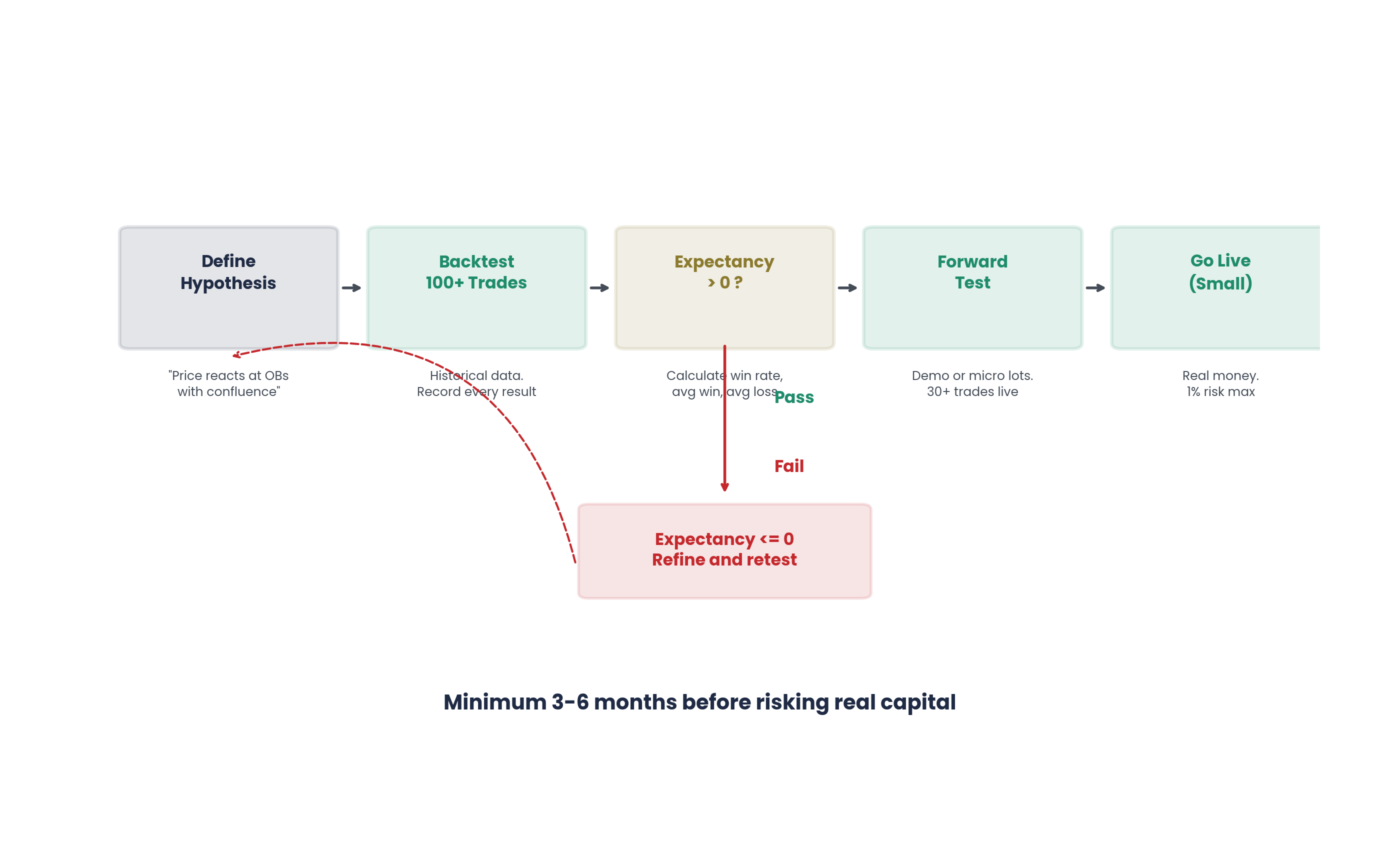
Apply your rules to historical data manually across a minimum of 50–100 examples. Record every qualifying setup — whether you would have taken it or not — and log the outcome. Calculate win rate, average R:R, and expectancy. This is your baseline. If expectancy is positive, you have a candidate edge. If not, revise the hypothesis and repeat.
Step 4: Forward Testing
Paper trade or demo trade the strategy in real-time for at least 30 trades. This validates that the edge works on unseen data and surfaces execution challenges that backtesting cannot reveal. Do not skip this phase.
Step 5: Live Minimum Size
Trade at minimum possible size for your first 20–30 live trades. The psychological reality of live capital changes execution in ways demo cannot simulate. Only after live validation at minimum size should you consider scaling up.
The Edge Validation Pipeline
| Phase | Sample Size | Purpose | Pass Criteria |
|---|---|---|---|
| 1. Backtesting | 50-100 trades | Prove the edge exists historically | Positive expectancy after costs |
| 2. Forward demo | 30-50 trades | Validate on unseen data + test execution | Results within 10% of backtest |
| 3. Live minimum size | 20-30 trades | Test psychological execution with real money | Process adherence above 85% |
| 4. Scale to full size | Ongoing | Trade the validated edge at normal position size | Continuous monitoring via journal |
Key Lessons
- Edge is a positive expectancy advantage. Without it, trading is gambling.
- Observation comes before rules: spend significant chart time before writing a strategy.
- Rules must be precise enough that two traders reading them take the same trades.
- The full validation sequence: historical backtest, forward demo, live minimum size, then scale.
- Each phase has a specific pass criterion. Do not skip phases or promote to the next level prematurely.
Frequently Asked Questions
How do I know if my edge is real or just luck?
Sample size is the answer. Over 10-20 trades, luck can mimic edge. Over 100+ trades, genuine edge becomes statistically distinguishable from random results. If your backtest shows positive expectancy over 100 in-sample trades AND positive expectancy over 50 out-of-sample trades, the edge is very likely real. If it only works on the data you developed it on, it is probably overfitted.
Can my edge disappear over time?
Yes. Market conditions change, and edges can degrade as more participants discover the same patterns. However, edges based on structural market dynamics (institutional order flow, liquidity mechanics, human psychology) tend to be more durable than edges based on specific technical patterns. Monitor your strategy’s KPIs monthly. If performance degrades beyond your backtest parameters for 3+ months, the edge may need refinement or the market regime may have shifted.
How many edges do I need?
One well-validated edge is sufficient for consistent profitability. Most developing traders make the mistake of searching for new edges before fully mastering the one they have. Master one setup across one instrument in one Kill Zone. After 200+ live trades with clean execution, consider adding a second setup or instrument.
What is the difference between an edge and a strategy?
An edge is the underlying advantage: the market condition that produces positive expectancy (for example, price tends to reverse at Order Blocks after liquidity sweeps). A strategy is the complete ruleset that captures that edge: entry criteria, stop placement, target, sizing, and filters. The edge is the why. The strategy is the how.
What are some examples of genuine trading edges?
Trend continuation after pullbacks to institutional demand zones. Reversals following liquidity sweeps at session highs/lows during Kill Zones. Fair Value Gap fills that produce reactions when aligned with higher timeframe structure. CME gap fills on Bitcoin futures. Golden pocket entries during trending markets. Each of these has a logical foundation (institutional mechanics, market efficiency, human psychology) and is testable over large sample sizes.
Continue Reading
▶ How to Build a Trading Strategy from Scratch
From The Book
This article covers concepts from Chapter 41 of The Complete Trader’s Edge.
 The Complete Trader's Edge
The full Mind · Method · Money framework. 70 chapters.
View on Amazon →
The Complete Trader's Edge
The full Mind · Method · Money framework. 70 chapters.
View on Amazon →
 Market Mayhem
400 years of bubbles, crashes, and the pattern that keeps repeating.
Buy on Amazon →
Market Mayhem
400 years of bubbles, crashes, and the pattern that keeps repeating.
Buy on Amazon →
 Greatest Companies
How the world's greatest companies were built — and what traders learn from them.
View on Amazon →
Greatest Companies
How the world's greatest companies were built — and what traders learn from them.
View on Amazon →
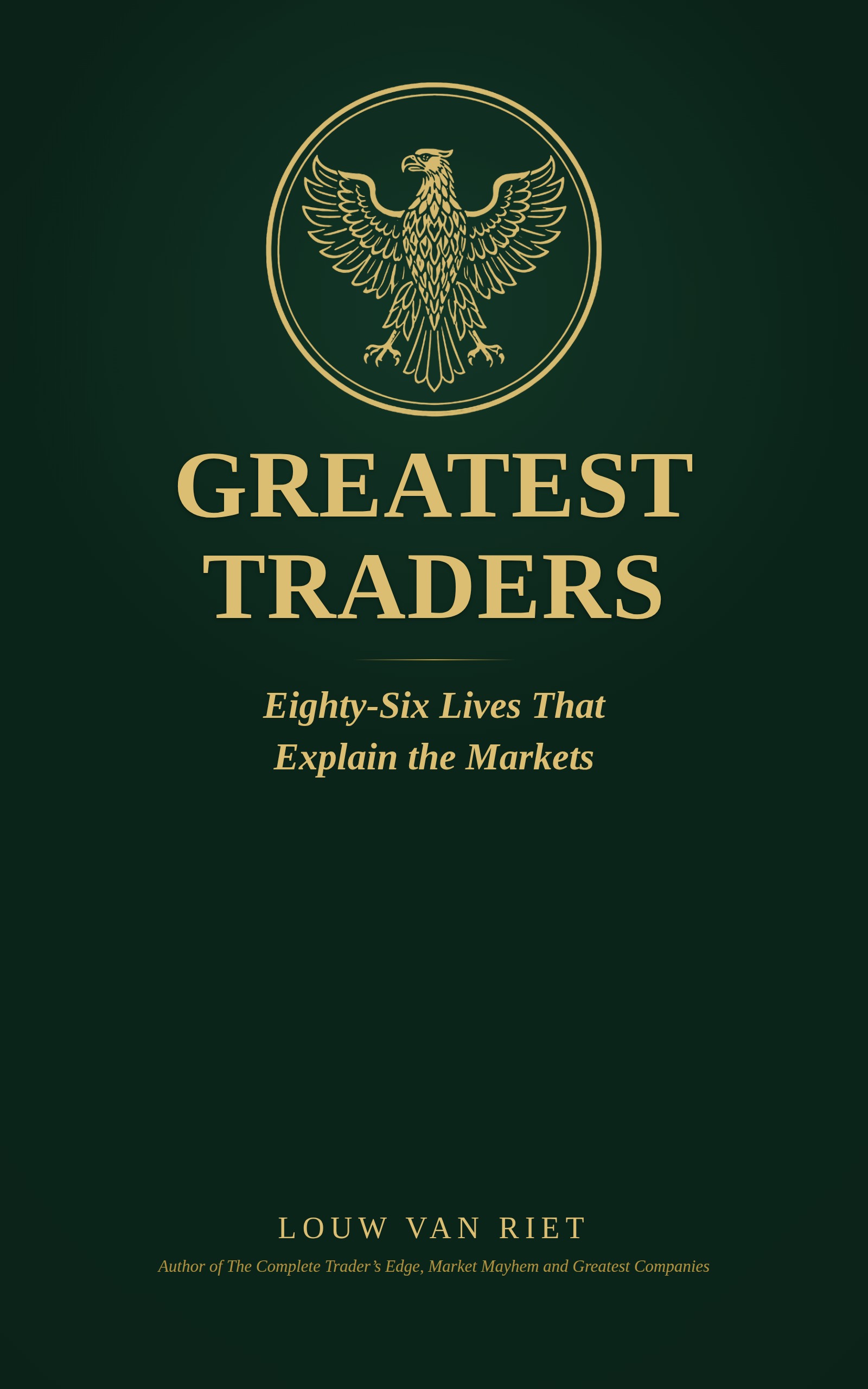 Greatest Traders
Eighty-six lives that explain the markets — Livermore to Madoff, told with the losses left in.
View on Amazon →
Greatest Traders
Eighty-six lives that explain the markets — Livermore to Madoff, told with the losses left in.
View on Amazon →