

Something significant is happening in the world of retail trading. The same artificial intelligence technology that powers self-driving cars, medical diagnoses, and language translation is quietly becoming available to everyday traders — and it is changing what is possible for anyone willing to learn how to use it.
| AI Application | Current Capability (2026) | Realistic for Retail Traders? |
|---|---|---|
| Chatbot research assistants | ChatGPT, Claude for strategy brainstorming, journal analysis, Pine Script coding | Yes. High value, low cost. |
| Automated pattern detection | TrendSpider, TradingView scanners identify candlestick patterns and trendlines automatically | Yes. Saves hours of manual scanning. |
| Sentiment analysis | NLP tools aggregating news and social media for market sentiment scoring | Emerging. Useful as supplementary input, not standalone signal. |
| Fully autonomous trading bots | ML-powered systems that adapt to conditions without human input | No. Requires institutional-level data, compute, and expertise. Retail “bots” are mostly scams. |
| Predictive price models | Neural networks trained on historical data to forecast direction | No. Academic research only. No reliable retail product exists. |
Not long ago, advanced data analysis, pattern recognition, and sentiment scanning were the exclusive domain of hedge funds and institutional desks with million-dollar technology budgets. Today, a retail trader with a laptop and an internet connection has access to AI tools that would have seemed extraordinary just five years ago.
But there is a catch. Most traders are either ignoring these tools completely, or using them in the wrong way — expecting AI to make decisions for them rather than using it to sharpen the decisions they make themselves. This guide cuts through the noise. It explains what AI actually is, how it applies to trading, which tools are worth your time, and — critically — how to use AI as a force multiplier for your own edge rather than a replacement for discipline.
AI does not trade for you. It makes you a better trader. That distinction is everything.
Whether you trade forex, equities, futures, or crypto — whether you are a complete beginner or a seasoned professional — understanding how AI fits into your workflow is now one of the most important edges you can develop.
What Artificial Intelligence Actually Means for Traders
Before you can use AI effectively, you need to understand what it actually is — and what it is not. Most of the confusion around AI in trading comes from treating it as a mysterious black box rather than a set of specific, learnable tools.
Machine Learning: Finding Patterns in Data
Machine learning is the branch of AI most relevant to trading. At its core, it works like this: you feed a system large amounts of historical data, define what you want it to find, and the system builds a mathematical model that identifies patterns — patterns that would take a human analyst months or years to detect manually. In trading, the skill lies in asking the right questions and interpreting the answers intelligently.
Pattern Recognition: The Charts You Are Not Seeing
Humans are good at recognising patterns — but we are slow, inconsistent, and subject to emotional bias. We see patterns that confirm what we already believe. Modern AI can scan thousands of charts simultaneously, identify specific price formations with consistent accuracy, and rank setups by historical reliability — all in real time. Tools like TrendSpider and TradingView‘s AI features are making this accessible at the retail level right now.
Natural Language AI: The Research Revolution
The arrival of large language models (LLMs) like ChatGPT and Claude represents a separate but equally important development. These tools process text, not price data. For traders, this means being able to ask complex research questions in plain English, get summaries of earnings reports, analyse market commentary, and refine trading rules in real time. Together, these three branches of AI give retail traders a genuinely new toolkit.
How Traders Can Use AI Today: Six Practical Applications
1. Market Research and News Analysis
Staying informed used to mean hours of reading financial news, earnings reports, central bank statements, and analyst commentary. AI compresses that research dramatically. You can use Claude or ChatGPT to summarise an earnings transcript, extract key points from a Federal Reserve statement, or get a plain-English explanation of why a sector is moving.
- Summarise earnings calls: “What were the three biggest risks the CEO mentioned?”
- Central bank analysis: “What did the Fed Chair signal about future rate decisions?”
- Sector scanning: “Which macro factors are currently driving gold prices higher?”
- Competitor comparison: “How does this company’s margins compare to industry peers?”
2. Strategy Development and Refinement
You can describe your current trading approach to an AI model and ask it to identify potential weaknesses, suggest refinements, or generate variations you have not considered. For example: “I trade order blocks on the 15-minute chart during the London session. What are the most common failure modes of this approach?”
“Give me five ways my strategy might fail in low-liquidity conditions.” This single question, asked to an AI, can be worth hours of backtesting.
3. Trade Journaling and Review
Instead of writing free-form journal notes, paste your trade details into an AI tool and ask structured questions: “Based on this trade, what pattern do you see in when I exit too early?” The AI becomes a thinking partner for your own data, helping you identify the patterns in your behaviour that are hardest to see yourself.
4. Psychology Analysis and Coaching
Trading psychology is where most retail traders lose money that has nothing to do with their strategy. AI language models are surprisingly effective at helping traders work through psychological patterns and identify what emotional mechanism was at work in a difficult trade.
- Use AI to analyse your trading journal entries for emotional language patterns
- Ask AI to play devil’s advocate against your trading decisions
- Use AI to help write your trading rules in clear, unambiguous language
- Ask AI to simulate what a disciplined trader would have done in a specific scenario
5. Backtesting Assistance
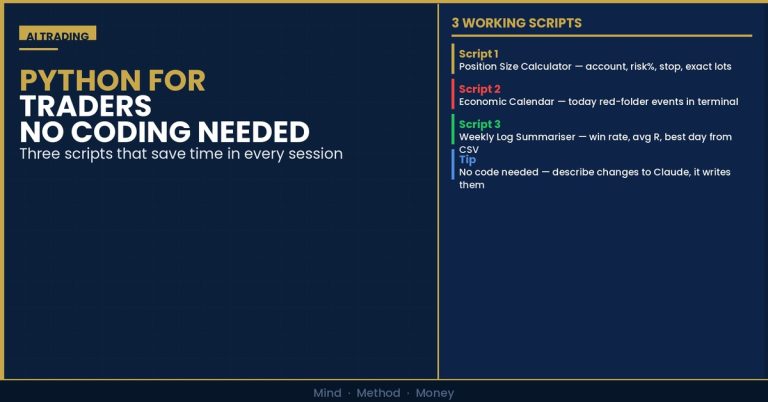
AI tools like ChatGPT and Claude can write backtesting code in Python or Pine Script from plain English descriptions of your strategy. “Write me a Pine Script that identifies order blocks on the 15-minute chart and marks them when price breaks structure” — this would have required a developer a few years ago. Today, AI produces a working first draft in minutes.
6. Risk Calculation and Position Sizing
Risk management is the mathematical foundation of trading survival. AI tools can help you build risk calculators, run scenario analysis on portfolio exposure, and identify correlation risks across multiple open positions. See our complete risk management guide for the full framework.
The AI-Enhanced Trading Workflow
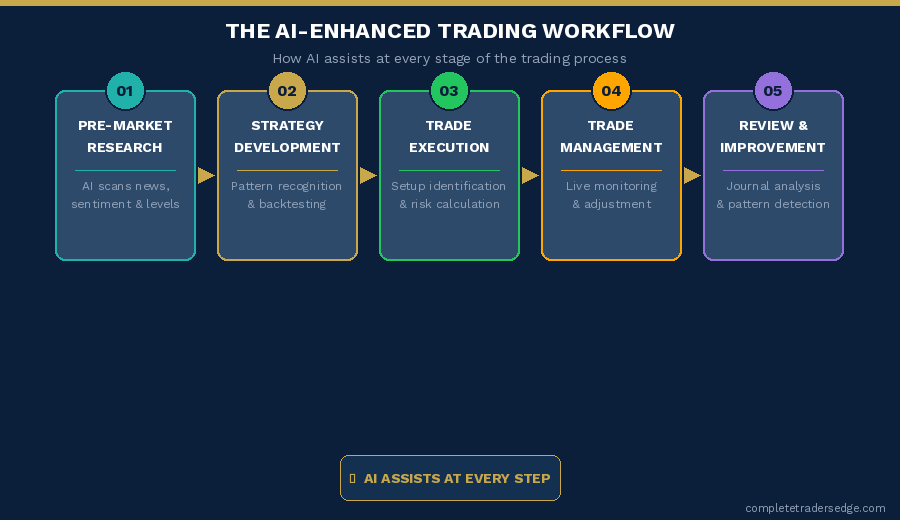
Understanding how AI fits into a coherent daily workflow is transformative. Here is how AI can assist at every stage of the professional trading process:
Stage 1: Pre-Market Research (AI Role: Research Assistant)
Before the market opens, use AI to compress your morning research. Ask it to summarise overnight news relevant to your watchlist, flag high-impact economic events, and provide a plain-English context for the macro environment you are trading into.
Stage 2: Strategy Development (AI Role: Pattern Analyst)
AI-powered charting tools can flag patterns, mark key levels, and identify setups matching your criteria across multiple instruments simultaneously — so you use your time applying judgment to the best candidates rather than manually reviewing twenty charts.
Stage 3: Trade Execution (AI Role: Rules Enforcer)
Before entering a trade, paste your plan into an AI tool and ask it to challenge your reasoning: “Here is my trade plan. What conditions would invalidate this setup?” Being forced to articulate your plan clearly — and then stress-test it — is one of the most effective discipline tools available.
Stage 4: Trade Management (AI Role: Scenario Planner)
Pre-planning your management scenarios with AI help means your decisions are made in advance, when you are thinking clearly — not in the heat of an adverse move.
Stage 5: Post-Session Review (AI Role: Performance Coach)
After the session, paste your trade notes into AI, ask structured analysis questions, and let it help identify the patterns in your performance that are invisible in the moment. Over time, this systematic review process separates traders who plateau from those who compound their skills month over month.
The Best AI Tools for Traders in 2025
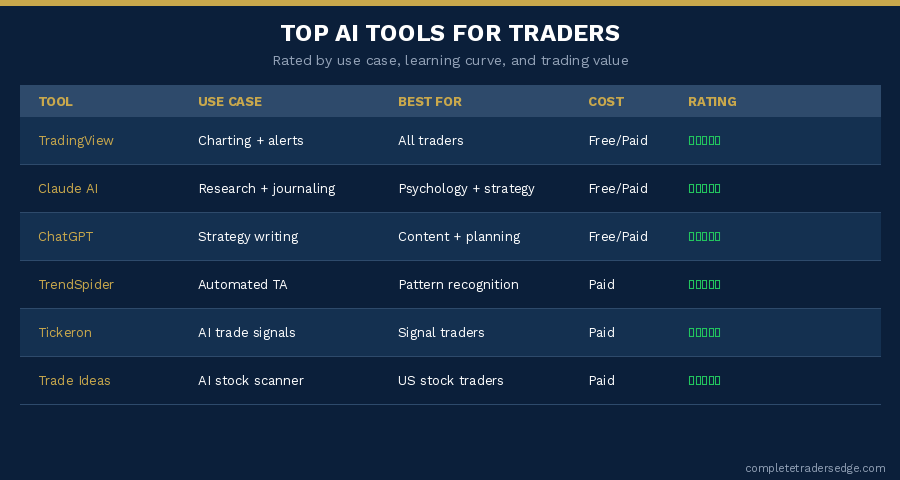
Here is an honest assessment of the most valuable tools available today:
TradingView — The Industry Standard Charting Platform
TradingView is where most retail traders live. Its Pine Script language enables custom indicator development, and the community library contains thousands of AI-enhanced scripts for pattern detection, volume analysis, and alert automation. For the vast majority of retail traders, it is the highest-value starting point for AI-enhanced technical analysis.
- Best for: Chart analysis, pattern scanning, custom indicator development
- Cost: Free tier is substantial; Pro plans from $14.95/month
- Learning curve: Low to moderate
Claude AI and ChatGPT — Research and Language Processing
Large language models are the most versatile AI tools in a trader’s kit. Both excel at research summarisation, strategy critique, journal analysis, and code generation. The key is learning to write effective prompts — specific, structured questions with context about your strategy get genuinely useful responses.
- Best for: Research, journaling, strategy development, code generation
- Cost: Free tiers available; Pro plans from $20/month
- Learning curve: Low — but prompting skill compounds over time
TrendSpider — Automated Technical Analysis
TrendSpider is purpose-built for automated technical analysis — automated trendline detection, multi-timeframe analysis on a single chart, and AI-powered pattern recognition across large instrument universes. The most powerful dedicated tool available at the retail level.
- Best for: Automated pattern detection, systematic traders
- Cost: From $39/month
- Learning curve: Moderate
Trade Ideas — AI Stock Scanner
Built specifically for US equity traders, Trade Ideas uses AI to scan the entire market in real time. Its ‘Holly’ AI system generates trade ideas continuously throughout the session — best suited to active traders who can justify the cost with frequent use.
- Best for: US equity day traders, momentum traders
- Cost: From $118/month
Common Mistakes Traders Make Using AI
Mistake 1: Expecting AI to Make Decisions For You
This is the number one error. Traders want AI to remove the burden of decision-making. It never works. AI does not have an edge in markets — it has information processing capability. The edge comes from your judgment, your discipline, and your experience.
AI is the analyst. You are the trader. The moment you forget that distinction, you give away the one thing that makes you profitable: your own judgment applied to your own edge.
Mistake 2: Trusting AI Output Without Verification
AI language models state things confidently even when they are wrong. For research, always verify specific claims against primary sources. For code, always test in a demo environment first. Treat AI output as a starting point for your own thinking, not a conclusion.
Mistake 3: Using AI as a Psychological Crutch
Some traders start using AI to validate every decision rather than build their own capability. The goal is to accelerate your development, not create a dependency. Use it intensively while learning. Use it selectively once you have genuine skill.
Mistake 4: Ignoring Risk Management While Chasing AI Signals
Risk management is not optional regardless of where your trade idea comes from. AI signals carry exactly the same uncertainty as human analysis. Your position sizing and stop placement must reflect that reality. Visit our complete risk management guide.
Mistake 5: Analysis Paralysis From Too Many Tools
Pick two or three AI tools that complement your existing workflow. Use them consistently. Master them deeply. Do not chase every new tool that launches.
The Future of AI in Trading: What to Expect
Democratisation of Institutional Tools
The gap between institutional and retail technology is narrowing faster than most people realise. Tools that cost millions five years ago are available to retail traders today for tens of dollars per month. The retail traders who develop fluency with these tools now will have a significant head start.
AI-Powered Risk Management
The next frontier is dynamic risk management — systems that monitor total portfolio exposure in real time, flag correlation risks, and alert when aggregate risk exceeds pre-set parameters. This is already available in sophisticated platforms; it will become mainstream.
The Human Edge Will Endure
Markets are ultimately driven by human behaviour — fear, greed, hope, and narrative. AI can model these forces statistically. It cannot understand them the way a disciplined, self-aware human trader can. Explore the psychology of trading that underpins everything.
Key Takeaways: How to Start Using AI in Your Trading Today
- Start with language AI for research. Use Claude or ChatGPT to summarise one piece of market news tomorrow morning and compare the time it takes.
- Pressure-test one trade plan this week. Before your next trade, paste your plan into AI and ask: “What are the three most likely ways this trade fails?”
- Start an AI-assisted journal. After each session, paste a brief summary and ask: “What psychological pattern do you see here?”
- Audit your backtesting with AI help. Describe your primary setup and ask AI to help design a structured backtesting protocol.
- Pick one new tool and commit to 30 days. Mastery takes repetition — you cannot evaluate a tool after one or two uses.
- Keep risk management non-negotiable. Whatever AI tools you adopt, your risk management rules remain absolute. See our complete risk management guide.
The traders who will benefit most from AI are not those who use the most tools. They are those who use the right tools, consistently, in service of a disciplined trading approach they have already built.
Conclusion
Artificial intelligence is not a trading shortcut. But used correctly — as a research accelerator, a pattern detection engine, a journaling partner, and a thinking tool — it represents one of the most significant improvements in the retail trader’s toolkit in a generation.
The Complete Trader’s Edge exists to help you build the real thing: a complete trading approach grounded in psychology, technical skill, and disciplined risk management. AI is a powerful addition to that approach. It is not a replacement for it.
Explore the full framework at completetradersedge.com — and start building the edge that lasts.
Frequently Asked Questions
Can AI replace human traders?
For fully systematic strategies, increasingly yes. For discretionary price action and ICT trading, no. These require contextual judgement that current AI cannot replicate. The future is hybrid: human judgement for strategy, AI for execution speed and data processing.
What AI tools should retail traders use?
Start with practical tools: AI-powered screening (scanning multiple charts for setups), automated alerts at key levels, backtesting platforms with parameter optimisation, and sentiment analysis tools. Avoid “black box” systems where you cannot understand the logic behind signals.
Are AI trading bots on social media legitimate?
The vast majority are not. If a bot genuinely produced consistent returns, the creator would trade it with borrowed capital rather than selling subscriptions. Be extremely sceptical of any automated system that promises specific returns. Legitimate AI tools are analytical aids, not money-printing machines.
How is AI changing market structure?
AI algorithms make liquidity sweeps more precise, news reactions faster, and market structure patterns more systematic. This makes ICT concepts more relevant because institutional algo behaviour creates the exact patterns ICT teaches you to identify.
Do I need coding skills to use AI in trading?
No. Many AI-powered tools have user-friendly interfaces. TradingView, TrendSpider, and modern charting platforms integrate AI features without requiring code. Coding (Python, Pine Script) is useful for building custom tools but not required for accessing AI-powered analysis.
From The Book
This article covers concepts from Chapter 50 of The Complete Trader’s Edge.
 The Complete Trader's Edge
The full Mind · Method · Money framework. 70 chapters.
View on Amazon →
The Complete Trader's Edge
The full Mind · Method · Money framework. 70 chapters.
View on Amazon →
 Market Mayhem
400 years of bubbles, crashes, and the pattern that keeps repeating.
Buy on Amazon →
Market Mayhem
400 years of bubbles, crashes, and the pattern that keeps repeating.
Buy on Amazon →
 Greatest Companies
How the world's greatest companies were built — and what traders learn from them.
View on Amazon →
Greatest Companies
How the world's greatest companies were built — and what traders learn from them.
View on Amazon →