Artificial intelligence and algorithmic trading are no longer the exclusive domain of hedge funds and investment banks. The democratisation of these tools, through accessible APIs, open-source libraries, and retail-focused platforms, means every serious trader needs at least a working understanding of how they function and how they are reshaping market dynamics.
You do not need to become a programmer or data scientist to benefit. Understanding how algorithms behave helps you anticipate the liquidity dynamics that algorithms create, avoid being caught on the wrong side of algorithmic moves, and selectively use automation tools to improve your own execution.
How Algorithms Are Reshaping Markets
Algorithms now account for 60 to 80% of volume in major equity and forex markets. This has practical implications for every discretionary trader:
| Impact | What It Means for You |
|---|---|
| Tighter spreads | Market-making algorithms have dramatically reduced transaction costs. EUR/USD spreads under 0.5 pips are common. |
| Faster news reactions | Algorithms react to economic data in milliseconds. You will never beat them to the initial move. Trade the post-news setup instead. |
| More precise liquidity sweeps | Institutional algorithms target stop clusters with surgical precision. ICT concepts become more relevant, not less. |
| Repeatable microstructure | Algo behaviour is rule-based, so market structure patterns are more systematic and tradeable. |
| Overnight gaps reduced (forex) | 24-hour algo activity means fewer gaps and more continuous price action in forex. CME gaps remain relevant for futures. |
What Algorithmic Trading Is
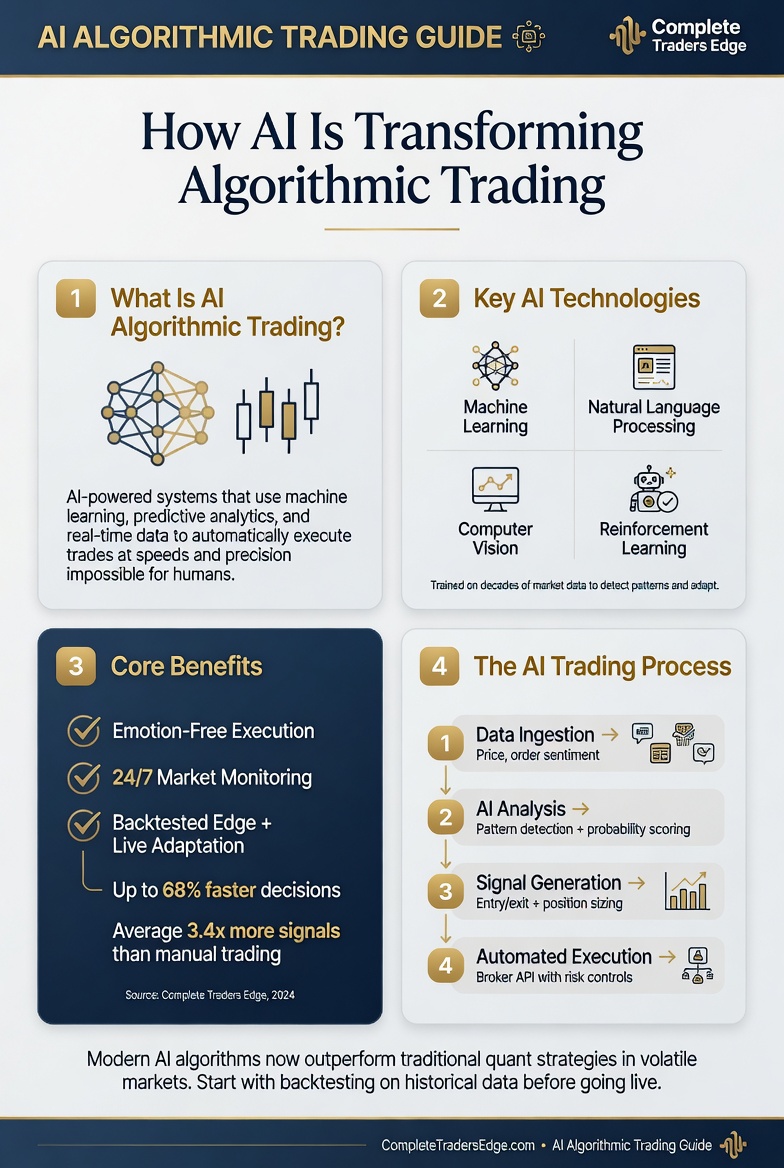
Algorithmic trading uses computer programs to execute trades based on pre-defined rules: entry conditions, exit conditions, position sizing. Automatically and at speeds impossible for human traders. The simplest algorithms are automated technical strategies (buy when price crosses above the 200 EMA). The most sophisticated use machine learning to identify patterns in vast datasets and adapt their behaviour over time.
This is the approach Ed Seykota pioneered in the 1970s: remove emotional interference from execution by letting the system make the decisions. The principle is the same whether the system is a simple moving average crossover or a neural network processing millions of data points.
AI-Powered Tools for Retail Traders
The most accessible AI applications for retail traders include: sentiment analysis tools that aggregate news and social media to gauge market mood, pattern recognition scanners that identify setups across multiple instruments simultaneously, and backtesting platforms that use machine learning to identify which parameters have historically performed best.
These tools are useful as inputs into a human decision-making process, not as replacements for it. The trader who understands the logic behind their strategy will consistently outperform one who blindly follows an algorithm they do not understand. AI is a tool. You are the decision-maker.
Building Simple Automated Systems
Platforms like TradingView (Pine Script), MetaTrader (MQL4/5), and Python with broker APIs allow traders with basic coding skills to automate rule-based strategies. The value is not in replacing judgement but in removing execution emotion from strategies with clear, testable rules.
Practical examples of what you can automate:
Alert systems: Get notified when price reaches a pre-identified Order Block or FVG level, rather than watching charts all day.
Stop loss and take profit orders: Always automated. No manual exit decisions under pressure.
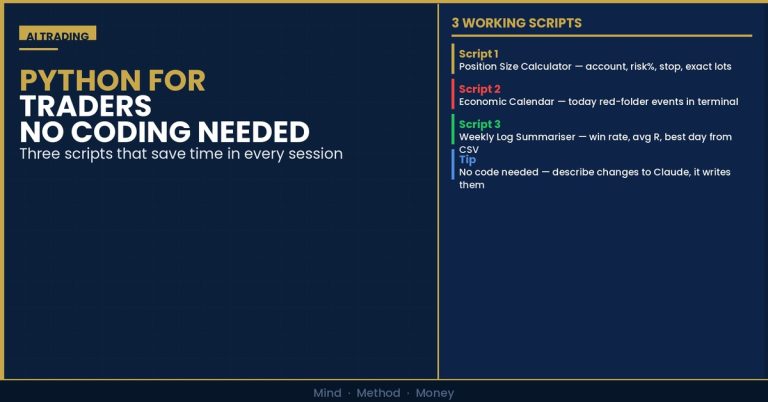
Position size calculators: Input account balance, risk percentage, and stop distance; get exact lot size. Removes calculation errors under pressure.
Session-based trade limits: Code a rule that disables your trading platform after 3 trades per session, enforcing discipline mechanically.
Key Lessons
- Algorithms dominate volume in major markets. Understanding this context improves discretionary trading.
- You will never beat algorithms on speed. Trade the post-reaction setup, not the initial spike.
- ICT concepts become more relevant in algorithmic markets because algo behaviour creates more precise liquidity dynamics.
- AI tools are inputs into human decisions, not replacements for strategy understanding.
- Simple automation (alerts, position calculators, trade limits) removes execution emotion without requiring advanced coding.
Frequently Asked Questions
Will AI replace human traders?
For fully systematic, rule-based strategies on liquid instruments, increasingly yes. Algorithms execute faster, without emotion, and at lower cost. For discretionary price action and ICT-based trading, no. These approaches require contextual judgement, the ability to assess setup quality, and adaptation to nuanced market conditions that current AI cannot replicate reliably. The most likely future is hybrid: human judgement for strategy and context, algorithmic execution for speed and discipline.
Do I need to learn coding to trade successfully?
No. Millions of profitable traders have never written a line of code. Coding is useful for automating alerts, building custom backtesting tools, and creating position size calculators, but it is not required for the discretionary trading approach taught in The Complete Trader’s Edge. If you want to explore automation, Pine Script (TradingView) is the most accessible starting point.
How do algorithms affect ICT concepts like liquidity sweeps?
Institutional algorithms are specifically programmed to target liquidity clusters at obvious levels. This makes liquidity sweeps more precise and more frequent in modern markets. The ICT framework is essentially a manual for reading what institutional algorithms are doing: where they are harvesting liquidity, where they are placing orders, and where the real move will go. As algorithmic participation increases, ICT concepts become more relevant, not less.
Are trading bots on social media legitimate?
Most are not. The vast majority of “trading bots” sold on social media or YouTube are either simple indicator-based systems with no genuine edge, scams that take subscription fees without delivering results, or marketing funnels for affiliate broker sign-ups. If a bot genuinely produced consistent returns, the creator would trade it themselves with borrowed capital rather than selling subscriptions for $49/month. Be extremely sceptical of any automated system that promises specific returns.
What is the difference between AI trading and algorithmic trading?
Algorithmic trading follows pre-defined rules (if X then buy, if Y then sell). The rules do not change unless a human reprograms them. AI trading uses machine learning to identify patterns in data and can adapt its behaviour as conditions change. AI systems “learn” from new data. In practice, most retail “AI trading” products are simple algorithms with a marketing label. Genuine AI/ML trading systems are expensive to develop, require massive datasets, and are typically the domain of institutional quant funds, not retail products sold on Instagram.
Continue Reading
▶ AI and the Future of Algorithmic Trading
▶ Ed Seykota: The Father of Systematic Trading
From The Book
This article covers concepts from Chapter 50 of The Complete Trader’s Edge.
 The Complete Trader's Edge
The full Mind · Method · Money framework. 70 chapters.
View on Amazon →
The Complete Trader's Edge
The full Mind · Method · Money framework. 70 chapters.
View on Amazon →
 Market Mayhem
400 years of bubbles, crashes, and the pattern that keeps repeating.
Buy on Amazon →
Market Mayhem
400 years of bubbles, crashes, and the pattern that keeps repeating.
Buy on Amazon →
 Greatest Companies
How the world's greatest companies were built — and what traders learn from them.
View on Amazon →
Greatest Companies
How the world's greatest companies were built — and what traders learn from them.
View on Amazon →