

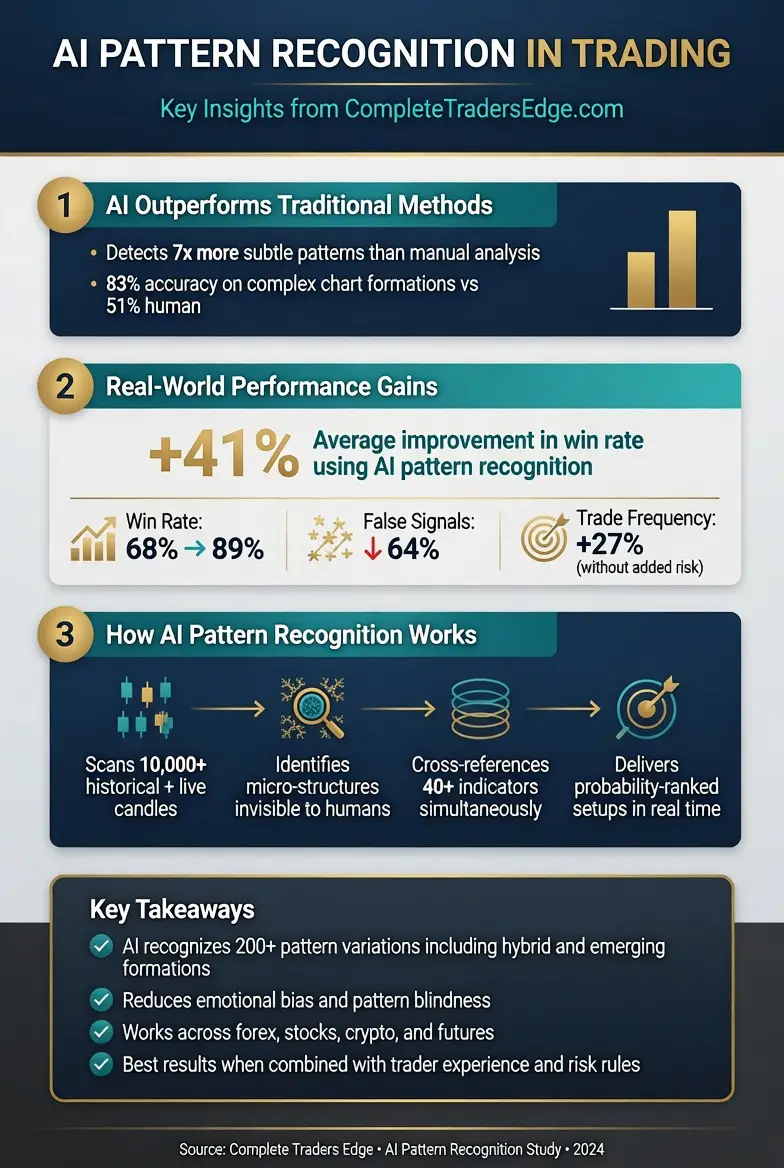
AI pattern recognition tools can identify chart patterns faster than any human. They can scan 5,000 instruments simultaneously, flag every head-and-shoulders, every bull flag, and every support test, and alert you within seconds. The real question is not whether AI can do this. The question is whether recognising the pattern is actually the hard part of trading — and whether automating it produces better results.
The honest answer is more nuanced than either “yes AI has replaced chart analysis” or “AI is useless for this.” Let’s break it down.
What AI Pattern Recognition Tools Actually Do
AI pattern recognition in trading typically works one of two ways:
Classical pattern matching: The algorithm is trained to identify defined chart patterns — head and shoulders, double tops/bottoms, triangles, flags, cups-and-handles — by matching the current price sequence against a library of historical templates. This is well-established technology and most major screening platforms have included it for years.
Machine learning pattern discovery: More advanced tools use neural networks or other ML models to identify patterns that produce statistically significant forward returns, without pre-defining what the patterns look like. The model learns from historical data which price sequences preceded profitable moves and flags similar current sequences.
Both approaches exist in consumer tools. The classical approach is more transparent (you can see which pattern it identified) and more limited (it only finds patterns it was trained to find). The ML approach is more flexible but harder to validate — the model may be finding genuine edge or overfitting noise.
Where AI Pattern Recognition Genuinely Helps
Screening for watchlist candidates. For swing traders who trade stocks or a broad universe of instruments, AI pattern scanners dramatically reduce the time required to build a watchlist. Instead of scanning 500 charts manually on Sunday, a scanner surfaces the 20-30 that show relevant setups. The human still evaluates each candidate and makes the entry decision — the AI just removes the 95% of charts that don’t qualify. This is the clearest genuine use case.
Consistency in pattern classification. Human pattern recognition is inconsistent: the same chart looks like a bull flag on a good day and ambiguous on a bad one. An AI classifier applies the same criteria every time. For traders who use classical patterns as part of their confluence stack, an AI classifier that flags “confirmed bull flag, pattern strength 87%” removes one source of subjective bias.
Historical pattern frequency and outcomes. AI tools can tell you how often a specific pattern has occurred in a given instrument and what the forward return distribution looks like. This is essentially automated backtesting of classical patterns — useful for calibrating whether a pattern type is worth incorporating into your strategy.
Where AI Pattern Recognition Falls Short
Context is everything. A bull flag in a strong uptrend with institutional backing is a completely different proposition from the same bull flag in a choppy range with declining volume. AI pattern classifiers identify the geometric form. They cannot read whether the underlying context makes the pattern meaningful. This is precisely the skill that separates profitable traders from pattern-matching losers.
ICT concepts don’t reduce to geometry. An Order Block is not a geometric shape. A Fair Value Gap is not a classical pattern. A liquidity sweep followed by a mitigation block is a narrative — a sequence of events with causal logic tied to institutional behaviour. Current AI pattern tools are built around classical technical analysis, not ICT/SMC theory. For traders whose primary edge comes from ICT setups, off-the-shelf AI pattern tools are largely irrelevant to their actual strategy.
The pattern is the easy part. Most experienced traders will tell you the same thing: the hardest part of trading is not identifying what the pattern is. It’s assessing whether this specific instance of the pattern, in this specific market context, with this specific confluence, merits a position. AI handles the identification. It cannot handle the assessment. For intermediate and advanced traders, the identification step takes maybe 10% of the analysis time. The other 90% is what AI still can’t do.
The Most Useful Pattern Recognition Tools in 2026
TradingView’s auto pattern recognition (available on Pro+ plans) flags classical chart patterns on your charts in real time. Useful as a background layer, not as a primary signal source. Best applied as a confirmation check — if your ICT analysis suggests a bullish move and TradingView also flags a bull flag in the same area, that’s a secondary confluence data point.
Finviz Elite includes pattern scanning across US equities. For swing stock traders, this is a legitimate time-saver for watchlist building.
TrendSpider offers the most sophisticated automated trendline and pattern detection available to retail traders. Its multi-timeframe pattern matching and Raindrop Charts provide a richer view of pattern quality than simple visual flag-detection.
Custom Claude/ChatGPT analysis of your own setup data (as covered in our AI backtesting and edge report guides) is more powerful than any pre-built pattern tool for ICT traders — because you define the patterns and the AI analyses your specific criteria, not generic geometric templates.
The Honest Verdict
AI pattern recognition tools are genuinely useful for two trader types: stock swing traders who screen a large universe of instruments (where AI scanning provides significant time savings), and traders who use classical TA patterns as part of their confluence stack and want consistent classification.
For ICT/SMC traders whose edge comes from liquidity sweeps, Order Blocks, and FVGs, current AI pattern tools address the wrong problem. Your edge is not in identifying that a double bottom formed. Your edge is in reading whether institutional repositioning is underway at a specific structural level in a specific session context. No AI pattern scanner currently does that.
The better question for an ICT trader is not “which AI pattern tool should I use?” but “how can I use AI to analyse my own setups more systematically?” That question has clear, actionable answers — and they’re in the AI backtesting and edge report guides linked below.
Frequently Asked Questions
Can AI pattern recognition tools replace technical analysis skills?
No. They can accelerate screening and provide consistent classification, but they cannot replace the skill of reading market context. Pattern recognition tools identify the shape of price action. Profitable trading requires understanding why that shape forms, whether the underlying cause is present in this instance, and whether the surrounding context supports an entry. These are judgement calls that current AI tools cannot make. Building genuine pattern recognition skills remains essential regardless of what tools you use.
Are there AI tools that specifically recognise ICT concepts?
There are TradingView community indicators that automatically mark Order Blocks, Fair Value Gaps, and Breaker Blocks on charts. Some are quite good at identifying the geometric conditions. The limitation is that these tools cannot assess whether the OB is significant (high volume imbalance, HTF structure alignment, Kill Zone timing) vs trivial (low-quality structure in a choppy session). The markers are useful as a starting point for visual confirmation; they should never be treated as standalone signals.
What is the difference between AI pattern recognition and a screener?
A traditional screener filters by quantitative criteria: price above 200 EMA, RSI below 30, volume above average. An AI pattern recognition tool identifies visual/geometric patterns that don’t reduce to simple numerical thresholds: “bull flag forming over the last 8 candles,” “descending triangle completing at support.” Both are useful for different things. Screeners are more reliable for quantitative criteria; pattern tools are better for geometric pattern identification that requires visual assessment.
Should I pay for an AI pattern recognition tool?
Only if pattern scanning addresses a genuine bottleneck in your current process. If you spend significant time manually scanning charts for classical patterns across a large instrument universe, an AI scanner saves real time and justifies its cost. If you trade a small, focused watchlist (5-10 instruments) and your setups are primarily ICT-based, the ROI of a dedicated AI pattern tool is low. Use TradingView’s built-in pattern detection (included with Pro+) as a free secondary layer and invest your tool budget where it produces more direct edge improvement.
How do I evaluate whether an AI pattern recognition tool has real edge?
Ask the provider for independently audited forward performance data — win rate, average gain/loss, and the time period covered. If they cannot provide this, assume the tool’s signal quality is unverified. Additionally, paper trade the tool’s signals for 30-60 days before committing capital. Measure the win rate and expectancy yourself. If the tool produces statistically significant positive expectancy in your paper trading, it warrants real-capital testing. Most tools will not pass this bar — which tells you something important.
▶ CONTINUE READING
Use AI where it genuinely helps:
▶ How to Backtest Your ICT Strategy Using AI Without Coding
▶ The Best AI Trading Tools in 2026: What Actually Works vs What’s Hype
The Complete Trader’s Edge
The Complete Trader’s Edge covers what actually produces edge in trading. Chapter 67 addresses how to integrate technology into your process without letting it replace the skills that create real, durable trading performance.
 The Complete Trader's Edge
The full Mind · Method · Money framework. 70 chapters.
View on Amazon →
The Complete Trader's Edge
The full Mind · Method · Money framework. 70 chapters.
View on Amazon →
 Market Mayhem
400 years of bubbles, crashes, and the pattern that keeps repeating.
Buy on Amazon →
Market Mayhem
400 years of bubbles, crashes, and the pattern that keeps repeating.
Buy on Amazon →
 Greatest Companies
How the world's greatest companies were built — and what traders learn from them.
View on Amazon →
Greatest Companies
How the world's greatest companies were built — and what traders learn from them.
View on Amazon →
 Greatest Traders
Eighty-six lives that explain the markets — Livermore to Madoff, told with the losses left in.
View on Amazon →
Greatest Traders
Eighty-six lives that explain the markets — Livermore to Madoff, told with the losses left in.
View on Amazon →