

The house always wins. Not because it wins every hand, but because it has a mathematical edge and the discipline to play it across thousands of hands. This is exactly how the best prop firm traders operate.
Casinos do not gamble. This is the single most misunderstood fact about the gaming industry, and it contains the single most important lesson for anyone trading a funded account.
A casino knows that on any given hand of blackjack, any given spin of roulette, any given roll of the dice, it might lose. It does not care. Because across thousands of plays, the mathematics are irrefutable. The house edge on European roulette is 2.7%. On blackjack, played against average players, it is roughly 2-5%. These are small edges. Tiny, even. But applied consistently across volume, they generate billions.
Now consider what most funded traders do. They pass a challenge, get a funded account, and immediately start gambling. They take oversized positions. They move stop losses. They revenge trade after a loss. They treat every trade as if it needs to be a winner, because the drawdown limit is breathing down their neck.
They are playing the casino’s game with the gambler’s mindset. And the result is the same as it is for every gambler: they lose.
This guide flips that. You are going to learn how to be the house, not the gambler. How to treat your prop firm account as a mathematical operation where the rules are not restrictions but the architecture of your edge.
Part 1: The Casino Mindset — Why the House Always Wins
The Three Properties of a Casino’s Edge
Every profitable casino operation shares three properties. Every profitable prop firm trader needs the same three.
Property 1: A defined statistical edge. The casino knows its exact advantage on every game, down to two decimal places. It does not hope it has an edge. It does not feel like it has an edge. It has calculated the edge and verified it across millions of data points. As a prop firm trader, your edge comes from your strategy, and it must be backtested and verified before you trade it live. If you cannot state your win rate, average winner, average loser, and expectancy as specific numbers, you are gambling.
Property 2: Consistent execution regardless of recent results. The casino does not change the rules of blackjack after a player wins a big hand. It does not tilt. It does not revenge-deal. It runs the same game, the same rules, the same edge, hand after hand, regardless of short-term outcomes. This is exactly what most funded traders fail to do. After two or three losses, they change their strategy, increase their size, or abandon their rules entirely.
Property 3: Bankroll management that makes ruin mathematically impossible. A casino never bets its entire bankroll on a single outcome. The table limits, the reserve requirements, the risk management infrastructure — all of it exists to ensure that no single event, no matter how extreme, can threaten the operation. Your prop firm drawdown limit is your bankroll. Your position sizing must make hitting that limit virtually impossible under normal variance.
← Swipe to see full table →
| Property | 🎰 What the Casino Does | 📈 What You Must Do |
|---|---|---|
| Defined Edge | Knows exact house edge on every game (2.7% roulette, 2-5% blackjack) | Know your win rate, avg winner, avg loser, and EV per trade as specific numbers |
| Consistent Execution | Same rules, same game, every hand — regardless of recent wins or losses | Same strategy, same sizing, every trade — no changes after losing streaks |
| Ruin Prevention | Table limits and reserves ensure no single event can bankrupt the operation | Position sizing ensures no losing streak can breach your drawdown limit |
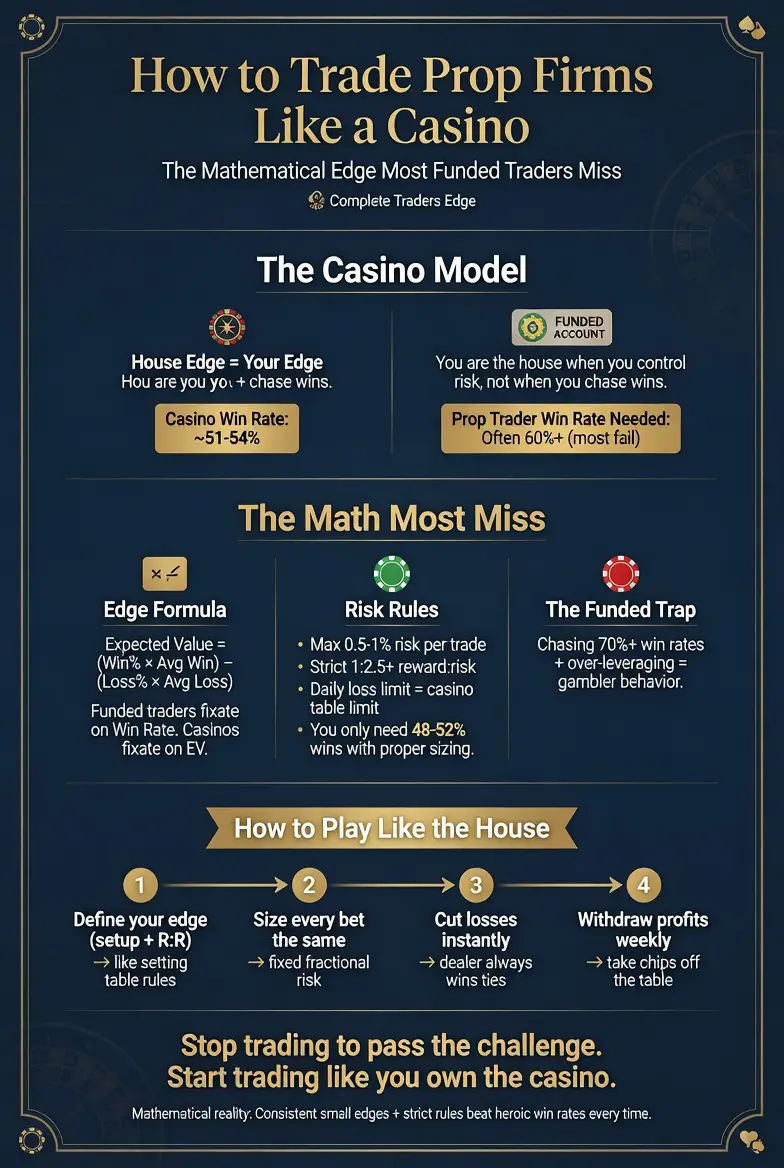
The core principle: A casino does not need to win every hand. It needs to play enough hands with a small edge and proper bankroll management. You do not need to win every trade. You need to take enough trades with a verified edge and position sizing that keeps you in the game.
Expected Value: The Only Number That Matters
Expected value (EV) is the average amount you expect to gain or lose per trade over a large sample. It is the single number that determines whether your prop firm operation is a business or a lottery ticket.
The formula is simple:
EV = (Win Rate × Average Win) – (Loss Rate × Average Loss)
If your win rate is 45%, your average winner is $300, and your average loser is $150:
EV = (0.45 × $300) – (0.55 × $150) = $135 – $82.50 = +$52.50 per trade
That is your edge. $52.50 per trade. It does not sound exciting. It is not supposed to. It is supposed to be reliable. Across 200 trades in a funded account, that edge produces $10,500 in expected profit. That is how casinos think, and that is how you should think.
If your EV is negative, nothing else in this article matters. No risk management system, no psychological framework, no prop firm hack will save a negative expectancy strategy. Fix the edge first.
Expected Value Per Trade ($) at Different Win Rates and Reward-to-Risk Ratios
Based on $200 risk per trade. Green = positive EV · Red = negative EV (do not trade)
← Swipe to see full table →
| Win Rate | 1:1 R:R | 1.5:1 R:R | 2:1 R:R | 3:1 R:R |
|---|---|---|---|---|
| 35% | −$60 | −$25 | +$10 | +$80 |
| 40% | −$40 | +$0 | +$40 | +$120 |
| 45% | −$20 | +$25 | +$70 | +$160 |
| 50% | +$0 | +$50 | +$100 | +$200 |
| 55% | +$20 | +$75 | +$130 | +$240 |
| 60% | +$40 | +$100 | +$160 | +$280 |
💡 Key insight: A 40% win rate with a 2:1 R:R (+$40 EV) outperforms a 55% win rate at 1:1 (+$20 EV). The reward-to-risk ratio matters more than being right.
Part 2: The Rules Are Your Strategy — Reverse-Engineering the Challenge
Understanding What You Are Actually Trading
Most traders approach a prop firm challenge as an obstacle to overcome. This is the wrong framing. The challenge parameters are not obstacles. They are the boundaries of your trading strategy.
A typical funded account — whether it is FundedNext or FundingPips — has these core parameters: a maximum daily drawdown (typically 3-5%), a maximum overall drawdown (typically 8-12%), a profit target (8-10% for challenges), and sometimes minimum trading day requirements.
These numbers are not arbitrary. They define a mathematical space within which you must operate. And the traders who treat them as the foundation of their strategy — rather than as limits they are trying to push against — are the ones who stay funded.
The Drawdown Budget: Your Most Important Number
Before you take a single trade on a funded account, you need to answer one question: how many consecutive losses can I sustain before I hit the maximum drawdown?
This number determines everything. Your position size, your stop loss distance, your trade frequency, your strategy selection. Everything flows from it.
Here is the calculation. Say your funded account is $100,000 with a 10% maximum overall drawdown ($10,000) and a 5% daily drawdown ($5,000).
If you risk 1% per trade ($1,000), you can sustain 10 consecutive losses before hitting the overall drawdown. If you risk 0.5% per trade ($500), you can sustain 20 consecutive losses. If you risk 2% per trade ($2,000), you can only sustain 5.
Drawdown Budget: How Many Losses Until You Blow the Account?
$100,000 funded account · 10% max drawdown ($10,000) · 5% daily drawdown ($5,000)
← Swipe to see full table →
| Risk Per Trade | $ Risk | Daily DD Losses | Overall DD Losses | Safety |
|---|---|---|---|---|
| 3.0% | $3,000 | 1.7 | 3.3 | 🔴 Gambling |
| 2.0% | $2,000 | 2.5 | 5 | 🟠 Risky |
| 1.0% | $1,000 | 5 | 10 | 🟡 Acceptable |
| 0.75% | $750 | 6.7 | 13 | 🟢 Safe |
| 0.5% | $500 | 10 | 20 | 🟢 Casino-Level |
💡 At 0.5% risk, you need 20 consecutive losses to fail. At 2%, you only need 5. The difference between the casino and the gambler is right here in the math.
Now ask yourself: what is the probability of 5 consecutive losses with your strategy? If your win rate is 50%, the probability of 5 losses in a row is 3.1%. That means if you risk 2% per trade, there is roughly a 1-in-32 chance that a normal losing streak blows your account. Over the lifetime of your trading career, that is not an if. It is a when.
At 0.5% risk, the probability of 20 consecutive losses with a 50% win rate is 0.0001%. That is the casino’s approach. Making ruin virtually impossible so the edge has time to compound.
Probability of Consecutive Losing Streaks by Win Rate
These are not worst-case scenarios. They are mathematical certainties over a large enough sample.
← Swipe to see full table →
| Win Rate | 5 Losses (2% risk = blown) | 10 Losses (1% risk = blown) | 15 Losses (0.67% risk) | 20 Losses (0.5% risk) |
|---|---|---|---|---|
| 40% | 7.78% | 0.60% | 0.047% | 0.0036% |
| 45% | 5.03% | 0.25% | 0.013% | 0.0006% |
| 50% | 3.13% | 0.10% | 0.003% | 0.0001% |
| 55% | 1.85% | 0.034% | 0.0006% | ~0% |
| 60% | 1.02% | 0.010% | 0.0001% | ~0% |
💡 Even with a solid 50% win rate, there is a 3.1% chance of 5 losses in a row. Over 200 trades, that streak is almost guaranteed to happen at least once. Size accordingly.
The funded trader’s golden rule: Risk no more than 0.5-1% of the account per trade. This gives you a drawdown buffer of 10-20 losing trades — enough to absorb any normal variance without threatening your account.
The Daily Drawdown Trap
The daily drawdown limit is where most funded traders blow up. Not the overall drawdown. The daily.
Here is why. A 5% daily drawdown on a $100,000 account is $5,000. If you risk 1% per trade, that is 5 losses in a single day. Sounds like a lot. But consider this scenario: you take two trades in the morning, both stop out. You are down 2%. Frustrated, you take a third trade with a slightly wider stop — 1.5% risk this time. It stops out. You are down 3.5%. Panic sets in. You take a fourth trade, moving your stop once to avoid the loss. It hits anyway. 5% gone. Account breached. One bad morning.
Anatomy of a Daily Drawdown Blow-Up
$100K account · 5% daily drawdown limit ($5,000) · What one bad morning looks like
← Swipe to see full table →
| Trade | What Happened | Risk | Loss | Total DD | Emotion |
|---|---|---|---|---|---|
| 1 | Clean setup, stop hit | 1.0% | −$1,000 | 1.0% | 😐 Calm |
| 2 | Second setup, stopped out | 1.0% | −$1,000 | 2.0% | 😤 Frustrated |
| 3 | Wider stop to “give it room” | 1.5% | −$1,500 | 3.5% | 😡 Angry |
| 4 | Moved stop, hit anyway | 1.5%+ | −$1,500+ | 5.0%+ 💀 | 🤯 Panic |
⚠️ Account breached in one morning. Total time: ~3 hours. The spiral always follows the same pattern.
The casino equivalent: the casino does not let a single table lose more than a predetermined amount in a single session. When the limit is approached, the table closes. This is not weakness. It is structural protection.
Your daily drawdown protocol should work the same way. Two consecutive losses: reduce size by 50%. Three consecutive losses: stop trading for the day. No exceptions. No “one more trade to get it back.” The day is over.
Mapping Your Strategy to the Rules
Here is a practical framework for reverse-engineering your challenge parameters into a trading strategy:
Step 1: Define your drawdown budget. Take the maximum overall drawdown and divide by your risk per trade. This gives you your “lives” — the number of losses you can absorb.
Step 2: Define your daily loss limit. Take the daily drawdown limit and set your personal limit at 60% of it. If the daily limit is 5%, your personal limit is 3%. This gives you a safety buffer for slippage and partial losses.
Step 3: Calculate required trades to hit the profit target. If the challenge target is 8% ($8,000 on a $100K account) and your expected value per trade is $52.50 at 0.5% risk ($500 per winner, $250 per loser), you need approximately 16 winning trades net. With a 45% win rate, that means roughly 80-100 total trades. At 2-3 trades per day, that is 30-50 trading days. No rush. No pressure. Just the math.
Step 4: Select your strategy based on the math, not your feelings. If the numbers require 80 trades, you need a strategy that generates 2-3 quality setups per day. If it requires 40 trades, a once-per-day setup works. Do not force a scalping strategy into a framework that needs swing trades, or vice versa.
Part 3: Why 90% of Funded Traders Blow Up (And How to Avoid Each Trap)
Trap 1: Trading to Hit the Target, Not to Execute the System
The moment you start thinking about the profit target as a goal to chase, you have stopped being the casino and started being the gambler. The casino does not have a daily revenue target. It has a process: run the games, maintain the edge, let the math work. Some days are above average, some below. The average is all that matters.
Funded traders who fixate on the profit target start doing predictable things. They increase size when they are close to the target. They take marginal setups they would normally skip. They hold winners too long, hoping for a bigger gain to close the gap. All of these behaviours introduce risk that the original strategy did not account for.
The fix: ignore the target. Execute your system. Track your EV per trade. If the EV is positive and you are executing consistently, the target will be reached as a byproduct of the process. The date you reach it is irrelevant.
Trap 2: The Revenge Trade After a Losing Day
This is the single largest account killer in prop firm trading. The sequence is always the same: a losing day creates frustration. Frustration creates the urge to “make it back.” The trader takes an unplanned trade, often with larger size, often with a wider stop or no stop at all. The trade goes against them. Now the daily drawdown is threatened, and the emotional spiral accelerates.
A casino has no mechanism for revenge. The roulette wheel does not spin faster after a player wins a big pot. The odds do not change. The house simply plays the next hand, identically to the last one, because the edge does not require any individual hand to win.
Your anti-revenge protocol must be mechanical, not psychological. Do not rely on willpower to resist the urge. Build a structural circuit breaker: after 2 consecutive losses, the platform closes. After hitting 60% of the daily drawdown, the day is done. Some traders physically separate themselves from the screen. Others use prop firm features that lock them out after a daily loss threshold. Use whatever works. The key is that the decision is made before the emotion arrives.
Revenge trading is the gambler doubling down after a loss. It feels logical in the moment and it is mathematically catastrophic over time. The casino never doubles down on a losing game. Neither should you.
Trap 3: Oversizing Because “The Setup Looks Perfect”
There is no such thing as a perfect setup. Every trade is a probability, not a certainty. The trader who risks 3% on a “perfect” A+ setup is the same as the gambler who bets big because “the table feels hot.” Both are confusing confidence with probability.
The casino bets the same amount on every hand because it knows something the gambler does not: the outcome of any individual hand is irrelevant to the long-term result. Only the average matters. And the average only works if the bet size is consistent.
Fixed fractional position sizing — the same percentage of your account on every trade, regardless of how good the setup looks — is the funded trader’s equivalent of the casino’s fixed bet. It removes the most dangerous variable from your decision-making: your own judgement about individual trade quality in the moment.
Trap 4: Ignoring the Variance Reality
A strategy with a 50% win rate will, at some point, produce 8-10 losses in a row. This is not a strategy failure. It is mathematics. A coin flipped 1,000 times will produce runs of 10 or more heads in a row. The probability is not just possible — it is expected.
Funded traders who do not understand variance interpret losing streaks as evidence that their strategy is broken. They switch strategies mid-challenge. They add indicators. They change timeframes. Every change resets their sample size to zero and destroys any statistical edge they had.
The casino does not change the rules of blackjack after a player goes on a hot streak. It does not panic. It does not switch to a different game. It knows the variance is temporary and the edge is permanent.
Before you start any funded account, calculate the maximum expected drawdown for your strategy. Use a Monte Carlo simulation or, at minimum, the formula for expected maximum consecutive losses. If your strategy can produce a drawdown of 6%, and your maximum allowed drawdown is 10%, you have a 4% buffer. That is enough. If the expected drawdown is 9% and the limit is 10%, you are one bad week from failure regardless of your edge. Reduce your position size until the buffer is comfortable.
Trap 5: Trading the Wrong Sessions
Your strategy has a statistical edge — but that edge is not uniform across all market conditions. Most strategies perform best during specific sessions (London open, New York open, the overlap) and underperform during low-volatility periods (Asian session for forex, pre-market for indices).
A casino does not open every table at 3 AM when foot traffic is minimal. It opens the tables when the conditions are right for volume. You should apply the same logic. Know which sessions your strategy performs best in. Trade only those sessions. The temptation to “find something” during off-hours is the funded trader’s equivalent of the gambler wandering to the slot machines at 4 AM.
To see exactly how devastating wrong-session trading can be, read our real case study of a funded trader whose 1,797 trades showed a $6,404 performance gap between core hours and evening sessions. The strategy was profitable. The trader was competent. The only problem was when they traded.
Trap 6: Failing to Track the Numbers
No casino in the world operates without detailed analytics on every game, every table, every hour. They know their edge to the decimal. They know which games are most profitable, which times of day produce the most volume, which promotions generate the best return.
Most funded traders cannot tell you their win rate. They cannot tell you their average winner versus average loser. They cannot tell you their expectancy per trade, their best-performing session, their worst day of the week. They are running a business with no financial statements.
A trading journal is not optional for funded accounts. It is the analytics dashboard that tells you whether your edge still exists, whether your execution is consistent, and where the leaks in your process are. Without it, you are the casino that does not count its money.
The 6 Funded Trader Traps: Casino Mindset vs Gambler Mindset
Which column describes your trading?
← Swipe to see full table →
| Trap | 🎲 The Gambler | 🏛️ The Casino |
|---|---|---|
| Target Fixation | Chases the profit target, increases size near the finish line | Ignores the target, executes the process and lets the math deliver results |
| Revenge Trading | Takes unplanned trades to “make it back” after losses | Mechanical circuit breaker: 2 losses = reduce, 3 = stop |
| Oversizing | Risks 3% on “perfect” setups because “this one is different” | Same % risk every trade, individual outcomes are irrelevant |
| Ignoring Variance | Switches strategy after a losing streak, resets sample to zero | Expects losing streaks, sizes to survive them, keeps executing |
| Wrong Sessions | Trades all hours hoping to find setups in dead markets | Trades only sessions where the edge is statistically proven |
| No Tracking | Cannot state their win rate, EV, or best session | Logs every trade, audits daily, knows every metric to the decimal |
Part 4: The System That Keeps You Funded
The Prop Firm Operating Framework
Here is the complete framework for treating your funded account like a casino operation. Every element is designed to remove emotion and enforce the mathematical edge.
Pre-session (The Floor Opens). Check the economic calendar. If there is a high-impact event during your session, reduce size by 50% or sit out entirely. The casino closes tables during renovation. You close your trading during scheduled volatility. Review your key levels, your bias, and your plan for the day. Write it down. The plan is the playbook. Once the session starts, you execute the playbook, not your feelings.
During session (Running the Games). Take only setups that match your strategy criteria. No improvisations. No “this looks like it could work” trades. The casino does not invent new games mid-shift. Fixed position size on every trade. No exceptions for “A+ setups.” Two consecutive losses trigger a size reduction to 50%. Three consecutive losses end the session. These are hard stops, enforced mechanically.
Post-session (Counting the House). Log every trade: entry, exit, size, R-multiple, notes on execution quality. Calculate your session EV. Compare actual results to expected results. If they diverge significantly over 20+ trades, investigate why. This is your quality control process. The casino audits its tables nightly. You audit your trades daily.
The 0.5% Rule for Challenge Accounts
For challenge accounts specifically — where you need to hit a profit target within a drawdown limit — the 0.5% rule is the safest mathematical approach.
Risk 0.5% of the starting account per trade. On a $100,000 account, that is $500 per trade. With a 2:1 reward-to-risk ratio and a 45% win rate, your EV per trade is approximately $125. To hit an 8% target ($8,000), you need approximately 64 trades at this EV. At 2 trades per day, that is 32 trading days.
At 0.5% risk, your maximum drawdown from 10 consecutive losses would be 5% — well within the 10% overall limit. The daily drawdown limit of 5% would require 10 losses in a single day, which is virtually impossible at 2-3 trades per day.
Is this slow? Yes. Is it boring? Yes. Does it work? Ask any casino. Slow and boring is the sound of compounding mathematics.
The 0.5% Rule: Full Challenge Math Breakdown
$100K account · 8% profit target · 10% max drawdown · 5% daily drawdown
| Metric | Value |
|---|---|
| Risk per trade | 0.5% ($500) |
| Reward-to-risk ratio | 2:1 ($1,000 win / $500 loss) |
| Win rate | 45% |
| Expected value per trade | +$125 |
| Trades needed for 8% target ($8,000) | ~64 trades |
| Trading days at 2 trades/day | ~32 days |
| Max drawdown from 10 consecutive losses | 5.0% (within limit ✓) |
| Losses to breach daily DD (2-3 trades/day) | 10 (virtually impossible ✓) |
| Probability of 20 consecutive losses (ruin) | 0.0006% ✓ |
💡 32 trading days is roughly 6-7 calendar weeks. Patient? Yes. But the probability of passing the challenge is dramatically higher than any “fast pass” approach.
Scaling: The House Gets Bigger
Once you are funded and consistently profitable, the scaling opportunity is significant. Most prop firms offer scaling plans — FundedNext’s scaling plan, for example, increases your account size as you hit profit milestones. This is the equivalent of the casino adding more tables. The edge stays the same. The volume increases. The revenue grows.
Many experienced prop firm traders run multiple funded accounts simultaneously. Same strategy, same rules, same edge — just more tables open. A $100K account paying out 80% of profits generates one income stream. Three $100K accounts with the same strategy generate three. The incremental effort is almost zero because the system is already built.
This is where the casino analogy becomes most powerful. A casino does not grow by making bigger bets. It grows by opening more tables, adding more locations, increasing volume. You grow by adding more funded accounts, not by increasing your risk per trade.
Scaling Income: More Tables, Not Bigger Bets
Assumes: 0.5% risk · 2:1 R:R · 45% win rate · ~40 trades/month · 80% payout
← Swipe to see full table →
| Setup | Account(s) | Monthly EV | Payout (80%) | Annual |
|---|---|---|---|---|
| Starter | 1 × $100K | $5,000 | $4,000 | $48,000 |
| Growth | 3 × $100K | $15,000 | $12,000 | $144,000 |
| Pro | 5 × $100K | $25,000 | $20,000 | $240,000 |
| Scaled | 3 × $200K | $30,000 | $24,000 | $288,000 |
💡 Same strategy, same 0.5% risk, same daily routine. The income scales linearly with account count. This is how prop firm trading becomes a business, not a side hustle.
Scale horizontally, not vertically. More accounts with the same risk is the institutional approach. Bigger bets on the same account is the gambler’s approach. One compounds wealth. The other compounds risk.
Part 5: The Prop Firm Trader’s Checklist
Print this. Put it next to your screen. Read it before every session.
📋 Before the Challenge
✅ Strategy has verified +EV across 100+ backtested trades
✅ Win rate, avg winner, avg loser, and EV per trade are known numbers
✅ Max expected drawdown is 4%+ below the firm’s drawdown limit
✅ Position sizing locked at 0.5-1% per trade, no adjustments
🔍 Before Each Session
✅ Economic calendar checked for high-impact events
✅ Key levels and directional bias identified
✅ Written plan for the day is ready
✅ Circuit breakers reviewed: 2 losses = reduce, 3 = stop
⚡ During the Session
✅ Only setups matching strategy criteria taken
✅ Fixed position sizing on every trade
✅ Stop losses never moved further from entry
✅ No trades motivated by the need to recover a loss
📊 After the Session
✅ Every trade logged with full details
✅ Session EV calculated and compared to expected
✅ Execution errors noted (not outcome errors)
✅ Losing trade + correct execution = good trade ✓
The House Always Wins — If It Plays by Its Own Rules
The traders who stay funded for years are not smarter than the ones who blow up in weeks. They do not have a secret strategy or access to better information. What they have is the casino mindset: a small, verified edge applied consistently across a large sample of trades with position sizing that makes catastrophic loss virtually impossible.
They understand that any individual trade is meaningless. That losing streaks are expected, not feared. That the drawdown limit is not a target to approach but a boundary to stay far away from. That the profit target is not a goal to chase but an outcome that arrives naturally when the process is followed.
Every funded trader who blows an account made the same fundamental error: they stopped being the house and started being the gambler. They chased a result instead of running a process. They let emotion override mathematics. They treated a probabilistic game as if individual outcomes mattered.
Be the casino. Build the edge. Fix the position size. Run the process. And let the mathematics do what mathematics always does: compound in your favour over time.
📚 Related Articles:
- Real Case Study: 1,797 Trades Expose Why This Funded Trader Was Losing
- Prop Firm Trading: The Complete Guide (FundedNext & FundingPips Review 2026)
- Position Sizing Mastery: Never Risk the Wrong Amount Again
- Revenge Trading: The Cycle That Destroys Accounts
- The Probability Mindset: How Professional Traders Think About Every Trade
- Risk-to-Reward: How to Make Money Even When You Are Wrong Half the Time
- Building a Trading Journal That Actually Improves Performance
This article is adapted from The Complete Trader’s Edge
70 chapters covering Mind · Method · Money — the most comprehensive trading education framework available.
Frequently Asked Questions
What does “trading prop firms like a casino” mean?
It means approaching prop firm challenges with a statistical edge, not gambling. A casino does not win every hand; it wins over thousands of hands because the maths are in its favour. Similarly, you buy multiple challenges knowing that your tested strategy has positive expectancy. Some challenges will fail (normal variance). The profitable ones will more than cover the cost of the failed ones. The key: your strategy must have a genuine, verified edge.
How many prop firm challenges should I run simultaneously?
Start with one to prove your process. Once you have passed 2-3 challenges, you can run multiple simultaneously (2-4 is typical). Treat each challenge fee as a business expense with expected return. If your pass rate is 40% and the average funded account earns 10x the challenge fee, the maths works in your favour across a sample of attempts.
What pass rate do I need for this approach to be profitable?
If challenge fees average $200 and a funded account generates $2,000+ before being lost or withdrawn, you need roughly a 20-25% pass rate to break even on fees. Most traders with a tested strategy and proper risk management achieve 30-50% pass rates. The approach becomes highly profitable above 40%.
Is this approach risky?
Only if you do not have a genuine edge. Buying challenges without a backtested, forward-tested strategy is gambling, not the casino approach. The casino only works because the house has a mathematical edge. Your edge comes from your tested strategy. Without it, you are the gambler, not the house.
Which prop firms are best for this approach?
Look for firms with: reasonable challenge fees relative to account size, consistent payout history, rules that align with sound risk management (not rules designed to fail traders), and no hidden restrictions. Our detailed comparison: Prop Firm Trading: The Complete Guide.
Continue Reading
From The Book
This article covers concepts from Chapter 61 of The Complete Trader’s Edge.
Frequently Asked Questions
What does “trading prop firms like a casino” mean?
Casinos do not win on every hand. They win because the mathematics favour them over thousands of hands. The same principle applies to prop firm trading: if your strategy has positive expectancy, every challenge you take has a positive expected value. Some challenges will fail (individual hands). Over many challenges, the edge compounds into profit.
How many prop firm challenges should I run simultaneously?
Start with one. Once you can pass consistently (3+ passes), consider running 2-3 simultaneously to diversify risk. The key is that each challenge uses the same tested strategy with the same risk management. Never buy more challenges than you can manage with full attention and proper routine preparation.
What win rate do I need to make prop firms profitable?
With a 1:2 R:R and 45%+ win rate, the expected value of each challenge is positive. Factor in the challenge fee as a cost and the funded account as the payoff. If your pass rate across challenges is above 30-40%, the mathematics are strongly in your favour over a 12-month period.
Should I treat the challenge fee as a business expense?
Yes. The challenge fee is your cost of capital. In traditional trading, the cost of capital is the opportunity cost of the money in your account. In prop firm trading, the cost is the challenge fee. Track it as an expense in your trading business accounting and evaluate ROI across all challenges, not just the ones you passed.
What if I keep failing challenges?
If you fail 5+ consecutive challenges, the issue is not bad luck. Review your journal for the specific failure patterns: are you hitting daily loss limits (sizing issue), missing the profit target (edge issue), or deviating from rules (psychology issue)? Return to demo or backtesting until the failure pattern is resolved before purchasing another challenge.
Continue Reading
From The Book
This article covers concepts from Chapter 61 of The Complete Trader’s Edge.
 The Complete Trader's Edge
The full Mind · Method · Money framework. 70 chapters.
View on Amazon →
The Complete Trader's Edge
The full Mind · Method · Money framework. 70 chapters.
View on Amazon →
 Market Mayhem
400 years of bubbles, crashes, and the pattern that keeps repeating.
Buy on Amazon →
Market Mayhem
400 years of bubbles, crashes, and the pattern that keeps repeating.
Buy on Amazon →
 Greatest Companies
How the world's greatest companies were built — and what traders learn from them.
View on Amazon →
Greatest Companies
How the world's greatest companies were built — and what traders learn from them.
View on Amazon →
 Greatest Traders
Eighty-six lives that explain the markets — Livermore to Madoff, told with the losses left in.
View on Amazon →
Greatest Traders
Eighty-six lives that explain the markets — Livermore to Madoff, told with the losses left in.
View on Amazon →