You can have the best strategy in the world. The cleanest setups, the tightest risk management, the most comprehensive trading plan ever written. None of it will save you if your mindset is wrong.
Your Brain Is Not Designed for Trading
The human brain evolved in an environment where loss aversion was survival. Losing resources was life-threatening. So the brain developed a powerful system for avoiding losses: fear, anxiety, hesitation, and the deep discomfort of being wrong. In a market environment, these same mechanisms sabotage you — moving stop losses, closing winning trades early, revenge trading after losses, doubling down on losers because admitting a mistake is painful.
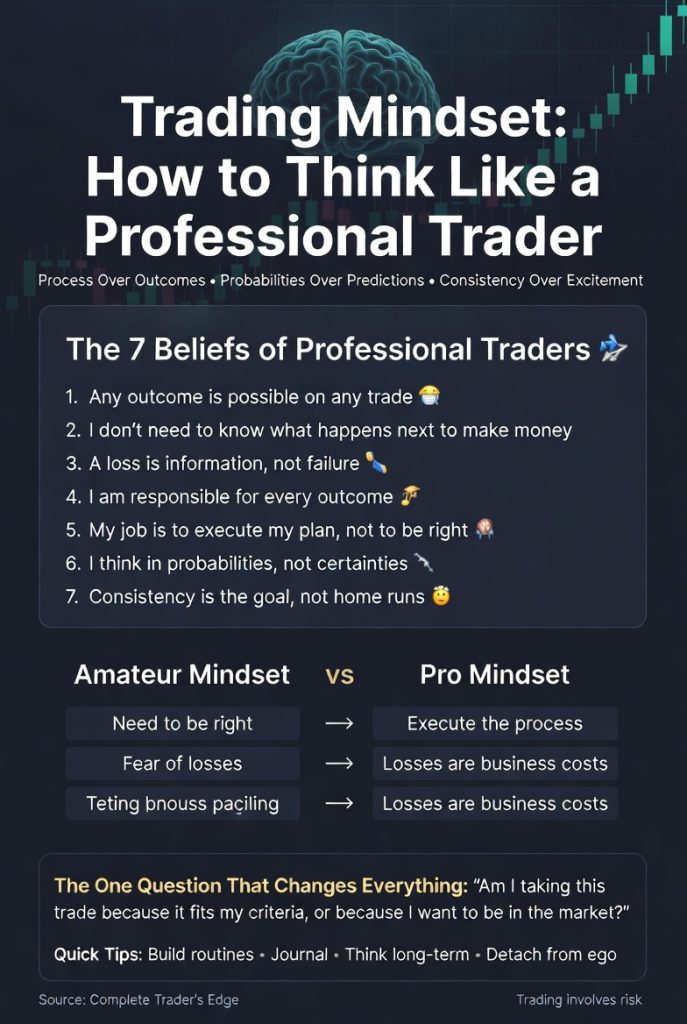
The Seven Beliefs of the Professional Trader
1. “Any outcome is possible on any individual trade.”
A 70% win-rate strategy will still lose 3 out of every 10 trades. A 5-loss streak is statistically normal. Every trade is independent. No outcome is guaranteed.
2. “I don’t need to know what will happen next to make money.”
Profitable trading is about finding situations where the probability is in your favour and sizing risk appropriately. You can be wrong 40% of the time and still be profitable if your average winner is larger than your average loser.
3. “A loss is information, not failure.”
Every losing trade executed correctly — the right setup, the right risk, the plan followed — is not a failure. It’s the cost of doing business. What matters is whether you executed your process correctly, not whether any individual trade won or lost.
4. “I am responsible for every outcome.”
The market didn’t “do this to you.” You chose the entry, set the stop, sized the position. Radical personal responsibility is not just a psychological virtue — it’s a practical necessity. Without it, you cannot identify what needs to change.
5. “My job is to execute my plan, not to be right.”
The ego has no place in trading. The need to be right keeps you in losing trades, encourages overriding stop losses, and leads to paralysis. Being right is irrelevant. Executing your process is everything.
6. “I think in probabilities, not certainties.”
Every setup has an expected value over a large sample. Professional traders think in terms of their edge playing out over 100, 200, 500 trades — not over the next 5. This long-term thinking removes the emotional charge from any individual outcome.
7. “Consistency is the goal, not home runs.”
The traders who last are boring traders. They take the same setups, risk the same percentage, follow the same rules, day after day. The exciting trades — the big bets, the revenge trades — are the account killers.
Process-Based Identity
Most traders define themselves by outcomes. “I’m a good trader” when they win. “I’m terrible” when they lose. This outcome-based identity is psychologically destructive. The professional alternative: “I am a trader who follows my rules.” Whether this particular trade wins or loses is irrelevant to that identity. Your self-worth is not on the line with every position.
The Role of Routine in Mindset
Mindset is not just beliefs — it’s maintained through behaviour. The pre-session routine, the shutdown ritual, the consistent sleep schedule, the journal: these are not optional extras. They are the infrastructure that keeps your mental state consistent enough to execute your edge. Tiredness makes you impulsive. Stress makes you emotional. The professional trader manages their mental state with the same intentionality they manage their positions.
The One Question That Changes Everything
Before every trade, ask yourself: “Am I taking this trade because it genuinely fits my criteria, or am I taking it because I want to be in the market?” The honest answer to that question, taken seriously, will save your account more reliably than any indicator, any strategy, or any market secret ever could.
 The Complete Trader's Edge
The full Mind · Method · Money framework. 70 chapters.
View on Amazon →
The Complete Trader's Edge
The full Mind · Method · Money framework. 70 chapters.
View on Amazon →
 Market Mayhem
400 years of bubbles, crashes, and the pattern that keeps repeating.
Buy on Amazon →
Market Mayhem
400 years of bubbles, crashes, and the pattern that keeps repeating.
Buy on Amazon →
 Greatest Companies
How the world's greatest companies were built — and what traders learn from them.
View on Amazon →
Greatest Companies
How the world's greatest companies were built — and what traders learn from them.
View on Amazon →