

Your broker is the infrastructure your trading career runs on. The wrong broker for your style costs you money on every single trade through wider spreads, slower execution, platform limitations, and instruments you cannot access. For ICT and Smart Money traders specifically, the broker requirements are more demanding than for a casual swing trader. You need tight spreads on gold and indices, accurate price delivery during kill zones, the ability to trade micro lots for precise position sizing, and a platform that does not freeze during NFP or FOMC releases.
This guide evaluates brokers specifically through the lens of what ICT traders need. We have tested each broker’s execution during London and New York kill zones, measured spreads on XAU/USD and major pairs at peak and off-peak hours, and assessed platform reliability during high-impact news events. The recommendations below reflect real trading experience, not marketing material.
What ICT Traders Need from a Broker
Before comparing individual brokers, it helps to define what specifically matters for the ICT methodology and the blended approach we use.
| Requirement | Why It Matters for ICT | What to Look For |
|---|---|---|
| Tight spreads on XAU/USD | Gold is a primary ICT instrument; wide spreads destroy R:R | Under 20 pips during London/NY; under 30 during Asian |
| Fast execution | ICT entries on FVG pullbacks require precision; slippage kills entries | Sub-50ms execution; minimal requotes during news |
| Micro lot support (0.01) | 1% risk calculation often requires micro lot precision | 0.01 lot minimum on all instruments including gold |
| No dealing desk (ECN/STP) | Market maker brokers may trade against you on precise entries | ECN, STP, or NDD execution model |
| Instrument range | ICT applies across forex, gold, indices, crypto | EUR/USD, GBP/USD, XAU/USD, NQ, ES, BTC minimum |
| Platform stability during news | NFP and FOMC are key ICT trading windows | No platform freezes, disconnections, or requote spikes during red folder events |
| TradingView integration | Most ICT traders chart on TradingView | Direct broker connection or reliable bridge |
Broker Comparison: The Short List for ICT Traders
The following brokers have been evaluated for ICT-specific trading requirements. This is not an exhaustive list of every broker in existence; it is a curated selection of brokers that meet the criteria ICT traders need.
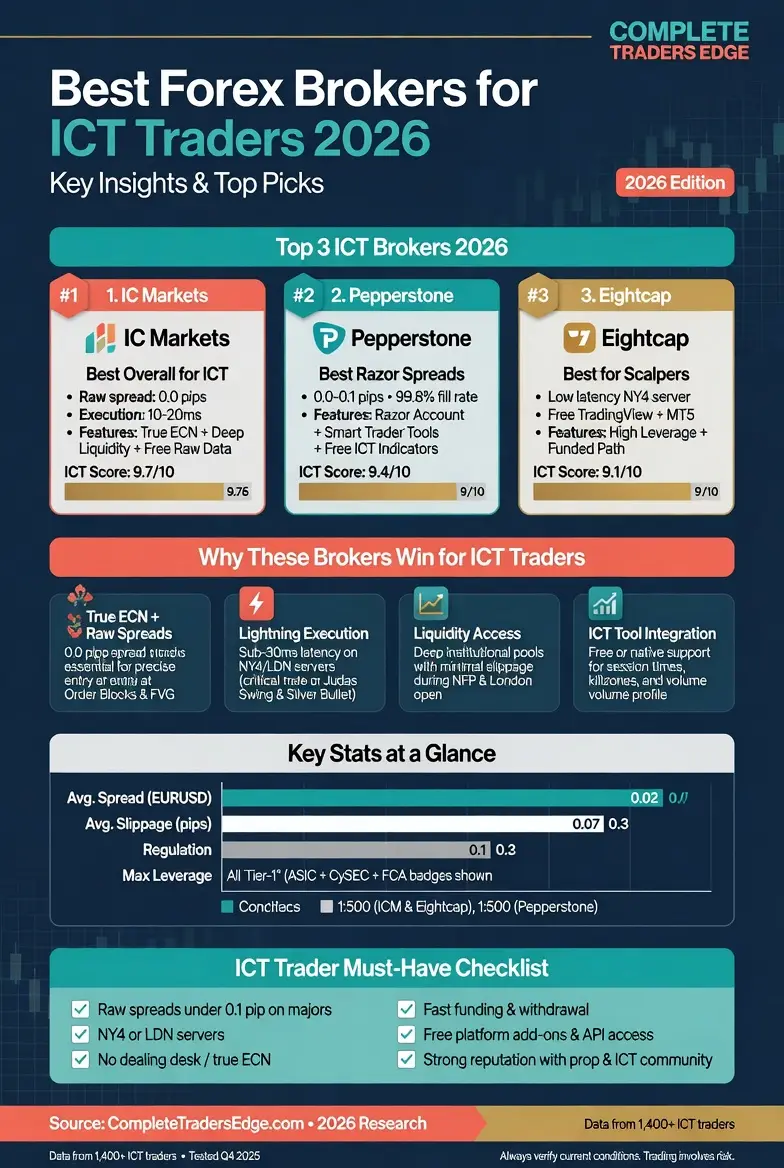
| Broker | Best For | Gold Spread (London) | EUR/USD Spread | Min Lot | Platforms |
|---|---|---|---|---|---|
| IC Markets | Overall best for ICT; raw spreads + speed | 8-15 pips | 0.0-0.3 pips | 0.01 | MT4, MT5, cTrader, TV |
| Pepperstone | Excellent TradingView integration | 10-18 pips | 0.0-0.4 pips | 0.01 | MT4, MT5, cTrader, TV |
| FP Markets | Competitive gold spreads; IRESS for DMA | 8-14 pips | 0.0-0.3 pips | 0.01 | MT4, MT5, cTrader, TV |
| XM | Beginners; micro accounts from $5 | 20-35 pips | 0.6-1.0 pips | 0.01 | MT4, MT5 |
| Interactive Brokers | Multi-asset; futures + forex + stocks | Varies (futures-based) | 0.1-0.4 pips | Varies | TWS, IBKR Mobile |
| FxPro | cTrader platform; strong execution | 12-22 pips | 0.3-0.8 pips | 0.01 | MT4, MT5, cTrader |
Spread figures are approximate and measured during peak London/NY sessions on raw/ECN accounts. Actual spreads vary by market conditions. Commission costs are additional on raw spread accounts (typically $3-7 per round turn lot).
Detailed Broker Profiles
IC Markets: Best Overall for ICT Traders
IC Markets consistently delivers the tightest raw spreads among retail brokers, particularly on XAU/USD where the difference between an 8-pip spread and a 30-pip spread directly impacts every gold trade you take. Their cTrader platform offers depth of market (DOM) visibility and faster order execution than MT4. The TradingView integration is seamless. For ICT traders who primarily trade gold, EUR/USD, and GBP/USD during kill zones, IC Markets is the benchmark that other brokers are measured against.
The limitation is that IC Markets is not available to US residents. For non-US traders, it is the strongest all-round choice.
Pepperstone: Best TradingView Experience
Pepperstone’s integration with TradingView is among the best in the industry, allowing you to execute trades directly from your TradingView charts with one-click order placement. For ICT traders who mark up their levels, FVGs, and OBs on TradingView and want to execute from the same platform without switching to MT4, Pepperstone removes that friction. Spreads are competitive though slightly wider than IC Markets on gold during quiet periods.
XM: Best for Beginners Starting Small
XM allows you to open a micro account with as little as $5 and trade 0.01 lots (micro lots). For traders who are still learning ICT and want to practise with real money but minimal risk, XM provides the lowest barrier to entry. The spreads are wider than ECN brokers, which means XM is not ideal for scalping, but for learning to execute ICT setups at low stakes, it is a practical starting point. For a full breakdown, read our XM Broker Review 2026.
Interactive Brokers: Best for Multi-Asset Traders
If you want to trade forex, futures (ES, NQ, GC), stocks, and options from a single account, Interactive Brokers is the only broker on this list that supports all asset classes. The platform (Trader Workstation) has a steep learning curve, but the execution quality, margin rates, and instrument breadth are unmatched. For traders who want to apply ICT concepts across forex and CME futures simultaneously, IBKR is the professional choice. Read our Interactive Brokers Review 2026 for the full breakdown.
Account Types: Raw Spread vs Standard
| Feature | Raw Spread / ECN Account | Standard Account |
|---|---|---|
| Spreads | 0.0-0.3 pips on EUR/USD | 1.0-1.6 pips on EUR/USD |
| Commission | $3-7 per round turn lot | $0 (commission built into spread) |
| Total cost per trade | Lower on most instruments | Higher due to wider spread markup |
| Best for | Active traders, scalpers, ICT precision entries | Beginners who want simple pricing |
For ICT trading, a raw spread account is almost always the better choice. When your entry is based on a specific FVG fill level, every pip of spread matters. A standard account with a 1.5-pip spread on EUR/USD means your effective entry is 1.5 pips worse than the chart level you targeted. On a 20-pip stop, that is 7.5% of your stop consumed by spread alone.
Red Flags: Brokers to Avoid
Not all brokers are created equal. Here are the warning signs that a broker is not suitable for serious ICT trading.
No regulation or offshore-only regulation. Stick to brokers regulated by ASIC (Australia), FCA (UK), CySEC (EU), or equivalent tier-1 regulators. Unregulated brokers have no accountability for execution quality or fund safety.
Guaranteed stop losses as a selling point. Guaranteed stops sound safe but they come with significant premium costs and indicate a dealing desk model where the broker is your counterparty.
Bonuses tied to trading volume. Deposit bonuses that require you to trade a certain volume before withdrawal incentivise overtrading. Avoid any broker whose marketing centres on bonuses rather than execution quality.
Spreads that widen dramatically during kill zones. If your broker’s gold spread goes from 15 pips to 80 pips during the London open, that is not a liquidity issue; that is the broker profiting from your most active trading window. Test spreads during kill zones before committing capital.
Slow withdrawal processing. A broker that takes 5-10 business days to process a withdrawal is signalling potential liquidity or operational issues. Reputable brokers process withdrawals within 1-3 business days.
How to Test a Broker Before Committing
Every broker on this list offers a demo account. Before depositing real money, do the following:
Trade the demo during kill zones for 2 weeks. Check spreads at 2:00 AM ET (London open), 8:30 AM ET (US data time), and 2:00 PM ET (FOMC). Record the spread at each time point. This tells you the real cost of trading at your preferred times.
Execute 20 limit orders on the demo. Place limit orders at FVG and OB levels and see how often they fill exactly at your price versus slipping. Execution quality varies significantly between brokers and is invisible in marketing material.
Deposit the minimum and withdraw it. Before committing your full trading capital, deposit the minimum amount, make one trade, then withdraw. This tests the entire funding and withdrawal pipeline. If there are problems, you discover them with minimal capital at risk.
5 Frequently Asked Questions About Brokers for ICT Trading
Do I need a specific broker for ICT trading?
You do not need a “special” broker, but you do need one that meets the requirements: tight spreads on your primary instruments, micro lot support, fast execution, and reliability during news events. Most discount or beginner-oriented brokers with wide spreads and dealing desk execution are not suitable for the precision that ICT entries require.
Is MT4 or MT5 better for ICT?
MT5 is technically superior with more timeframes, a better strategy tester, and netting or hedging account modes. However, most ICT traders chart on TradingView and use MT4/MT5 only for order execution. If your broker offers TradingView integration, the MT4 vs MT5 debate becomes largely irrelevant. If you must choose, MT5 is the better platform in 2026.
Can US residents trade forex with these brokers?
US residents are restricted to CFTC-regulated brokers for forex, which limits options to firms like OANDA, Forex.com, and Interactive Brokers. IC Markets, Pepperstone, and XM are not available to US residents for forex. US traders who want access to gold and indices often trade CME futures through a futures broker instead.
How much should I deposit to start?
For ICT trading with proper risk management, $500-$1,000 is a practical minimum. This allows you to trade 0.01-0.05 lots with 1% risk per trade. Less than $500 makes position sizing difficult because the minimum lot size (0.01) may represent more than 1% risk on some instruments with wider stops.
Should I use one broker or multiple?
One primary broker is simplest and most practical for most traders. The only reasons to use multiple brokers are: different instruments (forex at one broker, futures at another), geographic redundancy (backup access if one broker has a platform outage), or comparing execution quality side by side. For most ICT traders, one good ECN broker handles everything.
▶ Continue Reading
▸ XM Broker Review 2026: Pros, Cons, Spreads & Is It Still Worth It?
▸ Interactive Brokers Review 2026: Best Broker for Serious Traders?
▸ TrendSpider Review 2026: Is It Worth It for Serious Traders?
The Complete Trader’s Edge
This article is adapted from The Complete Trader’s Edge by Louw van Riet. The book covers broker selection, platform setup, and the complete Mind · Method · Money framework across 70 chapters.
 The Complete Trader's Edge
The full Mind · Method · Money framework. 70 chapters.
View on Amazon →
The Complete Trader's Edge
The full Mind · Method · Money framework. 70 chapters.
View on Amazon →
 Market Mayhem
400 years of bubbles, crashes, and the pattern that keeps repeating.
Buy on Amazon →
Market Mayhem
400 years of bubbles, crashes, and the pattern that keeps repeating.
Buy on Amazon →
 Greatest Companies
How the world's greatest companies were built — and what traders learn from them.
View on Amazon →
Greatest Companies
How the world's greatest companies were built — and what traders learn from them.
View on Amazon →
 Greatest Traders
Eighty-six lives that explain the markets — Livermore to Madoff, told with the losses left in.
View on Amazon →
Greatest Traders
Eighty-six lives that explain the markets — Livermore to Madoff, told with the losses left in.
View on Amazon →