

INSIDE THE MACHINE · EP. 1
The Middleman: Market Makers and the Hidden Spread
How Markets Really Work — Episode 1
| Listen on Spotify | Watch on YouTube |
Also available on Apple Podcasts · Amazon Music · iHeart Radio
You have never traded alone. Every order you have ever placed — every buy, every sell, every stop that triggered in the middle of the night — had a counterparty. Someone, or something, on the other side of your trade. And in the vast majority of cases, that counterparty knew more about the current state of the market than you did at the moment of execution.
This is not a conspiracy. It is a business. And understanding it is the difference between trading blind and trading with your eyes open.
This is Episode 1 of Inside the Machine: How Markets Really Work — the podcast series covering the hidden infrastructure behind every market you trade.
What Is a Market Maker?
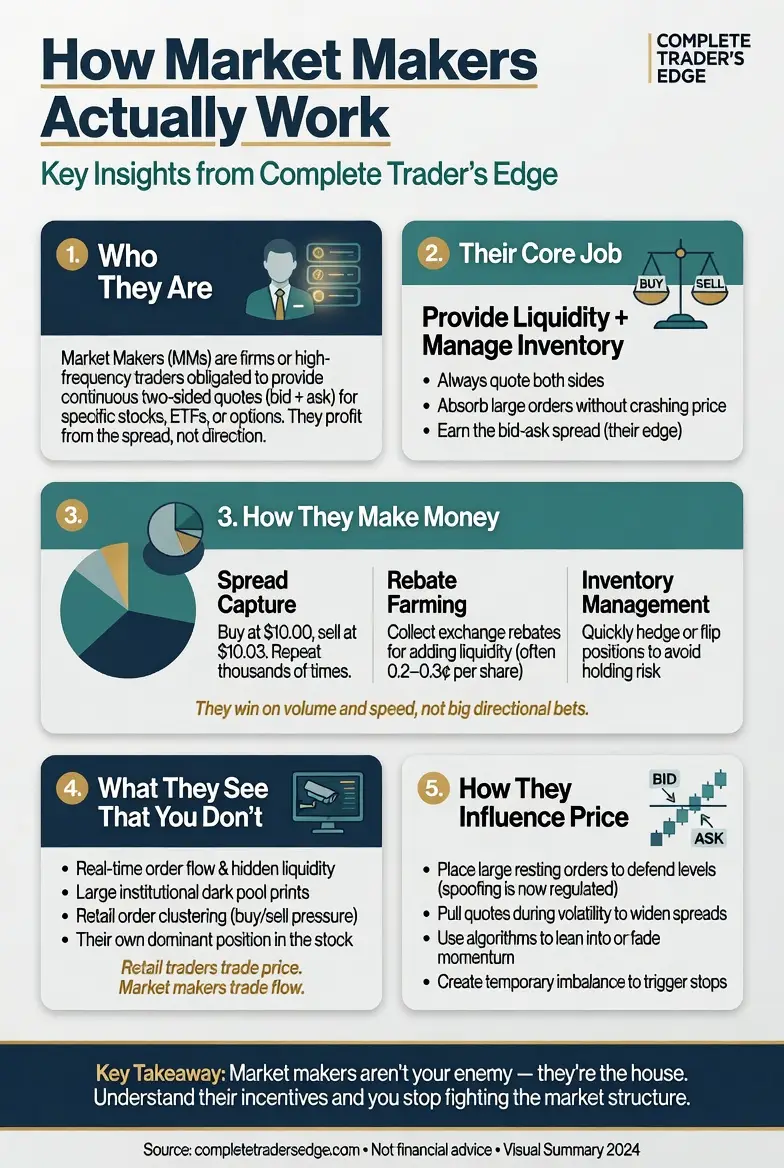
Every market you have ever traded has a market maker. Sometimes called a dealer, sometimes a liquidity provider — the names vary, the function is always the same: to stand between buyers and sellers, quote a price at which they will buy and a price at which they will sell, and profit from the difference between those two prices.
That difference is called the spread. And the spread is the first, most fundamental cost of every trade you place — whether you see it or not.
Here is how it works in practice. You open your trading platform. EUR/USD is quoted at 1.0847 bid, 1.0849 ask. The bid is the price at which the market maker will buy from you. The ask is the price at which they will sell to you. You want to buy, so you pay 1.0849. The market maker immediately holds a position worth 1.0847 — the spread — in their favour. Two pips. Before the market has moved a single tick, you are already behind by the cost of the spread.
In liquid markets like EUR/USD or S&P 500 futures, spreads are tight — a pip, maybe two. In less liquid markets — exotic pairs, small-cap stocks, low-volume options — spreads widen dramatically. The market maker takes more, because the risk is higher and the competition to provide liquidity is lower.
Who the Real Market Makers Are Today
Before the late 1990s, market making in equity markets was dominated by human specialists on exchange floors — assigned to specific stocks, obligated to maintain orderly markets. They had real information advantages: they could see the full order book and knew where stops were clustered.
Electronic trading changed everything. Specialists were replaced by algorithmic market makers — firms like Citadel Securities, Virtu Financial, Jane Street, and Two Sigma Securities. These are not household names to most retail traders. They are among the most profitable financial firms on earth.
Citadel Securities alone handles approximately 25 percent of all US equity volume. One firm. One in four trades in the entire US stock market. When you buy Apple shares, there is roughly a one-in-four chance that Citadel Securities is on the other side of your trade, capturing the spread, and moving on to the next thousand transactions before your fill confirmation has loaded on your screen.
These firms operate at speeds that have nothing to do with human decision-making. Microseconds. Their algorithms receive market data, process it, update quotes, execute trades, and hedge resulting positions in timeframes measured by how fast light travels through fibre-optic cable. The competitive advantage in algorithmic market making is not analytical edge — it is infrastructure. Physical proximity to exchange servers. Faster hardware. Lower latency.
The Flash Crash: When the Market Makers Switched Off
On May 6, 2010, the US equity market experienced what became known as the Flash Crash. Between 2:32 and 2:45pm, the Dow Jones Industrial Average fell nearly a thousand points — approximately nine percent — in thirteen minutes. Individual stocks traded at absurd prices. Accenture briefly traded at one cent. Other stocks traded at $100,000 or more.
The Flash Crash happened because of the relationship between algorithmic market makers and the liquidity they provide.
On a normal day, algorithmic market makers quote continuously, creating the appearance of deep, stable markets. On May 6, as a large selling programme overwhelmed the market, the algorithmic market makers did something very human: they stopped. Their risk management systems detected conditions outside their normal parameters. They pulled their quotes. The bids that had made the market look deep simply disappeared.
The market did not crash because of excessive selling. It crashed because the buyers — the algorithmic market makers providing the appearance of liquidity — switched off simultaneously. Prices fell not because sellers were pushing them down, but because there were no bids to catch them.
The Flash Crash lasted thirty-six minutes. Prices recovered almost entirely by the end of the day. But those thirty-six minutes revealed something important: the liquidity modern electronic markets depend on is not structural — it is conditional. Market makers provide it when conditions are normal and profitable. They withdraw it when they are not.
Adverse Selection: What Your Order Flow Signals
The market maker’s business model has two sides worth understanding — because both affect you directly.
The first is the spread: the cost you pay on every entry. The second is adverse selection — the market maker’s greatest risk is not volatility, but ending up on the wrong side of a trade placed by someone with better information. Being on the wrong side of informed trades consistently destroys spread income.
The response to adverse selection is quote adjustment. When a market maker detects informed order flow, they widen their spreads or pull quotes entirely. When they detect uninformed retail flow, they tighten spreads and provide more liquidity — because the expected profitability is higher.
This is why retail traders often get better apparent execution than large institutional traders moving the same capital. The retail order looks safe. The institutional order looks risky.
What This Means for Your Trading
Always account for the spread in your trade planning. Before you enter, know the spread cost. Add it to your entry price for longs, subtract it from your exit. A trade that looks like two-to-one risk-reward on the chart becomes less once entry and exit spread costs are applied. This matters more in less liquid instruments, but it matters everywhere.
Understand that market depth is a snapshot, not a guarantee. The bids you see in the order book can disappear. In high-volatility moments — major news events, data releases, unexpected shocks — that depth can evaporate faster than you can act. Size your positions and plan your exits with that in mind.
Think about what your order flow signals. Are you trading reactively, chasing moves after they have already happened? That pattern is identifiable. Or are you trading from a defined method, with predetermined entries, specific risk parameters, and genuine analytical work behind each position? The second type of trader is harder to exploit and harder to read. The gap between these two profiles is not a gap in luck — it is a gap in preparation and discipline.
The market maker is not your enemy. They provide an essential service. But they are not neutral either. Understanding their role, their incentives, and the conditions under which they withdraw is foundational knowledge for anyone who trades actively.
You have never traded alone. Now you know who was on the other side.
Frequently Asked Questions About Market Makers
What is a market maker in trading?
A market maker is a firm or individual that continuously quotes buy and sell prices in a financial instrument, profiting from the spread between the two. They provide liquidity — ensuring there is always a counterparty available when you want to trade — in exchange for the spread cost paid by traders on every transaction.
How do market makers make money?
Market makers profit primarily from the bid-ask spread: the difference between the price they will buy at and the price they will sell at. On a high volume of transactions, even very small spreads generate significant revenue. They also manage the inventory risk of holding positions between transactions through hedging in related instruments.
Who are the biggest market makers in equities?
The dominant algorithmic market makers in US equities include Citadel Securities (approximately 25% of US equity volume), Virtu Financial, Jane Street, Two Sigma Securities, and Susquehanna International Group. These firms replaced the human specialists who previously dominated exchange floors.
What caused the Flash Crash of 2010?
The Flash Crash on May 6, 2010 was triggered by a large automated sell programme in E-mini S&P 500 futures that created a feedback loop with other algorithms. As prices fell, algorithmic market makers withdrew their quotes simultaneously, removing the liquidity that had made the market appear deep. With no bids available, prices fell to absurd levels — Accenture traded at $0.01 — before recovering when a brief trading pause broke the feedback loop.
What is adverse selection in trading?
Adverse selection refers to the risk a market maker takes of trading against a counterparty with better information. If a market maker consistently fills orders from informed traders — institutional investors acting on research, or systematic algorithms with genuine edge — they will lose more on those trades than they earn from the spread. Market makers respond by widening spreads or withdrawing quotes when they detect potentially informed order flow.
Continue Learning
Related Episodes and Articles
▸ Market Mayhem EP01: Tulip Mania — The world’s first financial bubble and the trading lessons that still apply
▸ Position Sizing and Risk Management — Why understanding execution costs matters
▸ The Mind · Method · Money Framework — The three pillars of trading success
The Complete Trader’s Edge
Understanding your trading environment — including the role of market makers and the true cost of every trade — is part of the Method pillar. The book covers execution mechanics, spread management, and how to build a method that operates at a structural advantage.
 The Complete Trader's Edge
The full Mind · Method · Money framework. 70 chapters.
View on Amazon →
The Complete Trader's Edge
The full Mind · Method · Money framework. 70 chapters.
View on Amazon →
 Market Mayhem
400 years of bubbles, crashes, and the pattern that keeps repeating.
Buy on Amazon →
Market Mayhem
400 years of bubbles, crashes, and the pattern that keeps repeating.
Buy on Amazon →
 Greatest Companies
How the world's greatest companies were built — and what traders learn from them.
View on Amazon →
Greatest Companies
How the world's greatest companies were built — and what traders learn from them.
View on Amazon →
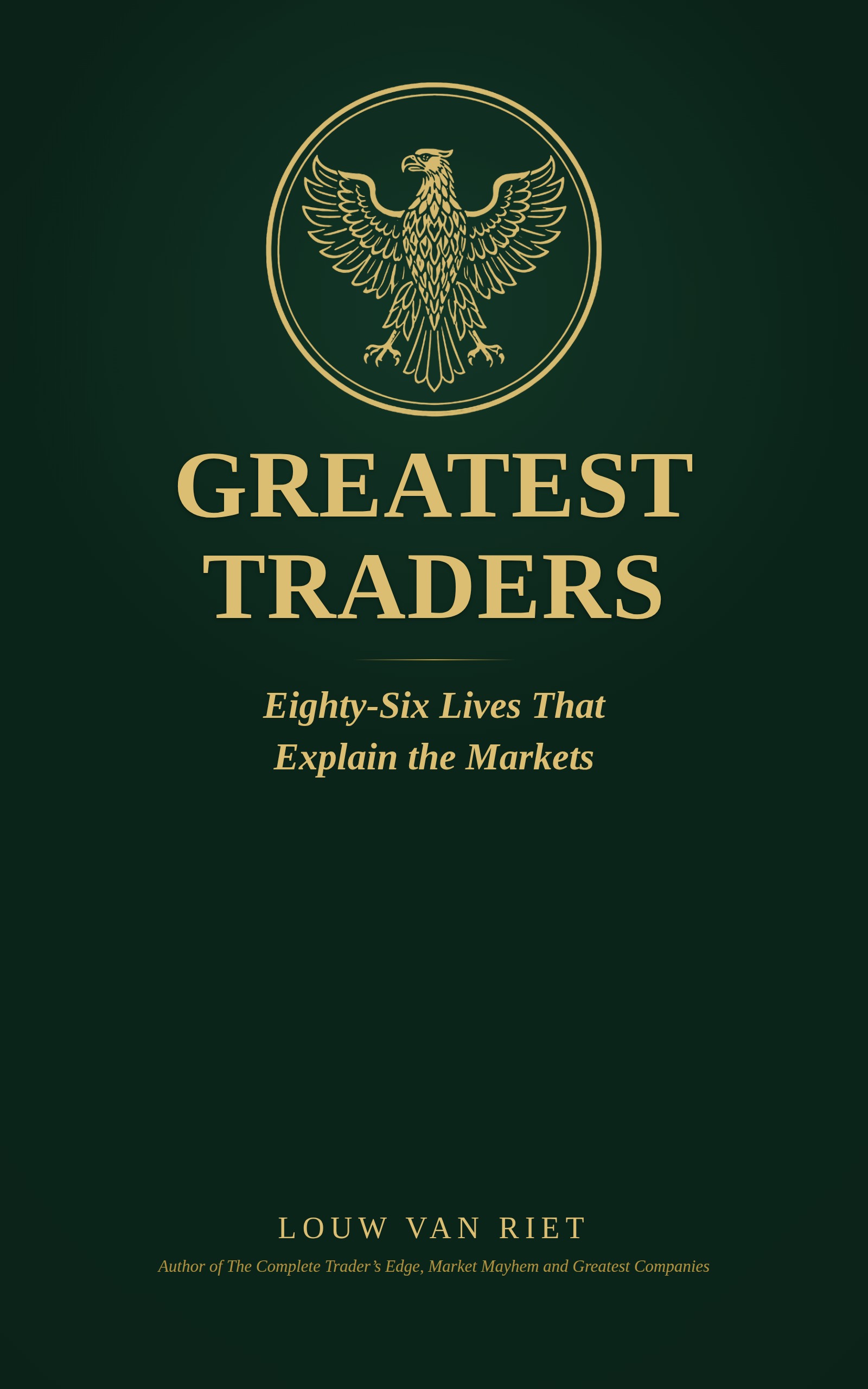 Greatest Traders
Eighty-six lives that explain the markets — Livermore to Madoff, told with the losses left in.
View on Amazon →
Greatest Traders
Eighty-six lives that explain the markets — Livermore to Madoff, told with the losses left in.
View on Amazon →