

Most retail traders lose money not because they lack a strategy but because they execute that strategy at the wrong time of day. They take valid setups during the Asian consolidation and wonder why price ranges instead of trending. They chase moves during the US afternoon and get chopped out of perfectly good positions. They miss the London open entirely because they did not know it was the most reliably directional 90 minutes in the entire trading week.
ICT Kill Zones are the solution to this problem. They are specific time windows when institutional participants are most active, when the largest orders are being executed, and when your setups carry the highest probability of working. This guide covers every Kill Zone in detail, the instruments each one suits, how to structure your trading day around them, and the exact pre-session routine that positions you to take maximum advantage of each window.
Why Time of Day Matters More Than Most Traders Realise
The financial markets do not operate uniformly across the 24-hour cycle. Volatility, liquidity, trend reliability, and false break frequency all vary dramatically depending on which institutional participants are active. The same setup that produces a clean 3R move during the London Kill Zone may produce a frustrating chopfest at 2 AM UTC when only algorithmic positioning activity is running.
This is not random. Institutions operate on schedules. Banks execute client orders during business hours. Algorithmic systems are programmed to trade during high-liquidity periods when their order execution has minimal market impact. Central bank communications and major economic releases are always timed to coincide with active sessions. The result is that price movement clusters predictably around specific windows every single day.
| Session / Period | GMT hours | ET hours | Character |
|---|---|---|---|
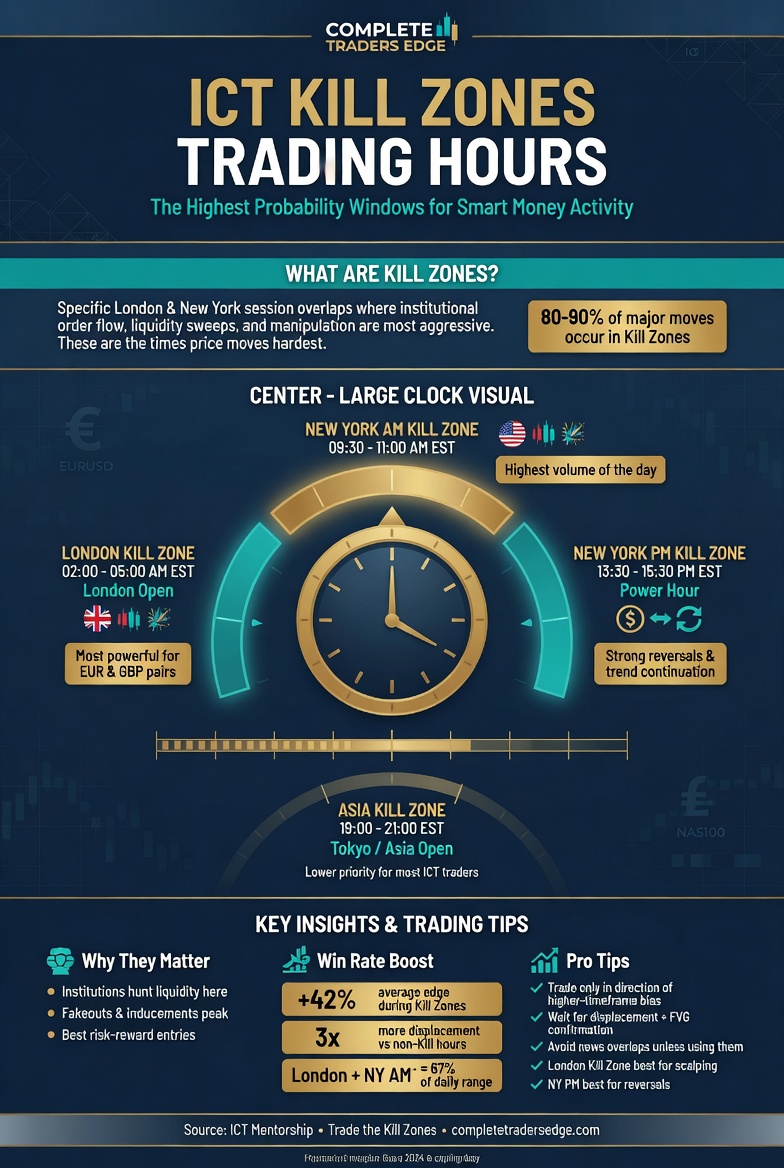
| Asian session | 00:00 – 08:00 | 19:00 – 03:00 | Range-bound, lower volume, liquidity accumulation |
| London Kill Zone | 07:00 – 10:00 | 02:00 – 05:00 | Highest probability directional moves, Judas Swing |
| New York Kill Zone | 12:00 – 15:00 | 07:00 – 10:00 | Highest volume, extends or reverses London move |
| London Close Kill Zone | 15:00 – 17:00 | 10:00 – 12:00 | Position squaring, often produces reversals |
| Dead zones (avoid) | 17:00 – 22:00 and 00:00 – 07:00 (excl. Asia) | 12:00 – 19:00 | Low volume, wide spreads, choppy, unreliable |
The practical implication is immediate: a trader who restricts their entries to the three Kill Zones and avoids the dead zones will, over a large sample, see meaningfully better results from the same strategy than one who trades at any hour. This is a free edge that costs nothing to implement except schedule discipline.
The Asian Session: Accumulation and Liquidity Building
The Asian session runs from approximately midnight to 8 AM GMT (7 PM to 3 AM ET). The Tokyo session is the primary driver during this window, with JPY pairs, AUD and NZD seeing the most relevant activity.
For traders focused on Gold, the major indices (ES, NQ), GBP, or EUR, the Asian session serves a different but critical purpose: it is the liquidity-building period that London will target. During the Asian session, price typically ranges within a defined high and low. This range is not random. It represents the accumulation of stop losses above the session high and below the session low — retail traders’ positions that London institutions will sweep before the real directional move begins.
How to use the Asian session range
Mark the Asian session high and low before the London open. These two levels are your primary liquidity reference points for the London Kill Zone. The most reliable scenario: London opens, sweeps one side of the Asian range (collecting those stop losses), then reverses and drives strongly in the opposite direction for the majority of the day’s move. This is the ICT Judas Swing — the false opening move designed to trap early session participants before institutional order flow reveals the true daily direction.
You do not need to trade during the Asian session to use it. You need to observe it. The range it creates is the map for what comes next.
London Kill Zone (02:00–05:00 ET / 07:00–10:00 GMT)
The London Kill Zone is the most important trading window of the day for most instruments. London is the largest forex trading centre in the world by volume, and the three hours following the London open consistently produce the most reliable, sustained directional moves of the entire 24-hour cycle.
What happens during the London Kill Zone
European institutional participants enter the market fresh with the full context of overnight Asian activity and any pre-market news. The large order flow they bring creates genuine directional displacement — moves that are fast, have clear structure, and tend to continue rather than immediately reverse.
The standard London Kill Zone sequence for a bullish day:
- Price opens the London session near the lower end of the Asian range or just below the Asian range low.
- In the first 30 to 60 minutes, price sweeps below the Asian range low, triggering stop losses that had accumulated overnight.
- The sweep creates a liquidity grab — institutions fill their buy orders against the retail stop losses being triggered.
- Price reverses sharply above the Asian range low, confirming the sweep, and begins the true daily move higher.
- The entry point is in the FVG or Order Block created by the reversal candle, with a stop below the sweep low.
On a bearish day, the mirror applies: price sweeps above the Asian range high, collecting buy stops, then reverses lower for the day’s move.
Best instruments for the London Kill Zone
| Instrument | London Kill Zone suitability | Notes |
|---|---|---|
| Gold (XAU/USD) | Excellent | London open often establishes Gold’s daily direction. Asian range sweeps are highly reliable. |
| GBP/USD, GBP/JPY | Excellent | UK banking session. Highest GBP volatility window of the day. |
| EUR/USD | Excellent | European institutional participation. Clear directional moves. London open is the primary EUR window. |
| ES, NQ (index futures) | Good | US futures begin early pre-market activity. Less dominant than NY Kill Zone for indices. |
| BTC/USD | Good | Crypto is influenced by London activity, particularly during periods of macro uncertainty. |
New York Kill Zone (07:00–10:00 ET / 12:00–15:00 GMT)
The New York Kill Zone covers the US market open and the London-New York overlap. By volume, this is the most liquid three-hour period in the entire trading week. Every major US economic release — NFP, CPI, FOMC, GDP — is scheduled to drop during or just before this window. The confluence of European and North American institutional participation creates the widest ranges, the strongest trend moves, and the most decisive price delivery of the day.
Two scenarios: continuation and reversal
The New York Kill Zone does one of two things relative to the London move:
Continuation: If London established a clear directional move and the New York open confirms the same bias — price continues in the London direction, often accelerating into the NY session’s liquidity sweep pattern before extending. This is the highest-conviction scenario and the one to trade with full size.
Reversal: If London produced a large move that overextended or was driven by a news spike without clean institutional structure, the New York Kill Zone frequently reverses it. Price sweeps the London session high or low, collects the stop losses that accumulated during London’s move, and then reverses back through the London range. These reversals can be extremely fast and volatile.
Determining which scenario is likely before the session opens is the core pre-session analytical task. The Daily and 4H structure, the position of price relative to key levels, and the presence of unfilled FVGs or liquidity above/below the current price all contribute to this determination.
Best instruments for the New York Kill Zone
| Instrument | NY Kill Zone suitability | Notes |
|---|---|---|
| NQ (Nasdaq futures) | Excellent | The primary NQ window. Most significant moves originate at or just after the NY open. |
| ES (S&P 500 futures) | Excellent | Same as NQ. NY session open is the most reliable window for ES directional moves. |
| Gold (XAU/USD) | Excellent | Gold moves significantly at the NY open, often continuing or reversing the London move. |
| EUR/USD, GBP/USD | Good | London-NY overlap is liquid for forex. US data releases drive sharp moves. |
| BTC/USD | Good | NY open often triggers Bitcoin moves, especially during macro-sensitive periods. |
London Close Kill Zone (10:00–12:00 ET / 15:00–17:00 GMT)
The London Close Kill Zone is the period when European banks close their books for the day. Position squaring, hedge adjustment, and end-of-day order execution create a final burst of activity that often produces sharp short-term moves — but with different characteristics from the earlier Kill Zones.
The London Close frequently produces reversals or consolidation after the directional moves of the morning. European participants exiting positions can temporarily reverse the day’s established direction before the true direction resumes. For intraday traders, the London Close is more commonly an exit window — taking profits on trades entered during London or NY Kill Zones — than a new entry window.
Where the London Close does produce genuine entries: if a significant HTF level (Order Block, Daily FVG, major pivot) aligns with the London Close timing, and the morning’s moves have swept liquidity cleanly, the London Close can produce a high-quality continuation entry into the final phase of the day’s move.
The Dead Zones: When Not to Trade
Two periods consistently produce the lowest-quality trading conditions:
US afternoon / NY continuation (12:00–19:00 ET / 17:00–00:00 GMT): After the London Close, volume drops significantly as European participants exit. The remaining NY session is driven by position management rather than fresh institutional order flow. Price tends to range, consolidate, or retrace the day’s moves in choppy, unpredictable patterns. Setups that look valid on the chart frequently fail or produce small, uncommitted moves.
Pre-London dead zone (00:00–07:00 GMT / 19:00–02:00 ET): The period between the NY close and the London open is the lowest-volume window of the trading week. Spreads widen. Any moves during this period are low-conviction and frequently reversed entirely at the London open. This is the period that should be spent on sleep, preparation, or review — not trading.
The discipline of not trading during dead zones is as valuable as the discipline of trading well during Kill Zones. Many of the worst decisions in trading happen during low-volume periods where boredom or impatience drives entries that should never be taken.
Building Your Kill Zone Trading Schedule
Your trading schedule should be built around three questions: which instruments do you trade, which Kill Zones are most relevant to those instruments, and what hours do you have available?
| Trader profile | Recommended Kill Zone focus | Primary instruments |
|---|---|---|
| Europe-based trader | London Kill Zone (primary), NY Kill Zone (first hour) | Gold, GBP/USD, EUR/USD |
| US East Coast trader | NY Kill Zone (primary), London Close | NQ, ES, Gold, GBP/USD |
| US West Coast / Asia-Pacific trader | London Kill Zone (early morning) or NY Kill Zone (late morning) | Gold, forex majors |
| South Africa / East Africa (SAST/EAT) | London Kill Zone (09:00-12:00 SAST), NY Kill Zone (14:00-17:00 SAST) | Gold, GBP, indices |
| Swing trader only | Daily chart review, enter on Daily FVG/OB during any Kill Zone | All instruments, daily timeframe |
The Pre-Kill Zone Routine
What you do in the 30 minutes before a Kill Zone opens determines the quality of your decisions during it. The traders who enter Kill Zones with clear structure marked, bias confirmed, and levels identified take better trades than those who open their chart as the session begins and try to read structure in real time.
The pre-Kill Zone routine covers five items:
- Daily and 4H bias confirmed. What is the overall direction? Is price in a premium or discount area? Are we approaching a major HTF level?
- Asian range marked (for London Kill Zone). Where are the Asian session high and low? These are the immediate liquidity targets.
- Key levels identified. Order Blocks, FVGs, pivots, and Volume Profile levels on the 1H and 4H charts, marked before the session opens.
- News events noted. Economic calendar checked. Red-folder events within the Kill Zone window identified. Position size adjusted or no-trade window noted if high-impact.
- Scenario planning complete. Two scenarios prepared: if price does X, I am looking for Y entry. If price does A first, I expect B setup. This eliminates real-time decision-making and lets you execute against a pre-written plan.
Frequently Asked Questions
What exactly is a Kill Zone in ICT trading?
A Kill Zone is a specific time window when institutional participants are most actively executing orders, creating the highest-probability conditions for directional price moves. The three primary Kill Zones are the London open (02:00-05:00 ET / 07:00-10:00 GMT), the New York open (07:00-10:00 ET / 12:00-15:00 GMT), and the London close (10:00-12:00 ET / 15:00-17:00 GMT). ICT methodology uses these windows as time filters — entries are primarily sought during Kill Zones, and trading outside them is avoided or significantly reduced.
Which Kill Zone is the best for Gold trading?
The London Kill Zone is generally the most reliable for Gold. The London open establishes Gold’s daily directional bias more often than any other session, and the Asian range sweep pattern — where London sweeps the overnight low or high before the true daily move — is highly consistent on Gold. The New York Kill Zone is the second best, particularly on days with US economic releases (CPI, NFP, FOMC) that directly affect precious metals pricing. Day traders focused on Gold should prioritise being available for both the London and New York Kill Zones.
Do Kill Zones work for all instruments or just forex?
Kill Zones apply to all liquid markets. For forex pairs, the London Kill Zone is most relevant for EUR, GBP, CHF and Gold. For US equity indices (NQ, ES), the New York Kill Zone is the primary window. For Bitcoin and other major cryptocurrencies, both London and New York Kill Zones produce the most significant moves, though crypto’s 24/7 nature means there is also influence from Asian session institutional activity, particularly around Hong Kong and Singapore trading hours. The principle is universal: trade when the relevant institutional participants are most active for your specific instrument.
What time zone should I use to track Kill Zones?
Eastern Time (ET/EST/EDT) is the reference time zone used in ICT methodology for Kill Zone definitions, which aligns with New York market hours. GMT/UTC is also commonly used as a universal reference. Whatever time zone your platform displays, simply convert: London Kill Zone = 07:00-10:00 GMT = 02:00-05:00 ET. New York Kill Zone = 12:00-15:00 GMT = 07:00-10:00 ET. Most charting platforms, including TradingView, allow you to set the chart to any time zone, and many ICT traders use New York or their local time zone with Kill Zone sessions clearly visible.
Can I trade profitably only targeting one Kill Zone per day?
Absolutely — and for many traders, this is the right approach. Focusing exclusively on one Kill Zone per day, thoroughly prepared and with your full analytical process applied, produces better results than trying to trade all three Kill Zones with divided attention. If your schedule allows only the New York Kill Zone, master that window on NQ and Gold. If you can only access the London Kill Zone, focus on Gold and EUR/GBP pairs. Depth in one window beats breadth across all three.
▶ ▶ ▶ Continue Reading
Build the complete ICT framework
The Complete Trader’s Edge
Kill Zones and the Session Map are covered in Chapter 43
The complete ICT and Smart Money framework across 30+ Method chapters — sessions, Kill Zones, liquidity sweeps, FVGs, Order Blocks, AMD cycles and the full blended approach that combines institutional structure with Volume Profile, AVWAP and Fibonacci. Available on Amazon in Kindle, paperback and full-colour editions.
 The Complete Trader's Edge
The full Mind · Method · Money framework. 70 chapters.
View on Amazon →
The Complete Trader's Edge
The full Mind · Method · Money framework. 70 chapters.
View on Amazon →
 Market Mayhem
400 years of bubbles, crashes, and the pattern that keeps repeating.
Buy on Amazon →
Market Mayhem
400 years of bubbles, crashes, and the pattern that keeps repeating.
Buy on Amazon →
 Greatest Companies
How the world's greatest companies were built — and what traders learn from them.
View on Amazon →
Greatest Companies
How the world's greatest companies were built — and what traders learn from them.
View on Amazon →