

If you had to identify the single most important variable in your long-term trading performance, position sizing would be the answer. Not your entry signal. Not your exit strategy. Not your indicator setup. How much you risk per trade determines whether you survive long enough for your edge to pay off — and how much you make when it does.
Two traders with identical strategies, identical win rates, and identical average winners can produce radically different results based solely on how they size their positions. The first, risking 1% per trade, compounds steadily and survives the inevitable losing streaks. The second, risking 5% per trade, blows through their capital during a statistically normal drawdown. Same strategy. Different survival rates. The difference is entirely in this one decision.
Why Position Sizing Determines Everything
Your entry determines whether you are right or wrong. Your position size determines what being wrong costs you. In a game where being wrong 40–50% of the time is perfectly normal for a profitable strategy, controlling the cost of being wrong is more important than being right more often.
| Risk Per Trade | 10 Consecutive Losses | 20 Consecutive Losses | Gain Needed to Recover |
|---|---|---|---|
| 0.5% | -4.9% | -9.5% | 10.5% |
| 1% | -9.6% | -18.2% | 22.2% |
| 2% | -18.3% | -33.2% | 49.7% |
| 5% | -40.1% | -64.2% | 179.2% |
| 10% | -65.1% | -87.8% | 722% |
At 1% risk, a 20-trade losing streak costs 18.2% — requiring a 22% gain to recover. Difficult but achievable in months. At 5% risk, the same streak costs 64%, requiring a 179% gain to recover. That is a career-ending drawdown for most traders. The strategy did not fail. The sizing did.
Drawdown Recovery: Why Capital Preservation Is the Priority
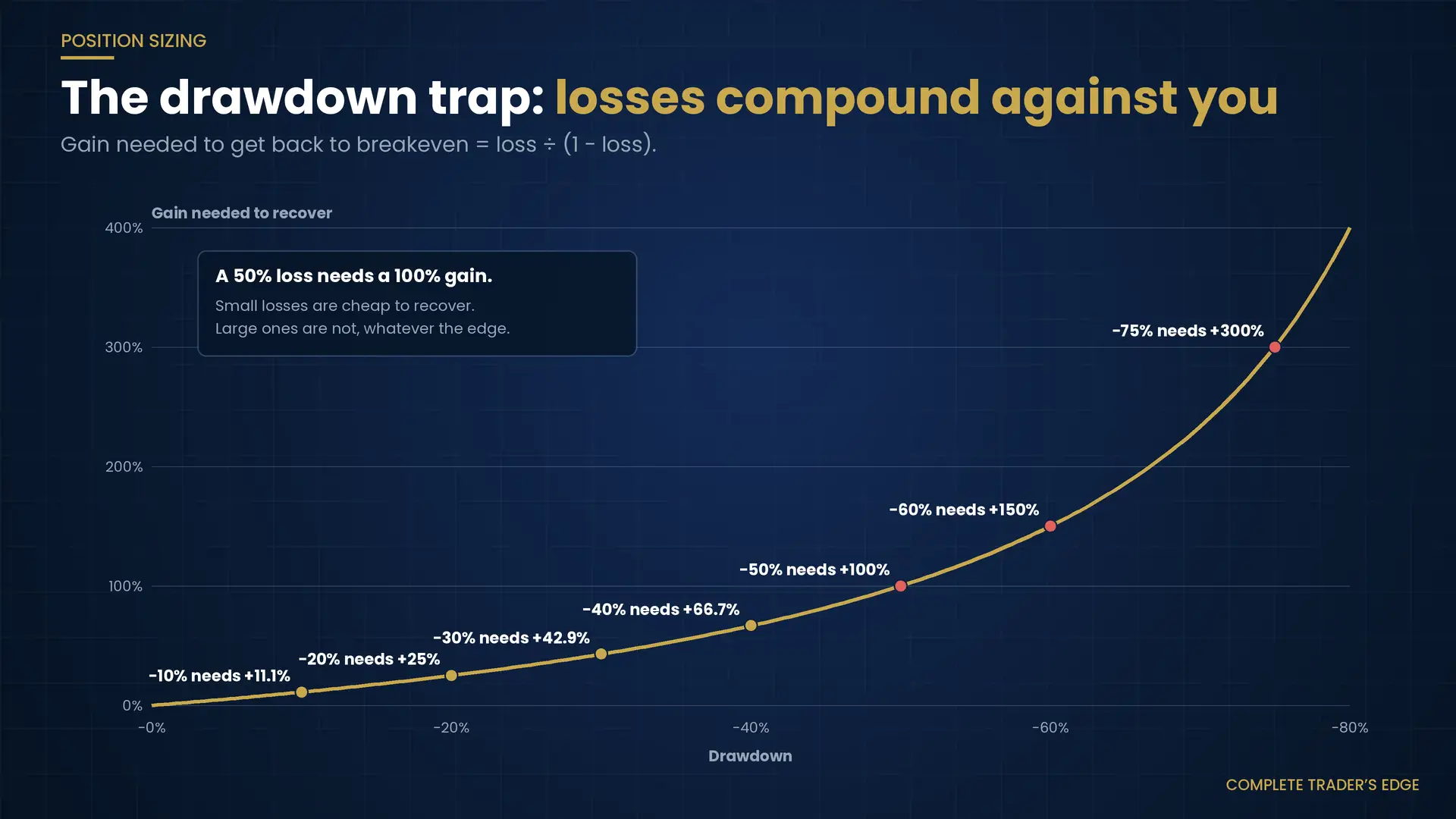
| Drawdown | Recovery Required | Difficulty |
|---|---|---|
| 10% | 11.1% | Easy |
| 20% | 25.0% | Moderate |
| 30% | 42.9% | Hard |
| 50% | 100.0% | Very Hard |
| 75% | 300.0% | Extremely Hard |
“The professional trader’s goal is not to maximise the return on any single trade. It is to still be trading five years from now.”
The Fixed Percentage Method
The most widely used professional approach is fixed percentage risk: risk a fixed percentage of your current account balance on every trade. Common professional benchmarks are 0.5% to 2% per trade, with most experienced traders sitting between 0.5% and 1% during normal conditions.
| Risk Per Trade | Profile |
|---|---|
| 0.5% | Ultra-conservative; for new traders or during drawdowns |
| 1% | Professional standard; sustainable over hundreds of trades |
| 2% | Acceptable for high win-rate strategies with tight stops |
| 3%+ | High risk; small losing streaks produce significant account damage |
The beauty of fixed percentage risk is that it automatically adjusts as your account grows or shrinks. When your account is growing, 1% becomes a larger dollar amount, allowing your gains to compound. When your account is in drawdown, 1% becomes a smaller dollar amount, reducing your exposure during the worst periods. The system is self-correcting.
Calculating Your Position Size: The Formula
Position Size = (Account Balance × Risk Percentage) ÷ (Stop Loss Distance × Point Value)
This calculation must be done before every single trade. Never estimate.
Example for Gold (XAUUSD): Account = $10,000. Risk = 1% ($100). Stop loss = 25 pips. Pip value = $1 per pip per 0.01 lot. Position size = $100 ÷ (25 × $1) = 4 micro lots (0.04 lots).
Example for NQ futures: Account = $50,000. Risk = 1% ($500). Stop loss = 20 points. Point value = $20 per point per contract. Position size = $500 ÷ (20 × $20) = 1.25 contracts, rounded down to 1 contract.
Example for EUR/USD: Account = $5,000. Risk = 1% ($50). Stop loss = 15 pips. Pip value = $1 per pip per micro lot. Position size = $50 ÷ (15 × $1) = 3.33, rounded down to 3 micro lots.
Always round down, never up. The goal is to keep actual risk at or below your target percentage. Rounding up might seem trivial on a single trade, but across hundreds of trades the excess risk accumulates.
Position Size Examples by Account Size
| Account Size | Risk % | Risk Amount | Stop (50 pips) | Position Size |
|---|---|---|---|---|
| $5,000 | 1% | $50 | 50 pips | $1.00/pip |
| $10,000 | 1% | $100 | 50 pips | $2.00/pip |
| $10,000 | 2% | $200 | 50 pips | $4.00/pip |
| $25,000 | 1% | $250 | 50 pips | $5.00/pip |
| $50,000 | 1% | $500 | 50 pips | $10.00/pip |
Stop Loss Placement Drives Position Size — Not the Other Way Around
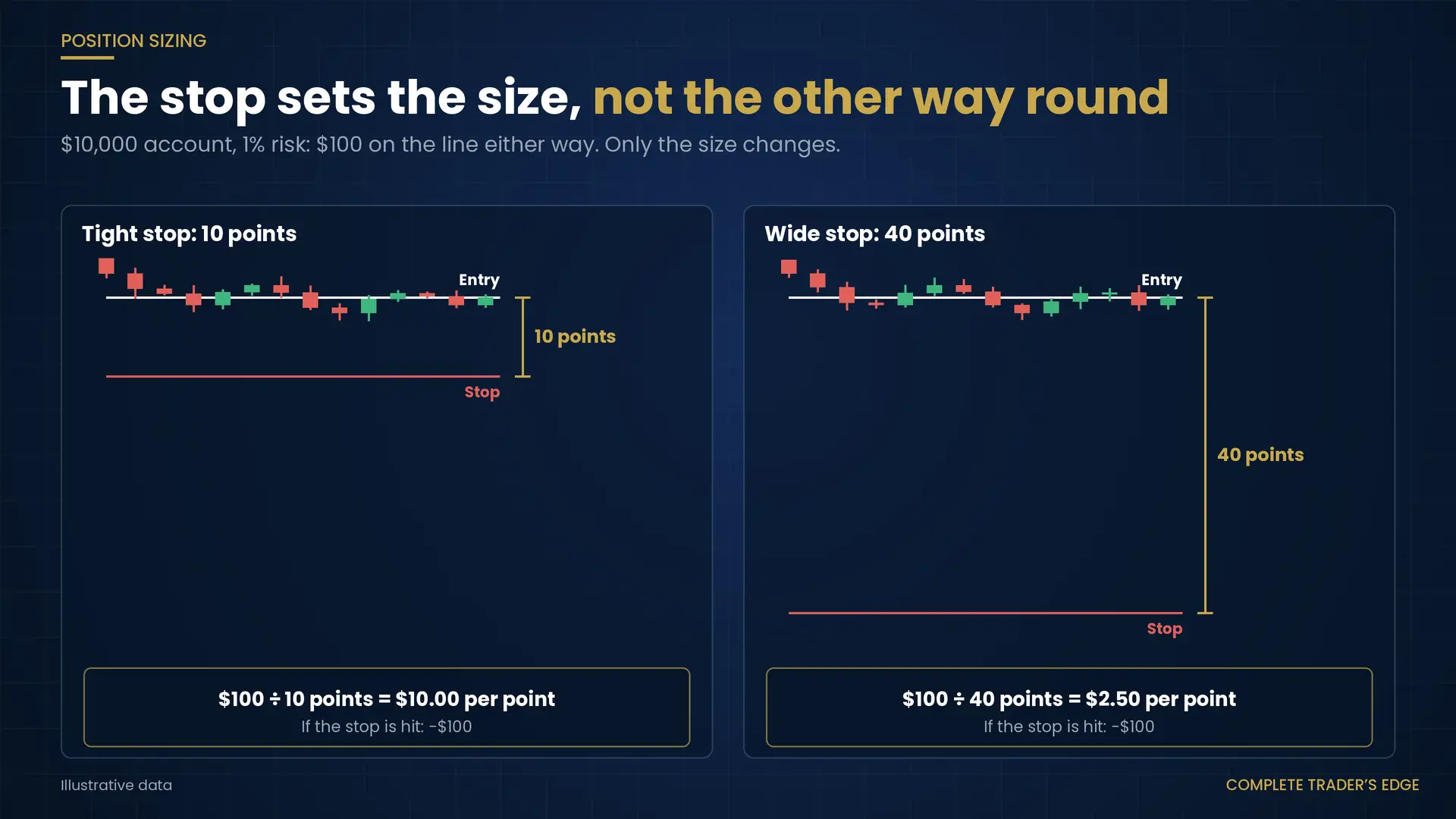
One of the most common errors is choosing a position size first and then setting the stop loss to match. This is backwards. Your stop loss goes at the level where your trade thesis is invalidated, not at a comfortable distance from your entry. Your position size then adjusts to keep the dollar risk at 1% given that stop distance.
If the correct stop loss is 50 pips but your account can only afford 3 micro lots at that distance, you trade 3 micro lots. The stop determines the size. The size does not determine the stop. Violating this principle is how traders end up with stops that are too tight (stopped out on noise) or positions that are too large (blown up on normal moves).
Adjusting for Market Conditions
High volatility: During volatile periods (red-folder news events, earnings, geopolitical shocks), stop distances often need to be wider to avoid being stopped by noise. Wider stops at the same dollar risk mean smaller position sizes. This is correct — the market is telling you to trade smaller.
Drawdown periods: During drawdowns, reduce risk percentage from 1% to 0.5% or 0.25%. This slows the drawdown mathematically and reduces the emotional pressure of each trade, making it easier to maintain discipline when it is hardest. Many professionals automatically reduce to 0.5% when down 10% from peak equity, and 0.25% when down 20%.
Correlation risk: If you are running three trades in the same direction on correlated instruments (long Gold, long Silver, long AUD/USD), your actual risk is not 1% per trade — it is closer to 3% because all three will lose simultaneously if the US dollar strengthens. Account for correlation by reducing individual position sizes when running multiple correlated trades.
Common Mistakes
Fixed Lot Trading: Trading 1 lot on every trade regardless of stop distance is one of the most common beginner mistakes. A 10-pip stop and a 100-pip stop with the same lot size are not remotely equivalent in risk.
Emotional Sizing: Increasing size on trades you “feel good about” introduces massive variability. Your most confident trades are not always your best trades.
Increasing risk after a winning streak: Keep risk at 1%. As your account grows, 1% naturally becomes a larger dollar amount — that is how compounding works. Deliberately increasing the percentage after wins is how experienced traders destroy accumulated gains.
Key Lessons
- Position sizing is more important to long-run performance than entry signals — it determines survival.
- Fixed percentage risk (0.5% to 1% per trade) is the professional standard for most traders.
- The formula: (Account × Risk %) ÷ (Stop Distance × Point Value) = Position Size. Calculate before every trade.
- Stop loss placement drives position size, not the other way around. Never choose size first.
- Adjust for volatility, drawdown, and correlation to maintain true risk levels.
- Always round position size down, never up.
Frequently Asked Questions
Is 1% risk per trade too conservative?
No. It is mathematically optimal for long-term survival and compounding. At 1% risk with a 55% win rate and 1:2 R:R, you grow your account roughly 5–8% per month during favourable conditions. The traders who call 1% conservative are the same traders who blow accounts. The traders who call it optimal are the ones still trading five years later.
Should I increase risk per trade as my account grows?
Not the percentage. Keep risk at 1%. As your account grows, 1% naturally becomes a larger dollar amount — which is how compounding works. A $10,000 account risks $100 per trade. A $50,000 account risks $500 per trade. Same percentage, larger absolute value, organic growth. Increasing the percentage is how experienced traders destroy accumulated gains.
How do I calculate position size for stocks?
The same formula applies. If you have a $25,000 account, risk 1% ($250), and your stop is $2 below your entry price, your position size is $250 ÷ $2 = 125 shares. For options, the calculation adjusts for delta and premium, but the principle is identical: define your maximum dollar loss first, then size the position to match.
What if the correct position size is too small to be worth trading?
If your calculated position size is so small that the potential profit is negligible, either your account is too small for the instrument you are trying to trade, or the stop distance is too wide for your capital. The solution is not to increase risk — it is to trade a smaller instrument (micro lots, micro futures) or find a setup with a tighter stop. Prop firms are also an option: they provide the capital, you provide the skill.
Do prop firms change how I should think about position sizing?
The percentage risk remains the same (1% or less), but the absolute dollars change because you are trading someone else’s capital. Prop firms have fixed drawdown limits (typically 5% daily, 10% total) that are non-negotiable. This makes conservative sizing even more important — a single oversized trade can breach the drawdown limit and lose the account. Many funded traders reduce to 0.5% risk to give themselves maximum room within the firm’s rules.
Position sizing is the Money pillar in practice. Two books cover it better than anything else in print:
- Trade Your Way to Financial Freedom — Van Tharp’s R-multiples and expectancy, the origin of most modern sizing maths.
- The New Trading for a Living — Elder’s 2% and 6% rules, the simplest workable risk ceiling for a small account.
 The Complete Trader's Edge
The full Mind · Method · Money framework. 70 chapters.
View on Amazon →
The Complete Trader's Edge
The full Mind · Method · Money framework. 70 chapters.
View on Amazon →
 Market Mayhem
400 years of bubbles, crashes, and the pattern that keeps repeating.
Buy on Amazon →
Market Mayhem
400 years of bubbles, crashes, and the pattern that keeps repeating.
Buy on Amazon →
 Greatest Companies
How the world's greatest companies were built — and what traders learn from them.
View on Amazon →
Greatest Companies
How the world's greatest companies were built — and what traders learn from them.
View on Amazon →
 Greatest Traders
Eighty-six lives that explain the markets — Livermore to Madoff, told with the losses left in.
View on Amazon →
Greatest Traders
Eighty-six lives that explain the markets — Livermore to Madoff, told with the losses left in.
View on Amazon →