

Tax is the cost of doing business as a trader that nobody teaches in trading courses. You can have a profitable year, hit your targets, and still find yourself owing more than you expected because you did not structure your record-keeping, your reporting, or your entity correctly. Trading taxes are not complicated once you understand the framework, but the consequences of getting them wrong range from paying unnecessary tax to facing penalties and audits.
This guide covers the core concepts that every trader needs to understand regardless of where you live. Tax laws vary by country and jurisdiction, so this article focuses on principles and frameworks rather than specific filing instructions. Always consult a qualified tax professional for advice specific to your situation. What this guide will do is ensure you understand the right questions to ask and the records to keep.
Disclaimer: This article is for educational purposes only and does not constitute tax, legal, or financial advice. Tax laws change frequently and vary by jurisdiction. Consult a qualified tax professional for guidance specific to your situation.
How Trading Income Is Typically Taxed
Trading profits are taxed differently depending on your country, the instruments you trade, your holding period, and whether you qualify for special trader status. The three most common frameworks are:
| Tax Treatment | How It Works | Typical Rate | Who It Applies To |
|---|---|---|---|
| Capital gains tax | Profits on asset sales taxed at capital gains rate | 0-37% depending on country and holding period | Most individual traders in most countries |
| Income tax | Trading profits treated as ordinary income | Marginal rate (up to 37-45%+) | Frequent traders, those with TTS (US), or self-employed traders |
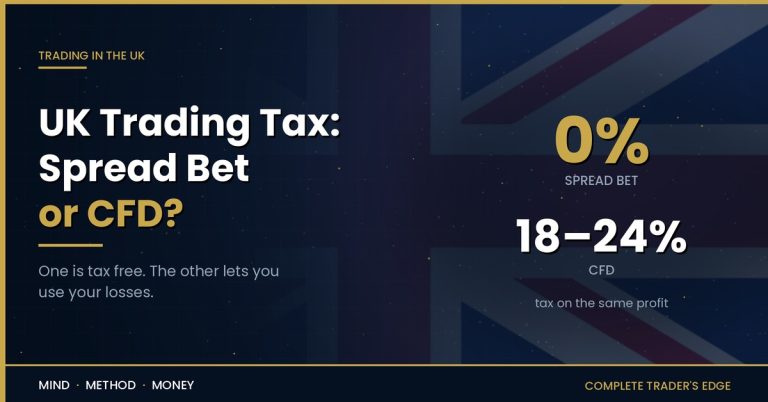
| Tax-free (in some jurisdictions) | Spread betting or CFD gains exempt from capital gains | 0% | UK/Ireland spread betting; some tax-advantaged accounts |
Tax Considerations by Country
The following overview covers the most common jurisdictions for retail traders. These are broad frameworks, not filing instructions.
| Country | Key Framework | Notes for Traders |
|---|---|---|
| United States | Capital gains (short-term at income rates); Section 1256 for futures (60/40 split); potential Trader Tax Status (TTS) | Futures traders benefit from 60% long-term / 40% short-term blended rate under Section 1256. TTS allows business expense deductions. |
| United Kingdom | Spread betting: tax-free. CFDs/forex: capital gains tax (CGT) | Spread betting profits are currently exempt from CGT and stamp duty. CFD profits above the annual allowance are taxable. |
| Australia | Capital gains (with 50% discount for assets held 12+ months); income tax for frequent traders | Day traders may be classified as carrying on a business, which changes the tax treatment. ATO provides specific guidance. |
| Canada | 50% of capital gains included in income; business income for frequent traders | TFSA and RRSP may shelter some investment gains. Day trading profits are typically business income. |
| European Union | Varies by member state; typically capital gains or flat withholding tax | Germany, France, and Netherlands each have different rules. Research your specific country. |
| South Africa | Income tax on trading profits (SARS treats frequent trading as income) | Capital gains treatment possible for infrequent trades. SARS uses intent and frequency to determine classification. |
| UAE / Dubai | No personal income tax on trading gains | One of the most tax-friendly jurisdictions for traders. Corporate tax (9%) applies to business profits above threshold. |
The Records Every Trader Must Keep
Regardless of your jurisdiction, you need the same core records. The time to set up your record-keeping system is before your first trade, not during tax season.
| Record | What to Capture | Why You Need It |
|---|---|---|
| Trade log | Entry date/time, exit date/time, instrument, direction, lot size, entry price, exit price, P&L | Required for calculating gains/losses per tax period |
| Broker statements | Monthly and annual statements from every broker | Official record of all transactions; may be required during audit |
| Deposit/withdrawal records | Every deposit to and withdrawal from trading accounts | Distinguishes capital contributions from trading gains |
| Expense receipts | Platform subscriptions, data feeds, courses, hardware, internet | Deductible as business expenses if you qualify for trader status |
| Swap/financing records | Overnight swap charges and credits | May be deductible or taxable depending on jurisdiction |
Most brokers provide downloadable trade history in CSV format. Download this at the end of every month and store it in a dedicated folder. If you trade across multiple brokers or prop firms, consolidate all records into a single spreadsheet or use trading journal software that aggregates across accounts.
Common Tax Mistakes Traders Make
Not tracking every trade. If you take 500 trades in a year and only record 400, your tax calculation is wrong. Most tax authorities require complete records, and discrepancies between your reported figures and your broker’s reported figures trigger questions.
Ignoring cryptocurrency tax obligations. In most jurisdictions, every crypto trade is a taxable event, including crypto-to-crypto swaps (BTC to ETH), not just crypto-to-fiat conversions. The record-keeping burden for active crypto traders is significant.
Not separating business expenses. If you qualify for trader tax status (or the equivalent in your jurisdiction), expenses like platform subscriptions, data feeds, trading courses, computer equipment, and a portion of your internet and home office costs are deductible. If you do not track them, you cannot claim them.
Assuming prop firm payouts are tax-free. Prop firm payouts are taxable income in most jurisdictions. The fact that you are trading the firm’s capital does not change the tax treatment of the profits you receive. Treat every prop firm payout as taxable unless your tax advisor confirms otherwise.
Waiting until tax season to organise records. Trying to reconstruct a year’s worth of trading records in March or April is stressful, error-prone, and expensive if you need an accountant to do it. Set up a monthly routine: download statements, reconcile, categorise expenses. Fifteen minutes per month saves hours of pain at year-end.
Should You Trade Through an Entity?
Some traders benefit from establishing a legal entity (LLC, Ltd, sole proprietorship, or corporation) for their trading. The advantages and requirements vary by jurisdiction, but the general considerations are:
| Factor | Trading as Individual | Trading Through Entity |
|---|---|---|
| Setup cost | $0 | $200-$2,000+ depending on jurisdiction |
| Tax deductions | Limited to investment expenses (if allowed) | Full business expense deductions |
| Liability protection | Personal assets at risk | Limited liability (LLC/Ltd) |
| Record-keeping burden | Simpler | More complex; may require separate books |
| When it makes sense | Trading part-time; small account | Full-time trading; significant annual profits; substantial business expenses |
The decision to incorporate depends on your income level, your jurisdiction’s tax code, and your trading volume. For most traders earning under $50,000/year from trading, the additional cost and complexity of an entity may not be justified. For full-time traders with significant income, the tax savings from deductions and potentially lower entity tax rates can be substantial. Talk to a tax professional before making this decision.
5 Frequently Asked Questions About Trading Taxes
Do I have to pay taxes on demo trading?
No. Demo accounts use virtual money, so there are no real profits or losses to report. Tax obligations begin only when you trade with real money and realise actual gains or losses.
Are prop firm profits taxable?
In most jurisdictions, yes. Prop firm payouts are treated as income (either self-employment income or ordinary income depending on the structure). The fact that the capital belongs to the prop firm does not make your share of the profits tax-exempt. Keep records of every payout you receive.
Can I deduct trading losses?
In most countries, trading losses can offset trading gains within the same tax year. Some jurisdictions allow you to carry losses forward to offset future gains. The specific rules vary. In the US, capital losses can offset capital gains plus up to $3,000 of ordinary income per year, with the remainder carried forward indefinitely.
Do I need a tax professional, or can I do it myself?
If you take fewer than 50 trades per year and trade only one instrument, you can likely handle your own taxes with good record-keeping. If you are an active trader with hundreds of trades, multiple brokers, prop firm income, and crypto transactions, a tax professional who specialises in trader taxation is a worthwhile investment. The cost of professional advice is typically far less than the cost of errors.
When should I start thinking about taxes?
From your first live trade. Set up your record-keeping system before you place your first order. Download monthly statements, track expenses, and reconcile quarterly. The traders who handle tax season smoothly are the ones who treated record-keeping as part of their trading routine from day one.
▶ Continue Reading
▸ Building a Trading Business: From Hobby to Professional Operation
▸ Trading Journal: The Complete System for Building Your Edge
The Complete Trader’s Edge
This article is adapted from The Complete Trader’s Edge by Louw van Riet. The book covers trading as a business, record-keeping, and the complete Mind · Method · Money framework across 70 chapters.
 The Complete Trader's Edge
The full Mind · Method · Money framework. 70 chapters.
View on Amazon →
The Complete Trader's Edge
The full Mind · Method · Money framework. 70 chapters.
View on Amazon →
 Market Mayhem
400 years of bubbles, crashes, and the pattern that keeps repeating.
Buy on Amazon →
Market Mayhem
400 years of bubbles, crashes, and the pattern that keeps repeating.
Buy on Amazon →
 Greatest Companies
How the world's greatest companies were built — and what traders learn from them.
View on Amazon →
Greatest Companies
How the world's greatest companies were built — and what traders learn from them.
View on Amazon →
 Greatest Traders
Eighty-six lives that explain the markets — Livermore to Madoff, told with the losses left in.
View on Amazon →
Greatest Traders
Eighty-six lives that explain the markets — Livermore to Madoff, told with the losses left in.
View on Amazon →