

Weekend gaps, RTH vs ETH gaps, gap-fill probability — how exchange closures create tradeable imbalances.
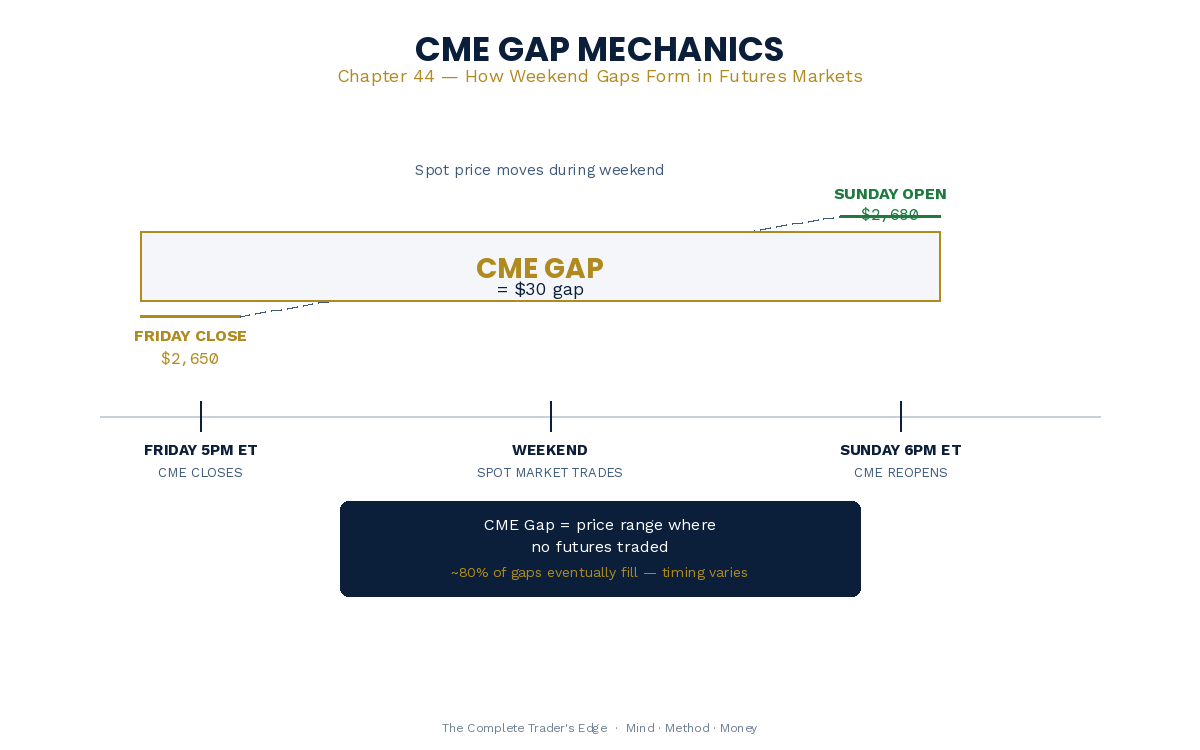
Fair value gaps are created by three-candle imbalances in price delivery. CME gaps are created by something far simpler: an exchange closing its doors. When the CME closes on Friday at 5:00 PM Eastern and does not reopen until Sunday at 6:00 PM, price continues to move on other venues. When the CME reopens, there is a gap between Friday’s close and Sunday’s open. That gap is not an imbalance in delivery — it is a physical absence. And the market treats these two types of gaps very differently.
CME gaps matter because futures markets are the primary venue for institutional price discovery in many asset classes. Gold futures, equity index futures, and Bitcoin CME futures are all instruments where the closing and opening prices carry institutional weight. When a gap exists between sessions, it represents unfinished business — a range of prices where no transactions occurred on the primary exchange.
What Creates a CME Gap
The CME Group operates most of its futures markets from Sunday 6:00 PM to Friday 5:00 PM Eastern, with a 60-minute daily maintenance break. Weekend gaps are the most significant. During the 49-hour weekend closure, geopolitical events, economic data from Asian markets, and sentiment shifts can all move the underlying asset.
CME Gaps vs Fair Value Gaps
It is critical to understand that these are different tools. A fair value gap is a three-candle pattern where the range of the first and third candles do not overlap. It exists on any chart, any timeframe, any instrument. A CME gap is structural — it exists because an exchange was physically closed. A CME gap on gold futures will not appear on a spot gold CFD chart.
Both types of gaps tend to get filled, but for different reasons. Fair value gaps fill because the market returns to rebalance delivery. CME gaps fill because the market returns to trade at prices where no transactions occurred on the primary exchange.
When a CME gap overlaps with a fair value gap — when the gap zone also contains a three-candle imbalance — the fill probability increases significantly. Both forces are pulling price back to the same zone.
| Gap Type | How It Forms | Fill Rate | How to Trade It |
|---|---|---|---|
| CME weekend gap (BTC/ETH) | Spot moves while CME is closed Sat-Sun | ~77% | Trade toward gap fill when price reverses toward Friday close level |
| RTH opening gap (ES/NQ) | Overnight (ETH) price moves before RTH open | ~70% | Gap fill trade during first 30-60 min of RTH session |
| Intraday FVG (any instrument) | Three-candle imbalance from aggressive displacement | Varies by context | Enter on pullback into FVG with confirmation at key level |
| News-driven gap | Major data release or geopolitical event | Lower (~50-60%) | Trade post-news setup after initial spike settles. Not a standard gap fill. |
Gap-Fill Probability
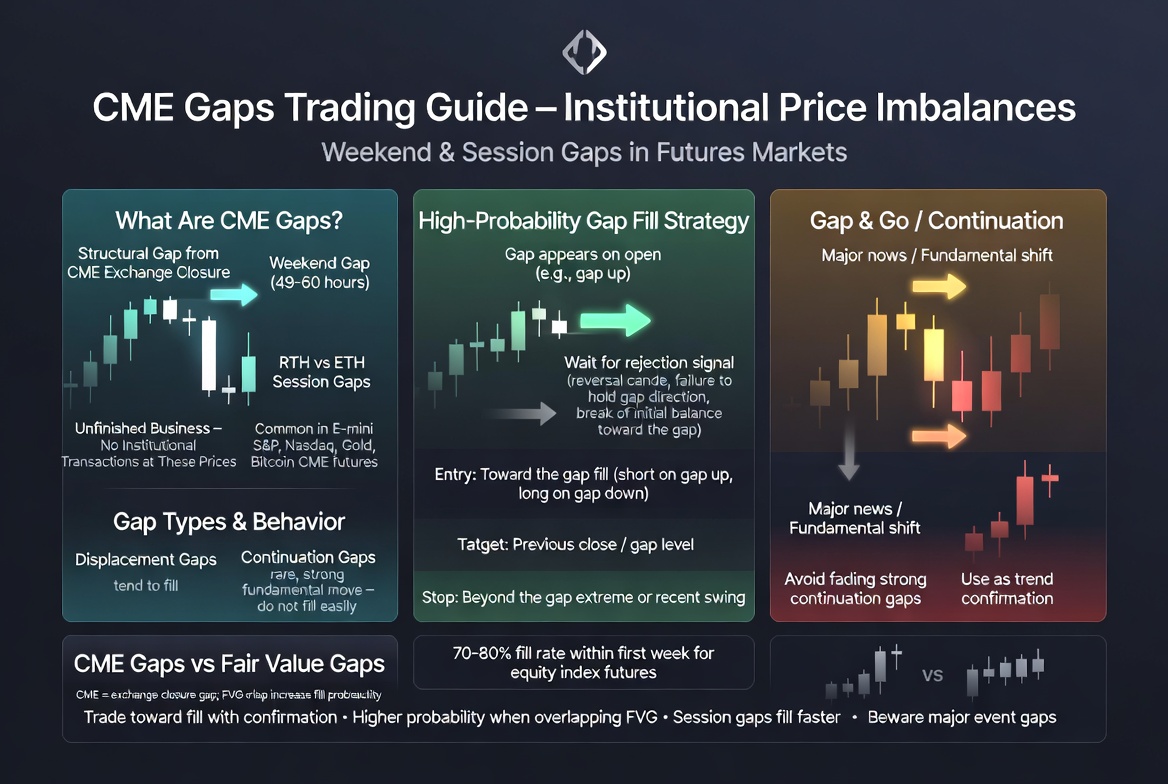
CME gaps fill at a remarkably high rate. For equity index futures like the E-mini S&P 500 and Nasdaq 100, weekend gaps fill within the first week approximately 70–80% of the time. Many fill within the first session. For gold futures, the fill rate is similar — the convergence between spot and futures venues pulls price back. For Bitcoin CME futures, weekend gaps have become one of the most discussed setups in crypto trading, though timing is less predictable.
RTH vs ETH: Session Gaps
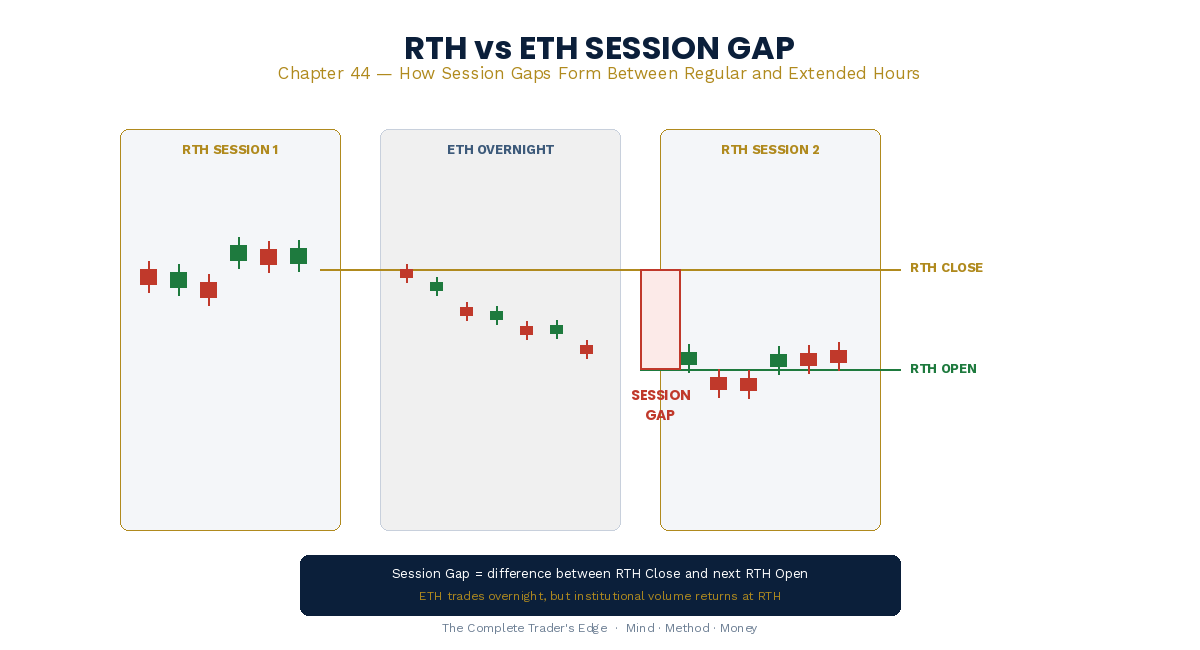
Beyond weekend gaps, there are intraday session gaps created by the difference between Regular Trading Hours (RTH) and Extended Trading Hours (ETH). A session gap occurs when the RTH close is different from the next day’s RTH open. These gaps are smaller but more frequent and tend to fill with even higher probability.
Trading CME Gaps
The Gap Fill Strategy
The simplest approach is to trade toward the gap fill. If the CME reopens with a gap up, look for short entries targeting the gap fill — Friday’s closing price. If it reopens with a gap down, look for long entries targeting the same level. The entry trigger should not be the gap itself. Wait for a rejection signal at the opening level — a failure to continue in the direction of the gap, a reversal candle, or a break of the initial balance range in the direction of the gap fill.
Gap and Go
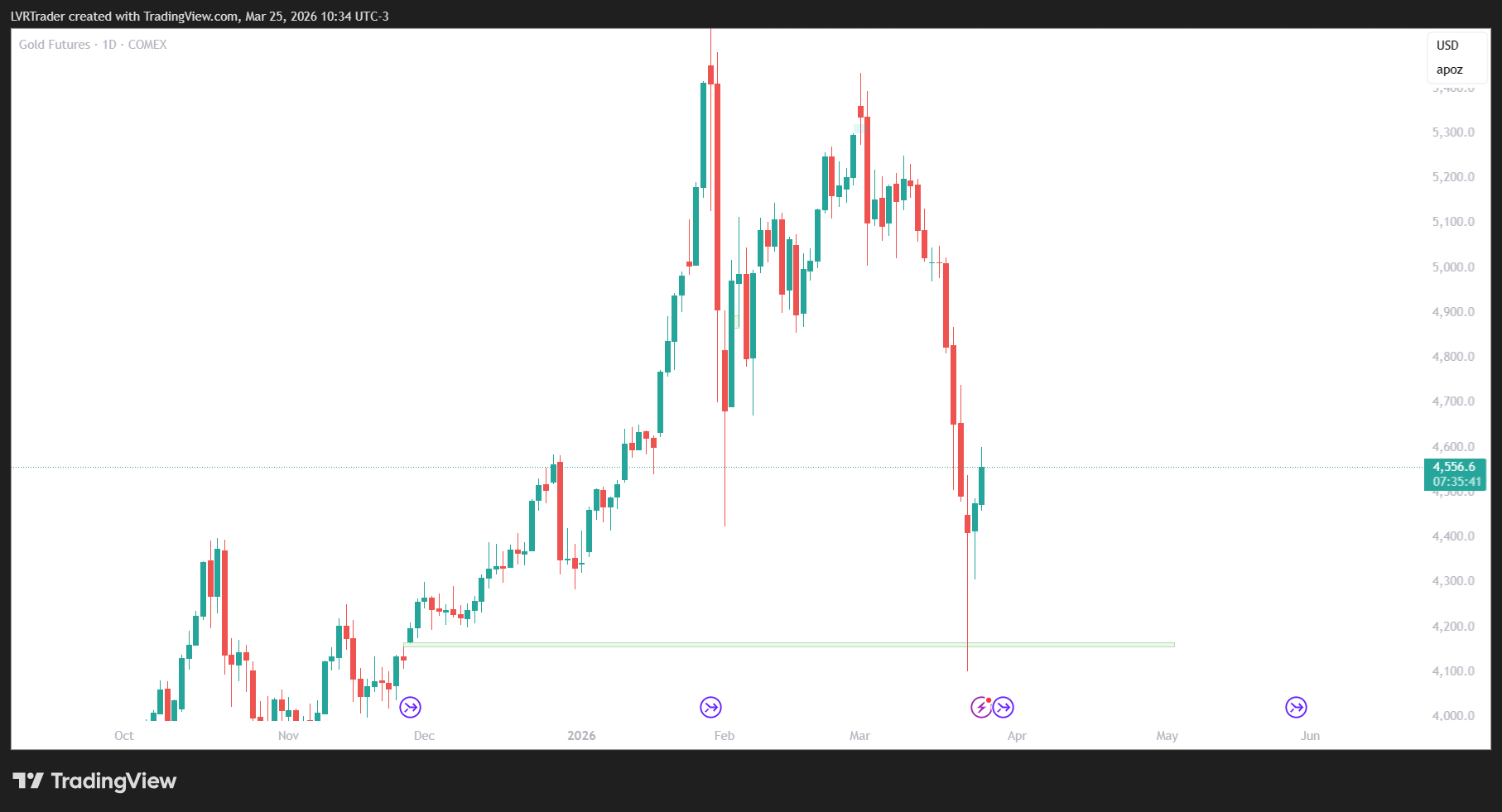
Not all gaps fill. When a gap is created by a significant fundamental shift — a major geopolitical event, a central bank surprise, or a structural change in market conditions — the gap may never fill. These are continuation gaps that signal a genuine shift in value. The key is to distinguish between displacement gaps (which tend to fill) and continuation gaps (which do not).
📚 Related Articles:
This article is adapted from The Complete Trader’s Edge
70 chapters covering Mind · Method · Money — the most comprehensive trading education framework available.
Frequently Asked Questions
What is a CME gap?
A CME gap is the price difference between Friday’s close and Monday’s open on CME futures contracts. Because CME futures for Bitcoin and Ethereum close over the weekend while spot crypto trades 24/7, price can move significantly while the futures market is closed. When CME reopens, the gap between the old close and the new open creates a visible gap on the futures chart.
How often do CME gaps fill?
Historical data shows that approximately 77% of CME Bitcoin gaps fill within one week. This high fill rate makes CME gaps one of the most statistically robust setups in crypto trading. However, 23% of gaps do NOT fill promptly, so the setup requires proper stop loss placement and position sizing, not blind conviction.
How do I trade a CME gap?
The standard approach: (1) Identify the gap between Friday’s close and Monday’s open on the CME BTC futures chart. (2) Determine the gap direction (price gapped up or down). (3) Enter a trade targeting the gap fill when price shows signs of reversing toward the gap on the entry timeframe. (4) Stop loss beyond the Monday open extreme. (5) Target: the Friday close price (the gap fill level).
Can I trade CME gaps on spot Bitcoin?
Yes. Even though the gap exists on the CME futures chart, spot Bitcoin price tends to gravitate toward the same levels because of arbitrage between futures and spot markets. Mark the CME gap levels on your spot chart and use them as reference zones for entries alongside your regular ICT analysis.
Are there CME gaps on other instruments?
CME gaps exist on all futures contracts that have closed trading sessions (ES, NQ, Gold futures, Oil futures). However, the gap-fill statistics are most studied and most reliable on BTC and ETH futures because the 24/7 spot market creates consistently larger weekend gaps than traditional commodities where weekend movement is more limited.
Continue Reading
▶ The Complete Guide to Cryptocurrency Trading
From The Book
This article covers concepts from Chapter 38 of The Complete Trader’s Edge.
 The Complete Trader's Edge
The full Mind · Method · Money framework. 70 chapters.
View on Amazon →
The Complete Trader's Edge
The full Mind · Method · Money framework. 70 chapters.
View on Amazon →
 Market Mayhem
400 years of bubbles, crashes, and the pattern that keeps repeating.
Buy on Amazon →
Market Mayhem
400 years of bubbles, crashes, and the pattern that keeps repeating.
Buy on Amazon →
 Greatest Companies
How the world's greatest companies were built — and what traders learn from them.
View on Amazon →
Greatest Companies
How the world's greatest companies were built — and what traders learn from them.
View on Amazon →