GREATEST TRADERS · EPISODE 5
Richard Dennis
The Turtle Trader Who Proved Trading Can Be Taught
▶ Watch on YouTube🎵 Listen on Spotify
Also available on Apple Podcasts · Amazon Music
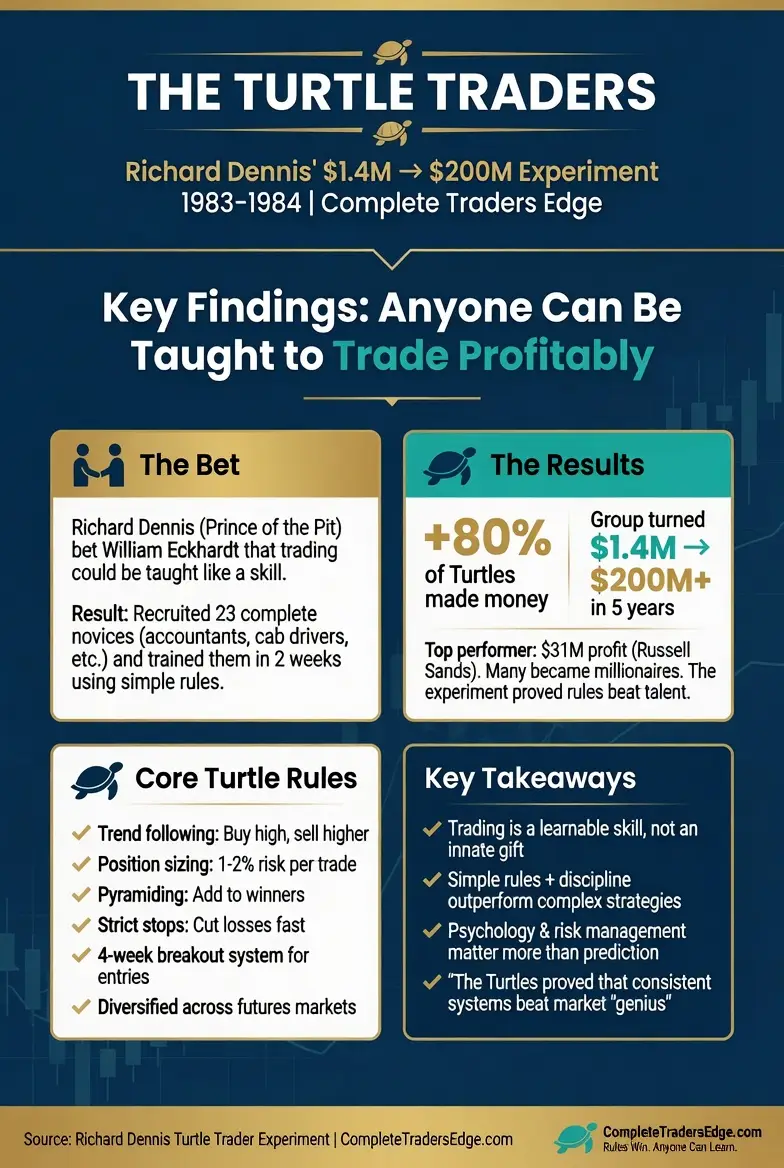
Richard Dennis turned $400 into $200 million trading commodities. Then he recruited 23 people off the street, taught them his system in two weeks, and those students collectively earned over $100 million in the years that followed. The experiment proved one of the most debated propositions in trading: that successful trading can be taught.
The Turtle Experiment, as it became known, is the most important controlled test ever conducted on whether trading is a learned skill or an innate talent. Its results have implications for every trader who has ever wondered whether they have “what it takes.” Dennis proved that they do, provided they are willing to learn a systematic approach and follow it without deviation.
| Principle | What It Means | Trading Application |
|---|---|---|
| Trading can be taught | Rules-based systems can be learned by anyone | A written, tested strategy with clear rules removes the need for innate talent. |
| Trend following | Enter on channel breakouts in the direction of trend | Trade BOS confirmations. Enter after the breakout, not before. |
| Fixed risk (2% rule) | Risk exactly 2% of account per trade | Consistent position sizing is non-negotiable. 1% is the modern professional standard. |
| Accept losses as costs | Losses are the cost of doing business, not failures | Process score matters more than individual trade P&L. A loss at 1 process score is a good trade. |
| System discipline | Follow the rules without exception, especially during drawdowns | The rules exist for the moments when you most want to break them. |
This is the full story of how a high school dropout from Chicago became one of the most successful commodity traders in history, settled the nature versus nurture debate in trading, and ultimately proved that the rules matter more than the genius behind them.
The Prince of the Pit
Richard Dennis was born in 1949 in Chicago’s South Side. His father was a city worker. There was no Wall Street pedigree, no family connections to finance, no trust fund to cushion early losses. What Dennis had was an intense interest in markets and a willingness to start at the bottom.
At 17, he got a job as a runner on the floor of the Chicago Mercantile Exchange. He could not trade because he was underage, so his father opened an account and executed orders on his behalf. Dennis started with $400 of borrowed money. By his early twenties, he had turned that $400 into over $200 million trading commodity futures.
His rise through the trading pits was legendary. He earned the nickname “Prince of the Pit” for his aggressive, conviction-driven style. He traded soybeans, corn, wheat, and other commodities with a trend-following approach that was simple in concept but demanding in execution. Buy breakouts in the direction of the trend. Cut losses immediately when wrong. Add to winning positions as the trend continued. And size positions based on market volatility so that no single trade could do catastrophic damage.
By the early 1980s, Dennis was one of the largest individual traders in the world. His success attracted attention, controversy, and one very important question from his trading partner William Eckhardt.
The Bet That Changed Trading History
Dennis and Eckhardt had been friends and trading partners for years, but they disagreed fundamentally on one question: could successful trading be taught, or was it an innate ability that certain people simply possessed?
Dennis believed that trading was a skill, like any other, that could be broken down into rules, taught systematically, and executed by anyone with sufficient discipline. He pointed to his own background as evidence: he had no special advantages, no education in finance, no mentor who handed him a system. He built his approach from observation, testing, and systematic refinement. If he could learn it, anyone could.
Eckhardt disagreed. He believed that while rules could be taught, the psychological ability to follow them under pressure was rare. In his view, the emotional fortitude required to hold a losing position to its stop, to add to a winner when every instinct screams to take profit, to sit through drawdowns without losing confidence in the system, was a temperamental quality that most people did not possess.
To settle the argument, Dennis proposed a radical experiment: they would recruit people with no trading experience, teach them a complete trading system, fund their accounts with real money, and see whether the students could replicate professional-level returns.
In 1983, they placed advertisements in the Wall Street Journal and Barron’s seeking applicants. Over 1,000 people responded. Dennis and Eckhardt selected 23, later expanded to include additional groups, based on criteria that had nothing to do with financial knowledge. They looked for intelligence, risk appetite, and the ability to think probabilistically. The selected group included a professional blackjack player, a security guard, a pianist, an accountant, and several recent college graduates. None had significant trading experience.
Dennis called them the Turtles, reportedly inspired by turtle farms he had visited in Singapore. “We’re going to grow traders just like they grow turtles in Singapore,” he said.
The Turtle Trading System
The system Dennis and Eckhardt taught was a complete, mechanical trading methodology. Every rule was explicit. Every signal was objective. There was no room for interpretation, discretion, or gut feeling. The system told you what to trade, when to enter, where to place your stop, when to add to a position, and when to exit. The trader’s only job was to follow the rules.
Market Selection
The Turtles traded a diversified portfolio of liquid futures markets: commodities (gold, silver, copper, oil, cotton, sugar, cocoa, coffee), currencies (Japanese yen, British pound, Swiss franc, Deutsche Mark), interest rates (Treasury bonds, Eurodollars), and equity indices (S&P 500). Diversification was essential. The system worked because different markets trend at different times. Losses in range-bound markets were offset by large gains in trending ones.
Entry Signals: Two Systems
The Turtles used two breakout systems:
System 1 (shorter-term): Enter a long position when price exceeded the highest high of the previous 20 trading days. Enter a short position when price fell below the lowest low of the previous 20 trading days. This system captured shorter-duration trends and had more frequent signals.
System 2 (longer-term): Enter a long position on a 55-day high breakout. Enter a short position on a 55-day low breakout. This system captured larger trends but with fewer signals and required more patience.
Both systems were purely mechanical. There was no analysis of whether the breakout “looked good” or whether the fundamentals supported it. If the price hit the level, the trade was taken. This is the essence of systematic trading: the system decides, not the trader. The parallel to modern market structure analysis is that breakouts remain one of the highest-probability entry signals when aligned with the dominant trend.
Position Sizing: The N System
The Turtles’ position sizing methodology was arguably the most innovative aspect of their system. Dennis and Eckhardt developed a volatility-based sizing approach using a concept they called N, which was essentially the Average True Range (ATR) of each market.
Each “unit” of risk was calculated so that a one-N move in the market would equal 1% of the trader’s account equity. This meant that more volatile markets received smaller position sizes, and less volatile markets received larger ones. The result was that every trade, regardless of which market it was in, carried approximately the same risk in dollar terms.
This is position sizing elevated to mathematical precision, and it remains one of the most sound approaches to risk normalisation available to retail traders today. If you trade Gold and also trade the S&P 500, your position size in each should reflect the relative volatility of each market, not an arbitrary lot size.
Maximum exposure was also controlled. No more than 4 units in a single market. No more than 10 units in a single direction (long or short) across highly correlated markets. No more than 12 units total in one direction. These rules ensured that even a series of losing trades could not threaten the account’s survival.
Adding to Winners: Pyramiding
One of the most psychologically challenging aspects of the Turtle system was the requirement to add to winning positions. As a trade moved in the Turtles’ favour, the system signalled additional entries. A new unit was added every time the price moved one-half N in the profitable direction, up to the maximum of 4 units per market.
This is counter-intuitive for most retail traders, who are more comfortable taking profits on winners than adding to them. But the mathematics are clear: in a strong trend, adding to a winning position dramatically increases the profitability of the trade while the risk on the added units is managed by the same stop-loss rules. This is the “ride winners” principle in its most aggressive form.
Stop Loss Rules
Every position had a stop loss set at 2N from the entry price. If the trade moved 2N against the position, it was closed. No exceptions. No “waiting to see.” No mental stops that somehow never get executed. The stop was real, it was in the market, and it was honoured every single time.
For positions that had been pyramided, the stop on all units was moved up so that the maximum risk on the entire position remained controlled. When the newest unit was added, all stops were adjusted. This meant that the worst-case loss on a fully pyramided 4-unit position was approximately 4% of account equity, a meaningful but survivable drawdown.
Exit Signals
System 1 used a 10-day low for long exits and a 10-day high for short exits. System 2 used a 20-day low for long exits and a 20-day high for short exits. In both cases, the system waited for the trend to show signs of reversal before exiting. There were no profit targets. The trend dictated the exit, not the trader’s desire to lock in gains.
This is the critical distinction between professional trend following and amateur trading. Amateurs set profit targets based on how much they want to make. Professionals let the market tell them when the trend is over. The result is that the biggest trades, the ones that produce the outsized returns, are held through their full duration rather than being cut short by a premature exit.
The Results: Dennis Wins the Bet
Over the following four to five years, the Turtles collectively earned over $100 million. Several individual Turtles went on to manage hundreds of millions of dollars in their own funds. The experiment was an unambiguous success. Dennis had proven that trading could be taught.
But the results also revealed something more nuanced. Not all Turtles performed equally. Some followed the system faithfully and earned spectacular returns. Others deviated, skipped signals, or reduced position sizes during drawdowns, and their returns suffered accordingly. The system was the same for everyone. The results were different because the people were different.
Eckhardt, gracious in conceding the bet, noted that the experiment had proved trading could be taught but had not eliminated the psychological variable. The rules could be transmitted. The discipline to follow them could not be guaranteed. This observation aligns perfectly with trading psychology research: knowing what to do and doing it are separated by a psychological gap that every trader must bridge.
Why Some Turtles Failed
The Turtles who underperformed did so for predictable reasons. They experienced the same drawdowns as the successful Turtles, but they responded differently. When the system produced a string of losing trades (which any trend-following system will do during range-bound markets), the less disciplined Turtles began to question the system. They skipped entries. They tightened stops. They reduced their position sizes at exactly the wrong time, ensuring that they missed the large trending moves that followed.
This is the drawdown management challenge in its purest form. Every system has drawdowns. The system is not broken during a drawdown. It is being tested. The traders who pass the test are the ones who follow the rules through the discomfort. The ones who fail are the ones who let the discomfort change their behaviour.
Dennis himself addressed this repeatedly. He noted that the hardest part of trading was not learning the system. It was executing the system during the periods when it felt most uncomfortable to do so. The signals that produce the biggest wins are often the ones that feel most frightening to take, because they come after a period of losses when confidence is lowest.
The Dennis Paradox: The Teacher Who Broke His Own Rules
The most sobering part of Richard Dennis’s story is what happened after the Turtle Experiment. Despite proving conclusively that systematic rules could produce extraordinary returns, Dennis himself deviated from his methodology and suffered devastating losses.
In the late 1980s and into the 1990s, Dennis reportedly took positions that were larger than his own rules allowed and held losing trades longer than his system specified. The losses were significant, estimated at over $100 million. He eventually returned to trading with smaller capital and more discipline, but the irony is inescapable: the man who proved that following the rules works was himself unable to follow them consistently.
The parallel with Jesse Livermore is striking. Livermore also proved that his trading method worked, and then destroyed himself by violating it. Both stories prove the same uncomfortable truth: knowing the rules is not enough. Following them requires a psychological discipline that even the creators of the rules sometimes lack.
This does not diminish the Turtle Experiment or Dennis’s contributions. It amplifies the lesson. The rules work when followed. The failure mode is always the same: the trader stops following them. Every trader who studies Dennis should absorb both halves of the story. The system that produced $100 million in profits for his students, and the psychology that produced $100 million in losses for the teacher.
The Turtle Legacy in Modern Markets
The Turtle trading rules were eventually published in full by Curtis Faith, one of the most successful Turtles, and they have been backtested, adapted, and applied by thousands of traders since. The specific parameters (20-day breakouts, 55-day breakouts, 2N stops) may or may not work in today’s markets with the same efficiency they showed in the 1980s. Markets evolve. Edges compress as more participants adopt them.
But the principles underlying the Turtle system remain as valid today as they were four decades ago. Markets still trend. Breakouts still work as entry signals in trending environments. Volatility-based position sizing is still the most logical approach to risk normalisation. Cutting losses and riding winners is still the mathematical foundation of positive expectancy. And the psychological challenge of following a system through drawdowns is still the primary determinant of whether a trader succeeds or fails.
What Every Trader Can Learn from Richard Dennis
Trading Can Be Learned
You do not need a finance degree, Wall Street connections, or innate talent. You need a system with positive expectancy, the discipline to follow it, and the patience to let the results compound over a meaningful sample size. Dennis proved this with $400 and a group of strangers.
Rules Beat Discretion
The Turtle system had zero discretion. Every decision was rule-based. This eliminated the primary failure mode in trading: emotional interference with execution. The closer your trading approaches this level of mechanical discipline, the more likely you are to capture your system’s edge.
Position Sizing Is the Edge
The Turtle system’s most sophisticated element was not the entry signal. It was the position sizing. Volatility-normalised risk per trade ensured that every position carried equivalent risk, regardless of the market’s characteristics. This is the foundation of professional risk management.
Drawdowns Are Normal
Every trend-following system experiences significant drawdowns during range-bound markets. This is not a bug. It is a feature. The cost of capturing large trending moves is enduring the losses that occur between them. The trader who cannot accept this cost will never capture the reward.
The Psychology Is the Bottleneck
Dennis taught 23 people the same system. Some made fortunes. Others underperformed dramatically. The difference was not intelligence, not effort, not capital. It was the psychological ability to follow the rules when doing so felt wrong. This is the probability mindset in its most practical application.
Dennis and the Mind · Method · Money Framework
Mind: Dennis’s greatest contribution was proving that trading is a learnable skill, not a genetic gift. But his own story also proved that knowing the rules is not sufficient. The psychological work of building the discipline to follow them is a separate challenge, and one that even the best traders can fail. His story is a case study in the gap between knowledge and execution.
Method: The Turtle system is one of the most elegant and complete trading methodologies ever documented. Breakout entries, volatility-based position sizing, systematic pyramiding, and trend-following exits. Every element is logical, objective, and testable. It remains a benchmark for what a complete trading system looks like.
Money: The N-based position sizing system is a masterwork of risk management. It normalises risk across markets, limits exposure at the portfolio level, and ensures that no single trade can inflict fatal damage. Combined with strict stop-loss discipline, it created a framework where the system could survive its losing periods and compound through its winning ones.
The Final Lesson
Richard Dennis proved that you do not need to be special to trade successfully. You need a system that works and the discipline to follow it. The Turtle Experiment remains the most compelling evidence that trading skill is not a matter of talent but of process, rules, and the willingness to execute them when every emotion in your body is screaming at you to do something different.
The system is available. The rules are known. The only variable left is you.
Key Takeaways from Richard Dennis
🎓 Trading can be taught. The Turtle Experiment proved it conclusively with $100 million in student profits.
📊 Volatility-based position sizing (the N system) ensures every trade carries equivalent risk regardless of market.
🔁 Breakout entries, trailing exits, and systematic pyramiding remain valid trend-following principles.
🧠 The psychology of following rules during drawdowns separates successful Turtles from unsuccessful ones.
⚠️ Even Dennis himself broke his own rules and suffered massive losses. Knowing the system is not enough; executing it is everything.
Explore the Full Legendary Traders Series
Learn from history’s greatest market minds.
George Soros ·
Jesse Livermore ·
Druckenmiller ·
Ed Seykota ·
Nicolas Darvas ·
Jim Simons
Dennis never wrote up the experiment. Curtis Faith, one of the Turtles he trained, did. It is the closest thing to the rules from inside the room, with the usual caveat that it is one participant’s account.

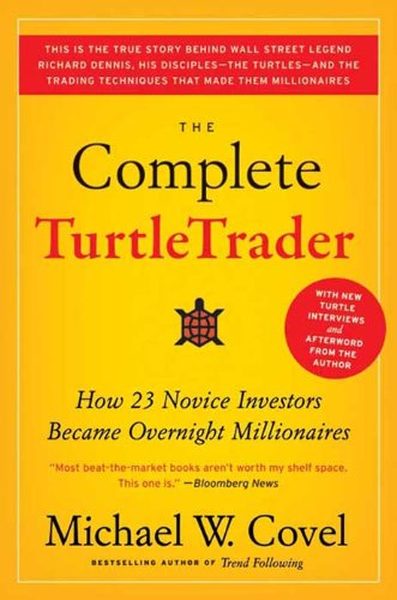
Covel was not a Turtle. He interviewed them, which makes his book the counterweight to Faith’s: less detail on the rules, more scrutiny of the claims.
Rated in the Trader’s Library.
 The Complete Trader's Edge
The full Mind · Method · Money framework. 70 chapters.
View on Amazon →
The Complete Trader's Edge
The full Mind · Method · Money framework. 70 chapters.
View on Amazon →
 Market Mayhem
400 years of bubbles, crashes, and the pattern that keeps repeating.
Buy on Amazon →
Market Mayhem
400 years of bubbles, crashes, and the pattern that keeps repeating.
Buy on Amazon →
 Greatest Companies
How the world's greatest companies were built — and what traders learn from them.
View on Amazon →
Greatest Companies
How the world's greatest companies were built — and what traders learn from them.
View on Amazon →
 Greatest Traders
Eighty-six lives that explain the markets — Livermore to Madoff, told with the losses left in.
View on Amazon →
Greatest Traders
Eighty-six lives that explain the markets — Livermore to Madoff, told with the losses left in.
View on Amazon →