

Nicolas Darvas turned $25,000 into $2.25 million between 1957 and 1959 while dancing his way around the world as a professional ballroom performer. He managed his trades entirely by telegram, without a broker on speed dial, without real-time data, without a terminal, and without access to anything resembling the tools that modern traders take for granted.
His story is the most improbable success narrative in market history. A Hungarian-born dancer with zero financial training, trading from hotel rooms in Calcutta, Hong Kong, and Saigon, making decisions based on newspaper stock tables that arrived days late. The fact that he achieved these results under these constraints is not just impressive. It is a direct challenge to every trader who believes they need better tools, faster data, or more indicators to succeed.
Darvas proved that a simple method, applied with discipline and patience, can produce extraordinary results. His Darvas Box Theory, developed through trial, error, and relentless self-observation, remains one of the most elegant breakout methodologies ever conceived.
From Budapest to Broadway
Nicolas Darvas was born in 1920 in Budapest, Hungary. He fled the Soviet occupation with his half-sister after World War II, eventually making his way to the United States. Together, they built a professional ballroom dancing act that became one of the highest-paid entertainment duos in the world, performing in nightclubs, theatres, and luxury hotels across six continents.
| Principle | What It Means | Trading Application |
|---|---|---|
| Darvas Box method | Buy breakouts from consolidation boxes with volume | Ranges create liquidity on both sides. The breakout with volume is the distribution phase. |
| Trend following only | Only buy stocks making new highs in uptrends | Trade with the HTF structure. New higher highs confirm the trend. |
| Cut losses fast | Automatic stop below the bottom of the box | Mechanical stop placement at the structural invalidation level. No discretion. |
| Let winners ride | Hold as long as the trend continues making new boxes | Trail stops behind structural swing lows. Do not take profit prematurely. |
| Part-time success | Made millions while working as a touring dancer | You do not need to trade full time. Swing trading with daily analysis works. |
Darvas had no interest in finance. His entry into the stock market was accidental. In 1952, he was paid for a performance in Toronto with shares in a mining company called Brilund instead of cash. He nearly threw them away. Within months, the shares had tripled in value. Darvas was hooked, not by the money itself but by the puzzle: what made that stock move, and could the pattern be repeated?
What followed was a five-year education in everything that does not work in trading, followed by a two-year period of extraordinary success once he finally discovered what did.
The Education Through Loss
Darvas’s early trading career was a comprehensive tour of every mistake a beginning trader can make. He traded on tips from brokers. He followed rumours. He bought stocks because people he trusted said they would go up. He held losing positions waiting for them to recover. He traded without any systematic framework, purely on emotion and other people’s opinions.
The results were predictable. He lost money consistently. But unlike most traders who repeat the same mistakes indefinitely, Darvas was analytically minded enough to study his failures. He kept meticulous records of every trade: what he bought, why he bought it, what happened, and where the decision went wrong.
Through this process of systematic self-examination, he identified the patterns that were destroying his account. Tip-following produced random results. Fundamental analysis (at his level of knowledge) was unreliable. Emotional decision-making was catastrophic. What consistently worked, he discovered, was price action. Stocks that were already going up tended to keep going up. Stocks that were breaking to new highs had a higher probability of continuing to rise than stocks that were languishing near their lows.
This realisation, which seems obvious today after decades of momentum research, was genuinely original in the 1950s. Darvas arrived at trend-following and momentum investing through personal observation, years before academic finance would confirm it statistically.
The Darvas Box Theory
The Box Theory is Darvas’s signature contribution to technical analysis, and it is a remarkably elegant framework for a self-taught dancer working from hotel rooms.
How the Boxes Form
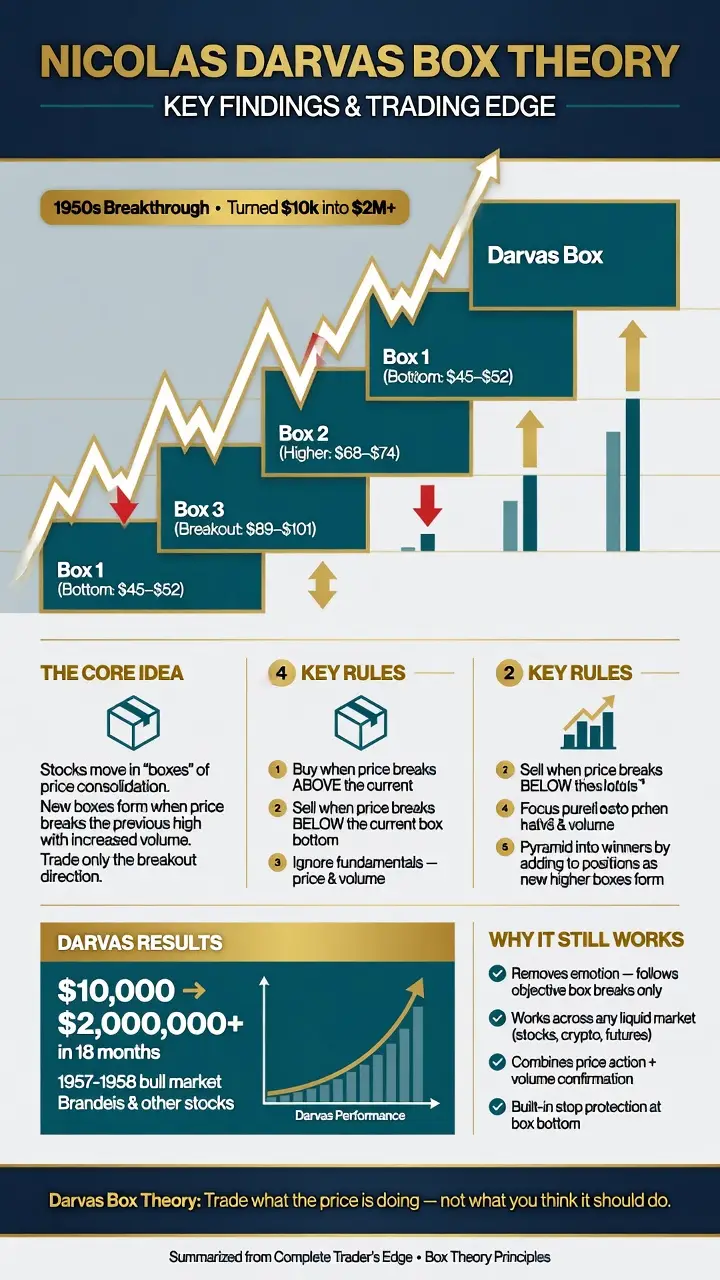
Darvas observed that stocks in strong uptrends do not move in straight lines. They advance in a series of steps. A stock would rally, consolidate within a defined price range, and then either break out of that range to a new high or break down below it. He visualised each consolidation as a “box” with a top (resistance) and a bottom (support).
A box was defined by the stock establishing a high, pulling back, testing the high again without exceeding it significantly, and then pulling back again to establish a low. The range between the high and the low became the box. The stock was considered to be “dancing within the box” until it made a decisive move above the top or below the bottom.
This is, in modern terms, a consolidation or range-bound phase. Today we might call it a range or a base pattern. Darvas called it a box, and the simplicity of the metaphor was part of its power. It required no indicators, no oscillators, no moving averages. Just price, a high, a low, and patience.
The Entry: Buy the Breakout
Darvas bought only when a stock broke above the top of its current box on increased volume. This was his entry signal. A breakout above the box suggested that demand had overcome supply at that level and the stock was ready to advance to a higher box.
He did not try to buy bottoms. He did not look for “undervalued” stocks. He bought stocks that were already in uptrends and were demonstrating the strength to continue. This is pure momentum trading, and Darvas was doing it with discipline and precision decades before momentum became a recognised factor in academic finance.
The Stop: Below the Box
Every trade had an automatic stop loss set just below the bottom of the current box. If the stock broke down below the box instead of breaking out above it, the position was closed immediately. No deliberation. No hoping. No averaging down.
This is the stop loss discipline that separates professional traders from amateurs. Darvas understood intuitively what every successful trader eventually learns: the cost of a small, defined loss is trivial compared to the cost of an undefined loss that grows until it threatens the account.
Riding the Trend: Box by Box
As a stock advanced through successive boxes, Darvas raised his stop to just below the bottom of each new box. This created a trailing stop that moved up with the stock, locking in profits as the trend continued while still giving the stock room to breathe within its current consolidation.
The genius of this approach is that it solves the trader’s most common dilemma: when to take profits. Darvas did not try to predict where the stock would top out. He let the boxes tell him. As long as the stock was making new boxes higher, he stayed in. When the stock broke below a box instead of above it, the trend was over and he exited.
Some of his biggest trades lasted months and moved through ten or more boxes. He captured the majority of the trend not because he predicted its magnitude but because his system was designed to stay in until the trend reversed. This is the “ride winners” principle that Ed Seykota would later articulate as one of his four rules.
Volume Confirmation
Darvas added one filter to his breakout entries: volume. He required that the breakout above the box occur on notably increased volume. This confirmed that the move was driven by genuine demand rather than thin, unconvincing price action. Low-volume breakouts were ignored. High-volume breakouts were traded.
This volume filter remains one of the most reliable confirmation tools in technical analysis today. A breakout on heavy volume has a significantly higher probability of follow-through than one on light volume. Darvas discovered this through observation; modern research has confirmed it through extensive backtesting.
The Techno-Fundamentalist Approach
Darvas did not rely on technical analysis alone. He called himself a techno-fundamentalist, meaning he combined his box theory with a basic fundamental filter: he only traded stocks in industries showing strong earnings growth and operated in sectors with positive future prospects.
This combination is more powerful than either approach alone. The fundamental filter ensured he was trading stocks with genuine business momentum behind them. The technical method ensured he entered at the right time and managed risk with precision. He was not interested in cheap stocks with improving fundamentals (value investing) or expensive stocks with deteriorating fundamentals (greater fool theory). He wanted stocks that were expensive and getting more expensive, backed by real earnings growth.
The parallel to Mark Minervini’s SEPA methodology is striking. Minervini, decades later, would build a remarkably similar approach: fundamental stock selection (strong earnings, high growth) combined with technical entry timing (Stage 2 uptrends, tight bases, volume breakouts). Darvas arrived at the same framework from a hotel room in Calcutta.
Trading by Telegram: The Constraint That Became an Advantage
Because Darvas was touring the world as a dancer, he could not sit in front of a screen and watch prices tick by tick. He received his stock data from newspaper tables, often one or two days delayed. He placed orders by telegram to his broker in New York.
Most people would consider this a crippling disadvantage. Darvas came to see it as his greatest advantage.
The delay forced him to think in terms of significant price levels rather than minute-by-minute noise. He could not be tempted by intraday volatility because he never saw it. He could not panic over a morning dip because he would not know about it until the next day. His buy-stop and sell-stop orders were placed in advance and executed automatically by his broker, removing the emotional component from execution entirely.
In modern terms, Darvas was forced into a higher-timeframe, process-driven approach by the constraints of his situation. He could not micromanage his trades, so he managed them systematically. The result was better execution than most traders achieve with instant access to real-time data, because the lack of access eliminated the noise that causes most traders to override their own rules.
This lesson is profoundly relevant for modern retail traders. More information does not produce better decisions. More screen time does not produce better returns. The trader who checks their positions once a day and executes a systematic plan will almost certainly outperform the trader who watches every tick and makes decisions in real time based on emotion. Darvas proved this with telegrams in the 1950s. The principle has not changed.
The Two-Year Run: $25,000 to $2.25 Million
Darvas’s extraordinary run began in 1957 and continued through 1959. He identified stocks like Lorillard, Diners’ Club, Universal Controls, Texas Instruments, and Thiokol Chemical, all companies in industries with strong growth prospects (electronics, aerospace, consumer finance) during the post-Sputnik technology boom.
He applied his box theory systematically. He bought breakouts on volume. He set stops below each box. He trailed his stops up as new boxes formed. He let his winners run through multiple boxes. When a stock broke a box to the downside, he exited and moved on.
The account grew from $25,000 to approximately $2.25 million. The returns were verified independently and documented in his book How I Made $2,000,000 in the Stock Market, published in 1960, which became one of the bestselling trading books of the twentieth century.
The Book and Its Legacy
How I Made $2,000,000 in the Stock Market was published in 1960 and has remained continuously in print for over six decades. It is one of the most honest and readable accounts of a trader’s development ever written. Darvas does not hide his early mistakes. He describes them in painful detail: the bad tips, the emotional decisions, the money lost before the system was developed.
This honesty is what makes the book so valuable. It is not a story of a natural talent who always got it right. It is the story of a systematic mind that learned from failure, developed a framework, and then executed it with the discipline that his early failures had taught him was necessary.
The book influenced generations of traders, including Mark Minervini, William O’Neil (founder of Investor’s Business Daily and creator of the CAN SLIM methodology), and thousands of retail traders who recognised in Darvas’s story the same potential in themselves.
What Every Trader Can Learn from Darvas
You Do Not Need Perfect Tools
Darvas made $2.25 million with newspaper stock tables and telegrams. You have a computer, real-time data, and instant execution. The tools are not the constraint. The discipline is.
Simplicity Is Not a Weakness
The Darvas Box is one of the simplest technical frameworks ever developed. No indicators. No oscillators. No algorithms. Just price, a range, and a breakout. Simple does not mean unsophisticated. It means focused. Most traders add complexity to avoid the discomfort of commitment. Darvas committed with clarity.
Buy Strength, Not Weakness
Darvas never bought cheap stocks. He bought expensive stocks getting more expensive. This is the momentum principle: strength tends to continue. Stocks making new highs have a higher probability of continuing to rise than stocks at 52-week lows have of recovering. This contradicts the intuition of most beginners, who want to buy “bargains.” Darvas proved that buying strength works.
Let the System Make the Decision
By placing his orders in advance by telegram, Darvas removed himself from the execution process. The system decided. The broker executed. Darvas reviewed. This is the model every trader should aspire to: decisions made in advance, executed mechanically, reviewed after the fact. The worst trading decisions are made in real time under emotional pressure.
Constraints Can Be Advantages
The lack of real-time data forced Darvas to focus on what mattered and ignore what did not. Modern traders have the opposite problem: too much data, too many indicators, too many opinions, too much noise. The cure is the same discipline Darvas was forced to adopt: define what matters, ignore everything else, and execute the plan.
Darvas and the Mind · Method · Money Framework
Mind: Darvas’s psychological journey is the most relatable in the Legendary Traders series. He started as an undisciplined tip-follower, lost money consistently, and then systematically rebuilt his approach from first principles. His willingness to document and learn from his failures is the model for how the trading journal can transform a struggling trader into a profitable one.
Method: The Darvas Box Theory is a complete technical methodology: entry (breakout above box on volume), stop (below the box), trail (raise stop to each new box), exit (break below current box). Its simplicity makes it one of the most accessible starting points for any trader learning to read market structure and price action.
Money: Darvas’s risk management was absolute. Every trade had a predefined stop. Losses were always small relative to the gains on trending winners. He never averaged into losing positions. He never let a profitable trade turn into a significant loss. This is position sizing discipline in its most intuitive form.
The Darvas Inspiration
Nicolas Darvas died in 1977, but his legacy continues to influence traders around the world. His story proves that you do not need to come from finance, you do not need expensive tools, you do not need insider connections, and you do not need to watch the market all day. What you need is a systematic approach, the discipline to follow it, and the patience to let the trend do the heavy lifting.
If a ballroom dancer trading from hotel rooms by telegram can turn $25,000 into $2.25 million, the only question remaining for any trader is not whether it is possible but whether they are willing to do what is required.
Key Takeaways from Nicolas Darvas
📦 The Darvas Box is one of the simplest and most effective breakout methodologies: buy above the box on volume, stop below it, trail up.
🧠 Constraints can be advantages. Less information means less noise. Define what matters and ignore everything else.
📈 Buy strength, not weakness. Stocks making new highs have higher momentum than bargain stocks at their lows.
📊 Combine technical signals with fundamental strength. The techno-fundamentalist approach selects quality stocks with timing precision.
📐 Your tools do not determine your results. Your discipline does. Darvas proved this with telegrams and newspapers.
Explore the Full Legendary Traders Series
Learn from history’s greatest market minds.
George Soros ·
Jesse Livermore ·
Druckenmiller ·
Ed Seykota ·
Richard Dennis ·
Mark Minervini
Darvas told the whole story himself, box theory included, in a book that has stayed in print since 1960.
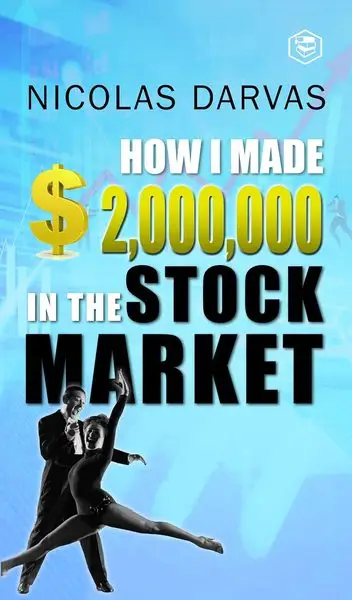
Rated in the Trader’s Library alongside seventy-nine others.
 The Complete Trader's Edge
The full Mind · Method · Money framework. 70 chapters.
View on Amazon →
The Complete Trader's Edge
The full Mind · Method · Money framework. 70 chapters.
View on Amazon →
 Market Mayhem
400 years of bubbles, crashes, and the pattern that keeps repeating.
Buy on Amazon →
Market Mayhem
400 years of bubbles, crashes, and the pattern that keeps repeating.
Buy on Amazon →
 Greatest Companies
How the world's greatest companies were built — and what traders learn from them.
View on Amazon →
Greatest Companies
How the world's greatest companies were built — and what traders learn from them.
View on Amazon →
 Greatest Traders
Eighty-six lives that explain the markets — Livermore to Madoff, told with the losses left in.
View on Amazon →
Greatest Traders
Eighty-six lives that explain the markets — Livermore to Madoff, told with the losses left in.
View on Amazon →