


The stop loss is not optional. This needs to be stated plainly because a significant number of retail traders either do not use them, use them inconsistently, or remove them when price approaches. Each of these behaviours is a form of unlimited risk acceptance, the opposite of professional trading.
A stop loss is the mechanical boundary between a manageable cost of doing business and an account-ending catastrophe. It is the single line of defence that keeps one bad trade from undoing months of disciplined work. This article explains where to place stops, why traders remove them, and how to make your stops structurally sound.
What a Stop Loss Actually Does
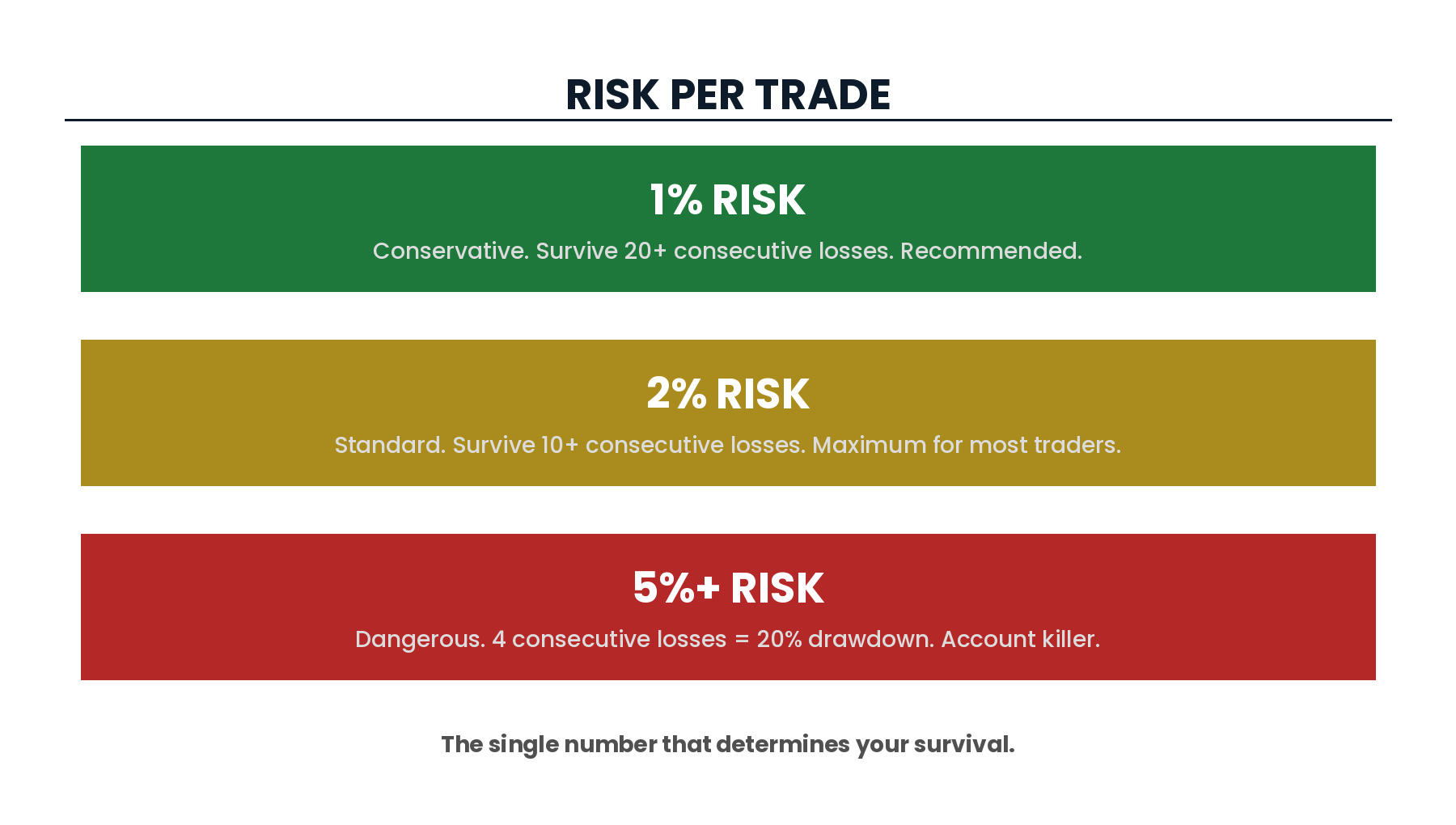
A stop loss defines the point at which your trade thesis is wrong. It is not an arbitrary number picked to avoid losing too much. It is the price level at which the market has demonstrated that your reason for being in the trade is no longer valid.
A properly placed stop converts open-ended risk into defined risk. Before you enter the trade, you know the maximum you can lose. This knowledge changes everything. It allows you to calculate your position size precisely. It allows you to determine your risk-to-reward ratio before entry. It allows you to trade with emotional clarity because the worst-case scenario is known and acceptable.
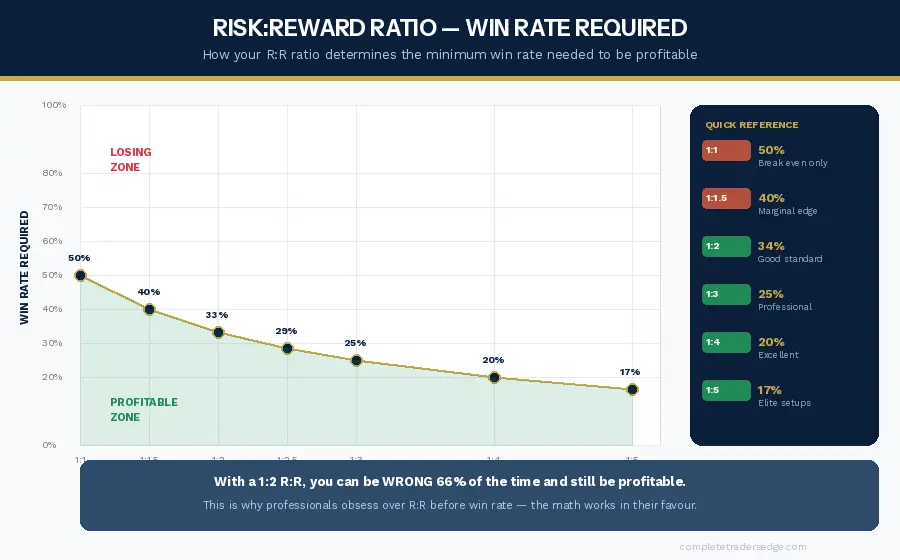
Without a stop, none of this is possible. The trade has no defined worst case, which means position size is a guess, R:R cannot be calculated, and the trader is sitting in a position where any amount of capital could be lost. This is not trading. It is gambling with unlimited downside.
Where to Place Stops: Structure-Based Placement
The best stop losses are placed based on market structure, not on financial tolerance. Your stop goes at the level where your trade thesis is invalidated, specifically one tick beyond the structural level that must hold for your analysis to remain correct.
| Setup Type | Stop Placement | Why |
|---|---|---|
| Bullish Order Block entry | Below the low of the Order Block | If price trades through the OB, institutional demand at that level has been absorbed. Thesis invalid. |
| Swing low entry (bullish) | Below the most recent higher low | A break of the higher low changes market structure from bullish to potentially bearish. |
| FVG fill entry | Below the full FVG (bottom of the gap) | If price fills the entire FVG and continues, the imbalance was not respected. No reason to hold. |
| Golden Pocket entry (0.618-0.702) | Below the 0.786 Fibonacci level | A retrace beyond 78.6% indicates the prior move may be fully reversing, not pulling back. |
| Trendline bounce | Below the trendline by a margin that accounts for volatility | A clean break and close below the trendline invalidates the trend-following thesis. |
The financial consequence of that stop distance then determines whether the trade is appropriately sized, not the other way around. If the correct structural stop is 40 pips and your account can only afford a micro lot at that distance, you trade a micro lot. If the stop is too far away for any meaningful position, you skip the trade. You never compromise stop placement to increase position size.
The Four Stop Placement Mistakes That Cost Traders Money
Mistake 1: Arbitrary distance stops. Placing a stop at a fixed 20-pip distance regardless of the chart structure. This stop has no relationship to the market. Sometimes 20 pips is too tight and you get stopped by noise. Sometimes it is too wide and you are risking more than necessary.
Mistake 2: Round number stops. Placing stops at psychologically convenient levels like $100, $2,300, or 1.1000. These are the most obvious stop clusters in the market. Institutional traders and algorithms actively target these levels. Placing your stop where everyone else does is an invitation to get swept.
Mistake 3: Financial tolerance stops. “I can afford to lose $200 on this trade, so my stop goes at -$200 from entry.” This ignores market structure entirely. The level where you can “afford” to lose has no relationship to the level where your trade thesis is invalidated.
Mistake 4: No stop at all. The most dangerous. “I will exit manually if it goes against me.” Under emotional pressure, manual exits are delayed, negotiated with, and often never executed. A mental stop is not a stop. It is a hope. Hope is not a risk management strategy.
Why Traders Remove Stops (And Why They Must Not)
The psychology of stop removal is rooted in loss aversion. As price approaches your stop, the impending realisation of a loss triggers emotional distress. The amygdala fires a threat response. The prefrontal cortex, weakened by stress, finds rationalisation easy: “The setup is still valid.” “It just needs more room.” “Support is right below.”
Moving the stop further away feels like giving the trade “more room.” In reality, it is converting a defined loss into an undefined one. The original stop was at the level where the trade thesis was invalidated. Moving it beyond that level means you are now holding a position where your own analysis says you should not be. You are hoping, not trading.
The traders who survive long term are those who treat their stops as immovable once set. The stop goes in at entry and stays there. This is non-negotiable.
Trailing Stops: When and How to Use Them
Once a trade is profitable, a trailing stop allows you to lock in gains while giving the trade room to continue. The most common approaches:
Break-even trail. Once the trade is 1R in profit, move the stop to breakeven (entry price). This eliminates the possibility of a winner turning into a loser. The trade-off: you may get stopped at breakeven on a trade that would have reached 2R or 3R. This is acceptable because the psychological benefit of risk-free trades is substantial.
Structure-based trail. As price creates new swing highs (in a long), move the stop below each new higher low. This keeps you in the trade as long as market structure remains bullish, only stopping you out when the trend actually changes.
R-multiple trail. At 1R profit, trail to breakeven. At 2R, trail to 1R. At 3R, trail to 2R. This systematically locks in a guaranteed minimum profit while allowing the trade to run.
Key Lessons
- Stop losses are non-negotiable. They convert unlimited risk into defined risk.
- Stops should be placed based on market structure (where the thesis is invalidated), not financial tolerance or arbitrary distances.
- The stop distance determines position size, not the other way around.
- Round number stops and fixed-distance stops are the most commonly targeted by institutional traders.
- Removing stops converts a defined loss into potentially unlimited loss. This is account destruction behaviour.
- Trailing stops lock in profits while allowing trades to run. Use structure-based or R-multiple trails.
Frequently Asked Questions
Should I use hard stops (on the platform) or mental stops?
Hard stops, always. A mental stop requires you to manually exit the trade at a specific level, which requires watching the screen constantly and executing under emotional pressure at the worst possible moment. Research and experience consistently show that traders exit later than intended when using mental stops because loss aversion causes delay. A hard stop on the platform executes automatically, regardless of your emotional state. The only exception is in extremely illiquid markets where a resting stop could be visible to market makers, but this does not apply to most retail-traded instruments.
My stops keep getting hit just before the market reverses. What am I doing wrong?
This is usually a placement problem, not a market manipulation problem. If your stops are at obvious levels (round numbers, previous highs/lows that every trader can see), they are in the exact location where liquidity sweeps target. The solution is to place stops beyond the obvious level, giving enough room for the sweep to occur while still protecting your position. Study ICT liquidity concepts to understand where stops cluster and how to position yours outside the kill zone.
Is it ever acceptable to widen a stop?
Before entry, yes. During the pre-trade analysis, if you realise the structural stop needs to be wider than initially planned, adjust the stop distance and recalculate position size accordingly. After entry, no. Once the trade is live, the stop stays where it was placed. Widening a stop after entry is a psychological decision driven by loss aversion, not an analytical decision driven by new information. If genuinely new information changes the thesis (a major news event shifts the macro picture), the correct response is to close the trade and reassess, not to widen the stop and hope.
How much room should I give beyond the structural level?
Add a buffer of a few pips or points beyond the key level to account for spread and momentary wicks. For forex majors, 3 to 5 pips beyond the structural level is standard. For Gold, 3 to 5 points. For NQ or ES futures, 2 to 5 points. The buffer size should reflect the typical noise range of the instrument on the timeframe you are trading. Check the average candle wick size on your entry timeframe to calibrate this.
Do professional traders always use stop losses?
Yes, without exception. The form may vary. Some use hard stops on the platform. Some use options to define maximum loss (a put option as a stop for a long stock position). Institutional desks have risk limits enforced at the firm level. But the principle is universal: every position has a defined maximum loss before it is entered. No professional trader in any market operates without predefined risk limits. The idea that “pros trade without stops” is a retail myth, usually perpetuated by traders who do not use stops and need justification for the decision.
Continue Reading
▶ Position Sizing Mastery: Never Risk the Wrong Amount Again
▶ Risk-to-Reward: Make Money Even When Wrong Half the Time
▶ The Stop-Hunt Explained: How Smart Money Engineers Liquidity Sweeps
From The Book
This article covers concepts from Chapter 55 of The Complete Trader’s Edge.
 The Complete Trader's Edge
The full Mind · Method · Money framework. 70 chapters.
View on Amazon →
The Complete Trader's Edge
The full Mind · Method · Money framework. 70 chapters.
View on Amazon →
 Market Mayhem
400 years of bubbles, crashes, and the pattern that keeps repeating.
Buy on Amazon →
Market Mayhem
400 years of bubbles, crashes, and the pattern that keeps repeating.
Buy on Amazon →
 Greatest Companies
How the world's greatest companies were built — and what traders learn from them.
View on Amazon →
Greatest Companies
How the world's greatest companies were built — and what traders learn from them.
View on Amazon →