
Mark Douglas never managed a billion-dollar fund. He never made a single trade that moved markets. He never appeared on the covers of financial magazines or generated the kind of returns that make traders legendary in the traditional sense. What he did was arguably more important: he explained why traders fail.
His book Trading in the Zone, published in 2000, is the most influential trading psychology text ever written. It has shaped how an entire generation of traders thinks about probability, expectation, and the relationship between their beliefs and their results. If you have ever heard a trader say “think in probabilities” or “the outcome of any single trade is random,” you are hearing Mark Douglas, whether the speaker knows it or not.
Douglas spent thirty years studying why intelligent, disciplined, successful people in other fields could not trade profitably. His conclusion was not that they lacked strategy or knowledge. It was that their psychological framework, the set of beliefs and expectations they brought to trading, was fundamentally incompatible with the reality of how markets work. Fixing the psychology was not a supplement to learning strategy. It was the prerequisite.
From Trader to Psychologist of Trading
Mark Douglas began his career as a trader in the early 1970s. His experience followed the pattern that would later become the foundation of his teaching: initial enthusiasm, inconsistent results, emotional turmoil, and the gradual realisation that the problem was not in his charts but in his thinking.
| Principle | What It Means | Trading Application |
|---|---|---|
| Think in probabilities | Each trade is one instance in a series of random outcomes | Stop evaluating individual trades. Evaluate 50-trade batches. |
| Consistent state of mind | Trade from calm, focused awareness every session | Rate emotional state 1-5 before each trade. Do not trade at 4 or 5. |
| Accept risk in advance | Fully accept the dollar risk before entering | If the potential loss makes you uncomfortable, reduce size until it does not. |
| Process over outcome | A trade that followed rules but lost is a good trade | Track process adherence score (1 or 0) as your primary journal metric. |
| The market is neutral | The market does not care about your analysis or feelings | Your job is to respond to what price does, not predict what it should do. |
After losing a significant portion of his trading capital, Douglas shifted his focus from trying to beat the market to understanding why he could not beat it. He began studying the psychology of performance, the nature of probability, and the cognitive biases that interfere with rational decision-making under uncertainty.
In 1990, he published his first book, The Disciplined Trader, which laid the groundwork for his psychological framework. A decade later, Trading in the Zone refined and expanded those ideas into the most comprehensive model of trading psychology available. He spent the rest of his career coaching traders, giving seminars, and developing his understanding of why the gap between knowing what to do and actually doing it is so persistent and so destructive.
Douglas passed away in 2015, but his work remains the starting point for every serious discussion of trading psychology.
The Core Problem: Your Mind Is Not Built for Trading
Douglas’s central insight is that the human mind is fundamentally unsuited for the task of trading. Not because traders are stupid, but because the cognitive and emotional systems that evolved to keep humans alive in a physical environment produce exactly the wrong responses in a probabilistic one.
The Need for Certainty
The human brain craves certainty. It wants to know what will happen next. It generates predictions constantly, scanning the environment for patterns that provide a sense of control and safety. In physical environments, this is adaptive. In trading, it is catastrophic.
Markets are inherently uncertain. The outcome of any single trade is unknown and unknowable, regardless of how perfect the setup looks. Douglas argued that the trader who approaches each trade expecting certainty, expecting to be right, expecting the setup to work, has already set themselves up for psychological failure. When the trade does not work (as 40-60% of trades will not, even with a positive-expectancy system), the trader experiences the loss not as a normal statistical outcome but as a personal failure, a violation of their expectation, a threat.
This threat response triggers a cascade of emotional reactions: fear, frustration, self-doubt, the urge to revenge trade, the impulse to move the stop, the decision to skip the next signal. Every one of these reactions degrades performance. And every one of them stems from the same root cause: the expectation of certainty in an uncertain environment.
The Pain of Being Wrong
Douglas observed that most people experience being wrong as painful, even threatening. In everyday life, being wrong carries social consequences: embarrassment, loss of status, damage to self-image. In trading, being wrong simply means that a probabilistic event did not go in your favour. It carries no more personal significance than a coin landing on tails.
But traders do not experience it that way. They experience a losing trade as evidence that they are wrong, that their analysis was flawed, that they are not good enough. This experience of loss as personal failure creates an emotional response that has nothing to do with the trade and everything to do with the trader’s relationship to being wrong.
Douglas’s solution was radical in its simplicity: redefine what it means to be wrong. A losing trade is not a wrong decision. It is a normal outcome within a probability distribution. The trader who can genuinely internalise this, not just understand it intellectually but feel it at the level of instinct, has solved the primary psychological problem of trading.
The Five Fundamental Truths
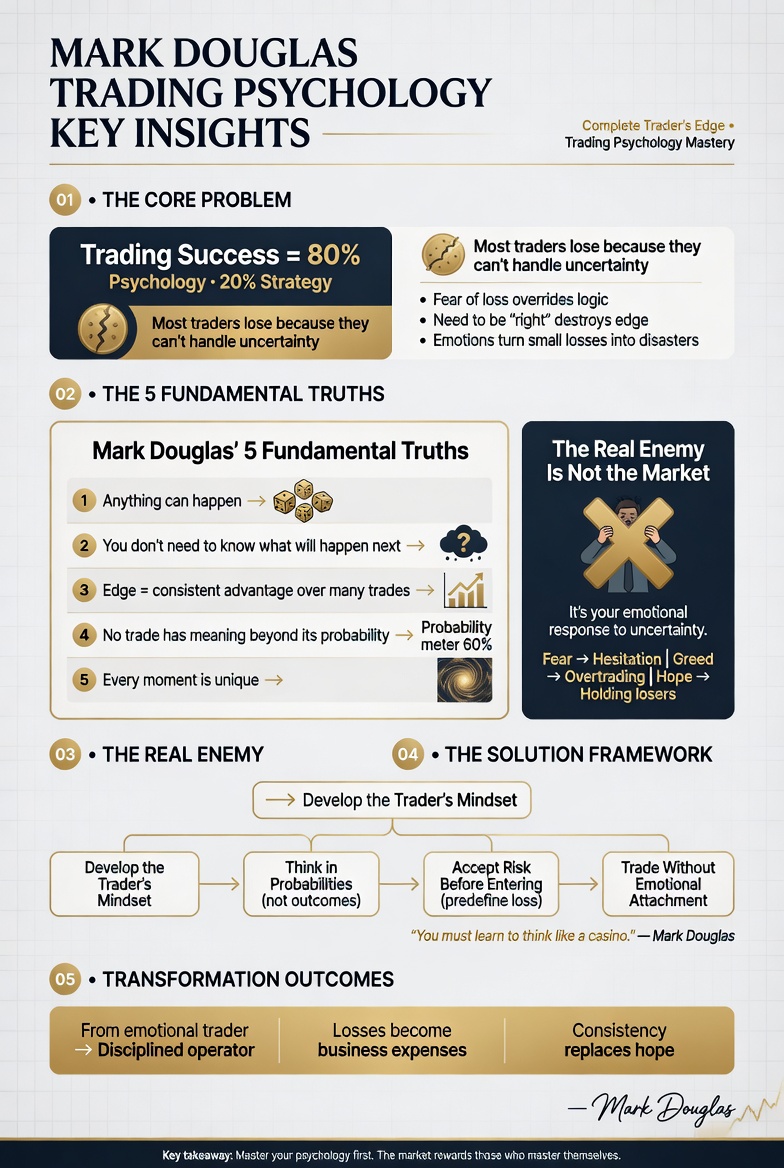
In Trading in the Zone, Douglas presents five truths that he considers the foundation of a professional trading mindset. These truths are deceptively simple. Understanding them is easy. Internalising them to the point where they govern your behaviour under pressure is the work of a trading career.
1. Anything Can Happen
Every trade exists in an environment of unlimited variables. No matter how thoroughly you analyse a setup, there are factors you cannot see, cannot measure, and cannot predict. A news event, a large institutional order, a shift in sentiment that has nothing to do with your chart. The market can do anything at any time, and your analysis cannot prevent it.
This is not a statement of helplessness. It is a statement of liberation. If anything can happen, then the outcome of any single trade is not a reflection of your skill. Your skill is reflected in your process, your edge over a sample size, and your ability to execute consistently regardless of individual outcomes.
2. You Do Not Need to Know What Is Going to Happen Next to Make Money
This is the most counterintuitive of the five truths, and the one that most traders resist most strongly. The desire to know what will happen next is deeply embedded in human psychology. But profitable trading does not require prediction. It requires a system with positive expectancy and the discipline to execute it consistently.
A casino does not know whether the next spin of the roulette wheel will produce a win or a loss. But the casino knows, with mathematical certainty, that over thousands of spins, the house edge will produce a profit. The casino does not need to predict individual outcomes. It needs to operate consistently and let the mathematics work.
This is the probability mindset that Douglas considered the single most important psychological shift a trader can make. Stop trying to be right on the next trade. Start being consistent over the next hundred trades.
3. There Is a Random Distribution Between Wins and Losses for Any Given Set of Variables That Define an Edge
Even a system with a 60% win rate will produce sequences of consecutive losses. Five losses in a row. Seven losses in a row. These sequences are not evidence that the system is broken. They are statistically inevitable features of a random distribution.
Douglas emphasised this point repeatedly because the inability to accept it is the most common cause of system abandonment. The trader starts with a profitable strategy, experiences a normal drawdown, interprets the drawdown as evidence that the strategy no longer works, and switches to a different approach. The new approach produces its own drawdown, which triggers another switch. The cycle repeats until the account is exhausted.
Understanding that losses are randomly distributed within a profitable system is the antidote to this cycle. You do not abandon a system because of a losing streak. You abandon a system because your edge has changed. These are entirely different assessments, and distinguishing between them requires the psychological maturity to endure discomfort without changing course.
4. An Edge Is Nothing More Than an Indication of a Higher Probability of One Thing Happening Over Another
Your edge does not guarantee anything on any single trade. It provides a statistical tendency over a large number of trades. This means that the quality of any individual trade is unknowable at the moment of execution. You cannot distinguish a future winner from a future loser when you enter the trade. You can only know that your edge, applied consistently, will produce a net positive result over many trades.
This understanding has a profound practical implication: every trade in your system is equal. The next trade is not more important or less important than any other trade. It is one more data point in a series. Treating every trade the same, with the same risk, the same rules, the same emotional neutrality, is the hallmark of professional execution.
5. Every Moment in the Market Is Unique
Even when a setup looks identical to one you have seen before, it is not the same. The participants are different. The context is different. The order flow is different. The macro environment is different. Every moment in the market is unique, which means that past patterns provide probabilities, not certainties.
This truth prevents two common errors: the expectation that a pattern “should” work because it worked last time, and the fear that a pattern will fail because a similar pattern failed in the past. Both responses project past experience onto a unique present moment. Both interfere with clean execution.
The Concept of “Thinking in Probabilities”
Douglas’s most enduring contribution is the framework of probabilistic thinking. He argued that the professional trader operates from a fundamentally different mental framework than the amateur. The amateur thinks in terms of individual outcomes: will this trade win or lose? The professional thinks in terms of distributions: over the next 100 trades, what is my expected result?
This shift changes everything. The professional does not experience emotional distress when a single trade loses because the single trade is irrelevant to the long-term outcome. The professional does not experience euphoria when a single trade wins because one winner does not validate the system any more than one loser invalidates it.
The emotional flatness that this framework produces is not apathy. It is freedom. Freedom from the emotional roller coaster that exhausts most traders and drives them to make progressively worse decisions. The professional trader is not calm because they do not care. They are calm because they understand the mathematics well enough to know that individual outcomes are noise, and only the aggregate matters.
This connects to everything in the Mind pillar of the Mind, Method, Money framework. Douglas provided the psychological architecture. The framework provides the practical implementation.
Why Traders Self-Sabotage
Douglas identified several mechanisms through which traders undermine their own success, even when they know exactly what they should be doing.
The Fear of Being Wrong
The fear of being wrong causes traders to hesitate on entries, take profits too early, hold losers too long (because closing a loss makes it “real”), and avoid taking trades that look risky even when the system signals them. Every one of these behaviours reduces performance by either missing winners or enlarging losers.
The Fear of Losing Money
Distinct from the fear of being wrong, the fear of losing money causes traders to reduce position sizes below what their system specifies, to skip trades after a losing streak, and to trade defensively when they should be executing normally. The irony is that the fear of losing money, through its effect on behaviour, causes the trader to lose more money than they would have lost by following the system.
The Fear of Missing Out
When a market moves without the trader in it, the fear of missing out drives impulsive entries at poor prices, chasing moves that are already extended, and abandoning waiting for proper setups in favour of “getting in.” These entries typically have worse risk-reward profiles and higher failure rates than the setups the system was designed to capture.
The Fear of Leaving Money on the Table
This fear causes traders to exit winners too late, trying to squeeze every last point out of a move. Alternatively, it causes them to re-enter trades they have already exited profitably, often at worse prices. The result is that profits are reduced and sometimes reversed entirely.
All four fears share a common root: the trader’s relationship with uncertainty. The professional trader accepts uncertainty as a permanent feature of the environment and operates within it. The amateur trader fights uncertainty, seeking control, prediction, and certainty. The fight produces the exact emotional responses that lead to poor decisions.
The “Zone” Explained
The title of Douglas’s most famous book refers to a state of mind that he considered the peak of trading performance. “The Zone” is not a mystical state. It is a practical psychological framework characterised by three qualities:
Confidence without euphoria. The trader trusts their system and their ability to execute it. This trust is not fragile. It does not depend on the last trade being a winner. It comes from understanding the mathematics of the edge and having verified it over a meaningful sample size.
Focus without tension. The trader is fully engaged with the market but not anxious about the outcome. They are observing, processing, and executing without the emotional noise that interferes with clear perception. They see what is happening rather than projecting what they want to happen.
Discipline without effort. The trader follows their rules not through willpower but through genuine acceptance of the probabilistic framework. They do not need to force themselves to take the stop loss because they genuinely believe that the stop loss is the right action. They do not need to force themselves to stay in a winning trade because they genuinely understand that premature exits reduce long-term expectancy.
Douglas argued that this state is achievable by any trader who has genuinely internalised the five fundamental truths. It is not reserved for the naturally talented or the emotionally invulnerable. It is the product of psychological work: examining your beliefs about trading, identifying the ones that conflict with probabilistic reality, and replacing them with beliefs that support consistent execution.
Douglas’s Practical Framework for Change
Douglas was not content to diagnose the problem. He provided specific exercises and frameworks for building the probabilistic mindset.
The 20-Trade Exercise
Douglas recommended that traders select a single setup with a defined edge and commit to executing the next 20 trades with perfect discipline: same entry rules, same risk, same stop, same exit rules, no deviation. The purpose is not to make money (though a positive-expectancy system will, over 20 trades, likely be profitable). The purpose is to experience the random distribution of wins and losses and to prove to yourself that the system works over a sample even though individual trades are unpredictable.
This exercise builds the neural pathways of consistent execution. After 20 trades executed with perfect discipline, the trader has direct experience of what probabilistic trading feels like. The intellectual understanding becomes embodied knowledge, and embodied knowledge is what governs behaviour under pressure.
Belief Inventory
Douglas encouraged traders to explicitly list their beliefs about trading and then evaluate each one against the five fundamental truths. Beliefs like “I need to be right to make money,” “a losing trade means I made a mistake,” or “I should be able to predict where the market is going” are directly contradicted by the probabilistic framework. Identifying these beliefs is the first step toward replacing them.
Redefining the Relationship with Loss
Perhaps Douglas’s most practical contribution was his insistence that traders must redefine their relationship with loss. A loss is not a failure. It is a cost of doing business. It is the premium paid for the opportunity to capture a winner. The trader who can take a loss with the same emotional neutrality as a casino operator watching a player win a hand has achieved the psychological foundation of professional trading.
This is not about becoming emotionless. It is about redirecting emotion. The professional trader does not feel nothing. They feel satisfaction from executing well, regardless of whether the individual trade won or lost. The process becomes the source of emotional reward, not the outcome. This shift, from outcome-focused emotion to process-focused emotion, is the single most important psychological transformation a trader can make.
How Douglas Connects to Other Legendary Traders
Douglas’s work explains why the other traders in this series succeeded and why some of them eventually failed.
Ed Seykota’s observation that “everybody gets what they want from the market” is the same insight Douglas described through the lens of unconscious belief patterns. Traders who consistently lose are operating from belief systems that produce losing behaviour, even when they consciously want to win.
Richard Dennis’s Turtle Experiment proved that the rules could be taught, but some Turtles failed because they could not follow them. Douglas would explain this failure as a conflict between the traders’ belief systems and the demands of the system. They believed, at some level, that they should be able to predict outcomes, and when the system’s drawdowns contradicted that belief, they abandoned the rules.
Jesse Livermore’s repeated destruction of his own fortune is the ultimate illustration of Douglas’s thesis: Livermore knew the rules better than almost anyone alive, but his psychological patterns, his need for excitement, his inability to sit with uncertainty, overrode his knowledge every time the pressure became sufficiently intense.
Stanley Druckenmiller’s dot-com mistake, chasing technology stocks despite knowing they were overvalued, is the fear of missing out that Douglas describes in detail. Even one of the greatest traders of all time was not immune to the psychological forces Douglas identified.
Douglas and the Mind · Method · Money Framework
Mind: Mark Douglas IS the Mind pillar. His work defines the psychological framework that professional trading requires. The five fundamental truths, the concept of thinking in probabilities, the diagnosis of self-sabotage through fear-based decision making. If you do not understand Douglas, you do not understand why you struggle to follow your own rules.
Method: Douglas was not a methodologist. He did not teach specific setups, indicators, or strategies. What he taught was something more fundamental: that no method will produce consistent results until the trader’s psychology is aligned with the probabilistic nature of markets. Method without mind is a car without a driver. It might go somewhere, but not where you intend.
Money: Douglas’s framework has direct implications for risk management. If every trade’s outcome is genuinely uncertain, then risking more than you can afford to lose on any single trade is mathematically and psychologically irrational. Proper position sizing is not just a mathematical calculation. It is the practical expression of probabilistic acceptance.
The Douglas Legacy
Mark Douglas passed away on September 8, 2015. He left behind two books, thousands of hours of seminar recordings, and a framework for trading psychology that has not been surpassed. Every trading coach who teaches probability-based thinking is working within the paradigm Douglas established. Every trader who has made the shift from outcome-focused to process-focused trading has followed the path he mapped.
His work does not tell you what to trade or when to trade it. It tells you something more important: how to think while you trade. And for most traders, that is the missing piece that no strategy, no indicator, and no amount of screen time can replace.
If you read one book on trading psychology, it should be Trading in the Zone. If you read two, add The Disciplined Trader. And if you do the work Douglas prescribes, if you genuinely examine your beliefs, commit to the 20-trade exercise, and rebuild your relationship with uncertainty, you will not just become a better trader. You will understand, for the first time, what it actually means to trade.
Key Takeaways from Mark Douglas
🧠 Think in probabilities. The outcome of any single trade is irrelevant. Your edge exists only over a sample of many trades.
📊 The Five Fundamental Truths: anything can happen, you do not need to know what happens next, wins and losses are randomly distributed, an edge is a probability, every moment is unique.
🔁 Self-sabotage through fear (of being wrong, of losing money, of missing out) is the primary cause of trading failure.
📐 The 20-trade exercise builds the neural pathways of consistent execution by proving the system works over a sample.
🎯 Process over outcome. When execution quality becomes your source of satisfaction, you have entered the Zone.
Explore the Full Legendary Traders Series
Learn from history’s greatest market minds.
George Soros ·
Jesse Livermore ·
Druckenmiller ·
Ed Seykota ·
Richard Dennis ·
Nicolas Darvas