

Nobody becomes a consistently profitable trader by accident. The ones who make it follow a sequence, whether they planned it consciously or stumbled into it through years of expensive trial and error. This guide maps that sequence deliberately, so you can compress the learning curve without compressing your account in the process.
This is the complete roadmap for learning to trade: from zero knowledge to a structured, repeatable process across Mind, Method and Money. Whether you are two weeks in or two years in and feeling stuck, this guide will show you exactly where you are, what you need next, and in what order to build it.
Why Most Trading Education Fails You
The trading education market has a structural problem. Most courses, YouTube channels and social media accounts teach tactics without context. You learn about RSI before you understand what price is actually doing. You learn about support and resistance before you understand why those levels form. You learn how to enter a trade before you know how to manage risk if it goes wrong.
The result is a large number of traders who know a lot of things but cannot connect them into a coherent process. They are technically literate but operationally lost. The roadmap below is built around the opposite principle: framework first, then tools.
The Five Stages of Trader Development
| Stage | Where you are | Common feeling | Typical timeline |
|---|---|---|---|
| 1. Unconscious incompetence | You don’t know what you don’t know | Excited, overconfident | Weeks 1-4 |
| 2. Conscious incompetence | You realise how much there is to learn | Overwhelmed, frustrated | Months 1-6 |
| 3. Conscious competence | You can trade well when focused and deliberate | Inconsistent, effortful | Months 6-24 |
| 4. Unconscious competence | Good decisions feel natural, process is habitual | Consistent, calmer | Years 2-4 |
| 5. Mastery | You understand your edge deeply, adapt to conditions | Confident, strategic | Year 4+ |
Almost every trader quits at Stage 2. The jump from unconscious excitement to conscious overwhelm is steep, and it arrives right when you are taking your first real losses. Stage 2 is not failure. It is the unavoidable gateway to everything that comes after.

Phase 1 — Build the Foundation (Months 1-3)
The foundation phase is not about learning setups. It is about understanding the nature of markets, how prices form, who is actually on the other side of your trades, and what a sustainable process looks like.
Step 1: Understand How Markets Actually Work
Price moves because of liquidity. Every time you enter a trade, someone else exits. The dominant players in any liquid market are institutions: banks, hedge funds, proprietary trading desks managing billions of dollars. They cannot transact the way a retail trader can. A hedge fund needing to buy 10,000 Gold contracts cannot simply send a market order without moving the price severely against itself. Instead, it operates in areas of concentrated liquidity: just below obvious support levels where retail stop losses cluster, at Fair Value Gaps where price moved too fast and left an imbalance, at Order Blocks where previous institutional activity created a zone of interest.
Understanding this dynamic transforms how you read a chart. You stop seeing patterns and start seeing the footprints of large participants. This is the single most important conceptual shift in early trading education.
Step 2: Learn the Three Pillars Before You Learn Any Setup
- Mind — the psychological infrastructure that allows you to execute your plan under pressure, accept losses without revenge trading, and maintain consistency when outcomes are uncertain.
- Method — the technical framework that identifies where, when and why to take a trade. The analytical approach, the setups, the confluences, the entry and exit criteria.
- Money — the risk management system that determines how much to risk, how positions are sized, what the daily loss limit is, and how to grow capital safely over time.
Most beginner traders skip straight to Method. This is the wrong order. Method without Money guarantees eventual account destruction. Both without Mind produces a trader who knows what to do but cannot do it consistently under live conditions.
Step 3: Choose Your Instruments and Sessions
| Instrument | Style | Best sessions | Beginner considerations |
|---|---|---|---|
| Gold (XAU/USD) | Day trade / swing | London + NY overlap | Highly responsive to ICT concepts; great for learning |
| NQ (Nasdaq futures) | Day trade | NY session | Fast-moving; requires tight execution |
| ES (S&P 500 futures) | Day trade | NY session | Lower volatility than NQ; smoother price action |
| BTC/USD | Day trade / swing | 24/7 (avoid 3-7 AM UTC) | Volatile; CME gaps are high-probability setups |
| Stocks (swing) | Swing trade | NY session + pre-market | Lower leverage; good for learning patience |
Pick one instrument and trade it exclusively for the first three to six months. Learn its personality. Understand how it moves during different sessions, how it reacts to news, where it tends to find liquidity. Depth of knowledge on one instrument beats surface-level familiarity with ten.
Phase 2 — Build Your Technical Framework (Months 3-9)
Phase 2 is where you build your Method pillar. The objective is not to learn every indicator or concept that exists. It is to build a coherent, internally consistent analytical framework that you understand deeply enough to explain to someone else in plain language.
Step 4: Learn Market Structure
Market structure is the foundation of all technical analysis. Before any setup, before any entry, before any indicator, you need to know one thing: is this market making higher highs and higher lows (uptrend), lower highs and lower lows (downtrend), or neither (range)? Spend at least two to three weeks reading charts every day with a focus exclusively on structure before adding any other concept.
Step 5: Understand Liquidity and Institutional Order Flow
Once you can read structure, you are ready to understand why price breaks structure when it does. The answer is almost always liquidity. Retail traders are predictable — they place stop losses just below obvious support and just above obvious resistance. Institutional participants use this predictability to engineer moves into areas of concentrated stops, fill their large positions, then drive price in their intended direction.
This is called a liquidity sweep, and it is one of the most consistently repeatable patterns in any liquid market. Learning to identify where stop losses are likely to cluster and watching for the sweep before entering in the opposite direction is one of the most powerful foundational skills in modern technical trading.
Step 6: Add the Core Confluence Stack
| Tool | What it identifies | Learn in order |
|---|---|---|
| Market structure | Trend direction on each timeframe | First |
| Liquidity levels | Where stop losses cluster; where sweeps target | Second |
| Order Blocks | Institutional entry zones from prior impulsive moves | Third |
| Fair Value Gaps (FVGs) | Imbalances where price moved fast and may return | Fourth |
| Volume Profile | Where real volume transacted; VAH, VAL, VPOC | Fifth |
| Fibonacci (Golden Pocket) | Optimal trade entry zone at 61.8-70.2% retracement | Sixth |
| Daily/Weekly pivots | Objective intraday and swing directional bias | Seventh |
| AVWAP | Dynamic institutional fair value from key swing points | Eighth |
| Kill Zones (session timing) | When institutional activity is highest (London, NY open) | Ninth |
Step 7: Build Your Top-Down Analysis Routine
- Daily chart: Overall directional bias. Where are the major liquidity levels above and below price?
- 4-hour chart: Intermediate structure, nearest Order Blocks, FVGs and pivots.
- 1-hour chart: Local structure. Is the market approaching or pulling away from a key level?
- 15-minute chart: Entry timeframe. Is there a sweep, a structural shift, and an Order Block or FVG at the right location?
This routine should take 10 to 15 minutes per instrument before each session. Without it, entries lack context and the probability of any individual trade drops significantly.
Phase 3 — Build Your Money Management System (Months 6-12)
Step 8: Set Your Non-Negotiable Risk Rules
- Maximum risk per trade: 1% of your total account. No exceptions, including “high-conviction” setups.
- Daily loss limit: 2%. Hit it, close the platform, done for the day.
- Weekly loss limit: 5%. Hit it, move to demo for the rest of the week.
- Minimum R:R: 1:2. Never take a trade where potential reward is less than twice your risk.
Step 9: Learn Position Sizing Properly
The formula: Position size = (Account balance x Risk %) / (Entry price – Stop loss price)
If your account is $10,000, your risk is 1% ($100), your entry on Gold is $2,350 and your stop loss is $2,340 (10 points), your position size is $100 / $10 = 10 units or 0.10 lot on Gold. The number comes from the maths, not from how you feel.
Step 10: Understand Drawdown and Recovery
| Drawdown depth | Return needed to break even | Time to recover at 5%/month |
|---|---|---|
| 10% | 11.1% | ~2 months |
| 20% | 25% | ~5 months |
| 30% | 42.9% | ~8 months |
| 50% | 100% | ~20 months |
| 75% | 300% | Effectively over |
Phase 4 — Build Your Mind (Ongoing, but Focus Months 3-18)
Step 11: Separate Process from Outcome
A well-executed trade that loses money is a success. A poorly-executed trade that makes money is a failure. What you can control is whether you followed your process. What you cannot control is the outcome of any individual trade. Most traders evaluate themselves on outcomes. Professional traders evaluate themselves on process.
Step 12: Start Journaling Immediately
At minimum, record for every trade: the date and session, the instrument, your setup type, the entry price, stop loss and target, the outcome in R, whether you followed your rules, and one sentence about what you learned. Review weekly. Look for patterns in your losses first.
Step 13: Manage the Four Emotional Traps
| Trap | What triggers it | What it looks like | The fix |
|---|---|---|---|
| Revenge trading | A loss, especially a large one | Immediately re-entering at larger size | Daily loss limit: hit 2% and you’re done for the day |
| FOMO | A fast move you didn’t take | Chasing price after a setup has fully played out | Rule: “If I missed the entry, I missed the trade.” |
| Overconfidence | A run of winning trades | Sizing up, skipping checklist steps | Risk stays at 1% regardless of recent results |
| Analysis paralysis | Too many conflicting signals or recent losses | Never pulling the trigger on valid setups | Pre-defined checklist: if all boxes tick, enter |
Phase 5 — From Learning to Earning (Months 12-36+)
Step 14: Build a Track Record Before Scaling
Before you increase your account size or risk percentage, you need documented evidence that your edge works: a journal with at least 100 trades showing positive expectancy across different market conditions. A 200-trade sample with positive expectancy is meaningful. Two good months is not.
Step 15: Consider a Funded Account
Once you have a documented track record, a funded prop firm account is one of the most efficient ways to scale your income without scaling your personal capital risk. Firms like FundedNext and FundingPips provide capital allocations of $25,000 to $200,000+ to traders who pass their evaluation challenges. The evaluation tests whether you can trade profitably within defined risk parameters — which is exactly what this roadmap has been building.
Step 16: Never Stop Reviewing
Every week, review your trades. Every month, review your system. Every quarter, ask whether your edge is still working and whether market conditions have changed. The market is not static. Conditions shift. The traders who adapt are the traders who last.
Your Complete Learning Roadmap at a Glance
| Phase | Timeframe | Key steps | Environment |
|---|---|---|---|
| Foundation | Months 1-3 | How markets work, Three Pillars, choose instruments | Study only, no live trading |
| Technical framework | Months 3-9 | Structure, liquidity, confluence stack, top-down analysis | Demo trading, chart reading daily |
| Risk management | Months 6-12 | Risk rules, position sizing, drawdown understanding | Small live account ($500-$1,000) |
| Psychology | Months 3-18+ | Process vs outcome, journaling, emotional management | Ongoing, parallel to all phases |
| Scaling | Months 18-36+ | Track record, funded accounts, adaptation | Live account or prop firm |
Frequently Asked Questions
How long does it realistically take to learn trading?
Most traders who approach learning systematically and maintain a journal from the start begin to see consistent profitability somewhere between 12 and 36 months. The wide range reflects how much the timeline depends on deliberate practice rather than time alone. A trader who charts daily, journals every trade, and reviews weekly for 18 months will progress faster than one who trades casually for three years.
Should I start with demo trading or a live account?
Demo trading for the Foundation and Technical Framework phases (roughly the first 3-6 months) is appropriate. After that, a small live account of $500-$1,000 is more valuable because it introduces the psychological pressure that demo trading cannot replicate. The goal on the small live account is not profit. It is process compliance and emotional management practice.
Which trading style is best for beginners — day trading or swing trading?
Neither is universally better, but they suit different circumstances. Day trading requires availability during specific market sessions and the psychological capacity for multiple decisions per day. Swing trading requires more patience but fewer active hours. Beginners with full-time jobs often find swing trading more manageable initially. The important thing is that your chosen style matches your available time and temperament.
Do I need expensive courses or software to learn trading?
No. The core concepts required to become a competent trader are all teachable through quality free content, books and a TradingView account. Where paid resources provide value is in structure and community: a well-organised course saves time by providing a logical sequence, and a quality community provides feedback on your analysis. Neither is a requirement. Discipline and consistency are.
What is the biggest mistake beginners make when learning to trade?
Skipping risk management until after they have a strategy. Almost universally, the traders who blow their first account do so not because their strategy was wrong but because they risked too much per trade and could not survive the inevitable losing streak every strategy produces. Setting your 1% risk rule, daily loss limit and minimum R:R before taking a single live trade is the single most impactful action a beginning trader can take.
▶ ▶ ▶ Continue Reading
Build each pillar properly
The Complete Trader’s Edge
This roadmap is the book
70 chapters covering every stage in this roadmap in full depth. Mind, Method and Money built in sequence, with the exact frameworks, tools and psychological concepts you need at each phase. Available on Amazon in Kindle, paperback and full-colour editions.
 The Complete Trader's Edge
The full Mind · Method · Money framework. 70 chapters.
View on Amazon →
The Complete Trader's Edge
The full Mind · Method · Money framework. 70 chapters.
View on Amazon →
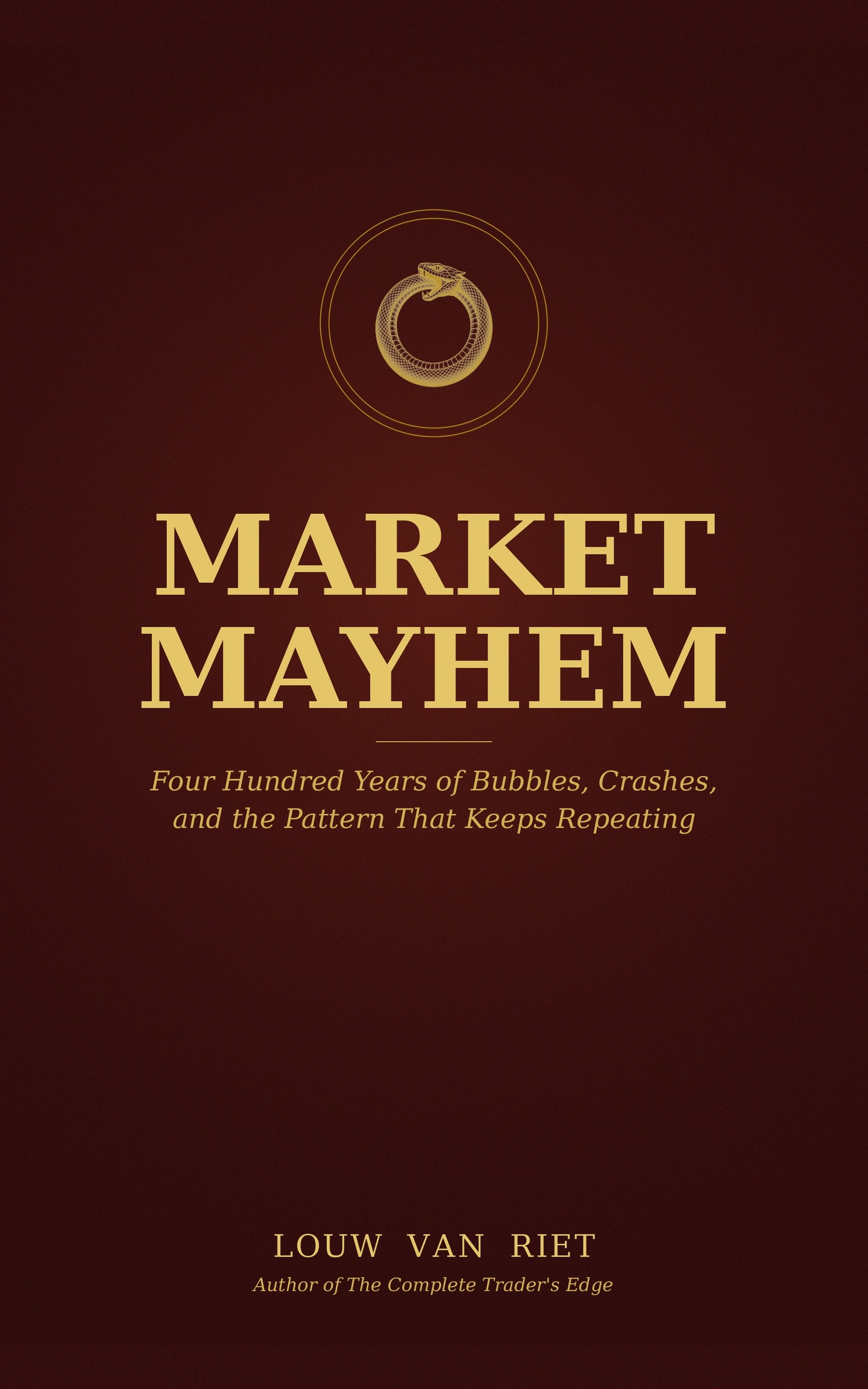 Market Mayhem
400 years of bubbles, crashes, and the pattern that keeps repeating.
Buy on Amazon →
Market Mayhem
400 years of bubbles, crashes, and the pattern that keeps repeating.
Buy on Amazon →
 Greatest Companies
How the world's greatest companies were built — and what traders learn from them.
View on Amazon →
Greatest Companies
How the world's greatest companies were built — and what traders learn from them.
View on Amazon →
 Greatest Traders
Eighty-six lives that explain the markets — Livermore to Madoff, told with the losses left in.
View on Amazon →
Greatest Traders
Eighty-six lives that explain the markets — Livermore to Madoff, told with the losses left in.
View on Amazon →