

Trading discipline is not a personality trait. It is not something you either have or don’t have. It is a system — one you design deliberately, test under pressure, and refine over time. The traders who appear to have supernatural discipline are not more virtuous than the ones who break their rules. They have built better systems that make rule-breaking structurally harder than rule-following.
This guide explains why discipline fails, what the research on habit formation and decision-making says about fixing it, and the exact system design principles that convert intention into consistent execution.
Why Discipline Fails: The Real Reason
Related tool: if discipline is the gap, the free Edge Companion app tracks it daily — a Mind · Method · Money check-in that shows whether your state actually predicts your results.
The standard diagnosis is wrong. When traders break their rules, the common explanation is weak willpower, lack of commitment, or insufficient motivation. These explanations lead to the standard fix: try harder, want it more, be more disciplined. This approach has roughly the same success rate as telling someone with a broken leg to walk it off.
The real reason discipline fails in trading is decision fatigue combined with emotional activation. Here is the sequence:
- You make dozens of micro-decisions during a live session: whether this candle confirms the setup, whether to enter now or wait, whether to move the stop, whether the current move is the one you planned for.
- Each decision depletes a finite cognitive resource. As fatigue accumulates, the quality of decisions degrades — specifically, the ability to override immediate emotional impulses with rational rule application gets worse over the course of a session.
- Simultaneously, live trading activates genuine stress responses. A 1R loss triggers a cortisol spike. A fast-moving market triggers adrenaline. These neurochemical states further reduce the prefrontal cortex’s ability to enforce rules against the limbic system’s urgency to act impulsively.
You cannot willpower your way through decision fatigue and neurochemical activation. The solution is to design a system that removes as many in-session decisions as possible and automates the most critical rule enforcement.
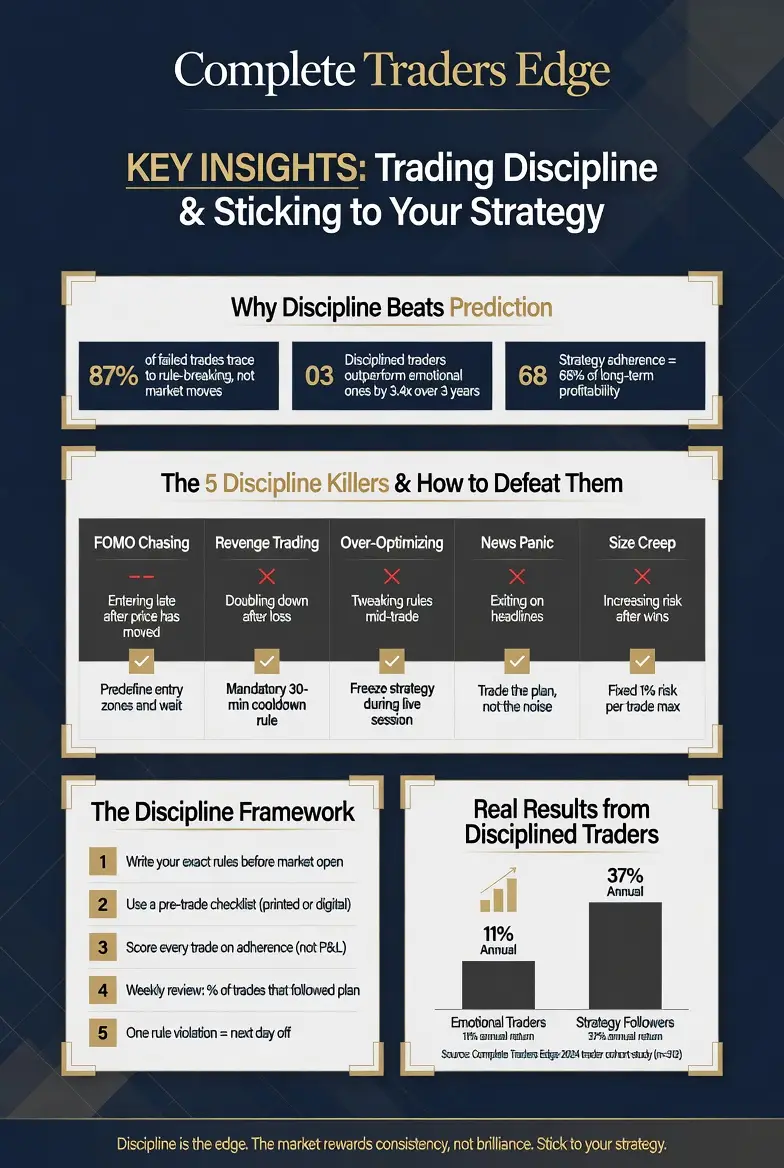
The Four Levels of Trading Discipline
Not all discipline failures are equal. They occur at different stages of the trading process and require different fixes.
| Level | Where it breaks down | Common example | Root cause |
|---|---|---|---|
| Pre-session | Skipping preparation | Opening charts without reviewing HTF bias or marking key levels | Underestimating how much preparation improves decision quality |
| Entry | Taking marginal or early setups | Entering before structure confirms because “it looks like it will work” | Impatience, FOMO, poorly defined entry criteria |
| Trade management | Moving stops, cutting winners early | Moving stop loss to “give more room” on a losing trade | Loss aversion, hope bias, emotional activation while in the trade |
| Post-loss | Revenge trading, overtrading | Immediately re-entering at larger size after a stop out | Cortisol response, ego threat, absent daily loss limit |
Each level has a different intervention. Blanket “be more disciplined” attempts fail because they do not target the specific failure point. The system below addresses each level separately.
The Trading Discipline System: All Five Components
Component 1: A written trading plan with no ambiguity
Discipline cannot exist without a clear definition of what following the rules means. Most traders have a plan that contains phrases like “wait for confirmation” or “trade with the trend.” These are not rules. They are preferences, and preferences can always be rationalised as satisfied in the moment of an emotional entry.
A rule that supports discipline is specific, binary and verifiable. “Price must close a 15-minute candle above the Order Block before entry” is a rule. “The setup must look strong” is not. Go through your trading plan and rewrite every rule in binary form: either the specific condition is met, or it is not. Remove every phrase that contains a judgement call.
The test for a well-written rule: could you give your trading plan to someone who has never traded and have them correctly identify whether a given chart meets your criteria? If yes, your rules are specific enough. If no, they need rewriting.
Component 2: The pre-session checklist
The pre-session checklist serves two functions. It prepares your analysis — ensuring you approach each session with the structural context needed to make good decisions. And it creates a mental state boundary between “not yet trading” and “now trading,” which reduces the number of in-session decisions required.
A complete pre-session checklist covers:
| Checklist category | Specific items to verify |
|---|---|
| HTF bias | Daily and 4H structure reviewed. Directional bias confirmed: bullish, bearish or range. No trades in the wrong direction relative to HTF bias. |
| Key levels | Major Order Blocks, FVGs, daily/weekly pivots, and liquidity levels marked on the chart before the session opens. |
| News events | Economic calendar checked. Red-folder events identified. Position size reduction or no-trade window noted for high-impact events. |
| Risk parameters | Today’s risk per trade confirmed at 1% (or 0.5% if in a drawdown). Daily loss limit of 2% noted. Maximum trade count for the session stated. |
| Emotional state | Honest self-assessment: am I calm, focused and prepared? If the answer is no — tired, stressed, distracted, emotionally unsettled — consider delaying or skipping the session. |
The emotional state check deserves particular attention. One of the highest-leverage discipline interventions available is simply deciding not to trade on days when your cognitive and emotional resources are compromised. A flat session costs nothing. A session traded badly on poor sleep and a stressful morning can cost weeks of gains.
Component 3: The trade entry checklist
The entry checklist is the enforcement mechanism at the most critical decision point: the moment before you click the button. Every criterion from your setup definition is listed. All must be ticked. No partial credit, no “close enough,” no “I’ll just get in and manage it.”
The format that works best is physical — printed or written on paper — rather than mental. A mental checklist can be completed in 10 seconds with every item “confirmed” by an optimistic subconscious. A physical checklist forces you to engage with each criterion individually, and the physical act of ticking boxes creates a brief moment of deliberate attention between impulse and action.
If you cannot tick every box, you do not take the trade. Write this statement at the bottom of your checklist and keep it in front of you during every session: “If a box is unticked, there is no trade.”
Component 4: Mechanical risk enforcement
The discipline failure that causes the most damage — moving stop losses, sizing up during emotional states, staying in losing trades past planned exit levels — happens inside open trades when emotional activation is at its peak. This is precisely the worst time to rely on willpower.
The structural solution is to remove the decision entirely wherever possible:
- Set your stop loss as an order immediately upon entry. Not as a mental note. As a live hard stop order in the platform. Once placed, a strict rule: the stop loss cannot be moved against the trade (i.e. further away from entry to give more room). It can only be moved in your favour (trailing the trade) according to pre-defined rules written in your plan.
- Set your take profit level as an order simultaneously. For traders who struggle to hold winners, a standing limit order removes the temptation to exit early when a trade moves in your favour but hasn’t yet reached target.
- Use your broker’s daily loss limit feature. Most regulated brokers allow you to set a hard daily loss limit that locks the account when reached. Enable it. Set it at 2%. When the system locks you out, the session is over, regardless of what you think about the remaining market opportunity.
Component 5: The post-session review and accountability loop
Discipline improves through feedback, not intention. The weekly journal review that examines your rule compliance — separate from your P&L — is the primary mechanism through which long-term discipline is built.
Each week, score yourself on process compliance: what percentage of your trades fully met every pre-trade criterion? What percentage of sessions included a full pre-session checklist? How many rule violations occurred, and what were the patterns? Track this score over weeks and months. A trader whose process compliance score is increasing is improving, even if their P&L is temporarily flat due to variance.
The accountability dimension matters too. Traders who review their journal with a partner, mentor or community consistently show better rule compliance than those who self-review alone. The mechanism is simple: knowing someone will see your journal entry creates a mild social accountability that activates at the moment of rule violation, when your own internal enforcement has failed.
Discipline and Trading Style: How to Align Them
Discipline failures are sometimes symptoms of misalignment between your trading style and your psychological profile. A trader who finds it psychologically intolerable to sit in a trade overnight is not undisciplined for cutting positions before close. They are using the wrong style. A trader who is paralysed by the fast decisions required in scalping is not undisciplined. They are suited to a slower pace.
| Trading style | Discipline requirements | Suits this psychological profile |
|---|---|---|
| Day trading (ICT/Kill Zone focus) | High session focus, fast entry execution, emotional recovery between trades | Thrives under pressure, prefers defined sessions, comfortable with frequent small losses |
| Swing trading (Daily/4H) | Patient waiting for setups (days), holding through noise, not over-checking charts | Comfortable with delayed results, not compulsively monitoring screens, good at macro perspective |
| Blended (swing positions + intraday management) | Both above, plus discipline not to let intraday noise close swing positions prematurely | Experienced traders who have developed both patience and session-level focus |
If you consistently fail at a specific discipline point — always cutting winners early, always overtrading, always moving stops — consider whether your trading style is demanding something that conflicts with your natural psychological profile, rather than assuming you simply lack discipline.
The Most Important Truth About Trading Discipline
Discipline is not the goal. Consistency is the goal. Discipline is the mechanism. The traders who frame their development as “I need to be more disciplined” often spiral into self-criticism when they fail, which worsens decision-making in subsequent sessions. The traders who frame it as “I need to design a better system” approach each failure as a system design problem with a technical solution.
You broke your stop loss rule. Why? Was the stop loss placed at an illogical level that was almost guaranteed to be hit before profit, causing you to move it rather than accept the bad placement? That is a system design problem: improve your stop loss placement criteria. Was the stop loss placed correctly but you moved it under emotional pressure? That is an enforcement problem: use a hard order rather than a mental stop, so the decision cannot be reversed in the moment.
Every discipline failure has a technical cause and a technical solution. Find it. Build it. Test it. That is how discipline becomes consistent execution.
Frequently Asked Questions
How long does it take to build consistent trading discipline?
The research on habit formation suggests that it takes between 60 and 250 days of consistent practice for a new behaviour to become automatic, depending on the complexity of the behaviour and the individual. Trading discipline is on the complex end of that spectrum because it requires maintaining rule compliance under conditions of genuine emotional activation, not just in calm circumstances. Most traders who approach discipline systematically — using the checklist and journal review framework — begin to see meaningful improvement within 3 to 6 months and genuine consistency within 12 to 18 months of deliberate practice.
Is it normal to break rules even when you know better?
Almost universal. Understanding a rule intellectually and applying it under live trading conditions are two completely different cognitive tasks. The emotional activation of live trading bypasses the analytical parts of the brain that “know better,” in favour of the limbic system that wants to avoid the pain of a loss or capture the pleasure of a gain. Knowing the rule is not sufficient. The rule needs to be enforced structurally, through checklists and hard orders, not just remembered.
What do I do if I keep breaking the same rule repeatedly?
Treat it as a system design failure, not a personal failure. Ask: what specifically causes me to break this rule, and how can I remove or reduce that trigger structurally? If you keep moving your stop loss, remove the ability to do so by using a hard order. If you keep entering early before confirmation, add one additional specific criterion to your entry checklist that must be met before you can enter. If you keep overtrading, set a hard maximum trade count and stop the session when you hit it. The same violation recurring repeatedly means the current system is not preventing it — design a better system.
Can journaling really improve discipline, or is it just record-keeping?
The research on deliberate practice consistently identifies structured review as the mechanism that converts experience into improvement. Without review, experience accumulates without learning. With review, patterns become visible, feedback loops activate, and specific behaviours change in response to specific data. Journaling, when done correctly — tracking process compliance rather than just outcomes — is the single most effective discipline-improvement tool available to a retail trader. It is not glamorous. It is also not optional if you are serious about improvement.
How do I stay disciplined during a winning streak, not just a losing one?
Winning streaks are actually the highest-risk period for discipline failure. The psychological mechanism is overconfidence: a run of winning trades creates a feeling of competence and certainty that makes rules feel unnecessary. Position sizes creep up. Entry criteria become more flexible. Confirmation steps get skipped. This is the Greed Cycle, and it ends the same way every time: a large loss at inflated size that gives back multiple wins in a single trade. The structural fix is exactly the same as during a losing streak: position size is determined by your 1% rule regardless of recent results. Process compliance is scored regardless of outcome. No exceptions.
▶ ▶ ▶ Continue Reading
Complete the psychology framework
The Complete Trader’s Edge
The full discipline and consistency system is in the book
70 chapters covering every dimension of the Mind pillar — from the neuroscience of why discipline fails, to the exact system design that makes consistent execution the path of least resistance. Available on Amazon in Kindle, paperback and full-colour editions.
 The Complete Trader's Edge
The full Mind · Method · Money framework. 70 chapters.
View on Amazon →
The Complete Trader's Edge
The full Mind · Method · Money framework. 70 chapters.
View on Amazon →
 Market Mayhem
400 years of bubbles, crashes, and the pattern that keeps repeating.
Buy on Amazon →
Market Mayhem
400 years of bubbles, crashes, and the pattern that keeps repeating.
Buy on Amazon →
 Greatest Companies
How the world's greatest companies were built — and what traders learn from them.
View on Amazon →
Greatest Companies
How the world's greatest companies were built — and what traders learn from them.
View on Amazon →
 Greatest Traders
Eighty-six lives that explain the markets — Livermore to Madoff, told with the losses left in.
View on Amazon →
Greatest Traders
Eighty-six lives that explain the markets — Livermore to Madoff, told with the losses left in.
View on Amazon →