


GREATEST TRADERS · EPISODE 3
Paul Tudor Jones
The Greatest Risk Manager in Trading History
| 🎧 Spotify | ▶ YouTube |
Also available on Apple Podcasts · Amazon Music
▶ Read the full written article: Paul Tudor Jones: Greatest Trader of All Time
About This Episode
On October 19, 1987, the stock market fell 22.6% in a single day. While most of Wall Street was destroyed, one man tripled his money. Not because he got lucky. Because he had spent months preparing for exactly this moment.
This is the complete story of Paul Tudor Jones, the trader who predicted Black Monday, never had a single losing year across four decades of trading, and built the most disciplined risk management approach in market history.
Jones started his career in the cotton pits of Memphis, where he was mentored by legendary broker Eli Tullis. That mentorship ended badly. Tullis fired him after Jones fell asleep at his desk during a trading session. But the lessons Tullis taught him about risk, discipline, and emotional control would become the bedrock of everything Jones built afterward.
His signature trade came in 1987, when he noticed an eerie similarity between the market’s price action and the pattern that preceded the 1929 crash. He overlaid the two charts, built a massive short position, and when Black Monday arrived, he was not just prepared. He was positioned for one of the greatest single-day profits in trading history.
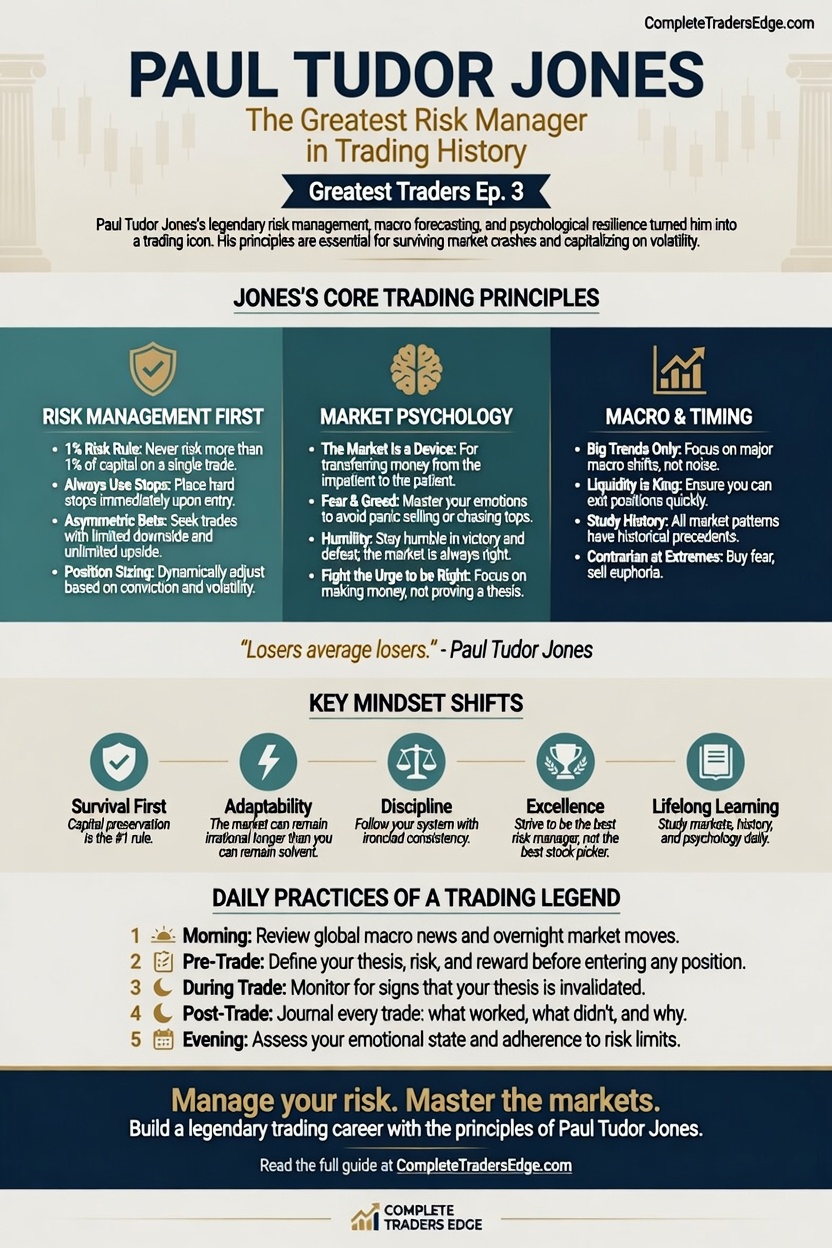
But the Black Monday trade is not the reason Jones belongs on this list. He belongs here because of what he did every other day. His three core principles: never risk more than you can afford to lose, assume every trade is wrong until proven right, and never accept less than a 1:5 risk-to-reward ratio. These rules, applied with absolute consistency, produced a track record that may never be equalled.
This episode tells his full story through the Mind, Method, and Money framework.
What You’ll Learn in This Episode
▶ How getting fired by legendary trader Eli Tullis was the best thing that ever happened to him
▶ The 1929/1987 chart overlay that predicted Black Monday
▶ Why he assumes every trade he enters is wrong until proven right
▶ The 200-day moving average rule he never breaks
▶ His minimum 1:5 risk-reward ratio and why most traders get this backwards
▶ The PBS documentary he tried to suppress and why
Episode Timestamps
| Time | Section | Theme |
|---|---|---|
| 0:00 | Black Monday | Cold Open — October 19, 1987 |
| 2:00 | Memphis to Wall Street | The cotton pits and Eli Tullis |
| 7:00 | The Principles | Defence wins — the three core rules |
| 12:00 | The 1929 Overlay | Spotting Black Monday before it arrived |
| 17:00 | The Legacy | Four decades without a losing year |
| 20:00 | The Lesson | Mind, Method, Money — what PTJ teaches every trader |
Key Quotes from This Episode
“The most important rule of trading is to play great defence, not great offence.”
— Paul Tudor Jones
“Don’t focus on making money. Focus on protecting what you have.”
— Paul Tudor Jones
“The edge is not in being right. It is in surviving being wrong.”
— The Complete Trader’s Edge
Full Episode Transcript
Click to expand full transcript
Welcome to Greatest Traders, by The Complete Trader’s Edge. I’m your host, and this series tells the stories of history’s most extraordinary traders, not just what they did, but how they thought, how they managed risk, and what their psychology reveals about the craft of trading. Every episode connects to the three pillars: Mind, Method, and Money. Today, Episode Three. Paul Tudor Jones. The greatest risk manager in trading history.
October nineteenth, nineteen eighty-seven. Black Monday. The single worst day in the history of the American stock market. The Dow Jones Industrial Average fell twenty-two point six percent in a single session. Twenty-two percent. In one day. Fortunes built over lifetimes disappeared between breakfast and dinner. Trading floors that had been temples of ambition became scenes of genuine panic.
On that day, while most of Wall Street was losing everything, one man tripled his money. Not because he got lucky. Not because he had insider information. Because he had spent months studying a pattern that no one else was paying attention to, had built a position with surgical precision, and had managed his risk with a discipline that bordered on obsession.
His name was Paul Tudor Jones. And the trade he made on Black Monday is the reason he is on this list, but it is not the reason he belongs here. He belongs here because in over four decades of trading, he has never had a single losing year. Not one. That kind of consistency is not the product of skill alone. It is the product of risk management so disciplined, so deeply embedded in his process, that it functions almost like a law of physics. Other traders might match him in any single year. No one has matched him across the span of a career.
To understand how he built that consistency, you have to go back to the cotton fields of Memphis, and a man named Eli Tullis who taught him the most important lesson of his life.
Memphis to Wall Street
Paul Tudor Jones the Second was born in Memphis, Tennessee, in nineteen fifty-four. His family was comfortable but not wealthy. He grew up in the South, attended the University of Virginia, and graduated with a degree in economics. By his mid-twenties, he had found his way to the New York Cotton Exchange, one of the last remaining open-outcry trading pits where traders shouted orders across a physical floor.
Before that, he had a mentor. Eli Tullis was one of the largest cotton traders in the world, a legendary figure in the Memphis commodities scene. Jones worked for Tullis, learned from him, watched him operate. And then Tullis fired him. The reason: Jones fell asleep at his desk during a particularly exhausting trading session.
Being fired by Tullis was, by Jones’s own admission, one of the most important events of his career. Not because it taught him to stay awake. Because it taught him that the market does not forgive lapses in attention. That complacency, even for a moment, can cost you everything. Tullis ran his operation with a level of intensity that Jones initially found excessive. After being fired, he realised it was not excessive at all. It was exactly the level of seriousness that trading demands.
Jones took that lesson and built Tudor Investment Corporation in nineteen eighty. From the beginning, the fund was built around a single philosophy that Jones would articulate more clearly than perhaps any trader in history.
The Principles
Don’t lose money. Those three words are the foundation of everything Paul Tudor Jones has ever done. Not don’t take losses. Not don’t have losing trades. Don’t lose money. The distinction is critical.
Jones assumes that every single trade he enters is wrong. He does not hope it will work. He does not believe it will work. He assumes it will fail, and he builds his position management around that assumption. If the trade proves him wrong by going in his favour, he lets it run. If it confirms his assumption by going against him, the stop loss is already in place and the damage is controlled.
This psychological inversion, assuming failure as the baseline, is the most powerful risk management tool in his arsenal. Most traders enter a position and then look for reasons to stay in it. They anchor to the entry price. They move their stop loss. They add to losers. They rationalise. Jones does none of this. He enters with the assumption that he is wrong, and he lets the market prove him right before he adjusts his posture.
His three core rules have remained consistent for four decades. First, never risk more on a single trade than you can afford to lose. This sounds obvious. It is not. The vast majority of traders who blow up do so because they violate this single rule. They take a position that is too large for their account, the market moves against them, and the loss becomes catastrophic rather than manageable.
Second, his minimum risk-to-reward ratio is one to five. For every dollar he risks, he wants the potential to make at least five. This means he can be wrong four out of five times and still break even. In practice, his win rate is much higher than twenty percent, which means the asymmetry compounds over time into extraordinary returns.
Third, the two hundred-day moving average. Jones has stated repeatedly that no individual stock or market is worth owning if it is trading below its two hundred-day moving average. This is not a complex indicator. It is the simplest trend filter in existence. And Jones uses it religiously. If price is above the line, the trend is up and he will trade from the long side. If price is below the line, the trend is down and he will trade from the short side or stay flat. No exceptions. No overrides.
The simplicity of these rules is itself a lesson. Jones does not use complex algorithms. He does not rely on teams of quantitative analysts running models. He uses a small number of clear, simple rules and applies them with total consistency. The edge is not in the complexity of the system. The edge is in the discipline to follow it.
The 1929 Overlay
By nineteen eighty-seven, Jones had been studying the market with increasing concern. He noticed something that few others were paying attention to. The price action of the Dow Jones Industrial Average in nineteen eighty-six and eighty-seven bore an uncanny resemblance to the price action that preceded the nineteen twenty-nine crash.
Jones did something that was both brilliantly simple and deeply contrarian. He overlaid the two charts. The nineteen twenty-eight to twenty-nine pattern and the nineteen eighty-six to eighty-seven pattern. The similarity was striking. The same euphoric rally. The same pattern of higher highs on declining internal strength. The same signatures of exhaustion masked by headline optimism.
This was not quantitative analysis in the modern sense. It was pattern recognition combined with historical awareness combined with the psychological independence to take it seriously when the rest of the market was dismissing any possibility of a crash. The market in the summer of nineteen eighty-seven was euphoric. Portfolio insurance, a new financial product that was supposed to protect investors from downside risk, had given the market a false sense of security. Everyone believed they were hedged. Jones believed that the hedging itself had created a structural vulnerability.
He built a massive short position. Futures on the S and P five hundred. He sized the position according to his rules: large enough to matter if he was right, small enough to survive if he was wrong. And then he waited.
On October nineteenth, nineteen eighty-seven, the Dow Jones fell five hundred and eight points. Twenty-two point six percent in a single session. It remains the largest single-day percentage decline in the history of the American stock market. Trading floors descended into chaos. Screens went blank. Phones rang with margin calls that could not be met.
Paul Tudor Jones made approximately one hundred million dollars. In a single day. While the rest of Wall Street was in freefall, Jones was executing a plan that had been months in the making. He tripled his fund’s money that month.
A PBS documentary crew happened to be filming Jones during this period. The resulting film showed his trading floor, his methods, and his personality in remarkable detail. Jones later tried to suppress the documentary, reportedly buying up copies to prevent its distribution. The commonly cited reason is that he felt it revealed too much about his approach. Whatever the reason, the film has become one of the most sought-after pieces of trading footage in history.
The Legacy
The Black Monday trade made Jones famous. But his legacy is not built on a single trade. It is built on consistency. Over four decades of trading, Paul Tudor Jones has never had a single losing year. His fund, Tudor Investment Corporation, has delivered positive returns every year since its founding in nineteen eighty.
To appreciate how extraordinary this is, consider that even the greatest traders in history have had losing years. Soros had them. Druckenmiller had them. Buffett has had periods of significant underperformance. The fact that Jones has avoided a single calendar-year loss across more than forty years of trading suggests something deeper than skill. It suggests a risk management framework so robust that it functions as a structural protection against catastrophic loss.
Jones has also been remarkably consistent in his public commentary about what matters in trading. In every interview, across decades, he returns to the same themes. Risk management first. Defence before offence. Simple rules, totally followed. Assume you are wrong. Let the market tell you when you are right. Cut losses immediately. Let winners run. Never argue with the tape.
These are not new ideas. Every trading book contains them. The difference between Jones and the millions of traders who read those same ideas and still lose money is not knowledge. It is implementation. Jones does what he says. Every single day. Without exception. That is the edge.
The Lesson
The mind lesson from Paul Tudor Jones is about psychological inversion. Instead of entering trades hoping to be right, he enters assuming he is wrong. This removes ego from the process entirely. There is no attachment to being right, no anchoring to the entry price, no rationalising of a losing position. He removed ego from the process by assuming failure as the baseline. This psychological inversion, this willingness to be wrong gracefully and move on, is the mind of a professional trader operating at the highest level.
The method lesson is about simplicity. A small number of clear rules applied with total consistency will outperform a complex system applied inconsistently. The two hundred-day moving average is not sophisticated. The one-to-five risk-reward ratio is not groundbreaking. But applied without exception for forty years, they produce results that complex systems cannot match.
The money lesson is the most important of all. Don’t lose money. Those three words contain more practical trading wisdom than most entire trading courses. Jones did not mean never take a loss. He meant never take a loss that matters. Never let a single trade, a single day, a single week damage your ability to trade tomorrow. Survival is the strategy. Everything else is secondary.
If Livermore taught us that psychology is the foundation, and Soros taught us that conviction must be matched with size, then Paul Tudor Jones teaches us the third and perhaps most practical lesson of all. The traders who survive are not the ones who make the most. They are the ones who lose the least. Defence wins. The risk comes first. And the greatest edge a trader can have is the discipline to accept a small loss today so they are still in the game tomorrow.
The edge is not in being right. It is in surviving being wrong. Paul Tudor Jones built that edge. And it made him one of the greatest traders who ever lived.
You have been listening to Greatest Traders, by The Complete Trader’s Edge. This episode was based on Chapter sixty-eight of the book, The Complete Trader’s Edge, by Louw van Riet. Available now on Amazon in Kindle, paperback, and full colour editions. For the full article on Paul Tudor Jones, trading guides, and free resources, visit completetradersedge.com. If this episode resonated with you, subscribe wherever you listen to podcasts, and leave a review. It helps more traders find us. Next episode, we tell the story of the quiet genius who turned five thousand dollars into fifteen million. Ed Seykota. See you then.
Continue Learning
▶ Read the full Paul Tudor Jones article
▶ Next Episode: Ed Seykota — The Quiet Genius Who Turned $5,000 into $15 Million
▶ Previous Episode: George Soros — The Man Who Broke the Bank of England
This podcast is education, not financial advice. Always do your own research before making trading decisions.