


GREATEST TRADERS · EPISODE 4
Ed Seykota
The Quiet Genius Who Turned $5,000 into $15 Million
| 🎧 Spotify | ▶ YouTube |
Also available on Apple Podcasts · Amazon Music
▶ Read the full written article: Ed Seykota: Greatest Trader of All Time
About This Episode
He turned $5,000 into $15 million. A return of 250,000%. He did it with a computer, a set of rules, and the psychological discipline to follow them without interference. Then he moved to a lake in Nevada and mostly stopped talking to people.
This is the complete story of Ed Seykota, the father of systematic trading, the man who proved that the simplest rules, applied with total consistency, produce the most extraordinary results in all of trading history.
In the early 1970s, while most traders were still shouting orders across exchange floors, Seykota was writing computer programs to test trading rules on historical data. He was one of the first people in the world to use a computer for trading. The system he built was staggeringly simple: follow the trend, cut your losses, let your winners run, and manage position size according to volatility. Four rules. That was it.
Between 1972 and 1988, those four rules turned a $5,000 client account into approximately $15 million. After fees. After drawdowns. After every market condition imaginable. The system worked because Seykota had the discipline not to override it. And that discipline came from a deep understanding of trading psychology that led him to create the Trading Tribe, a process for identifying and resolving the emotional patterns that cause traders to sabotage their own systems.
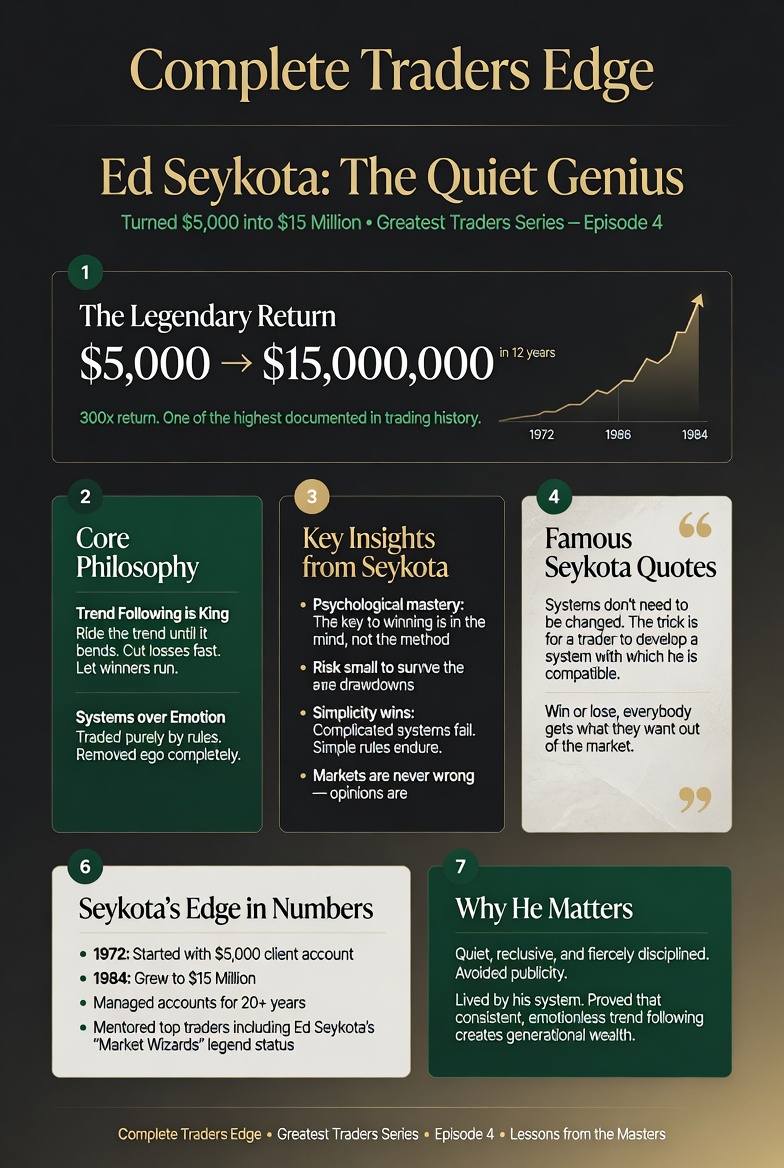
Seykota’s most famous insight captures his entire philosophy: “Everybody gets what they want out of the market.” If you want excitement, the market will give you excitement, and it will cost you money. If you want to be right, the market will let you be right, and it will cost you money. The traders who want profits, and only profits, are the ones who build systems and follow them.
This episode tells his full story through the Mind, Method, and Money framework.
What You’ll Learn in This Episode
▶ How he pioneered computerised trading in the 1970s before anyone else
▶ The four rules that produced a 250,000% return over 16 years
▶ Why he believes “everybody gets what they want out of the market”
▶ The Trading Tribe and the psychology of self-sabotage
▶ Why the best trading system in the world is useless without the mind to follow it
▶ What his story teaches about simplicity, patience, and emotional discipline
Episode Timestamps
| Time | Section | Theme |
|---|---|---|
| 0:00 | The Lake | Cold Open — A house on Lake Tahoe |
| 2:00 | The Programmer | Building the first computerised trading system |
| 8:00 | The System | Four rules, 250,000% returns |
| 13:00 | The Psychology | The Trading Tribe and self-sabotage |
| 17:00 | The Legacy | Simplicity as the ultimate edge |
| 20:00 | The Lesson | Mind, Method, Money — what Seykota teaches every trader |
Key Quotes from This Episode
“Everybody gets what they want out of the market.”
— Ed Seykota
“The elements of good trading are: cutting losses, cutting losses, and cutting losses.”
— Ed Seykota
“The edge is not in the system. The edge is in the discipline to follow it.”
— The Complete Trader’s Edge
Full Episode Transcript
Click to expand full transcript
Welcome to Greatest Traders, by The Complete Trader’s Edge. I’m your host, and this series tells the stories of history’s most extraordinary traders, not just what they did, but how they thought, how they managed risk, and what their psychology reveals about the craft of trading. Every episode connects to the three pillars: Mind, Method, and Money. Today, Episode Four. Ed Seykota. The quiet genius who turned five thousand dollars into fifteen million.
Somewhere on the shore of Lake Tahoe, in a house that most people would drive past without noticing, a man sits at a desk with a computer. He does not work on Wall Street. He does not appear on financial television. He does not manage a billion-dollar fund with a team of analysts. He has no social media presence. He gives almost no interviews. And yet, among the small community of traders who understand what genuine long-term performance actually looks like, he is considered one of the greatest who ever lived.
His name is Ed Seykota. Between nineteen seventy-two and nineteen eighty-eight, he took a client account of five thousand dollars and turned it into approximately fifteen million. A return of two hundred and fifty thousand percent. Not with leverage that would make a risk manager weep. Not with insider information. Not with a team of PhDs running complex algorithms. With four rules. Follow the trend. Cut your losses. Let your winners run. Manage your position size. That is the entire system. And it produced one of the greatest track records in the history of financial markets.
To understand how four simple rules can produce returns that seem almost fictional, you have to understand the man who built them. Because the rules are not the hard part. Following them is.
The Programmer
Ed Seykota was born in nineteen forty-six in the Netherlands and grew up in the United States. From an early age, he demonstrated two qualities that would define his career: an affinity for systems and a deep curiosity about why people behave the way they do.
He studied electrical engineering at MIT and graduated in the early nineteen seventies. While most MIT graduates were heading into academia or corporate engineering, Seykota had already become fascinated by the financial markets. Specifically, he was fascinated by a question that almost no one in finance was asking at the time: could you use a computer to test whether trading rules actually work?
This was the early nineteen seventies. Computers were room-sized machines that required specialised knowledge to operate. The idea of using one to analyse stock prices was considered eccentric at best. Most traders at the time relied on gut feeling, broker tips, and fundamental analysis. The notion that a machine could identify profitable trading patterns was, to most of Wall Street, absurd.
Seykota did not care what most of Wall Street thought. He got his hands on one of the earliest commercially available computers and began writing programs to test a simple hypothesis: that prices trend, and that a system which follows trends, cuts losses, and lets winners run should produce positive returns over time.
He tested this on historical data going back decades. The results confirmed what he suspected. Trend following worked. Not every trade was profitable. Not every month. Not every year. But over time, a disciplined trend-following system captured the large moves that drive most market returns, while the stop losses ensured that the losing trades remained small.
He took a position at a major brokerage firm, where he was given a client account to manage using his computerised system. This was one of the first, if not the first, commercially operated computerised trading systems in the world. The account started with five thousand dollars. Over the next sixteen years, it grew to approximately fifteen million.
But the story of what happened at the brokerage firm is as important as the returns themselves. Because it reveals the central tension that would define Seykota’s entire philosophy.
The firm’s management did not fully trust the system. When Seykota’s computer generated signals that seemed counterintuitive, managers would override them. They would reduce position sizes on trades that felt too aggressive. They would take profits early on trades that were running. They would hesitate on entries that seemed badly timed.
Seykota tracked the performance of the pure system signals alongside the performance of the overridden trades. The difference was devastating. The system, left alone, dramatically outperformed the same system with human interference. Every time a human overrode the computer’s signal based on feeling, intuition, or fear, the result was worse than simply following the rules.
This experience crystallised something that Seykota had suspected but could now prove: the trading system is not the hard part. The human operating the system is the hard part. The rules work. The question is whether the trader has the psychological discipline to follow them.
The System
Seykota’s system is remarkable for its simplicity. While most professional traders spend their careers adding complexity, layering indicators on top of indicators, building models that require PhDs to understand, Seykota went the opposite direction. He stripped everything down to the absolute minimum that works.
Rule one: follow the trend. Seykota uses long-term moving averages to identify the direction of the trend. When prices are trending up, he buys. When prices are trending down, he sells short. He does not try to predict when trends will start or end. He observes that they have started and positions himself accordingly.
Rule two: cut your losses. Every position has a predefined stop loss. If the market moves against the position by a certain amount, the position is closed. No exceptions. No moving the stop. No hoping for a recovery. No adding to a loser. The loss is taken immediately, and the capital is preserved for the next opportunity.
Rule three: let your winners run. This is the complement to cutting losses, and it is the part that most traders find psychologically impossible. When a trade moves in Seykota’s favour, he does not take a quick profit. He holds. He lets the trend carry the position as far as it will go. The only thing that closes a winning trade is a reversal signal from the system itself.
Rule four: manage position size. Seykota adjusts the size of each position based on the volatility of the market and the current risk in the portfolio. In high-volatility environments, he trades smaller. In low-volatility environments, he trades larger. This ensures that no single trade or single market can inflict catastrophic damage on the portfolio.
Four rules. That is the entire methodology that produced a two hundred and fifty thousand percent return. The intellectual simplicity of the system is almost offensive to the trading education industry, which thrives on complexity, specialised indicators, and proprietary methods. Seykota proved that you do not need any of that. You need four rules and the discipline to follow them.
The returns are even more impressive when you consider what the system endured during that sixteen-year period. The oil crisis. Stagflation. Volcker’s interest rate shock. Multiple recessions. Currency crises. Every kind of market environment that exists. The system handled all of them. Not by being clever. By being consistent.
The Psychology
If the system is so simple, and the returns are so extraordinary, why doesn’t everyone do it? This is the question that led Seykota to what may be his most important contribution to trading: his work on psychology.
Seykota’s answer to the question is deceptively simple and profoundly unsettling. Everyone gets what they want out of the market. If a trader says they want profits but consistently overrides their system, takes profits too early, and holds losing positions too long, then what they actually want is not profits. What they want is the emotional experience of trading. The excitement. The drama. The feeling of being right. The adrenaline of risk.
Seykota observed that most traders are not conscious of what they actually want. They believe they want to make money. But their behaviour reveals different priorities. The trader who cannot cut a loss is getting something from the experience of holding a loser. Perhaps it is hope. Perhaps it is the avoidance of admitting they were wrong. Perhaps it is the excitement of uncertainty. Whatever it is, it is more important to them, in that moment, than the money they are losing.
This insight led Seykota to develop what he called the Trading Tribe. This was not a fund or a firm. It was a process for identifying and resolving the emotional patterns that cause traders to sabotage their own systems. The Trading Tribe used techniques drawn from psychology, group therapy, and Seykota’s own experience to help traders identify the feelings that drive their self-destructive behaviour.
The process works like this. A trader identifies a recurring pattern in their behaviour. Perhaps they always take profits too early. Perhaps they add to losing positions. Perhaps they freeze when a signal fires and miss the entry. They then explore the feeling behind the behaviour. Not the rationalisation. The actual feeling. What does it feel like in the body when you are about to cut a loss, and instead you move the stop? What emotion is present?
Seykota found that traders who could identify and process these emotional patterns became dramatically better at following their systems. Not because they eliminated the emotions. Because they stopped being controlled by them. They could feel the fear and follow the rule anyway. They could feel the greed and take the profit according to the system anyway. The emotions were still there. But they were no longer in charge.
This is perhaps the most important psychological insight in all of trading. The goal is not to become emotionless. The goal is to become aware of your emotions and to follow your rules regardless of what you feel. Seykota proved this both through his own trading and through the hundreds of traders he worked with through the Trading Tribe process.
The Legacy
Ed Seykota never sought fame. He never wrote a bestselling book. He never built a billion-dollar fund. He never appeared regularly on financial television. He lives quietly, trades his own accounts, and occasionally works with traders who seek him out.
And yet his influence on modern trading is enormous. Michael Marcus, who featured in Market Wizards, credited Seykota with being his most important mentor. Marcus went on to make extraordinary returns himself, and he attributed much of his success to the principles Seykota taught him about trend following and risk management.
The entire field of systematic and quantitative trading owes something to Seykota. He was not the only person exploring computerised trading in the nineteen seventies, but he was among the first to demonstrate, with real money over a long period, that a systematic approach could produce results that no discretionary trader could match for consistency.
His emphasis on psychology anticipated by decades what is now mainstream in trading education. The idea that a trader’s psychological state is the primary determinant of their results was considered fringe in the nineteen seventies and eighties. Today, thanks in part to Seykota and to Mark Douglas, who came after him, it is widely accepted as foundational.
But perhaps Seykota’s most enduring legacy is the question he forces every trader to answer honestly. What do you actually want from the market? If you want profits, build a system and follow it. If you want excitement, drama, validation, or distraction, the market will provide those too. But not for free.
The Lesson
The mind lesson from Ed Seykota is about self-awareness. The traders who succeed are not the ones who never feel fear, greed, or doubt. They are the ones who feel those emotions and follow their rules anyway. Seykota proved that the gap between knowing the rules and following the rules is entirely psychological. And he built a process for closing that gap.
The method lesson is about simplicity. Four rules. Follow the trend. Cut losses. Let winners run. Manage position size. No indicators layered on indicators. No complex algorithms. No proprietary secrets. The simplest system, followed with total consistency, produced a two hundred and fifty thousand percent return. Complexity is not an edge. Consistency is.
The money lesson is about position sizing. Seykota’s system survived every market condition for sixteen years not because it avoided drawdowns, but because the position sizing ensured that no drawdown was fatal. The system had losing trades. It had losing months. It had losing stretches. But because position size was always calibrated to volatility and portfolio risk, the losses were always survivable. And the wins, when they came, were large enough to more than compensate.
If Livermore taught us that psychology is the foundation, if Soros taught us that conviction backed by framework creates historic returns, and if Paul Tudor Jones taught us that defence wins, then Ed Seykota teaches us the final and deepest lesson. That the system is not the edge. The discipline to follow the system is the edge. And that discipline requires doing the hardest work of all: the work on yourself.
The greatest traders are not the ones with the best indicators, the fastest computers, or the most complex models. They are the ones who have done the hardest work of all: the work on themselves.
The edge is not in the system. The edge is in the discipline to follow it. Ed Seykota built that discipline. And it made him one of the greatest traders who ever lived.
You have been listening to Greatest Traders, by The Complete Trader’s Edge. This episode was based on Chapter sixty-eight of the book, The Complete Trader’s Edge, by Louw van Riet. Available now on Amazon in Kindle, paperback, and full colour editions. For the full article on Ed Seykota, trading guides, and free resources, visit completetradersedge.com. If this episode resonated with you, subscribe wherever you listen to podcasts, and leave a review. It helps more traders find us. Next episode, we tell the story of the greatest trading experiment ever conducted. Richard Dennis and the Turtle Traders. See you then.
Continue Learning
▶ Read the full Ed Seykota article
▶ Next Episode: Richard Dennis and the Turtle Traders (coming soon)
▶ Previous Episode: Paul Tudor Jones — The Greatest Risk Manager
This podcast is education, not financial advice. Always do your own research before making trading decisions.


