

GREATEST TRADERS · EPISODE 18
Marty Schwartz
Pit Bull, U.S. Investing Champion, and the Trader Who Learned to Lose
▶ Watch on YouTube🎵 Listen on Spotify
Also available on Apple Podcasts · Amazon Music
Martin “Buzzy” Schwartz
| Born | 23 March 1945, New Haven, Connecticut |
| Nickname | “Pit Bull” |
| Education | Amherst College (1967), Columbia MBA (1970) |
| Military service | U.S. Marine Corps Reserves 1968–1973 (Captain) |
| Years losing as analyst | ~9 years before becoming profitable trader |
| Starting trading capital | $40,000 (after saving $100K and buying ASE seat) |
| Compounded to | Over $20 million |
| Maximum monthly drawdown | Never exceeded 3% (across years) |
| First full year as independent | $600,000 in profits |
| Year two | $1.2 million in profits |
| U.S. Investing Championship | Won 1984 with verified +210% in 4 months |
| Famous quote | “When did I turn from a loser to a winner? When I was able to separate my ego needs from making money.” |
Marty Schwartz spent almost a decade losing money before he became one of the most successful traders in America. That fact is the most important thing about him. Not the U.S. Investing Championship he won in 1984. Not the forty thousand dollar account he built into over twenty million dollars. Not the Market Wizards profile or the book that followed. What matters most is the decade of losses and what he finally did about them.
The turning point, when he separated his ego from his trading and accepted that being wrong was acceptable but staying wrong was not, produced a transformation he could describe clearly and that every serious student of markets should study. Schwartz was not a Turtle. He did not go through Richard Dennis’s experiment or learn the systematic rules William Eckhardt designed. His approach to the markets, short-term, technically driven, disciplined by moving averages and price action, is different in its mechanics from the long-term trend following the Turtles were taught. But the psychological core is identical, and the consistency of his record across decades makes the case for that core in concrete numerical terms.
Schwartz ran a forty thousand dollar account into more than twenty million dollars. Across that period, his maximum drawdown measured on month-end data never exceeded three percent. Three percent. He was careful to note that his two worst months, losses of three percent and two percent, were the months his children were born and he was inevitably distracted. The discipline was real enough that he could account for every deviation from it.
This is the story of how Martin “Buzzy” Schwartz, a Marine Corps captain and Columbia MBA who spent nine years losing money as a Wall Street analyst, became the Pit Bull. The man whose nerves of steel and killer instinct earned him a permanent place in trading literature. The man who proved that consistent short-term trading, sized correctly and disciplined ruthlessly, can compound at extraordinary rates over decades.
New Haven, Amherst, and the Marine Corps
Martin S. Schwartz, known as “Buzzy” since childhood, was born on 23 March 1945 in New Haven, Connecticut. He grew up in middle-class circumstances and was, by his own account, not a particularly distinguished student in his early years. He developed a competitive streak early, partly through sports and partly through the kind of household pressure that gives mediocre students permission to outwork their more naturally gifted peers.
He attended Amherst College, graduating in 1967. After Amherst he went to Columbia Business School and earned his MBA in 1970. Between the two, he served in the U.S. Marine Corps Reserves from 1968 through 1973, finishing his commitment with the rank of captain. The Marine Corps gave him something he drew on throughout his trading career. A belief that discipline and preparation could produce outcomes that exceeded what natural talent alone would deliver. Amherst and the Corps together, he later said, convinced him he could do almost anything if he worked hard enough.
After his military commitment ended he took a job as a financial analyst at E.F. Hutton, the same firm where many of his generation’s traders eventually passed through. He spent the better part of a decade as a securities analyst, writing reports, building DCF models, and recommending stocks. The work was, by his own description, methodical and sound. He was paid reasonably well. The problem was that he wanted to be a trader, not an analyst, and the path between the two was much harder than he had assumed.
The decade of losses
Schwartz’s account of the decade he spent as an unsuccessful trader is the most candid section of Pit Bull and is the part of his career most relevant to working traders. He had, by his own description, all the analytical tools he needed. He understood securities valuation. He understood industry dynamics. He could read a 10-K. He could build a model. None of that translated into profitable trading.
The reasons, as he eventually understood them, were structural. Fundamental analysis is concerned with what a stock is worth. Trading is concerned with what a stock is going to do in the next hour, day, or week. The two activities require fundamentally different mental frameworks, and the analyst’s habits, holding views with conviction, defending positions against contradicting data, treating short-term price moves as noise, are exactly the wrong habits for active trading.
The deeper problem was psychological. Schwartz was, like most analysts, addicted to being right. The job rewarded the analyst who could defend his recommendation with enough rigor that no one could fault his thinking. That same defensive posture, applied to trading, meant holding losing positions because admitting they were wrong felt like an admission of analytical failure. The losses compounded. The career stagnated. The trading account drained.
The turning point came not from a new technique but from a psychological shift. Schwartz has described it in his own words across multiple interviews: “When did I turn from a loser to a winner? When I was able to separate my ego needs from making money.”
The shift took roughly nine years to internalize. Most traders never internalize it. Schwartz was unusually self-aware about what was holding him back, and unusually willing to do the painful work of unlearning the analytical habits that had defined his career to that point.
The American Stock Exchange seat
By the late 1970s, Schwartz had managed to save approximately one hundred thousand dollars despite his trading losses. He used the bulk of the savings to buy a seat on the American Stock Exchange, leaving himself with approximately forty thousand dollars in actual trading capital. He resigned from E.F. Hutton and began trading for his own account full-time.
The first year was the test. By his own subsequent description, the psychological framework he had developed during the losing decade either worked or it did not. There would be no analyst salary cushion. No firm capital to absorb losses. The forty thousand was his stake. If he could not turn it into something larger, he would have to go back to being an analyst.
His first full year as an independent trader, he made six hundred thousand dollars. The second year, he made one point two million. The decade of losses had been preparation, not failure. Once the psychological framework was in place, the trading capital compounded almost immediately at extraordinary rates. The math underneath is the same risk-of-ruin arithmetic that governs every trading account: edge plus appropriate sizing plus discipline to take losses small produces compounding that the loss-averse trader never accesses.
The 1984 U.S. Investing Championship
The U.S. Investing Championship, organized by Norm Zadeh of the AAII, was the most prestigious trading competition of the early 1980s. Traders entered with audited capital, traded for a defined period, and the highest verified return won. The 1984 contest is the one that put Schwartz on the public radar.
Schwartz entered the championship in the futures division and dominated. The verified return was approximately two hundred and ten percent over four months, turning a two hundred and fifty thousand dollar trading account into more than seven hundred and fifty thousand dollars in less than half a year. He defeated the field by such a margin that his profits exceeded the combined profits of every other trader in the contest. The result, in the headline characterization at the time, was that Schwartz “made more profits than all the other traders put together.”
The 1984 result is significant for several reasons beyond the dollar amount. First, it was verified. Audited capital, audited returns, with the integrity that legal sanctions of misrepresentation imply. There was no question whether Schwartz had actually achieved what he claimed. Second, it happened in a public competition watched by professional traders, journalists, and money managers. The scrutiny was intense, and Schwartz delivered under it. Third, it established the day trading model in the public imagination. The end of the 1984 tournament marked the beginning of the era when independent traders, working from their own desks with their own capital, became a recognized category of market participant.
The actual method
Schwartz’s trading method, as he describes it in Pit Bull and the Schwager interview, is short-term, technically driven, and deeply disciplined by risk management. The key components are simpler than the results would suggest.
Moving averages as the path of least resistance. Schwartz uses moving averages, particularly the ten-day exponential moving average, to identify the prevailing trend on his trading time frame. His core rule is to avoid trading against moving averages. As he has said many times: “I try not to go against the moving averages; it is self-destructive.” The reasoning is structural. A stock above its ten-day EMA in an upward-sloping configuration is a stock where the path of least resistance is up. Trading short into that configuration means fighting the dominant momentum and accepting unfavorable odds even when the technical setup looks good in isolation.
Buy strong stocks showing temporary weakness. The classic Schwartz setup is a stock in a clear uptrend that has pulled back to a support level near or just above its ten-day EMA. The pullback represents the rubber band stretching. The expected move is the snap back as the dominant trend reasserts itself. The combination of trend, pullback, support, and moving average alignment puts the odds firmly in the trader’s favour. The setup itself is unremarkable. The discipline to wait for it and not take inferior setups is what produces the results.
The Magic T theory. One of the more idiosyncratic elements of Schwartz’s framework is his use of Terry Laundry’s Magic T theory for big-picture timing. The theory visualizes markets as having time symmetry between accumulation and distribution phases, with the right arm mirroring the left in duration. Schwartz used the framework not for entry decisions but to adjust his risk tolerance based on where in the broader market cycle he believed he was operating. As he put it: “With the Magic T, there was order in the universe, a high and low tide every twelve hours.”
Stock Trader’s Almanac for context. Schwartz uses the Stock Trader’s Almanac for historical seasonality and cyclical context. As with the Magic T, the Almanac is not used for direct entry decisions but to adjust risk appetite. He has been clear that he never bases trade entries on seasonal patterns alone. The seasonality data informs how aggressively he is willing to size when other technical conditions align.
Position duration measured in minutes to hours, not days. Schwartz is, by his own admission, a short-term trader. A trade lasting as long as a week would be considered long-term in his framework. Most of his trades last from minutes to hours. He gets in and out quickly when the technical conditions align, captures the move, and steps aside. The fast turnover requires markets with sufficient liquidity and volatility, which is why his focus has been on actively traded futures and options rather than illiquid small-caps.
The three percent rule
The most distinctive feature of Schwartz’s career is the consistency of his risk management. Across decades of active trading, including the period when he turned forty thousand dollars into more than twenty million, his maximum month-end drawdown never exceeded three percent. This is an extraordinary discipline that most retail traders would find impossible to replicate.
The mechanics of how he maintained the three percent ceiling are straightforward in principle. Position sizes are calibrated so that no single trade can produce a meaningful drawdown by itself. Stop losses are placed before entry and respected without exception. Losing trades are exited quickly. Winning trades are allowed to run within disciplined exit rules. The net result is that the distribution of monthly P&L outcomes is heavily skewed toward small wins and small losses, with occasional larger wins that drive the overall return.
The two months in which Schwartz violated his own three percent ceiling, taking losses of three percent and two percent respectively, were the months his children were born. He has been candid that the distraction of new fatherhood interfered with the focus that the discipline required. The honesty of accounting for those specific months, in a memoir that could have hidden them, is part of what makes his record credible. The discipline that builds twenty million dollar trading accounts is the same discipline that admits when distraction broke it.
The Schwager interview and the book
Schwartz was profiled in Jack Schwager’s first Market Wizards book, published in 1989. The interview is one of the more candid in the collection, partly because Schwartz was unusually honest about the decade of losses and the psychological transformation that ended them. The Schwager profile turned Schwartz into a public figure within the trading community.
In 1998, Schwartz published his own memoir: Pit Bull: Lessons from Wall Street’s Champion Day Trader. The book is unusual in the genre of trading memoirs because it spends substantial pages on the losing years and the psychological work required to end them. Most trading memoirs minimize or skip the losing period entirely, focusing on the wins. Schwartz did the opposite. The book is candid about what failure looked like, what it felt like, and what specifically had to change for the trading to start working.
The book’s title comes from a description Schwartz earned on the trading floor. The “pit bull” image captures what trading at the level he operated requires. Tenacity. The willingness to bite hard on conviction trades. The refusal to release a profitable position prematurely. The aggression that, properly disciplined, produces consistent results, but undisciplined produces blow-ups.
Both Pit Bull and the Schwager interview remain widely cited in trading literature. They are unusual in being both useful and entertaining. Schwartz is a vivid writer, and the New York trading floor of the 1980s comes through in detail.
Martec and managing other people’s money
In 1985, Schwartz launched his own fund, Martec, to manage outside capital alongside his personal account. The fund operated under the same general framework Schwartz used for his own trading, with appropriate adjustments for the constraints of running pooled capital. The transition from solo trader to fund manager is one most successful traders never make successfully. The skills are different. The pressures are different. The accountability to outside investors is different.
Schwartz has discussed in interviews that the transition was harder than he expected, partly because he had to slow down his trading to accommodate the operational realities of fund management. He has subsequently shifted the structure of his activities multiple times, including periods of trading purely his own capital and periods of running educational platforms for retail traders.
The lesson here for working traders is structural. The skills that produce a great solo trading record do not automatically transfer to running outside capital. The shift requires a different operational framework, and many great traders discover that they are happier and more productive trading their own capital than running a fund. Schwartz’s career has reflected an honest grappling with that distinction.
What Schwartz means for your trading practice
Schwartz’s career maps onto Mind, Method, Money with unusual clarity because his entire framework is explicitly built around the integration of all three.
Mind. Separate ego from outcomes. Schwartz’s nine-year decade of losses ended when he stopped needing to be right and started needing to make money. The two desires sound similar but produce opposite behaviors. The trader who needs to be right will hold losing positions to defend the original analysis. The trader who needs to make money will exit losing positions to preserve capital for the next opportunity. The mental shift is invisible to outsiders but transforms the entire trading record. The intellectual humility to admit you were wrong on a specific trade is the foundation of long-term profitability.
Method. Build a framework with multiple independent inputs. Schwartz combined moving averages for trend, support and resistance for entry, the Magic T for cycle context, and seasonality for risk calibration. The framework was not a single indicator. It was a multi-input synthesis that gave him conviction when several inputs aligned and kept him sidelined when they did not. The math underneath is the same conditional logic that governs all professional trading: edge appears when multiple independent factors agree, not when one indicator flashes a signal in isolation.
Money. Hold drawdowns small and let winners compound. Three percent maximum monthly drawdown over decades is an extraordinary discipline. The retail equivalent is keeping per-trade risk small enough that no individual loss is catastrophic, sizing winners appropriately when conviction is high, and refusing to let a single trade or single day damage the account permanently. The compounding curve does the rest. Forty thousand dollars compounded into twenty million dollars not by hitting any single home run but by stacking small wins on top of small losses for years.
The last word
Marty Schwartz is now in his eighties. He has stepped back from the most active phases of his trading career and now runs an educational platform for retail traders, sharing the framework he refined over four decades on the desk. Pit Bull remains in print and continues to be one of the most-recommended trading memoirs in the field. The Schwager interview is taught in trading curricula around the world.
The decade of losses is the part of his story that retail traders should sit with longest. Most trading literature describes successful traders as if they emerged fully formed, which is misleading and discouraging to working traders who are struggling. Schwartz’s honest account of nine years of losing, followed by the psychological work that ended the losing, followed by decades of consistent profitability, is the more useful template. The transformation is available. It just takes longer than most traders are willing to invest in.
What Schwartz leaves the working trader is a method that combines technical clarity with psychological discipline in a way that most retail trading frameworks fail to integrate. The moving averages, the support and resistance, the Magic T, the seasonality, the three percent rule, are all individually accessible. Most retail traders use some subset of them. Few use all of them with the discipline that turns the framework into a compounding machine.
The forty thousand dollars to twenty million dollar arc was not produced by any single brilliant trade. It was produced by years of consistent execution at a level of discipline most traders cannot sustain. The trader who learns to internalize that discipline, even at a much smaller scale, has access to the same arithmetic that built the Pit Bull.
“When did I turn from a loser to a winner? When I was able to separate my ego needs from making money.” — Marty Schwartz
Frequently Asked Questions
Who is Marty Schwartz?
Martin S. “Buzzy” Schwartz is an American trader best known for winning the U.S. Investing Championship in 1984 with a verified +210% return in four months, for being profiled in Jack Schwager’s first Market Wizards book in 1989, and for authoring the trading memoir Pit Bull: Lessons from Wall Street’s Champion Day Trader in 1998. Born on 23 March 1945 in New Haven, Connecticut, he graduated from Amherst College in 1967, earned an MBA from Columbia Business School in 1970, and served in the U.S. Marine Corps Reserves from 1968 to 1973, reaching the rank of captain. He spent approximately nine years losing money as a Wall Street analyst before transforming into a profitable independent trader.
How did Marty Schwartz become a successful trader?
Schwartz’s transformation from loser to winner came through a psychological shift rather than a new technique. After approximately nine years of losing money as a securities analyst at E.F. Hutton, he separated his ego from his trading and stopped needing to be right. He has described this shift as the moment he turned from a loser to a winner. The framework he built afterward combined moving averages for trend identification, support and resistance levels for entry timing, the Magic T theory for big-picture cycle context, and seasonal patterns from the Stock Trader’s Almanac for risk calibration. Position sizing was disciplined to keep maximum monthly drawdowns under 3% throughout his career.
What was Schwartz’s 1984 U.S. Investing Championship result?
Schwartz entered the 1984 U.S. Investing Championship with audited trading capital and produced a verified return of approximately 210% in roughly four months, turning a $250,000 trading account into over $750,000. He defeated the field by a margin so wide that his profits exceeded the combined profits of every other trader in the contest. The 1984 result was the public event that established Schwartz as a leading independent trader and helped catalyze the broader day trading model.
What is Schwartz’s trading strategy?
Schwartz’s method is short-term, technically driven, and disciplined by ruthless risk management. He uses moving averages, particularly the 10-day exponential moving average, to identify trend direction and avoid trading against the prevailing momentum. The classic Schwartz setup is buying strong stocks showing temporary weakness on a pullback to a support level near the 10-day EMA. He uses Terry Laundry’s Magic T theory for cycle context and the Stock Trader’s Almanac for seasonality, both as risk-calibration tools rather than entry signals. Position duration is typically minutes to hours, with a trade lasting a week considered long-term.
What is the Pit Bull book?
Pit Bull: Lessons from Wall Street’s Champion Day Trader is Schwartz’s 1998 memoir of his trading career. The book covers his decade of losses as a securities analyst, the psychological shift that turned him into a consistent winner, his 1984 U.S. Investing Championship victory, and the discipline that sustained his performance over the following years. It is notable for its candor about the losing period, which most trading memoirs minimize or skip entirely. The title comes from a description Schwartz earned on the trading floor for his tenacity and aggression. The book remains widely recommended in trading literature.
What is Schwartz’s three percent rule?
Throughout the period when Schwartz turned $40,000 into over $20 million, his maximum monthly drawdown measured on month-end data never exceeded 3%. The discipline was a function of strict position sizing, pre-set stop losses, quick exits on losing trades, and a multi-input framework that kept him sidelined when conditions were unfavorable. The two months he violated the 3% ceiling, taking losses of 3% and 2%, were the months his children were born and he was distracted by new fatherhood. The honesty of accounting for those specific months in his memoir is part of what makes his record credible.
What is the Magic T theory?
The Magic T theory, developed by Terry Laundry, visualizes markets as having time symmetry between accumulation and distribution phases. The “T” represents the symmetry between two halves of a market cycle: the left arm of the T is the accumulation period, when capital flows into undervalued assets; the right arm is the distribution phase, when momentum is released through rising prices. The crossbar marks the midpoint where liquidity peaks. Schwartz used the Magic T not for entry decisions but to adjust his risk tolerance based on where he believed he was in the broader cycle. He has described it as the framework that gave him a sense of order in markets.
Does Marty Schwartz still trade?
Yes, in some capacity. Schwartz has stepped back from the most active phases of his trading career and now operates an educational platform for retail traders, sharing the framework he refined over four decades. Pit Bull remains in print and continues to be widely recommended. He has been a guest at trading conferences and at his alma mater Amherst College, including a notable 2013 talk titled “A Market Wizard Speaks.” His public profile is smaller than during the 1984-1998 period of championship trading and book publication, but his framework continues to be taught and applied.
Continue Learning
- Larry Williams: The 11,376% Record That Has Stood for Nearly 40 Years · A peer of Schwartz in the 1980s competition era. Different method, similar discipline core.
- Bill Lipschutz: The Sultan of Currencies and the Method Behind It · The same era. The same defining loss as preparation. A different market.
- Charlie Munger: The Latticework Mind That Built Berkshire · The intellectual humility that runs through every great trader’s framework, including Schwartz’s psychological shift.
- The Risk of Ruin: Mathematics Every Trader Must Understand · The arithmetic underneath Schwartz’s three percent rule.
Build Your Own Discipline Framework
Schwartz spent nine years losing before he learned to separate ego from outcomes. The Mind · Method · Money structure in The Complete Trader’s Edge codifies the same psychological shift for retail traders: edge from concrete setups, discipline from systematic risk management, and the intellectual honesty that lets both compound.
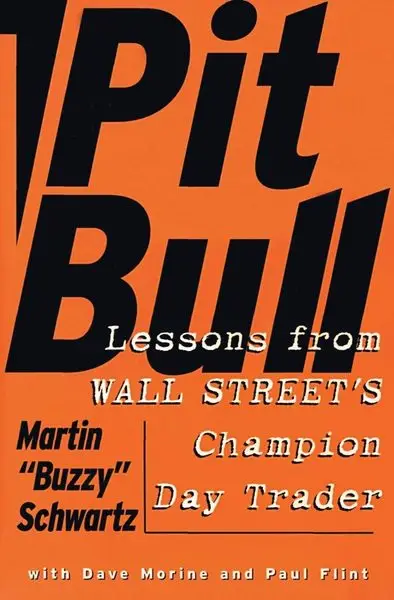
Schwartz told his own story in Pit Bull: Lessons from Wall Street’s Champion Day Trader, one of the few trading memoirs written by someone with a verified competition record rather than a marketing budget. It is unusually honest about the losing years that came first.
Our full review lands in December 2026. Until then you can see where it sits among the eighty books we rate in the Trader’s Library.
 The Complete Trader's Edge
The full Mind · Method · Money framework. 70 chapters.
View on Amazon →
The Complete Trader's Edge
The full Mind · Method · Money framework. 70 chapters.
View on Amazon →
 Market Mayhem
400 years of bubbles, crashes, and the pattern that keeps repeating.
Buy on Amazon →
Market Mayhem
400 years of bubbles, crashes, and the pattern that keeps repeating.
Buy on Amazon →
 Greatest Companies
How the world's greatest companies were built — and what traders learn from them.
View on Amazon →
Greatest Companies
How the world's greatest companies were built — and what traders learn from them.
View on Amazon →
 Greatest Traders
Eighty-six lives that explain the markets — Livermore to Madoff, told with the losses left in.
View on Amazon →
Greatest Traders
Eighty-six lives that explain the markets — Livermore to Madoff, told with the losses left in.
View on Amazon →