

Sleep and Trading: Why Less Than Six Hours Is Worse Than Drunk Trading
The single highest-leverage protocol in this series.
PILLAR · RECOVER
If you read only one article in this 16-episode series and apply only one protocol, this is the one. Sleep is not the foundation of physical performance. Sleep is physical performance. Everything else, every other protocol we will cover across this series, runs on what your brain has done overnight. If sleep is broken, the rest does not matter.
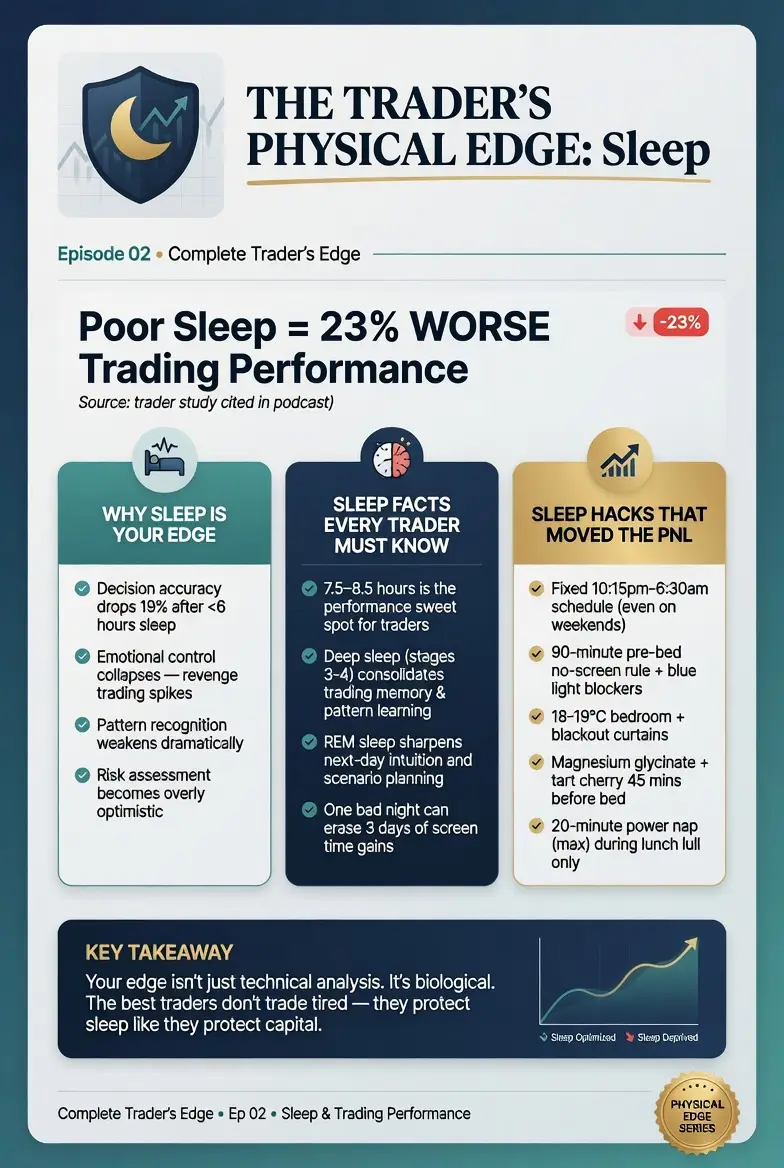
The data on this is unusually clear. Most areas of physiology contain real debates and contested findings. Sleep does not. The research consensus over the past 25 years is one of the cleanest in modern science: chronic sleep restriction degrades cognition severely, predictably, and invisibly. Invisibly is the word that matters most for traders. The sleep-deprived trader does not feel impaired. They feel fine. They are not fine. They are taking trades with measurably diminished judgement while operating under the conviction that they are sharp.
This episode is going to do four things. First, walk through what sleep deprivation actually does to the trader’s brain, with the specific cognitive functions broken down. Second, look at sleep architecture and why the different sleep stages each matter to the trader for different reasons. Third, hand over ten specific protocols you can implement starting tonight. And fourth, give you a calculator that converts your typical sleep into a weekly deficit number you can actually act on.
The Drunk Trader Study
In 2003, researchers at the University of Pennsylvania ran a sleep restriction experiment that has since become the most cited piece of sleep research in performance science[1]. The setup was simple. Adult subjects were divided into groups. One group slept four hours per night for two weeks. Another slept six hours per night for two weeks. A third slept eight hours. A fourth group was kept awake for three consecutive nights.
The cognitive testing across the two weeks measured working memory, reaction time, sustained attention, and complex decision-making. The findings were striking on two counts.
The first finding was that the six-hour group performed as poorly on cognitive tasks as the group that had been kept awake for two consecutive nights. Six hours of sleep, sustained for two weeks, produced impairment equivalent to 48 hours of total sleep deprivation. The four-hour group performed worse, equivalent to three nights of total sleep deprivation.
The second finding was the one that should concern every trader. The six-hour group did not notice the impairment. Subjective ratings of alertness barely changed across the two weeks. The participants felt slightly tired the first few days and then adapted, reporting that they felt mostly normal. The cognitive measures said otherwise. The brain was performing significantly worse, but the subjective experience was that everything was fine.
This is what makes sleep deprivation uniquely dangerous for traders. With alcohol, you know you are drunk. The feedback is immediate and obvious. With sleep deprivation, there is no comparable feedback. You believe you are operating at full capacity. You are not. You are making decisions about risk, about position sizing, about whether to take a trade, about whether to exit, under cognitive conditions that research equates to being legally intoxicated. And you have no idea.
What Sleep Deprivation Specifically Does to a Trader
The cognitive cost is not generalised. Specific functions degrade in specific ways, and several of them map directly onto trading.
Prefrontal cortex shutdown
The prefrontal cortex is the brain region responsible for executive function: planning, impulse control, risk assessment, and strategic decision-making. It is also the region most sensitive to sleep loss. Functional MRI studies have shown that after a single night of inadequate sleep, prefrontal cortex activity is measurably reduced[2].
For a trader, this is not abstract. Impulse control is the function that lets you walk away from a setup that does not meet your rules. Risk assessment is the function that says “this position is too large for this account.” Strategic thinking is the function that lets you hold a winner instead of taking profit at the first sign of a wiggle. All three of these come from the prefrontal cortex. All three are degraded after six hours of sleep.
Amygdala hyperactivity
While the prefrontal cortex goes offline, the amygdala becomes hyperactive. The amygdala is the brain’s threat-detection and emotional reactivity centre. In a well-rested brain, the prefrontal cortex modulates amygdala responses, keeping emotional reactions proportional. In a sleep-deprived brain, this modulation collapses. Emotional reactions amplify by roughly 60 per cent compared to baseline[3].
For a trader, this means a normal drawdown feels catastrophic. A normal pullback feels like the trade is going against you. A piece of news that you would normally interpret with measured attention now triggers a fight-or-flight response. The trader is not making rational decisions in this state. The trader is making decisions that feel rational while being driven by an amplified emotional system.
Working memory collapse
Working memory is the cognitive scratchpad that holds information in active use. When you are looking at a chart and holding in mind the levels you marked yesterday, the open positions you have, the news catalysts for the week, and the rule you set about not trading the first 15 minutes of the open, you are using working memory. Working memory capacity is reduced by roughly 30 per cent after one night of restricted sleep[4].
This is why sleep-deprived traders make rule-breaking trades that they later describe as “I do not know what I was thinking.” They were not thinking. They could not. The cognitive scratchpad was too small to hold all the relevant information at once. Something dropped off the list, and the dropped item was almost always the rule.
Pattern recognition degradation
This one is the hardest pill. Pattern recognition, the core skill of every discretionary trader, depends on the brain’s ability to compare current market structure against thousands of previously seen patterns stored in long-term memory. This comparison happens largely below the level of conscious awareness. You look at a chart and feel that it looks like a continuation, or like a reversal, or like a chop zone. That feeling is the output of pattern matching.
Sleep is when the brain consolidates new patterns into long-term memory and rehearses the matching circuits. Without adequate sleep, both consolidation and retrieval degrade. The sleep-deprived trader is not seeing the same chart as the rested trader. They are seeing a degraded version, with fewer pattern matches available and slower retrieval. They feel they are making the same decisions. They are making different decisions because they are working from different data.
Sleep Architecture: The Stages and Why Each One Matters
Sleep is not a single block. It is a cycle of distinct stages, each with a different function. A typical adult cycles through these stages four to six times per night, and each cycle lasts roughly 90 minutes. Two stages matter most for traders.
Slow-wave sleep (deep sleep)
Slow-wave sleep, sometimes called deep sleep or delta sleep, dominates the first half of the night. It is the stage when the brain physically clears metabolic waste, consolidates declarative memories (facts, rules, explicit knowledge), and restores the physical body. Growth hormone is released. The immune system rebuilds. The brain quite literally washes itself, with cerebrospinal fluid flushing accumulated proteins from the day[5].
For a trader, slow-wave sleep is where your trading rules and the day’s lessons get burned into long-term memory. You read about a setup, you study it, you make a note. Whether that note becomes part of your operational toolkit tomorrow depends on whether you got adequate slow-wave sleep tonight. Cut your sleep short by going to bed late, and you have not just lost time. You have lost a disproportionate share of the slow-wave sleep that lives in the early part of the night.
REM sleep (rapid eye movement)
REM sleep dominates the second half of the night. It is the stage of vivid dreaming, and it is the stage that does two things critical to traders: emotional regulation and pattern integration.
Emotional regulation in REM works by a specific mechanism. The brain replays the day’s emotional events but does so while the noradrenaline system, which normally amplifies stress responses, is switched off. This allows the brain to integrate the emotional content of memories without the associated arousal. You wake up able to think about yesterday’s losing trade without your heart rate spiking. Cut REM sleep, and yesterday’s losing trade keeps feeling like a fresh wound[6].
Pattern integration in REM is the stage where loosely connected information is woven into new associations. This is where insight comes from. The classic finding here is the Wagner 2004 study, in which subjects who slept after exposure to a hidden mathematical rule were twice as likely to discover the rule the next morning compared to subjects who stayed awake[7]. For traders, this is the mechanism by which experience compounds. You can review hundreds of charts during the day. Whether those charts integrate into improved instinct tomorrow depends on REM sleep tonight.
The catch with REM is that it concentrates in the last third of the night. The trader who goes to bed at midnight and wakes at six is not just losing an hour of sleep. They are losing the part of the night that is disproportionately REM. The cost is not 14 per cent fewer hours. The cost is 30 to 40 per cent less REM, which is the stage that handles emotional regulation and pattern integration. Both core functions of a discretionary trader.
The Sleep Debt Calculator
Before we go into protocols, get a concrete number for what we are working with. The calculator below takes your typical weeknight sleep and your sleep target and gives you a weekly debt number plus an interpretation.
THE SLEEP DEBT CALCULATOR
A weekly debt of seven hours or more is, by the research, a significant deficit. The good news is that this is also the most fixable part of the entire physical edge stack. Sleep responds quickly to consistent inputs. Most traders who make four or five of the protocol changes below see measurable improvement within two weeks.
Ten Sleep Protocols for Traders
These are ordered by impact. Start with the first three. Add the others as those become consistent. The temptation will be to try all ten at once. Resist it. The trader who changes one variable at a time can attribute results to that variable.
PROTOCOL 01 · Anchor your wake time, even on weekends
The single most impactful change. Pick a wake time that works for your trading schedule, and hit it within 30 minutes seven days a week. Weekend sleep-ins disrupt the circadian rhythm by the equivalent of mild jet lag. The Monday-morning trader who slept until 10 on Sunday is, in chronobiological terms, jet-lagged. Wake time is the anchor. Bedtime drifts to meet it.
PROTOCOL 02 · Get bright light within 30 minutes of waking
Outdoor light, ideally. Five to ten minutes is enough on a sunny day, longer if overcast. This is the strongest signal you can send to the circadian system that the day has started. It sets the wake-melatonin cycle for the next 16 hours and brings sleep onset forward in the evening. Stepping outside with coffee in hand is sufficient. The light through a window is not.
PROTOCOL 03 · No caffeine after midday
Caffeine has a half-life of five to seven hours. A 3 PM coffee is still operating at half-strength at 9 PM. The trader who reports falling asleep fine but waking unrefreshed often has residual caffeine in their system, preventing the descent into slow-wave sleep. If you are not willing to give up afternoon coffee entirely, swap to decaf or to a low-caffeine tea after lunch.
PROTOCOL 04 · Last alcohol three hours before bed, if any
Alcohol is a sleep destroyer that masquerades as a sleep aid. It accelerates sleep onset, then fragments sleep architecture in the second half of the night, specifically suppressing REM sleep. The trader who has two glasses of wine with dinner is trading away exactly the emotional-regulation and pattern-integration sleep they need most for tomorrow’s session.
PROTOCOL 05 · Cool the room to around 18 to 19 degrees Celsius
Sleep onset requires a drop in core body temperature of about one degree. A cool room facilitates this. A warm room fights it. If you cannot control the room temperature, a cool shower 90 minutes before bed creates the same effect through a slower mechanism. The skin warms, then cools below baseline as a rebound, dropping core temperature and signalling sleep onset.
PROTOCOL 06 · Dim the lights two hours before bed
Bright light, especially blue-spectrum light from screens, suppresses melatonin production. Melatonin is the hormone that signals the body it is night-time. Suppressed melatonin means delayed sleep onset and reduced sleep depth. Two hours before bed, dim household lights, switch screens to night mode, and avoid overhead lighting. The trader who insists on screen work right up to bedtime should wear blue-blocking glasses for the last 90 minutes.
PROTOCOL 07 · Keep the bedroom dark, and the phone elsewhere
Even minor light exposure during the night impairs sleep quality. Blackout curtains, no LED indicator lights on devices, no phone screen lighting the room. The phone should not be in the bedroom at all if you can manage it. The argument that “I use it for an alarm” is solved by a 12 dollar bedside clock. The phone in the bedroom is the single biggest sleep-quality threat in most modern households.
PROTOCOL 08 · Last meal three hours before bed
Digestion competes with sleep. A heavy meal at 9 PM is still being processed at midnight, raising body temperature, demanding cardiovascular work, and pushing back the descent into slow-wave sleep. The trader who eats dinner at 6 or 7 sleeps measurably better than the trader who eats at 9. If your schedule forces a late dinner, eat lighter, with less fat and protein.
PROTOCOL 09 · Build a 20-minute wind-down ritual
The brain does not have an off switch. It has a ramp. The trader who is on the chart at 11:55 PM and expects to be asleep at midnight is fighting the architecture of their own nervous system. A 20-minute ritual of reading something physical (a book, a journal, anything not lit by a screen), light stretching, or simply sitting in a dim room with a hot drink gives the nervous system the runway it needs.
PROTOCOL 10 · Track one metric for two weeks
Pick one: total sleep duration, sleep onset latency (how long it takes to fall asleep), or wake-after-sleep-onset (how often and how long you wake during the night). Track it the same way you track your trading P&L. After two weeks, you will have a pattern. After four weeks, you will see which protocols are working. The trader who measures sleep takes it seriously. The trader who does not, does not.
The Naps Question
Short naps work. Long naps usually do not. The mechanism is simple: a 10 to 20 minute nap delivers light sleep without descending into slow-wave sleep, so you wake feeling restored. A 40 to 90 minute nap typically wakes you out of slow-wave sleep, producing sleep inertia, the groggy heavy feeling that takes another hour to clear. For traders, the 15-minute mid-afternoon nap, often referred to as the “NASA nap” because of agency research on pilot fatigue, is a useful tool when it fits the schedule[8]. Set an alarm. Do not nap after 3 PM if you have trouble sleeping at night.
When to See a Doctor
Two patterns suggest you should not solve this with protocols alone but with medical input. The first is consistent sleep duration over seven hours with persistent daytime fatigue. This may indicate sleep apnoea, which is dramatically more common than people realise (estimated to affect one in five adults to some degree). The second is the inability to fall asleep within 30 minutes despite good sleep hygiene over a four-week period. This may indicate insomnia that responds to cognitive behavioural therapy for insomnia (CBT-I), which is the first-line evidence-based treatment.
Frequently Asked Questions
I’m a short sleeper. I can run on five hours.
True short sleepers exist. They make up roughly one to three per cent of the population, and they are genetically identifiable. The other 97 per cent of people who report being short sleepers are sleep-deprived people who have lost the ability to notice their own impairment. The Van Dongen study made this point bluntly. Subjective alertness ratings disconnect from actual cognitive performance during chronic sleep restriction. The way to test which group you are in is to sleep eight hours for two weeks and compare your trading. Most traders find the comparison settles the question.
I’m a night owl. Forcing myself to wake early ruins me.
Chronotype is real and partially genetic. Some people are biologically wired to function better later in the day. The protocols above still apply, just shifted to your chronotype. If you trade Asian session and sleep from 4 AM to noon, that is not unhealthy. Inconsistency is unhealthy. The same eight hours every night beats variable hours, regardless of when they fall. Episode 15 will deal with chronotype alignment in detail.
Can I catch up on weekends?
Partially, yes. Some research suggests that one long weekend of recovery sleep restores most cognitive function to baseline. But this is fragile. Catch-up sleep does not undo the cumulative damage of consistent restriction. And the weekend sleep-in disrupts the circadian rhythm enough to make Monday harder. The better strategy is to prevent the deficit in the first place rather than relying on weekend recovery.
What about sleep tracking devices?
Most consumer sleep trackers (Oura ring, Whoop, Apple Watch) are reasonably accurate for total sleep duration and timing. They are less reliable for sleep-stage breakdown, especially for REM percentage. The trend data they provide is useful. The specific numbers should be treated as approximate. If a tracker tells you that you got 90 minutes of REM, the real number is probably between 70 and 110. The directional information is the value, not the precision.
Should I use sleep medication?
This is a conversation to have with a doctor, not via an article. Most over-the-counter sleep medications work by inducing sedation rather than sleep, and sedation is not the same as restorative sleep. Prescription sleep medications have specific use cases (jet lag, short-term insomnia) but generally do not restore normal sleep architecture. Magnesium glycinate and L-theanine, taken before bed, are reasonably well-supported supplements that promote relaxation without significant side effects, but again, consult a doctor before starting anything new.
References
- Van Dongen, H. P., Maislin, G., Mullington, J. M., & Dinges, D. F. (2003). The cumulative cost of additional wakefulness: Dose-response effects on neurobehavioral functions and sleep physiology from chronic sleep restriction and total sleep deprivation. Sleep, 26(2), 117-126. doi.org/10.1093/sleep/26.2.117
- Krause, A. J., Simon, E. B., Mander, B. A., Greer, S. M., Saletin, J. M., Goldstein-Piekarski, A. N., & Walker, M. P. (2017). The sleep-deprived human brain. Nature Reviews Neuroscience, 18(7), 404-418. doi.org/10.1038/nrn.2017.55
- Yoo, S. S., Gujar, N., Hu, P., Jolesz, F. A., & Walker, M. P. (2007). The human emotional brain without sleep — a prefrontal amygdala disconnect. Current Biology, 17(20), R877-R878. doi.org/10.1016/j.cub.2007.08.007
- Lim, J., & Dinges, D. F. (2010). A meta-analysis of the impact of short-term sleep deprivation on cognitive variables. Psychological Bulletin, 136(3), 375-389. doi.org/10.1037/a0018883
- Xie, L., Kang, H., Xu, Q., Chen, M. J., Liao, Y., Thiyagarajan, M., et al. (2013). Sleep drives metabolite clearance from the adult brain. Science, 342(6156), 373-377. doi.org/10.1126/science.1241224
- Walker, M. P. (2017). Why We Sleep: Unlocking the Power of Sleep and Dreams. Scribner. (General reference for REM and emotional regulation mechanism.)
- Wagner, U., Gais, S., Haider, H., Verleger, R., & Born, J. (2004). Sleep inspires insight. Nature, 427(6972), 352-355. doi.org/10.1038/nature02223
- Rosekind, M. R., Smith, R. M., Miller, D. L., Co, E. L., Gregory, K. B., Webbon, L. L., et al. (1995). Alertness management: Strategic naps in operational settings. Journal of Sleep Research, 4(s2), 62-66. doi.org/10.1111/j.1365-2869.1995.tb00229.x
Get the Sleep Protocol Worksheet (free)
The Self-Audit Worksheet plus EP02 sleep tracker. Print it, log your sleep for two weeks, identify your weakest protocol.
The Trader’s Physical Edge publishes every Sunday at 11:00 SAST.
Next week: EP03 — The Trader’s Diet: How What You Eat Drives Your P&L
Take it further
The Complete Trader’s Edge book covers the full Mind · Method · Money framework that sits above this series.
 The Complete Trader's Edge
The full Mind · Method · Money framework. 70 chapters.
View on Amazon →
The Complete Trader's Edge
The full Mind · Method · Money framework. 70 chapters.
View on Amazon →
 Market Mayhem
400 years of bubbles, crashes, and the pattern that keeps repeating.
Buy on Amazon →
Market Mayhem
400 years of bubbles, crashes, and the pattern that keeps repeating.
Buy on Amazon →
 Greatest Companies
How the world's greatest companies were built — and what traders learn from them.
View on Amazon →
Greatest Companies
How the world's greatest companies were built — and what traders learn from them.
View on Amazon →
 Greatest Traders
Eighty-six lives that explain the markets — Livermore to Madoff, told with the losses left in.
View on Amazon →
Greatest Traders
Eighty-six lives that explain the markets — Livermore to Madoff, told with the losses left in.
View on Amazon →