

INSIDE THE MACHINE · EP. 3
The Dark Pool: The Invisible Market Where 40% of Trades Happen
How Markets Really Work — Episode 3
| Listen on Spotify | Watch on YouTube |
Also available on Apple Podcasts · Amazon Music · iHeart Radio
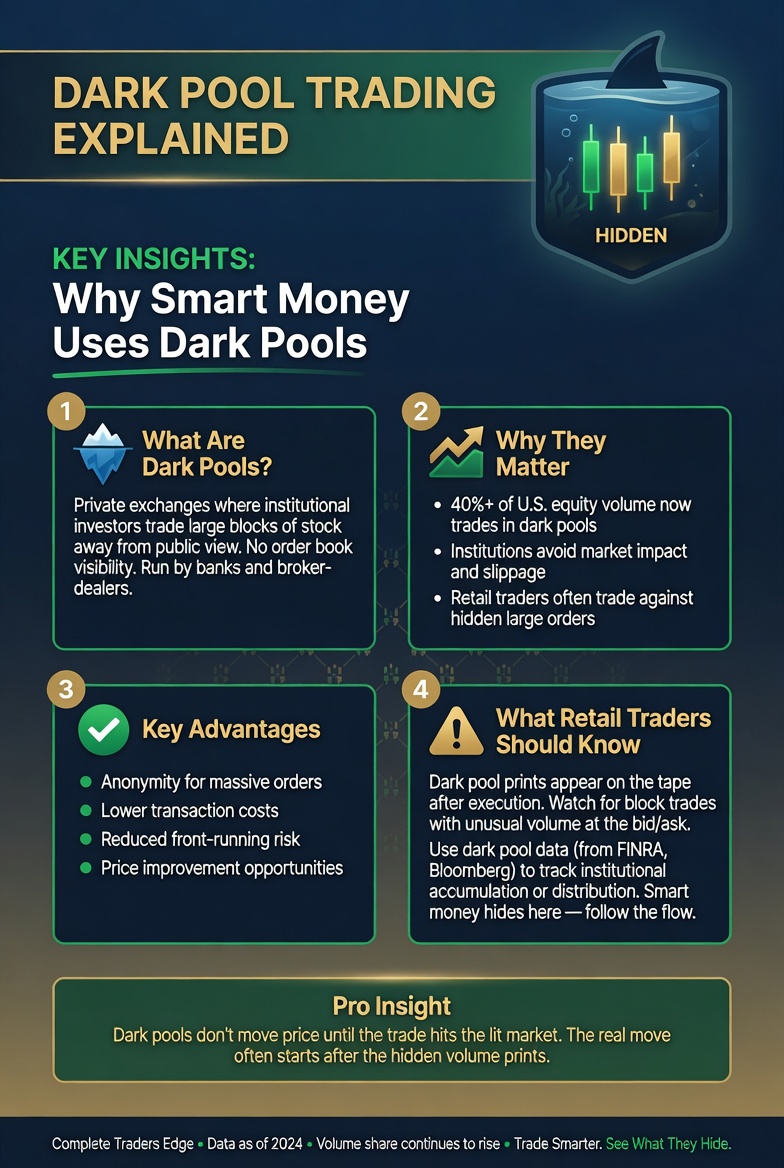
There is a parallel stock market. It operates alongside the exchanges you know — the NYSE, NASDAQ, the CME. It processes roughly forty percent of all US equity volume. Its prices are invisible to the public. Its participants are anonymous. And it almost certainly executed some of your trades without you knowing it existed.
It is called a dark pool. This is Episode 3 of Inside the Machine: How Markets Really Work.
What Is a Dark Pool?
A dark pool is a private trading venue that does not display its order book to the public. Unlike exchanges, which publish every bid and ask in real time, dark pools match orders internally without revealing prices or participants until after the trade executes.
They were not created to deceive retail traders. They were created to solve a specific problem faced by large institutional investors: market impact. If a pension fund needs to sell five million shares of Microsoft, submitting that to a public exchange immediately signals the intention. Algorithmic traders detect the large sell order and begin selling ahead of it, pushing prices lower before the order completes. By the time the last share trades, the price has moved significantly against the institution.
Dark pools allow large institutions to execute significant orders without telegraphing their intentions. The trade is reported only after execution. Both sides typically receive the midpoint between the national best bid and offer — a price better than either could achieve on a public exchange. In this sense, dark pools serve a legitimate function.
Who Operates Dark Pools?
Most dark pools are operated by major broker-dealers — Goldman Sachs, Morgan Stanley, JPMorgan, Credit Suisse — as well as independent operators like Liquidnet and IEX. There are currently over forty registered alternative trading systems operating in the United States, varying significantly in size, participant composition, and the types of orders they accept.
When your retail broker routes your order, they are choosing between public exchanges and these alternative venues based on execution quality metrics, speed, and — as covered in Episode 1 — payment for order flow arrangements. Some retail orders do execute in dark pools, typically at the national best bid and offer midpoint, which can represent genuine price improvement.
The Barclays LX Scandal
In June 2014, the New York Attorney General filed suit against Barclays Capital over the operation of its dark pool, Barclays LX. The allegations were specific and damaging.
Barclays had marketed LX as a safe haven from aggressive high-frequency trading strategies — implying that institutional clients could trade in the pool without being picked off by faster algorithmic participants. In reality, the allegations stated, Barclays had actively encouraged HFT firms to participate in LX because their activity increased volume and improved matching rates. The very participants Barclays claimed to protect clients from were operating actively inside the pool.
Beyond this, Barclays was alleged to have falsified data in marketing materials — presenting clients with a sanitised view of pool composition that omitted the most aggressive HFT participants.
Barclays settled in 2016 for $70 million — at the time the largest ever fine for dark pool misconduct — without admitting or denying the findings.
The Barclays LX case illustrates the fundamental tension at the heart of dark pool operations. Dark pool operators profit from volume. Volume is driven partly by HFT firms. And the institutional clients using dark pools are often trying to avoid the very HFT activity that makes the pools profitable to operate. The opacity that makes dark pools useful for large orders also makes it difficult for clients to verify that the pool is operating as described.
What This Means for Your Trading
Some of your retail trades are executing in dark pools — and that is not necessarily bad. If your broker routes your order to a dark pool that provides genuine price improvement at the midpoint, you are receiving a better fill than you would on a public exchange. Your orders are small enough that market impact is not a meaningful concern. What matters is your net execution price, not which venue produced it.
Dark pool activity explains some institutional price behaviour. Large institutions often accelerate dark pool activity ahead of significant index rebalancing events, earnings announcements, and major data releases — precisely when they most want to avoid showing their hand on public markets. This creates patterns in public market activity that can appear anomalous without the dark pool context to explain them.
If evaluating a broker, look specifically at their dark pool routing. A broker routing retail orders to their own affiliated dark pool has a different conflict of interest than one routing to an independent venue. Rule 606 disclosures contain this information, though it requires reading carefully to identify the specific routing destinations.
Frequently Asked Questions
What is dark pool trading?
Dark pool trading refers to transactions executed in private, off-exchange venues that do not display their order books publicly. Orders are matched internally at prices typically derived from public market quotes, with the transaction reported only after execution. Dark pools exist primarily to allow large institutional investors to trade significant positions without revealing their intentions to the broader market.
Are dark pools legal?
Yes. Dark pools operate legally in the United States as registered alternative trading systems (ATS) under SEC oversight. They must report transaction data to consolidated tape after execution and are subject to regulatory requirements around fair access and disclosure. The Barclays LX case resulted in a $70M fine not because dark pools are illegal, but because Barclays was alleged to have misrepresented the composition of the pool to its clients.
How much trading volume goes through dark pools?
Approximately 35–45% of US equity trading volume executes in dark pools and other off-exchange venues, varying by market conditions and stock characteristics. Large-cap, liquid stocks tend to have higher dark pool participation because they are easier to match in large sizes. Small-cap stocks with lower volume are more likely to route to public exchanges where liquidity is available.
Do retail trades execute in dark pools?
Yes, some retail orders execute in dark pools, typically through wholesale market maker internalisation — where the market maker fills the order from its own inventory at or better than the national best bid and offer. This is distinct from the institutional dark pool model but operates on similar principles. Whether this benefits or disadvantages retail traders depends on whether the execution price is genuinely at or better than what a public exchange would have provided.
What was the Barclays dark pool scandal?
In 2014, the New York Attorney General sued Barclays over its dark pool Barclays LX, alleging that the bank had misled institutional clients about the presence of aggressive high-frequency traders in the pool and had falsified marketing data to present a more favourable view of pool composition. Barclays settled in 2016 for $70 million — then the largest dark pool fine on record — without admitting wrongdoing.
The Complete Trader’s Edge
Understanding your full trading environment — including the off-exchange venues where your orders may execute — is part of the Method pillar’s execution layer.
 The Complete Trader's Edge
The full Mind · Method · Money framework. 70 chapters.
View on Amazon →
The Complete Trader's Edge
The full Mind · Method · Money framework. 70 chapters.
View on Amazon →
 Market Mayhem
400 years of bubbles, crashes, and the pattern that keeps repeating.
Buy on Amazon →
Market Mayhem
400 years of bubbles, crashes, and the pattern that keeps repeating.
Buy on Amazon →
 Greatest Companies
How the world's greatest companies were built — and what traders learn from them.
View on Amazon →
Greatest Companies
How the world's greatest companies were built — and what traders learn from them.
View on Amazon →