

Charlie Munger said he had underestimated the power of incentives his whole life, and he was not a man who underestimated things.
His formulation is worth memorising. Show me the incentive and I will show you the outcome. Not because people are dishonest, but because they are not: an intelligent, sincere person, paid in a particular way, will construct a genuinely held belief that happens to justify the way he is paid. He will not notice. Nobody notices.
So let us do the exercise properly, and start where it hurts.
Us, first
This site earns affiliate commissions from prop firms, brokers, and platforms. When you click a link here and open an account, we may be paid.
That is a real conflict and it points in a specific direction: toward recommending firms that convert, toward reviewing products with affiliate programmes rather than those without, and toward tone. We are structurally more likely to write about a broker that pays than a broker that does not, and no amount of good intention removes the gradient.
We also sell books, which pays whether or not you trade, and that is a better incentive, and it is why the books say things the affiliate pages do not.
Apply this article to this article. If a review here is uniformly positive, ask what it is paid by. The correct response to a disclosure is not reassurance. It is discounting.
The map
Every party in your trading life is paid by something. In almost no case is that something your profit.
| Party | Paid by | Therefore wants you to |
|---|---|---|
| Broker (commission) | Volume | Trade more, whatever the outcome |
| Broker (spread / market maker) | The spread, and sometimes your loss | Trade more, in size, with tight stops |
| Prop firm | Challenge fees | Attempt, fail, and attempt again |
| Signal seller | Subscriptions | Feel dependent, and renew |
| Educator | Course sales | Believe the next course is the missing piece |
| Influencer | Attention, then affiliate | Watch, and click |
| Exchange | Fees per contract | Trade the front month, frequently |
| You | Expectancy over many trades | Trade rarely, and only your edge |
Read the last row against the others. Your interest is opposed to every party above you, on the single most consequential variable in trading: how often you press the button.
Nobody in that table is a villain. Each is running a legitimate business, and each business is paid by activity, and activity is what destroys retail traders. The alignment failure is structural. It requires no bad actors and it survives their absence.
The arithmetic of a challenge
Consider a prop firm. This is an illustrative model with invented numbers, chosen to be plausible. It is not any firm’s data, and we do not have any firm’s data.
Ten thousand people pay five hundred dollars for a challenge. One in ten passes. Of those who pass, three in ten ever withdraw anything, averaging two thousand dollars.
| Illustrative | Amount |
|---|---|
| Challenge revenue | $5,000,000 |
| Traders paid out | 300 |
| Total payouts | $600,000 |
| Gross margin before costs | $4,400,000 (88%) |
Under these assumptions the payouts would need a pass rate of eighty-three percent before they consumed the fees.
The conclusion is not that prop firms are frauds. Many are honest businesses that pay promptly, and this site links to several. The conclusion is narrower and more useful: within a very wide range of plausible numbers, the fee is the business and the payout is a marketing expense. Which tells you exactly what the firm’s product is, and it is not funding.
Now reread the drawdown clause. A trailing limit that kills a profitable trader four times in five is not a bug from the firm’s perspective. It is not sabotage either. It is simply not a cost.
Incentives you cannot see
The educator’s real product. A course cannot sell you competence, because competence would end the relationship. It sells the feeling of proximity to competence, which renews. Notice which trading educators publish their own live results, and how few.
The influencer’s selection. He is not lying about the trade he posted. He posted the trade that worked, because the trade that worked is what generates attention, and attention is the input to the business. You are watching a survivorship filter with a face.
The platform’s default. Every default setting on your platform was chosen by someone. One-click trading is a default. A confirmation dialogue is not. That is not an accident of user experience.
The book you are reading. Including ours. Every trading book is written by someone who benefits from you believing trading is learnable, and although we believe it is, we would say that either way, and you should notice that we would.
Where Munger goes further
The subtle part is not that people respond to incentives. It is that they convert incentives into sincere belief.
The broker who tells you that active trading builds skill is not lying to you. He believes it. He has watched thousands of accounts and constructed, from that experience, a theory in which frequent trading and eventual success are connected, because the alternative theory would require him to conclude that his life’s work harms his customers.
Nobody can hold that thought for long. So the belief adjusts, and it adjusts in the direction of the cheque, and the person holding it experiences nothing but conviction.
This is why sincerity is not evidence. The most persuasive people in trading are persuasive because they believe it, and they believe it because of how they are paid. Sincerity and incentive are not in tension. Sincerity is what incentive produces.
Four questions
1. Who is paid, and by what? Ask it of every recommendation, every review, every default, every free tool. The answer is usually one search away, and it is usually in the footer.
2. What would this person have to believe to keep being paid? That is the belief they will hold, sincerely, and it is the belief they will transmit.
3. Who is paid when I do nothing? Almost nobody. Which is why nobody will ever tell you that the correct number of trades this week is zero, and why it frequently is.
4. What does my own incentive make me believe? The hardest one. You are paid, emotionally, by action, by being right, and by having a story. Those are incentives too, and they have shaped your beliefs about the market as thoroughly as any commission.
The one aligned party
There is exactly one participant whose payoff is your long-run expectancy, and you are reading this on his behalf.
He is outnumbered. Everyone else in the system is paid to keep him clicking, and each of them is pleasant, credible, and sincere. Nothing about that arrangement is going to change, and no regulation will fix it, because there is no fraud in it.
What you can do is name the incentive before you accept the advice. Including here. Especially here.
Nobody in your trading life is paid when you sit on your hands.
Which is a fact about them, and it should become a fact about how you read them.
 The Complete Trader's Edge
The full Mind · Method · Money framework. 70 chapters.
View on Amazon →
The Complete Trader's Edge
The full Mind · Method · Money framework. 70 chapters.
View on Amazon →
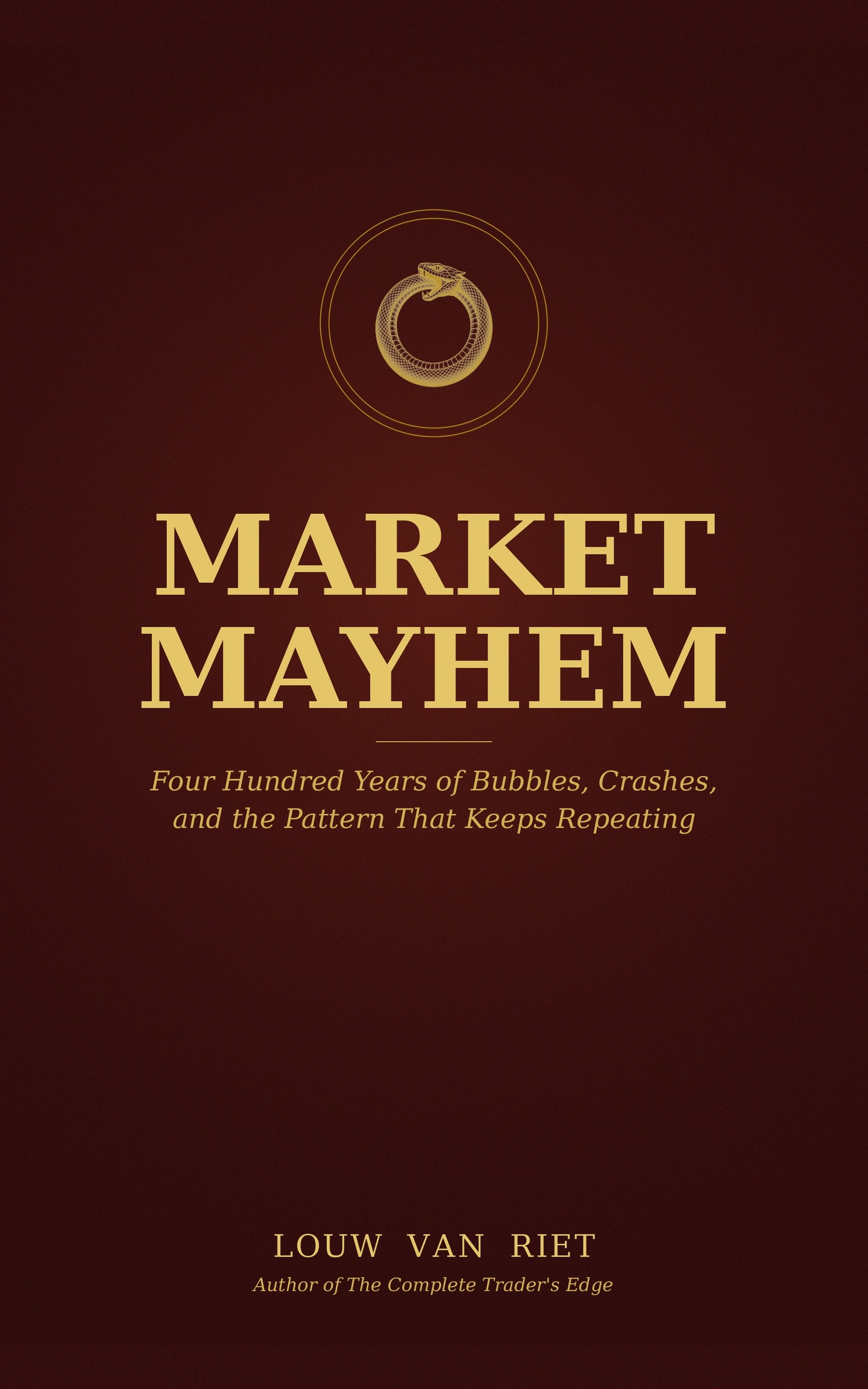 Market Mayhem
400 years of bubbles, crashes, and the pattern that keeps repeating.
Buy on Amazon →
Market Mayhem
400 years of bubbles, crashes, and the pattern that keeps repeating.
Buy on Amazon →
 Greatest Companies
How the world's greatest companies were built — and what traders learn from them.
View on Amazon →
Greatest Companies
How the world's greatest companies were built — and what traders learn from them.
View on Amazon →