


GREATEST TRADERS · EPISODE 13
Linda Raschke
Turtle Soup, the First Market Wizard, and One Losing Year
Also available on Apple Podcasts · Amazon Music
Linda Bradford Raschke
| Born | 1959, Pasadena, California |
| Active as a professional trader since | 1981 (over 40 years) |
| Career losing years | One. Across her entire managed-money career. |
| Granat Fund BarclayHedge ranking | 17th of approximately 4,500 hedge funds (5-year) |
| Schwager Market Wizards | First woman ever profiled (New Market Wizards, 1992) |
| Floor memberships | Pacific Coast Stock Exchange · Philadelphia Stock Exchange |
| Firms founded | LBRGroup (1992, CTA) · LBR Asset Management (2002, CPO) |
| Signature setup | Turtle Soup · fading failed 20-day breakouts |
| Books | Street Smarts (1996, with Connors) · Trading Sardines (2018) |
| Lifetime Achievement Award | International Federation of Technical Analysts, 2024 |
| Famous quote | “You don’t have to be a rocket scientist to be a trader.” |
In 1983, Richard Dennis recruited a group of novices and taught them a single mechanical system: buy 20-day breakouts, sell 20-day breakdowns, ride the trend until it ends. The Turtles became famous for it. Their group made hundreds of millions of dollars over the next four years. The breakout system became one of the most-copied templates in retail trading history.
Thirteen years later, a Pacific Stock Exchange options trader named Linda Bradford Raschke published a book containing dozens of short-term setups. One of them was specifically designed to fade the Turtles. She called it Turtle Soup. The premise was that a meaningful percentage of all 20-day breakouts fail, the trend-followers get stopped out, and the price snaps back. If you positioned for the failure instead of the trend, you could systematically take money from the system that made the Turtles famous.
That setup is now in every short-term-trading curriculum on earth. The trader who built it is one of the longest-tenured professional traders working today, with one of the most extraordinary records in managed money: across her entire career running outside capital, she had only one losing year. One. Across more than two decades.
This is the story of Linda Raschke. The trader who reverse-engineered the most famous breakout system in trading history, ranked her own hedge fund 17th out of 4,500, and did all of it as the first woman ever profiled in Jack Schwager’s Market Wizards series.
Pasadena to the Pacific Stock Exchange
Linda Bradford Raschke was born in 1959 in Pasadena, California. Her father was a trader. Importantly, an unsuccessful one. She has spoken openly across her career about helping him scan stock charts as a child, looking for patterns. The work was not abstract or academic. It was practical. She grew up watching markets move and watching her father try, and frequently fail, to read them.
She studied economics and music composition at Occidental College, graduating in 1980 with dual bachelor’s degrees. The combination matters more than it sounds. Music composition demands pattern recognition under temporal constraint: you have to hear the structure of what is unfolding and anticipate where it is going. Economics gave her the framework for thinking about markets. Music gave her the ear.
What happened next was less a career plan than a decision to stay close to where the action was. Raschke spent time near the Pacific Coast Stock Exchange after graduation. A trader on the floor explained how options pricing worked. Her response, which she has repeated many times since, was that you did not need to be a rocket scientist to do this. Some of the best traders she encountered were former surf bums. Formal education had little visible relationship with trading skill.
She had been considering an MBA. When someone offered to back her instead, she chose the floor. By 1981 she was a market maker in equity options on the Pacific Coast Stock Exchange. Within a few years she had moved to the Philadelphia Stock Exchange, the largest options exchange in the country at the time. The next decade was spent making thousands of small markets in real time, watching prices move, learning what the screen was actually showing.
This kind of training does not exist anymore. The pits are gone. The skills they produced — fast tape reading, instant volatility judgment, pattern recognition built on millions of repetitions — were earned by accumulated screen time and accumulated risk. Raschke’s edge for the next forty years was built in those years on the floor.
Off the floor and into Schwager’s book
By the early 1990s, Raschke was preparing to leave the floor. She had earned enough trading her own account to capitalise a fund. In 1992 she registered with the National Futures Association as a Commodity Trading Advisor and founded LBRGroup, the vehicle through which she would manage outside capital for the next two decades.
The same year, Jack Schwager published The New Market Wizards, the second volume of his interviews with elite traders. Across the original Market Wizards (1989) and The New Market Wizards (1992), Schwager had interviewed dozens of professionals: Paul Tudor Jones, Ed Seykota, Richard Dennis, William Eckhardt, Bruce Kovner, Marty Schwartz. Raschke was the first woman to appear in either volume.
What set her interview apart was not biography. It was the specificity of method. Where other Market Wizards described philosophies and frameworks, Raschke walked through actual setups: how she identified swing failures, how she managed her exits, how she read the first and last hour of the trading day, why most of her trades were managed against the prior day’s high or low. The interview was the first time a wide trading audience had encountered her precise, technical, pattern-driven approach.
The transition from floor trader to CTA, however, is not automatic. The skills that make someone effective at reading the order flow in a pit do not always translate to managing a systematic program for institutional clients with monthly performance reviews and drawdown limits. Raschke made the translation successfully, which puts her in a small minority of floor traders who survived the move to electronic markets and outside capital.
Turtle Soup: the setup that defined her name
In 1996, Raschke co-authored Street Smarts: High Probability Short-Term Trading Strategies with Larry Connors. The book contains dozens of setups for short-term trading, all of them concrete, mechanical, and testable. It became one of the most cited books on technical trading ever published.
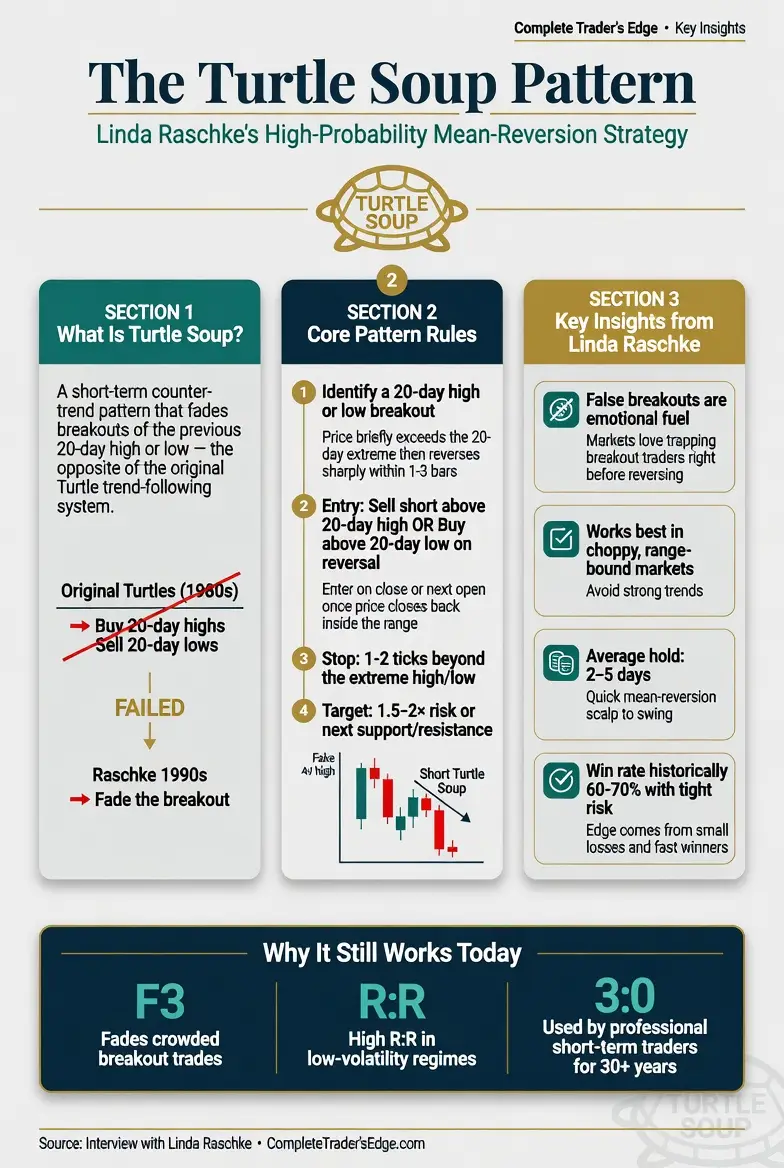
The single setup that got the most attention was Turtle Soup, and the name itself is the joke. The original Turtles, trained by Richard Dennis, made their money buying breakouts of 20-day or 55-day price extremes. The system worked because in trending markets, those breakouts continue. But the system also pays a structural tax: a meaningful percentage of all breakouts are false. Price makes a new 20-day high, the Turtles enter long, the move fails within a few bars, and the position gets stopped out for a small loss.
Raschke looked at this vulnerability and built the inverse strategy. Turtle Soup enters short when price makes a new 20-day high but the breakout shows signs of failure. It enters long when price makes a new 20-day low but fails to follow through. The mechanics are precise:
- The new 20-day extreme must occur at least four trading days after the previous 20-day extreme. This filter ensures you are not just measuring noise.
- For a long entry: price hits a new 20-day low, then a buy stop is placed 5-10 ticks above the previous 20-day low. The trade triggers if the price reverses back up through the prior low.
- The protective stop sits just below the new low.
- Targets are managed against 1R or trailed against the previous swing.
The structural beauty of Turtle Soup is that it sits in a different probability space than trend-following. Trend systems win 35-45% of the time with large average winners. Turtle Soup wins 60-70% of the time with smaller, faster wins. The two strategies can both be profitable simultaneously because they are extracting edge from different market behaviours: trend-followers get paid by the few breakouts that run, mean-reverters get paid by the many that don’t. Both work over a sufficient sample because the math underneath both is sound. They simply harvest different edges in different conditions.
Turtle Soup is now a foundational pattern in mean-reversion trading literature. It has been backtested across 32 years of data and 42 futures markets. It has been adapted to forex on 30-minute charts, to indices, to crypto, to anything with a recent extreme that traders pile in to defend. The strategy was published almost thirty years ago. It still works. That fact alone says something about Raschke’s eye.
The longevity argument
The most important number in Linda Raschke’s career is not a peak return. It is one. As in: across her entire career running outside capital, she had exactly one losing year.
That is the kind of statistic that requires immediate context, because it sounds impossible at first. Markets crash. 1987 happened. 1998 happened. 2000-2002 happened. 2008 happened. 2020 happened. How does a trader survive five separate market regimes and only have one negative year across them?
The answer is that Raschke’s edge was never about catching the biggest moves. It was about being there. Day after day. Year after year. Trading a defined set of patterns with disciplined sizing, taking the small wins available, sitting out the conditions where her setups did not appear, and never blowing up. The compounding from a base of “small wins consistently” with “no large losses” is more powerful than the compounding from “big wins occasionally” with “occasional large drawdowns,” even if the latter has higher peak returns.
Her own Granat Fund, the institutional vehicle she ran from 2002, was ranked 17th out of approximately 4,500 hedge funds for five-year performance by BarclayHedge. That ranking is not the result of one spectacular year. It is the result of a sustained risk-adjusted return that compounded across years. The fund’s stated focus was on drawdown management. Raschke understood that the path matters, not just the destination.
For a working trader, this is the most quietly important Raschke lesson. Survival is the foundation. Without it, no edge produces wealth. The trader who builds a set of repeatable, concrete setups, sizes them with discipline, and shows up every day for thirty years will outperform the spectacular trader who blows up in year five. That is not a romantic philosophy. It is arithmetic.
The first and last hour
One of Raschke’s most repeated tactical observations is that the first hour and the last hour of the trading day are the most important. This is not abstract. She built her trading day around them.
The first hour establishes the day’s structure. Reversals from the prior day’s close, gap fills, opening range breakouts, and the early reaction to overnight news all happen here. Whether the day will trend or chop is largely determined in the first sixty minutes. The trader who is paying close attention here gets the framework for everything that follows.
The last hour is when professional money rebalances and positions for the next session. Sharp moves in the last hour are signals about institutional intent. A strong rally into the close on rising volume is genuine demand. A failure to hold gains into the close is a warning. The last-hour signature of any session is the closest thing markets give you to a verdict on what just happened.
Most retail traders do the opposite of what Raschke recommended. They check in mid-session, miss the open, miss the close, and try to read the chop in between. The result is trading without the structural information that makes the chop interpretable. Raschke’s discipline was the opposite: be there for the open, be there for the close, treat the middle session as a place to manage trades that were established at higher-information moments. The asymmetry of attention matters.
Trade what happens, not what you think should happen
Raschke’s other repeated mantra is one of the most useful sentences in trading literature: trade what happens, not what you think should happen.
The asymmetry inside that sentence is everything. Most traders, including most experienced traders, hold a thesis about what the market should do based on news, fundamentals, sentiment, or their own analysis. When the market behaves contrary to that thesis, the natural human response is to argue with the market. To assume the market is wrong, that the move is a fakeout, that the price will eventually revert to what the trader thinks is correct.
Raschke’s method is the inversion. The market is the data. The market is always right by definition because the market is the truth being traded. If price is moving against your thesis, your thesis is the thing that needs to be re-examined, not the market. The trader who can suspend their belief about what the market should do and react to what is actually happening on the chart has a structural advantage over the trader who is fighting the tape.
This is also the connective tissue between Raschke’s pattern-recognition skill and her risk discipline. Patterns are the market telling you what is happening right now. They are not predictions. They are descriptions. The trader who reads them as descriptions and reacts trades very differently than the trader who reads them as forecasts and overcommits.
The trading floor is gone, but the lessons aren’t
The exchanges Raschke trained on no longer exist as physical pits. The Pacific Stock Exchange floor closed in 2002. The Philadelphia options floor was largely electronic by 2010. The training environment that made her career possible — thousands of repetitions watching real prices move with real money on the line — is not available to the next generation of traders in the same form.
Some of what she learned does not transfer cleanly. Tape reading on a pit floor required specific skills (reading the body language of brokers, hearing volume in the noise level, recognising who was buying or selling) that have no electronic equivalent. The closest modern analogue is order flow analysis on Level 2 screens, but it is a different sport.
What does transfer is the underlying principle: edge is built on repetition. The reason Raschke’s pattern recognition was so good was not innate talent. It was that she had seen the pattern thousands of times in live conditions and learned what it actually does, distinct from what it looks like it should do. A retail trader today can build the same kind of recognition by replaying historical price action, journaling every trade against a strict template, and committing the kind of seat-time most retail traders avoid.
The mistake retail traders make is assuming that pattern recognition is intuition. It is not. It is a skill that was built by accumulated reps. Raschke’s books are full of patterns precisely because she wanted to give working traders a way to short-circuit some of that accumulation. Read Street Smarts, work through the setups, run them through your own data, and you will compress a decade of floor time into something more like two years of structured practice. That trade-off is worth taking.
What Raschke means for your trading practice
The Mind, Method, Money structure maps cleanly to Raschke’s career.
Mind. Trade what happens, not what you think should happen. The market is the data. Your thesis is the thing being tested. When they disagree, the thesis is wrong. This is the single most counterintuitive psychological move a discretionary trader can make, and it is what separates Raschke from traders with similar technical knowledge who never produced her record. Munger called this “intellectual humility”. Raschke called it reading the tape. They are the same idea expressed in different vocabularies.
Method. Build a finite set of concrete, mechanical, testable setups. Know the entry, the stop, the target, the exit, and the conditions under which the setup is invalid. Turtle Soup is a useful template not because every trader should be trading it, but because of how precisely defined it is. Every Raschke setup in Street Smarts has the same structure: explicit entry trigger, explicit stop placement, explicit exit logic, explicit invalidation. If your trading method does not look like this, your method is not yet a method. It is a feeling.
Money. The path matters more than the peak. Raschke’s career was built on drawdown management, position sizing relative to volatility, and the discipline to take the small wins available rather than swinging for the fences. A 25% return with a 5% maximum drawdown is far more compoundable than a 60% return with a 30% drawdown, both because the math compounds better and because the trader survives long enough to see the compounding work. Raschke’s one losing year across her entire managed-money career is the proof of that arithmetic.
The last word
Linda Raschke retired from her institutional roles as a CTA and CPO in 2014-2015. She is still trading. She trades for her own account, using the same patterns she has used since 1992, and she is one of the few professional traders working today whose career genuinely spans from physical exchange floors to fully electronic markets to algorithmic order flow to whatever comes next.
In 2024, the International Federation of Technical Analysts gave her their Lifetime Achievement Award. She has spoken in over 30 countries. She has served on the board of the Market Technicians Association and as a two-term president of the American Association of Professional Technical Analysts. Street Smarts is still in print thirty years after publication. Trading Sardines, her 2018 memoir, is on every serious trader’s reading list.
What she leaves the working trader is something different from what Lynch or Munger or Soros leaves. Lynch leaves a framework for picking stocks. Munger leaves a latticework of mental models. Soros leaves an epistemological framework for macro trades. Raschke leaves something more granular: specific setups, written down, that have worked for thirty years and still work today, presented in language that any working trader can implement on Monday morning.
The trading floor that produced her does not exist anymore. The skill she built on it does. And the patterns she committed to print in 1996 are still extracting edge from markets that are otherwise unrecognisable from the world in which she learned to trade.
“I truly feel that I could give away all my secrets and it wouldn’t make any difference. Most people can’t control their emotions or follow a system.” — Linda Raschke
Frequently Asked Questions
Who is Linda Raschke?
Linda Bradford Raschke is an American professional trader who has been trading futures, options, and commodities full-time since 1981. She started as a market maker in equity options on the Pacific Coast Stock Exchange and Philadelphia Stock Exchange, founded LBRGroup as a Commodity Trading Advisor in 1992, and was the first woman ever profiled in Jack Schwager’s Market Wizards book series. She co-authored Street Smarts: High Probability Short-Term Trading Strategies in 1996 and her hedge fund Granat was ranked 17th out of approximately 4,500 hedge funds by BarclayHedge for five-year performance.
What is the Turtle Soup trading strategy?
Turtle Soup is a mean-reversion trading setup developed by Linda Raschke and Larry Connors, published in their 1996 book Street Smarts. The strategy enters trades against failed 20-day breakouts. When price hits a new 20-day high or low but fails to follow through, Turtle Soup enters in the opposite direction with a tight stop and targets a snap-back to the prior range. The name is a deliberate inversion of Richard Dennis’s Turtle Trading system, which buys 20-day breakouts; Turtle Soup is designed to extract edge from the false breakouts that the original Turtle system pays as a tax.
How many losing years did Linda Raschke have?
Across her entire career managing outside capital, Linda Raschke has publicly stated that she had only one losing year. She managed money as a registered Commodity Trading Advisor and Commodity Pool Operator from 1992 until her retirement from institutional roles in 2014-2015. The longevity and consistency of that record, across multiple market regimes including the 1998 LTCM crisis, the 2000-2002 dot-com crash, the 2008 financial crisis, and various other dislocations, is one of the most remarkable in modern professional trading.
What books did Linda Raschke write?
Raschke’s most influential book is Street Smarts: High Probability Short-Term Trading Strategies, co-authored with Larry Connors and published in 1996. The book contains dozens of concrete, mechanical short-term setups including Turtle Soup, and is still considered one of the best technical-trading manuals in print. In 2018 she published Trading Sardines: Lessons in the Markets from a Lifelong Trader, a memoir blending biography with market lessons drawn from her four-decade career.
Was Linda Raschke a Turtle?
No. Linda Raschke was not part of Richard Dennis’s original Turtle experiment in 1983-1984. She was already trading professionally on her own account at that point. Her connection to the Turtle universe is through her 1996 setup Turtle Soup, which is a mean-reversion strategy explicitly designed to fade the breakout signals that the original Turtle system used. The naming was a friend’s joke that stuck.
What is Linda Raschke’s most famous trading rule?
Raschke is most often associated with the principle “trade what happens, not what you think should happen.” The rule captures her tape-reading discipline: the market itself is the data, your thesis is the thing being tested, and when they disagree, your thesis is what needs to be revised. She also emphasised the importance of the first and last hours of the trading day, the use of stop-loss orders that are never cancelled once placed, and the discipline to plan trades in advance and trade the plan.
What does Linda Raschke do now?
Linda Raschke retired from her institutional roles as a Commodity Trading Advisor and Commodity Pool Operator in 2014-2015. She continues to trade actively for her own account, using the same patterns and setups she has refined since the early 1990s. She also speaks at trading conferences, writes educational material, and serves in industry leadership roles. In 2024 she received the Lifetime Achievement Award from the International Federation of Technical Analysts.
How can I learn Linda Raschke’s trading method?
The starting point is her 1996 book Street Smarts, which contains the actual setups in mechanical form. Each setup specifies an entry trigger, a stop, an exit, and an invalidation condition. The work after reading the book is to backtest the setups on your own data, journal the live trades you take using them, and accumulate the kind of repetition that makes pattern recognition reliable rather than approximate. Raschke has consistently emphasised that the setups themselves are not the edge; the edge comes from the discipline of executing them consistently across years.
Continue Learning
- Peter Lynch: The Magellan Years and the Method That Made Them · The fund manager who turned $18M into $14B with a method as concrete as Raschke’s.
- Charlie Munger: The Latticework Mind That Built Berkshire · The mental-models architect whose philosophy of intellectual humility runs through every Raschke setup.
- The Probability Mindset: Thinking in Batches, Not Single Trades · The math underneath both trend-following and Turtle Soup.
- The Risk of Ruin: Mathematics Every Trader Must Understand · Why Raschke’s “one losing year” record is the most important number in her career.
Build Your Own Pattern Library
Raschke’s method is the same Mind · Method · Money discipline that runs through every chapter of The Complete Trader’s Edge: a finite set of concrete setups, executed with discipline, sized for survival, repeated across years until the compounding does its work.
Raschke was interviewed in The New Market Wizards, Schwager’s 1992 follow-up, and it remains the fullest first-hand account of how she actually traded.
Fair warning: Street Smarts has been out of print for years and used copies routinely sell at collector prices in the hundreds. The strategies inside are genuinely good, but check the price before you click.
See also our review of the original Market Wizards.
 The Complete Trader's Edge
The full Mind · Method · Money framework. 70 chapters.
View on Amazon →
The Complete Trader's Edge
The full Mind · Method · Money framework. 70 chapters.
View on Amazon →
 Market Mayhem
400 years of bubbles, crashes, and the pattern that keeps repeating.
Buy on Amazon →
Market Mayhem
400 years of bubbles, crashes, and the pattern that keeps repeating.
Buy on Amazon →
 Greatest Companies
How the world's greatest companies were built — and what traders learn from them.
View on Amazon →
Greatest Companies
How the world's greatest companies were built — and what traders learn from them.
View on Amazon →
 Greatest Traders
Eighty-six lives that explain the markets — Livermore to Madoff, told with the losses left in.
View on Amazon →
Greatest Traders
Eighty-six lives that explain the markets — Livermore to Madoff, told with the losses left in.
View on Amazon →