


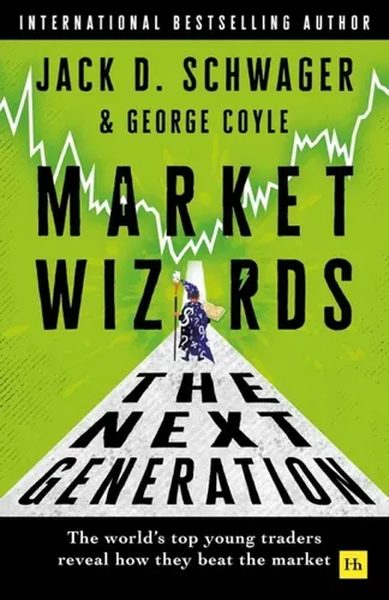
Jack Schwager has been running the same experiment since 1989. Find traders with records that cannot be explained by luck, interview them properly, and see whether anything they say overlaps.
The 2026 edition, written with George Coyle, runs that experiment on a generation that has never stood in a pit. If you are deciding which one to buy, the honest answer depends less on quality than on what you want out of it.
The short answer
If you have read neither, start with the original Market Wizards. We rate it 9.0/10. It is the foundation, the interviews are the most famous in trading literature, and several of them have become part of the vocabulary.
If you want traders whose conditions resemble yours, go to The Next Generation. We rate it 8.8/10. The gap in score is small and it is not a gap in usefulness.
What actually changed in thirty-seven years
The 1989 cohort traded in a world of pits, phone orders, physical order flow and information that took real time to travel. Their edges frequently came from being faster or better connected than the person on the other side. Several of them describe advantages that no longer exist in any form.
The 2026 cohort trades against algorithms. Their information is the same information everyone else has, arriving at the same moment. Whatever edge they have is not structural, because the structural edges have been arbitraged away.
That difference matters more than it first appears. When a 1980s trader describes a method, part of what you are hearing is a description of an environment that will never come back. When a 2026 trader describes a method, the environment is the one on your screen right now.
What refused to change
This is the reason both books exist, and it is the finding Schwager keeps arriving at.
Across both cohorts, separated by nearly four decades and by a complete rebuild of market infrastructure, the same handful of things keep appearing. Risk control ahead of everything else. A method that fits the person running it rather than one borrowed from someone else. Comfort with losing. A long unprofitable apprenticeship that almost nobody skips.
Two entirely different sets of traders, tested against two entirely different markets, converge on the same short list. That is about as close to evidence as trading gets.
Side by side
| Market Wizards | The Next Generation | |
|---|---|---|
| Published | 1989 | 2026 |
| Authors | Jack D. Schwager | Jack D. Schwager and George Coyle |
| Our rating | 9.0/10 | 8.8/10 |
| Market era | Pits, phones, slow information | Screens, algorithms, instant information |
| Relevance of methods | Historical in places | Directly comparable to now |
| Cultural weight | The reference point | Too new to tell |
| Read it | First, for the foundation | First, if you want traders like you |
The honest counterweight
Both books have the same structural flaw, and it is worth understanding before you treat either as a manual.
Schwager interviews winners. He does not interview the far larger group who applied similar methods, took similar risks and did not survive. That is survivorship bias, and it is unavoidable in a book of this design, but it means you cannot read either volume as proof that a method works. You are reading the traders the method happened to work for.
The correct way to read both is as a study of shared habits rather than a catalogue of strategies. The habits are the signal. The specific trades are stories. Taleb’s Fooled by Randomness is the natural antidote and reads well immediately after either volume.
The Next Generation carries one additional caveat. It is new enough that its reputation has not been tested. The 1989 book has had thirty-seven years for its lessons to be checked against reality. The 2026 book has had months.
What about the other Wizards books?
Schwager has written several. The New Market Wizards, Stock Market Wizards, Hedge Fund Market Wizards and Unknown Market Wizards each take the same format to a different population. Reviews of those are scheduled across late 2026 in the Trader’s Library.
If you want the shortest useful path: original, then Unknown Market Wizards for solo retail traders, then The Next Generation.
The second name on the cover
One difference the comparison tables tend to miss: the 2026 book is the first in the series Schwager did not write alone, and the co-author is not a ghostwriter.
George F. Coyle spent twenty-one years inside hedge funds, research firms and family offices as a chief investment officer, portfolio manager, systematic strategy designer, macro strategist and trader. He founded Triangulated Capital Management and Triangulated Research, holds a finance degree from Ohio State and a master’s in applied statistics from Columbia, and had already written Principles of Great Traders, a study of what elite traders have in common, before Schwager called.
The statistics background is the relevant part. The 1989 book asked readers to trust records in an era when faking one took effort. The 2026 book arrives in a market where a fabricated equity curve costs nothing to produce, and the verification work is visibly more careful because of it. If you are weighing the two on credibility rather than nostalgia, that is the argument for the newer one.
Publication details
| Market Wizards | The Next Generation | |
|---|---|---|
| First published | 1989, revised edition 2012 with added material | 9 June 2026 |
| Publisher | Wiley (revised edition) | Harriman House |
| Length | Seventeen interviews | 368 pages, paperback |
| Audiobook | Narrated by DJ Holte, re-recorded to replace the original | Narrated by Hopper Stone, includes a companion chart PDF |
| Where to buy | Amazon → | Amazon → · Kindle B0GQWW8GLG |
A practical note on format. The Next Generation puts its charts in a companion PDF for audiobook buyers rather than in the audio itself, so if you listen and never open the PDF you will miss them. The original has no such problem, because in 1989 the interviews carried almost everything.
Full reviews
- Market Wizards Book Review (2026) — the seventeen interviews and the patterns they share.
- Market Wizards: The Next Generation Book Review (2026) — the new cohort, what changed, and what did not.
- Explore all 80 books in the Trader’s Library
 The Complete Trader's Edge
The full Mind · Method · Money framework. 70 chapters.
View on Amazon →
The Complete Trader's Edge
The full Mind · Method · Money framework. 70 chapters.
View on Amazon →
 Market Mayhem
400 years of bubbles, crashes, and the pattern that keeps repeating.
Buy on Amazon →
Market Mayhem
400 years of bubbles, crashes, and the pattern that keeps repeating.
Buy on Amazon →
 Greatest Companies
How the world's greatest companies were built — and what traders learn from them.
View on Amazon →
Greatest Companies
How the world's greatest companies were built — and what traders learn from them.
View on Amazon →