

Risk of ruin is the probability that you will lose enough capital to stop trading. It is the single most important number in your trading career.
| Risk Per Trade | Consecutive Losses to -50% | Risk of Ruin (55% WR, 1:2 R:R) | Verdict |
|---|---|---|---|
| 0.5% | 139 | ~0% | Virtually indestructible |
| 1% | 69 | <0.1% | Professional standard |
| 2% | 35 | ~1% | Acceptable but aggressive |
| 5% | 14 | ~15% | Dangerous. One bad week can be fatal. |
| 10% | 7 | ~40%+ | Not trading. Gambling. |
Before you learn a single strategy, before you place a single trade, there is one mathematical concept that determines whether you survive long enough for anything else to matter: risk of ruin. It is the probability that a series of losing trades will draw your account down to a level where you either cannot trade or cannot recover.
Most retail traders never calculate their risk of ruin. They focus on win rate, risk-to-reward ratio, and monthly return targets. These metrics matter. But they are all downstream of one reality: if you blow up, nothing else matters. Risk of ruin is the guardrail that keeps you in the game.
The Mathematics of Survival
Related tool: the free Edge Companion app pairs with the math here — log your risk per trade in the journal and watch your discipline score move alongside your Edge Score.
Risk of ruin depends on three variables: your win rate, your average payoff ratio, and your risk per trade. The interaction between these three creates a probability of account destruction that is either negligibly small or terrifyingly large, with very little middle ground.
A trader with a 50% win rate and a 1:2 payoff ratio has a positive expectancy. But if they risk 10% per trade, their risk of ruin is approximately 100%. They will blow up. It is not a question of if, but when. The same trader risking 2% per trade has a risk of ruin near zero. Same edge. Same strategy. Radically different survival probability.
This is the critical insight: your edge does not matter if your position sizing destroys you before the edge has time to manifest over a large enough sample of trades.
The Risk of Ruin Formula
The simplified risk of ruin formula for a fixed-fraction betting system is:
Risk of Ruin = ((1 – Edge) / (1 + Edge)) ^ Capital Units
Where Edge = (Win Rate × Average Win) – (Loss Rate × Average Loss), and Capital Units = your account divided by your risk per trade. A trader with a 5% edge risking 2% per trade has 50 capital units. Their risk of ruin is approximately 0.007%, which is effectively zero.
The same trader risking 5% per trade has only 20 capital units. Their risk of ruin jumps to approximately 13%. At 10% risk per trade, with only 10 capital units, the risk of ruin exceeds 60%.
Why Losing Streaks Are Longer Than You Think
Human intuition is catastrophically bad at estimating the probability of extended losing streaks. A trader with a genuine 60% win rate will experience a run of 7 consecutive losses approximately once every 600 trades. That sounds rare until you realise that an active day trader takes 600 trades in a few months.
A 50% win rate trader will hit 10 consecutive losses roughly once every 1,000 trades. At two trades per day, that is less than two years of trading. The streak is not unusual. It is inevitable. The question is whether your account survives it.
At 2% risk per trade, 10 consecutive losses produce a 20% drawdown. Painful but survivable. At 5% risk, the same streak creates a 50% drawdown. You now need a 100% gain just to return to breakeven. At 10% risk, 10 losses leaves you with less than 35% of your original capital. Recovery is mathematically nearly impossible.
The Drawdown Recovery Table
This is the table every trader should memorise. A 10% drawdown requires an 11% gain to recover. A 20% drawdown requires a 25% gain. A 30% drawdown requires a 43% gain. A 40% drawdown requires a 67% gain. A 50% drawdown requires a 100% gain. A 60% drawdown requires a 150% gain. A 75% drawdown requires a 300% gain.
The relationship is not linear. It is exponential. Every additional percentage of drawdown makes recovery disproportionately harder. This is why professional risk management focuses on preventing deep drawdowns rather than maximising returns. The math demands it.
Professional Risk Per Trade Guidelines
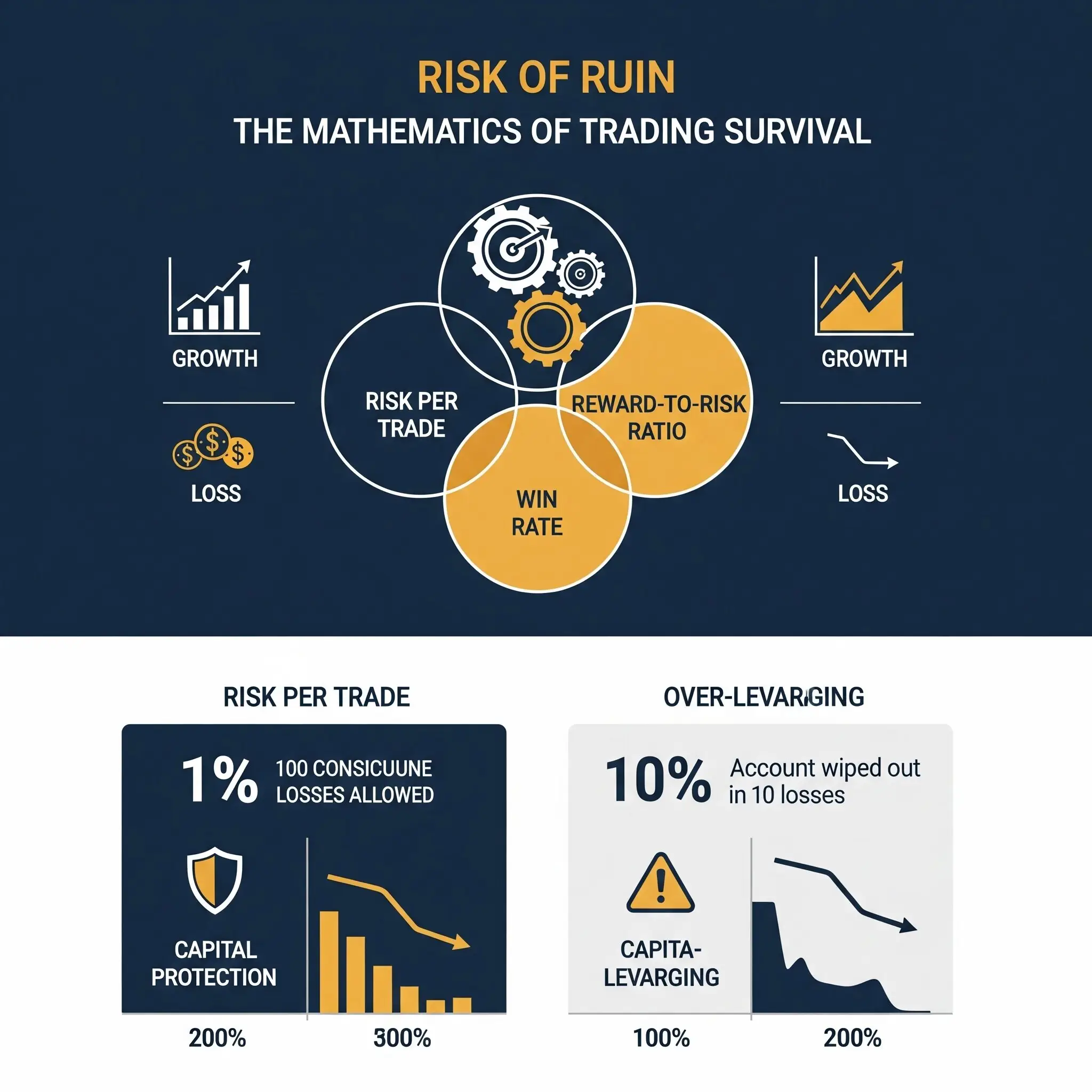
The professional standard is 1-2% of account equity per trade. This is not conservative. It is mathematically optimal for strategies with typical retail win rates of 40-60%. At 1% risk, a 20-trade losing streak, which is extremely unlikely for any decent strategy, only produces a 20% drawdown. At 2%, the same streak creates a 40% drawdown, which is severe but recoverable.
Prop firm traders should be even more conservative, typically 0.5-1%, because the maximum drawdown limits on funded accounts are usually 5-10%. At 0.5% risk per trade, you can survive a 10-trade losing streak while staying within a 5% drawdown limit.
How to Calculate Your Personal Risk of Ruin
You need your historical win rate from at least 100 trades, your average winner in R-multiples, your average loser, which should be close to 1R if you manage stops well, and your risk per trade as a percentage of equity. With these inputs, you can calculate your expectancy and then determine the number of capital units you are playing with. If your risk of ruin exceeds 1%, you are risking too much per trade. Reduce your size until the number approaches zero.
📚 Related Articles:
This article is adapted from The Complete Trader’s Edge
70 chapters covering Mind · Method · Money — the most comprehensive trading education framework available.
Frequently Asked Questions
What is risk of ruin in trading?
Risk of ruin is the mathematical probability that a trader will lose enough capital to be unable to continue trading. It is calculated based on three variables: your win rate, your average risk-to-reward ratio, and the percentage of capital risked per trade. At 1% risk per trade with a 55% win rate and 1:2 R:R, the risk of ruin is effectively zero. At 10% risk per trade with the same edge, it becomes alarmingly high.
How do I calculate my risk of ruin?
The simplified formula uses your win rate and risk-to-reward ratio to determine the probability of a losing streak long enough to deplete your account. Online risk-of-ruin calculators are freely available. Input your strategy’s backtested win rate, average R:R, risk per trade percentage, and the drawdown threshold you consider “ruin” (typically 50% or more). The output is the probability, from 0% to 100%, of reaching that threshold.
Why does risk per trade matter more than win rate?
Because position sizing determines how many consecutive losses you can survive. A 60% win rate at 10% risk per trade has a much higher risk of ruin than a 45% win rate at 0.5% risk per trade. The smaller risk per trade gives you enough “lives” to survive the inevitable losing streaks that every strategy produces. This is why 1% risk is the professional standard regardless of win rate.
What risk of ruin percentage is acceptable?
Professional traders aim for a risk of ruin below 1%, and ideally below 0.1%. Any risk of ruin above 5% means your sizing or edge is not sufficient for long-term survival. If your calculated risk of ruin is above 1%, reduce your risk per trade until it falls below that threshold. This is a non-negotiable mathematical requirement, not a preference.
Does risk of ruin change as my account grows?
If you maintain the same percentage risk per trade (1%), the risk of ruin remains constant regardless of account size. The dollar amount at risk increases, but the mathematical survival probability is identical. This is one of the key benefits of fixed percentage position sizing: it scales automatically while keeping the risk profile constant. If you switch from percentage-based to fixed-dollar sizing, your risk of ruin changes as your account fluctuates.
Continue Reading
From The Book
This article covers concepts from Chapter 58 of The Complete Trader’s Edge.
 The Complete Trader's Edge
The full Mind · Method · Money framework. 70 chapters.
View on Amazon →
The Complete Trader's Edge
The full Mind · Method · Money framework. 70 chapters.
View on Amazon →
 Market Mayhem
400 years of bubbles, crashes, and the pattern that keeps repeating.
Buy on Amazon →
Market Mayhem
400 years of bubbles, crashes, and the pattern that keeps repeating.
Buy on Amazon →
 Greatest Companies
How the world's greatest companies were built — and what traders learn from them.
View on Amazon →
Greatest Companies
How the world's greatest companies were built — and what traders learn from them.
View on Amazon →
 Greatest Traders
Eighty-six lives that explain the markets — Livermore to Madoff, told with the losses left in.
View on Amazon →
Greatest Traders
Eighty-six lives that explain the markets — Livermore to Madoff, told with the losses left in.
View on Amazon →