

Jim Simons built Renaissance Technologies into the most profitable trading operation in history. His Medallion Fund returned an average of 66% per year before fees for over three decades. He did it not with charts or fundamental analysis, but with mathematics, data science, and an absolute refusal to let human intuition interfere with quantitative signals.
To put that performance in perspective: a dollar invested in the Medallion Fund in 1988 would have grown to over $40,000 by 2020, even after the fund’s steep 5-and-44 fee structure. Warren Buffett’s Berkshire Hathaway, widely considered the greatest long-term investment vehicle ever created, would have turned that same dollar into roughly $150. Simons didn’t just beat the market. He broke the scale by which market performance is measured.
And he did it all without reading a single earnings report.
From Code Breaker to Market Breaker
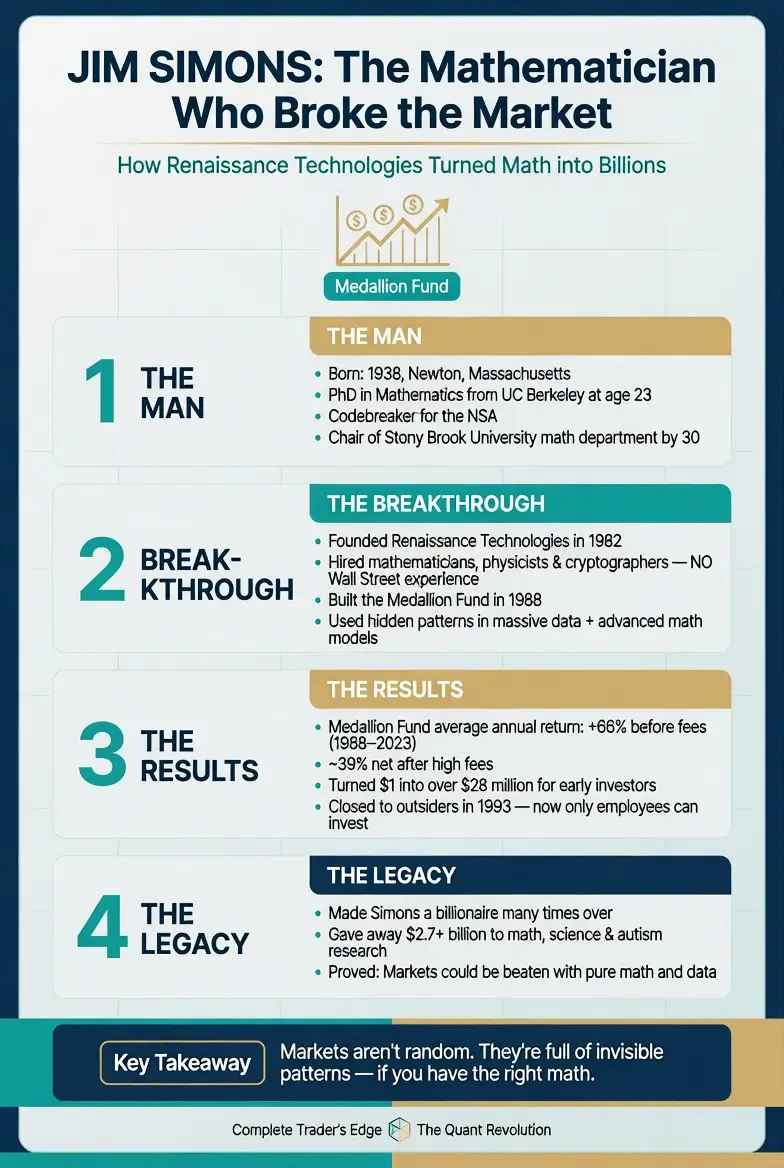
Before Simons ever touched a financial market, he was already one of the most accomplished mathematicians of his generation. He earned his PhD from Berkeley at 23, worked as a Cold War codebreaker at the Institute for Defence Analyses, and later chaired the mathematics department at Stony Brook University. His work in differential geometry with Shiing-Shen Chern produced the Chern-Simons theory, a foundational contribution to theoretical physics that is still used in string theory today.
| Principle | What It Means | Trading Application |
|---|---|---|
| Quantitative edge | Statistical patterns in data provide repeatable edges | Backtest across large sample sizes (100+ trades). Trust the data, not the feeling. |
| Remove human emotion | Medallion Fund is fully systematic with no discretionary overrides | Automate what you can: alerts, stops, position sizing. Reduce the number of decisions made under pressure. |
| High frequency of small edges | Thousands of small-advantage trades compound into massive returns | Consistent 1R winners at 55% win rate compound dramatically over 200+ trades per year. |
| Secrecy and intellectual humility | Never reveal your edge. Never assume you are smarter than the market. | Protect your process. Stay humble. The market can invalidate any thesis at any time. |
Simons didn’t drift into finance because mathematics bored him. He saw markets as the ultimate unsolved pattern recognition problem — billions of data points, hidden relationships, and inefficiencies that human traders would never spot but computers could. In 1982, he founded Renaissance Technologies in a modest office on Long Island, staffing it not with traders or MBAs, but with mathematicians, physicists, and computer scientists.
The hiring philosophy was deliberate and radical: Simons wanted people who had never traded a stock in their lives. Experience on Wall Street was a disqualifier, not a credential. He believed that conventional financial training introduced biases — narrative thinking, emotional attachment to positions, the illusion of understanding cause and effect — that would contaminate the purity of data-driven decision making.
The Medallion Fund: Numbers That Shouldn’t Exist
The Medallion Fund, launched in 1988, became the vehicle for Simons’s vision. Its performance over the following decades remains, statistically speaking, almost impossible.
Average annual returns of approximately 66% before fees and 39% after fees. Only one losing year in over three decades (and that was a marginal loss in 1989, early in the fund’s life). Maximum drawdown that never threatened the fund’s survival. By the early 2000s, the fund had been closed to outside investors entirely — the returns were so extraordinary that Simons returned all external capital and ran the fund exclusively with employee money.
How did he do it? The short answer is that nobody outside Renaissance knows for certain. The firm’s secrecy is legendary. Employees sign ironclad non-disclosure agreements. Papers are not published. The algorithms are not shared. What is known comes from interviews, SEC filings, and Gregory Zuckerman’s detailed account in The Man Who Solved the Market.
The Method: Statistical Arbitrage at Scale
Renaissance’s approach is fundamentally different from anything a discretionary trader does. The firm collects enormous quantities of data — not just price and volume, but weather patterns, satellite imagery, news sentiment, macroeconomic releases, even the linguistic patterns in central bank communications. Thousands of data streams feed into models that detect statistical anomalies: small, repeatable, non-random patterns in how assets behave.
Each individual pattern might have an edge of fractions of a percent. But Renaissance trades thousands of these patterns simultaneously, across thousands of instruments, executing hundreds of thousands of trades per day. The law of large numbers transforms a tiny statistical edge into massive, consistent returns. It is the casino model applied to markets with mathematical rigour that makes Las Vegas look amateurish.
The signals are not based on stories about what a company is worth or where the economy is headed. They are based on the statistical behaviour of prices. If pattern X has occurred 10,000 times in the historical data and has been followed by outcome Y 53% of the time with a specific payoff distribution, the model trades it. Not because it understands why the pattern exists, but because the probability is positive and the sample size is large enough to be reliable.
This is the key philosophical insight: you do not need to understand why a pattern works to profit from it. You need to know that it works, how reliably it works, and how to size your position correctly given the uncertainty involved.
What Discretionary Traders Can Learn from Simons
Most readers of this article are not going to build a quantitative hedge fund. You do not have PhD-level mathematicians, proprietary data feeds, or the infrastructure to execute 100,000 trades per day. But the principles underlying Simons’s success translate directly to discretionary trading in ways that most traders ignore.
Think in Probabilities, Not Predictions
Simons never tried to predict what the market would do. He calculated what the market was likely to do based on historical patterns, and he sized his bets accordingly. Every discretionary trader should adopt this exact framework. Your job is not to be right about the next trade. Your job is to execute a positive-expectancy process across hundreds of trades and let the mathematics do the compounding.
This is the Probability Mindset we teach throughout this framework — and Simons is its ultimate practitioner.
Remove Human Emotion from Execution
Renaissance’s models execute without hesitation, without fear, without greed. When a signal fires, the trade happens. When the signal says exit, the position closes. There is no “let me wait and see” or “I feel like this one will keep running.” The system operates on rules, not feelings.
For discretionary traders, this means building rules that are clear enough to follow even when your emotions scream otherwise. Your trading plan is your algorithm. Your routine is your execution engine. The moment you override your rules because of a feeling, you have abandoned the edge.
Edge Comes from Process, Not Insight
Simons was not smarter about markets than George Soros or Paul Tudor Jones. He was smarter about process. His edge was systematic: data collection, pattern recognition, execution discipline, and portfolio-level risk management. The individual trade was irrelevant. The aggregate of thousands of trades was everything.
The parallel for discretionary traders: stop searching for the one setup that will make you rich. Build a process that makes money across hundreds of setups. Track your data. Journal your trades. Identify what actually works in your trading, not what feels like it works. Your trading journal is the closest thing a discretionary trader has to a quantitative research department.
Position Sizing Is the Real Edge
Renaissance allocates capital based on the statistical properties of each signal: its win rate, its payoff distribution, its correlation with other positions in the portfolio, and the current volatility regime. No signal gets an oversized allocation just because it “looks good.” This is position sizing elevated to a science.
For your own trading, this means that how much you risk per trade matters more than your entry signal. A mediocre setup with perfect sizing will outperform a brilliant setup with reckless sizing every single time over a large sample.
The Simons Paradox: Why You Can’t Copy Him (and Don’t Need To)
Here is the paradox of studying Jim Simons: his specific methodology is impossible to replicate, but his principles are universally applicable. You cannot build Renaissance’s infrastructure. But you can think probabilistically. You can remove emotion from execution. You can let data guide your decisions. You can size positions based on mathematics rather than intuition.
Simons himself acknowledged this tension. In a rare interview, he noted that the most important quality for a trader was not intelligence but discipline — the ability to follow a system without interference. He built an organisation designed to eliminate the human tendency to override good process with bad intuition.
Simons and the Mind · Method · Money Framework
Mind: Simons demonstrated the ultimate trader’s mindset — detachment from individual outcomes, commitment to process over prediction, and the humility to acknowledge that understanding why a pattern works is less important than knowing that it works.
Method: His method was the systematic exploitation of small, repeatable statistical edges across massive sample sizes. The discretionary equivalent is building a clearly defined setup with positive expectancy and trading it hundreds of times without deviation.
Money: Renaissance’s risk management was arguably its greatest competitive advantage. Position sizing, portfolio-level correlation management, and drawdown protocols ensured that no single trade or cluster of trades could threaten the operation. This is portfolio-level risk management at its finest.
Jim Simons’s Legacy
Simons passed away in May 2024 at the age of 86. His legacy extends far beyond trading. Through the Simons Foundation, he donated billions to mathematics, physics, autism research, and education. He proved that markets could be approached as a scientific problem rather than an art form — and that the scientific approach, executed with rigour and discipline, could produce the greatest track record in financial history.
For traders at every level, the lesson is clear: respect the data, trust the process, size the risk, and never let your feelings override your system. Jim Simons did not predict markets. He measured them, bet on the probabilities, and compounded the results into something extraordinary.
That is an edge you can build too — one trade at a time.
Key Takeaways from Jim Simons
📊 You do not need to understand why a pattern works — you need to know that it works and how reliably.
🧠 Emotion is the enemy of systematic execution. Build rules clear enough to follow when feelings disagree.
📐 Position sizing and risk management are the true competitive advantages, not entry signals.
🔁 Think in samples of hundreds of trades, not individual outcomes. The edge lives in the aggregate.
Explore the Full Legendary Traders Series
Learn from history’s greatest market minds.
George Soros ·
Paul Tudor Jones ·
Jesse Livermore ·
Druckenmiller ·
Ed Seykota
Renaissance never explained itself, so Gregory Zuckerman did the reporting instead. It is the fullest public account of how Medallion was built, and it is honest about how much remains unknown.

Rated in the Trader’s Library.
 The Complete Trader's Edge
The full Mind · Method · Money framework. 70 chapters.
View on Amazon →
The Complete Trader's Edge
The full Mind · Method · Money framework. 70 chapters.
View on Amazon →
 Market Mayhem
400 years of bubbles, crashes, and the pattern that keeps repeating.
Buy on Amazon →
Market Mayhem
400 years of bubbles, crashes, and the pattern that keeps repeating.
Buy on Amazon →
 Greatest Companies
How the world's greatest companies were built — and what traders learn from them.
View on Amazon →
Greatest Companies
How the world's greatest companies were built — and what traders learn from them.
View on Amazon →
 Greatest Traders
Eighty-six lives that explain the markets — Livermore to Madoff, told with the losses left in.
View on Amazon →
Greatest Traders
Eighty-six lives that explain the markets — Livermore to Madoff, told with the losses left in.
View on Amazon →