

Ray Dalio built Bridgewater Associates into the largest hedge fund in the world, managing over $150 billion at its peak. He did it by treating investing as an engineering problem: build a machine, test it against reality, fix what breaks, and repeat. His framework for understanding how economies and markets work has influenced a generation of institutional investors. His book Principles codified his approach to life, work, and markets into a system that reads more like an operating manual than a memoir.
What makes Dalio uniquely valuable for developing traders is not his specific trades — though they are instructive — but his relentless commitment to building systems that work regardless of who operates them, and his framework for understanding the large-scale forces that drive all markets.
From a Garage to $150 Billion
Dalio started investing at twelve, buying shares of Northeast Airlines for $300. He studied finance at Long Island University and earned an MBA from Harvard Business School. In 1975, he founded Bridgewater Associates in his two-bedroom apartment.
The early years were humbling. In 1982, Dalio made a highly public prediction that the American economy was heading for a depression. He was wrong. The economy boomed. The experience nearly destroyed his fund and his reputation. But Dalio has described this failure as the single most important event in his career — because it taught him that no matter how confident he felt, he could always be wrong. And if he could always be wrong, he needed systems designed to account for that possibility.
This insight — that humility is not a personality trait but an engineering requirement — became the foundation of everything Bridgewater built afterward.
The Principles: Radical Truth and Radical Transparency
Dalio’s management philosophy at Bridgewater became famous (and controversial) for its emphasis on what he calls radical truth and radical transparency. Every meeting is recorded. Employees rate each other in real time. Disagreements are encouraged and documented. The goal is to create an environment where the best ideas win, regardless of who proposes them — and where mistakes are treated as learning opportunities rather than failures.
For traders, this philosophy translates directly into how you should treat your own performance data. Your trading journal should be your personal radical transparency system: an honest, unflinching record of every trade, every decision, every emotion, and every outcome. If you are not willing to confront the truth about your own trading, you cannot improve it. Dalio would say you are choosing to be blind — and markets punish blindness.
The Economic Machine: How Dalio Sees the World
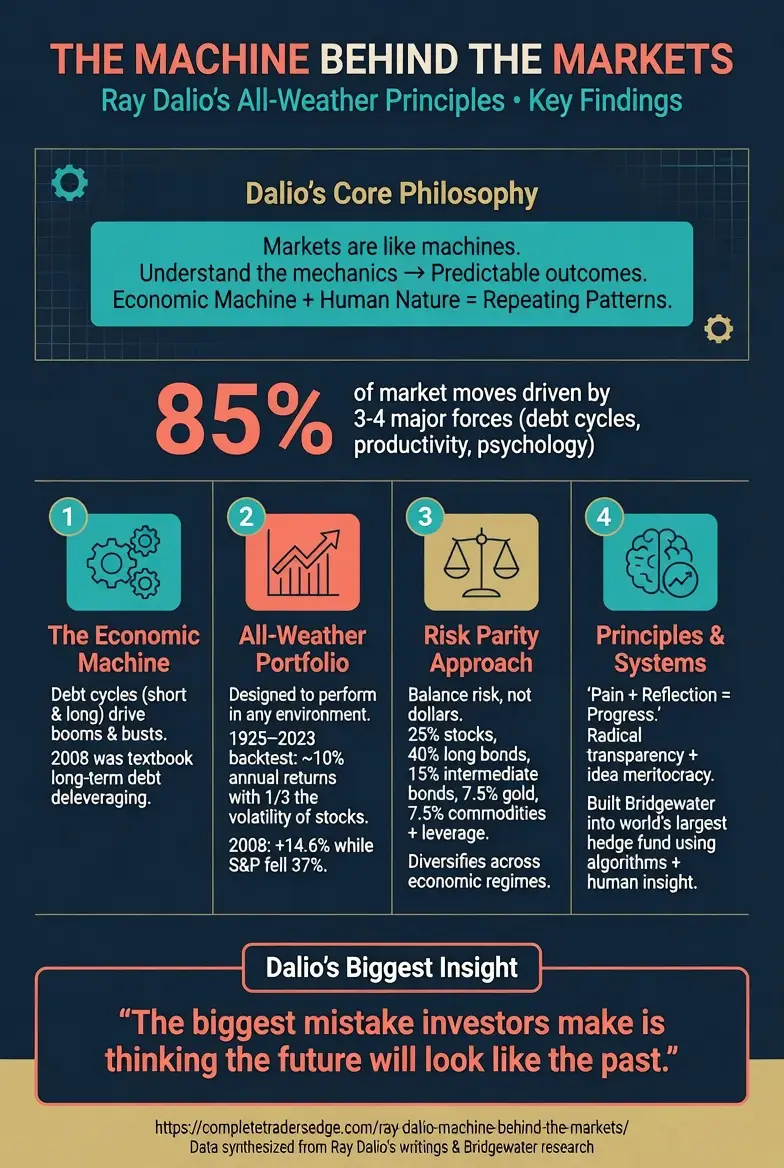
Dalio’s most valuable intellectual contribution to market education is his framework for understanding how economies work. He describes the economy as a machine driven by three forces: productivity growth (the long-term trend), the short-term debt cycle (5-8 years), and the long-term debt cycle (75-100 years).
| Principle | What It Means | Trading Application |
|---|---|---|
| Radical transparency | Record and examine every decision for learning | Journal every trade with full pre/post analysis. Do not hide from your mistakes. |
| Principles-based decisions | Codify rules for every recurring situation | A written trading plan with rules for every scenario eliminates emotion at the moment of decision. |
| Diversification (Holy Grail) | 15+ uncorrelated return streams smooth the equity curve | Even 2-3 uncorrelated setups across different instruments reduce portfolio variance significantly. |
| Pain + Reflection = Progress | Losses are data, not failures. Study them systematically. | Weekly reviews that examine losing trades for patterns are the highest-leverage improvement activity. |
| Bridgewater machine | Build systems that operate independently of any individual | Your trading system should produce results whether you feel great or terrible. The system trades, not your mood. |
Most market participants focus on short-term noise — this quarter’s earnings, next month’s jobs report, today’s price action. Dalio zooms out to the structural forces that drive decades of market behaviour. He asks questions like: Where are we in the debt cycle? Is credit expanding or contracting? Are central banks tightening or easing? What happens when interest rates reach zero?
This macro perspective does not tell you where to place your stop loss on a 15-minute chart. But it tells you something equally important: what environment you are trading in, and whether the conditions favour risk-on or risk-off positioning. Understanding this context — the difference between trading in a credit expansion and a credit contraction — is the foundation of economic calendar awareness at the deepest level.
All Weather: The Portfolio That Survives Everything
Dalio’s most famous contribution to portfolio theory is the All Weather portfolio — a risk-parity approach designed to perform reasonably well in any economic environment. The insight is that most portfolios are heavily concentrated in one economic regime (usually growth + moderate inflation) and get devastated when conditions change.
The All Weather portfolio allocates risk equally across four economic scenarios: rising growth, falling growth, rising inflation, and falling inflation. In practice, this means holding assets that perform differently in each environment — stocks, long-term bonds, intermediate bonds, gold, and commodities — in proportions weighted by volatility rather than dollar amount.
The principle for active traders is not to copy this allocation but to understand the thinking behind it: you should never be 100% reliant on a single market condition for your profitability. If your strategy only works in trending markets, you are vulnerable to every ranging period. If you only trade one asset class, you are exposed to regime changes that a diversified approach would survive. This is portfolio-level risk thinking applied to active trading.
Dalio’s Trading Lessons for Active Traders
Systematise Everything
Dalio does not make decisions on intuition. He builds decision rules, tests them against data, and follows them. At Bridgewater, this means hundreds of algorithmic models running simultaneously. For a discretionary trader, it means writing down your trading rules clearly enough that someone else could execute them. If your strategy exists only in your head, it is not a strategy — it is a feeling. And feelings do not survive drawdowns.
Build your trading plan the way Dalio builds his algorithms: precise, testable, and followed without deviation once the rules are set.
Pain + Reflection = Progress
This is perhaps Dalio’s most quoted principle, and it applies to trading with surgical precision. Every loss, every drawdown, every emotional decision is a data point. The traders who improve fastest are the ones who reflect on their pain honestly — not to punish themselves, but to extract the lesson and adjust the system.
Dalio’s 1982 depression call was painful. But the reflection it produced — the humility to know he could be wrong, the drive to stress-test every assumption — created the framework that turned Bridgewater into a $150 billion machine. Your trading losses can produce the same transformation if you are willing to sit with the discomfort and ask what really went wrong.
Diversify Across Uncorrelated Return Streams
Dalio calls diversification the holy grail of investing. But he does not mean owning fifteen different stocks. He means combining return streams that are genuinely uncorrelated — strategies and assets that perform differently in different environments. Even a modest improvement in the correlation profile of your portfolio can dramatically improve your risk-adjusted returns and reduce your maximum drawdown.
For active traders, this could mean trading multiple setups (a trend-following strategy alongside a mean-reversion strategy), multiple timeframes, or multiple asset classes. The goal is to ensure that when one approach is bleeding, another is earning — reducing the psychological pressure and the financial risk of any single strategy going through a rough patch.
Understand the Macro Environment
You do not need to be a macro trader to benefit from macro awareness. Knowing whether central banks are tightening or easing, whether the dollar is strengthening or weakening, whether risk appetite is expanding or contracting — this context shapes everything on your intraday charts. The killzones are more volatile around FOMC days. Gold moves differently when real rates are rising. Bitcoin correlates more tightly with equities during liquidity contractions.
Dalio’s framework does not give you entries. It gives you context — and context determines whether your technical setups have the wind at their back or in their face.
Dalio and the Mind · Method · Money Framework
Mind: Dalio’s core psychological principle — radical honesty about your own mistakes — is the foundation of trader development. His formula (Pain + Reflection = Progress) maps directly onto the psychology of drawdown management and the willingness to journal honestly rather than selectively.
Method: The systematic approach to everything. Write down your rules. Test them. Follow them. When they fail, identify why and improve the system. Do not override the system with gut feelings. This is strategy building as an engineering discipline.
Money: The All Weather approach and the diversification principle both point to the same truth: risk management is not about avoiding risk but about understanding and distributing it. Portfolio-level thinking — how your trades interact with each other, not just how each trade performs individually — is the mark of professional-grade capital management.
Ray Dalio’s Legacy
Dalio stepped back from day-to-day management of Bridgewater in recent years, but his influence on how institutional investors think about markets, risk, and portfolio construction is permanent. His YouTube video “How the Economic Machine Works” has been viewed over 35 million times and remains one of the best 30-minute economics lessons ever produced.
For traders at every level, Dalio’s message is consistent: be radically honest with yourself, systematise your approach, diversify your risk, and treat every mistake as a gift that shows you where to improve. Markets reward those who build machines that work. They punish those who rely on hope, intuition, and unexamined assumptions.
Build the machine. Fix what breaks. Repeat.
Key Takeaways from Ray Dalio
⚙️ Systematise everything. If your strategy can’t be written down and followed by someone else, it’s a feeling, not a system.
🪞 Pain + Reflection = Progress. Your losses are data. Mine them for lessons instead of burying them.
🌐 Understand the macro environment. Your technical setups perform differently depending on the economic regime.
📊 Diversify risk across uncorrelated return streams. Never be 100% dependent on a single market condition for your edge.
Explore the Full Legendary Traders Series
Learn from history’s greatest market minds.
George Soros ·
Paul Tudor Jones ·
Druckenmiller ·
Ed Seykota ·
John Paulson
Dalio codified the whole system in Principles, including the 1982 call that nearly ended his career. It is a decision-making manual rather than a trading book, and about a third of it is organisational management a solo trader can skip.
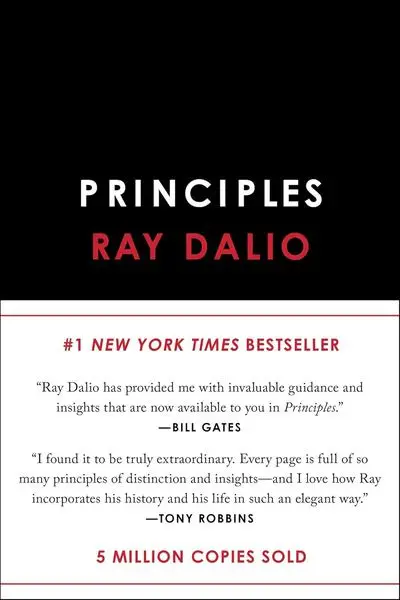
Read our breakdown of what in Principles actually transfers to a trading account, plus which of Dalio’s six books are worth owning.
 The Complete Trader's Edge
The full Mind · Method · Money framework. 70 chapters.
View on Amazon →
The Complete Trader's Edge
The full Mind · Method · Money framework. 70 chapters.
View on Amazon →
 Market Mayhem
400 years of bubbles, crashes, and the pattern that keeps repeating.
Buy on Amazon →
Market Mayhem
400 years of bubbles, crashes, and the pattern that keeps repeating.
Buy on Amazon →
 Greatest Companies
How the world's greatest companies were built — and what traders learn from them.
View on Amazon →
Greatest Companies
How the world's greatest companies were built — and what traders learn from them.
View on Amazon →
 Greatest Traders
Eighty-six lives that explain the markets — Livermore to Madoff, told with the losses left in.
View on Amazon →
Greatest Traders
Eighty-six lives that explain the markets — Livermore to Madoff, told with the losses left in.
View on Amazon →