

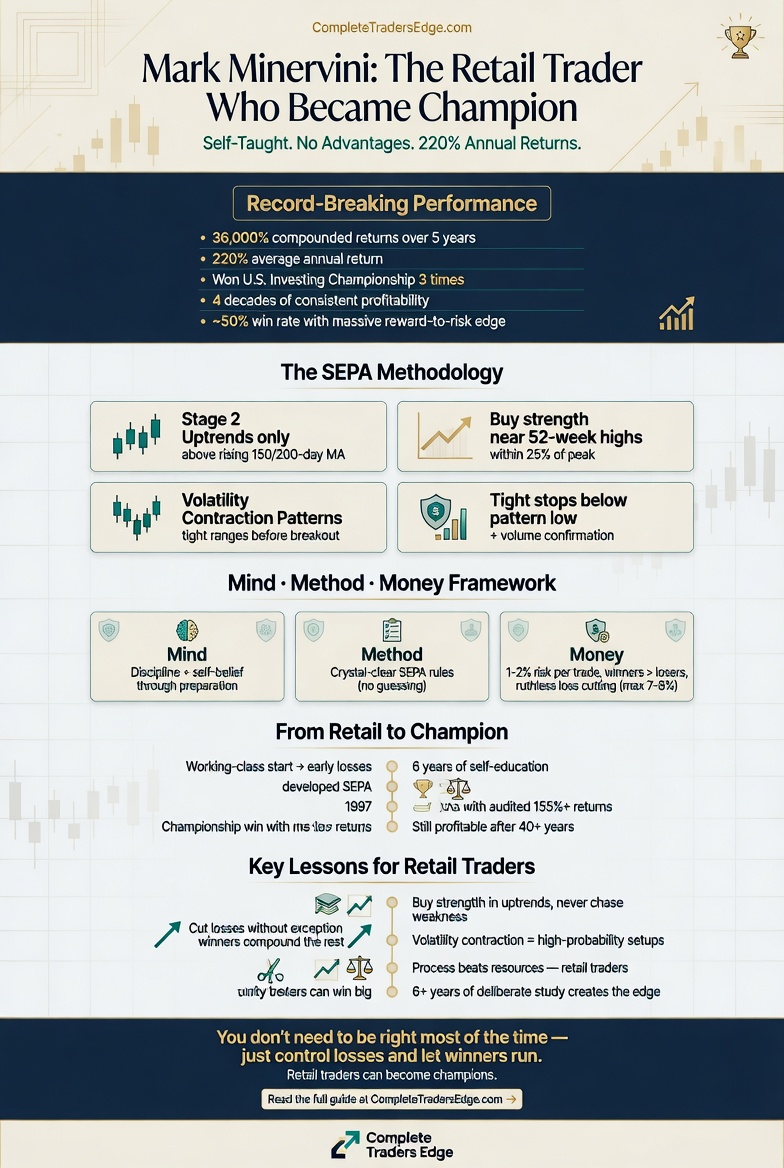
Mark Minervini is the most successful retail-origin trader of the modern era. He started with almost nothing — no Wall Street connections, no Ivy League degree, no family money. What he built through relentless self-education and systematic skill development is a track record that puts most hedge fund managers to shame: a verified 220% annual return in his U.S. Investing Championship year, compounded returns of 36,000% over a five-year stretch, and consistent profitability spanning four decades.
His story matters more to developing traders than almost any other legendary figure in this series, because Minervini did not have the advantages that Simons, Dalio, or Soros had. He was you. He started exactly where most readers of this article are starting — with a screen, a small account, and a burning desire to figure out how markets work.
From Nothing to Champion
Minervini grew up in a working-class family and dropped out of school early. He had no formal financial education. His introduction to the stock market came in the mid-1980s, and like most beginners, his early years were marked by losses, frustration, and the slow realisation that enthusiasm alone was not enough.
| Principle | What It Means | Trading Application |
|---|---|---|
| SEPA methodology | Specific Entry Point Analysis: buy strength, not weakness | Enter on breakouts from consolidation at key levels, not on pullbacks into falling knives. |
| Stage analysis | Only trade stocks in Stage 2 uptrends | Only take long setups when the daily and weekly structure is bullish. No counter-trend longs. |
| Tight risk control | Average loss must be smaller than average win | Never let a trade exceed 1R loss. Cut early if the setup is not working quickly. |
| Champion mindset | Won the US Investing Championship 3 times as a retail trader | Retail traders can compete with institutions. The edge is discipline, not resources. |
| Volatility contraction | Buy when price tightens (low vol) before expanding | Inside bars, narrowing Bollinger Bands, and pennants signal accumulation before moves. |
What separated Minervini from the majority of traders who wash out was his response to failure. Instead of blaming the market, switching strategies, or giving up, he treated his early losses as tuition. He studied obsessively. He read every book on trading and investing he could find. He analysed hundreds of historical stock charts, looking for the common characteristics of the biggest winning stocks before they made their major moves.
Over six years of grinding study and small-account trading, he developed what he now calls the SEPA methodology — Specific Entry Point Analysis. This systematic approach to finding, timing, and managing growth stock trades became the foundation of a career that would eventually see him win the U.S. Investing Championship and earn recognition as one of the top stock traders alive.
SEPA: The Specific Entry Point Analysis Methodology
Minervini’s SEPA methodology is a trend-following system for growth stocks built on a precise set of criteria. Unlike many trend-following approaches that are vague about entries, SEPA defines exactly when to buy, where to place the stop, and how to manage the trade as it develops.
The methodology is built on what Minervini calls the Trend Template — a set of moving average and price criteria that a stock must meet before it qualifies for consideration. The stock must be above its 200-day and 150-day moving averages. The 200-day average must be trending upward. The current price must be within 25% of the 52-week high and at least 25% above the 52-week low. And the relative strength rating must be above 70.
These criteria serve as a filter that eliminates the vast majority of stocks from consideration. Minervini is not interested in catching bottoms or buying cheap stocks that might recover. He wants stocks that are already in confirmed uptrends, showing institutional accumulation, and approaching a specific technical pattern that offers a low-risk entry point.
The entry itself typically occurs at a volatility contraction pattern — a tightening of the price range that occurs after a stock has been trending higher and then consolidates. This contraction represents a pause in the trend where supply and demand reach a temporary equilibrium. When the stock breaks out of this tight range on increasing volume, it often begins the next leg of its advance.
The stop loss is placed just below the low of the contraction pattern — which, because the range has tightened, means the risk is mathematically small relative to the potential reward. This is where Minervini’s approach becomes most relevant to our framework: the entry is designed to minimise the distance to the stop, which means position sizing can be optimised for the tightest possible risk.
The 220% Year: U.S. Investing Championship
In 1997, Minervini entered the U.S. Investing Championship and delivered a verified return of 155%. He won again with even more spectacular returns in subsequent competitions. His overall five-year compounded return of 36,000% (averaging roughly 220% annually) was audited and verified — making it one of the most impressive documented retail trading records in history.
The numbers are extraordinary, but the consistency behind them is what matters more. Minervini did not achieve these returns through a handful of lucky bets. He achieved them through hundreds of carefully selected, properly sized, systematically managed trades. His win rate hovers around 50%, which means he is wrong roughly half the time. His edge comes entirely from the risk-to-reward ratio: his winners are significantly larger than his losers because he cuts losses fast and lets winners develop.
This is the single most important lesson from Minervini’s career: you do not need to be right most of the time to generate exceptional returns. You need to control your losses and give your winners room to compound.
What Active Traders Can Learn from Minervini
Cut Losses Ruthlessly and Without Exception
Minervini’s maximum loss on any single trade is typically 7-8% of the stock’s price, and he often exits much sooner if the trade is not behaving as expected. This is not a guideline — it is an inviolable rule. He has described a loss limit as the single most important rule in his system, more important than any entry criteria.
The mathematics support this obsession. A 10% loss requires an 11% gain to recover. A 20% loss requires a 25% gain. A 50% loss requires a 100% gain — a doubling of your capital just to get back to even. By keeping losses small, Minervini ensures that recovery is always achievable and that drawdowns remain manageable. This is stop loss discipline at its most fundamental.
Buy Strength, Not Weakness
Most retail traders instinctively look for bargains — stocks that have fallen sharply and “should” bounce. Minervini does the opposite. He exclusively buys stocks that are already in strong uptrends, already showing institutional buying, and already near their 52-week highs. This feels counterintuitive to beginners, but the data is clear: the biggest winning stocks in history were already trending strongly before they made their largest moves.
This is trend following in its purest form. You are not predicting reversals. You are joining momentum that is already established and positioning yourself for the continuation.
Volatility Contraction Equals Opportunity
Minervini’s entry patterns almost always involve a contraction of volatility — a tightening of the daily range after a period of trending. This concept applies across all markets and timeframes. When volatility contracts after a directional move, it signals that the battle between buyers and sellers has temporarily paused. A breakout from this compression often launches the next leg.
For forex and crypto traders using our framework, this maps directly to concepts like consolidation before expansion, ranging before fair value gap creation, and the “spring” phase in Wyckoff analysis.
The Power of Compounding Small Edges
Minervini’s annual returns did not come from one massive bet. They came from dozens or hundreds of trades per year, each with a small but positive expectancy, compounded over time. A 50% win rate with an average win twice the size of the average loss produces substantial returns when executed consistently across a large sample.
This is the probability mindset in action. You are not trying to hit home runs. You are trying to execute a reliable process hundreds of times and let the math work in your favour.
Self-Education Is a Legitimate Path
Minervini is proof that you do not need a finance degree, a Bloomberg terminal, or a mentor at Goldman Sachs to become an exceptional trader. He built his entire methodology through self-study: reading books, studying historical charts, journaling his trades, and iterating on what worked. He invested thousands of hours before he became consistently profitable.
The path is available to everyone. But the commitment is not optional. Minervini estimates that it took him approximately six years of serious study before he found his edge. He does not sugarcoat this. Trading mastery requires the same dedication that mastering any other profession demands.
Minervini and the Mind · Method · Money Framework
Mind: Minervini’s psychology is built on two pillars: discipline and self-belief. The discipline to follow his system without deviation — particularly the loss-cutting rules — is what keeps drawdowns manageable. The self-belief, earned through years of dedicated study, gives him the confidence to execute even during losing streaks. He teaches that confidence in trading should come from preparation, not from recent results.
Method: SEPA is a complete trading system: defined entry criteria (Trend Template + volatility contraction pattern), defined risk (stop below the pattern low), and defined trade management (sell rules based on price behaviour and volume). Its clarity is its strength. There is no ambiguity in whether a stock meets the criteria or not. This is exactly how every trader should build their strategy — specific enough to be followed without interpretation.
Money: Position sizing based on the distance to the stop, maximum risk per trade of 1-2% of equity, and a maximum portfolio heat that limits total concurrent exposure. Minervini’s capital management is textbook professional. He compounds gains by increasing position sizes as equity grows and reduces size during drawdowns — the opposite of what most retail traders do. This is position sizing mastery in practice.
The Relatable Legend
Every other trader in this series had some extraordinary advantage. Simons had PhD-level mathematics. Soros had the Quantum Fund’s billions. Burry had the structural insight of a trained physician reading mortgage documents. Dalio had Harvard Business School and institutional backing.
Minervini had a screen and a stack of books.
That is why his story resonates so powerfully with developing traders. He proves that the retail trader’s path is viable — that you can build genuine mastery through self-education, disciplined practice, and relentless commitment to improving your process. The tools are available. The information is accessible. What separates those who make it from those who do not is the willingness to put in the years of work and the discipline to follow the rules once you have them.
Minervini’s championship returns are impressive. But his real legacy is the message: you can do this, if you are willing to do the work.
Key Takeaways from Mark Minervini
✂️ Cut losses ruthlessly. A 7-8% maximum loss per trade keeps drawdowns survivable and recovery achievable.
📈 Buy strength, not weakness. The biggest winners are already trending before they make their largest moves.
🎯 Volatility contraction equals opportunity. Tight ranges after trends signal the next expansion.
🔁 Compound small edges. A 50% win rate with 2:1 reward-to-risk produces exceptional returns over hundreds of trades.
📚 Self-education works. You don’t need a finance degree — you need thousands of hours of dedicated study and practice.
Explore the Full Legendary Traders Series
Learn from history’s greatest market minds.
George Soros ·
Jesse Livermore ·
Druckenmiller ·
Paul Tudor Jones ·
Ed Seykota
Minervini put the SEPA method into print, and unlike most champion traders he shows the losing trades as well as the winners.
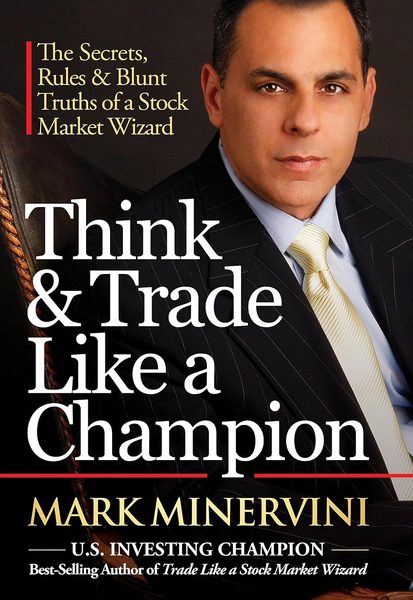
This is the earlier book and the one that lays out SEPA and the Trend Template properly. Think and Trade Like a Champion is the follow-up and assumes you already have the method.
Rated in the Trader’s Library.
 The Complete Trader's Edge
The full Mind · Method · Money framework. 70 chapters.
View on Amazon →
The Complete Trader's Edge
The full Mind · Method · Money framework. 70 chapters.
View on Amazon →
 Market Mayhem
400 years of bubbles, crashes, and the pattern that keeps repeating.
Buy on Amazon →
Market Mayhem
400 years of bubbles, crashes, and the pattern that keeps repeating.
Buy on Amazon →
 Greatest Companies
How the world's greatest companies were built — and what traders learn from them.
View on Amazon →
Greatest Companies
How the world's greatest companies were built — and what traders learn from them.
View on Amazon →