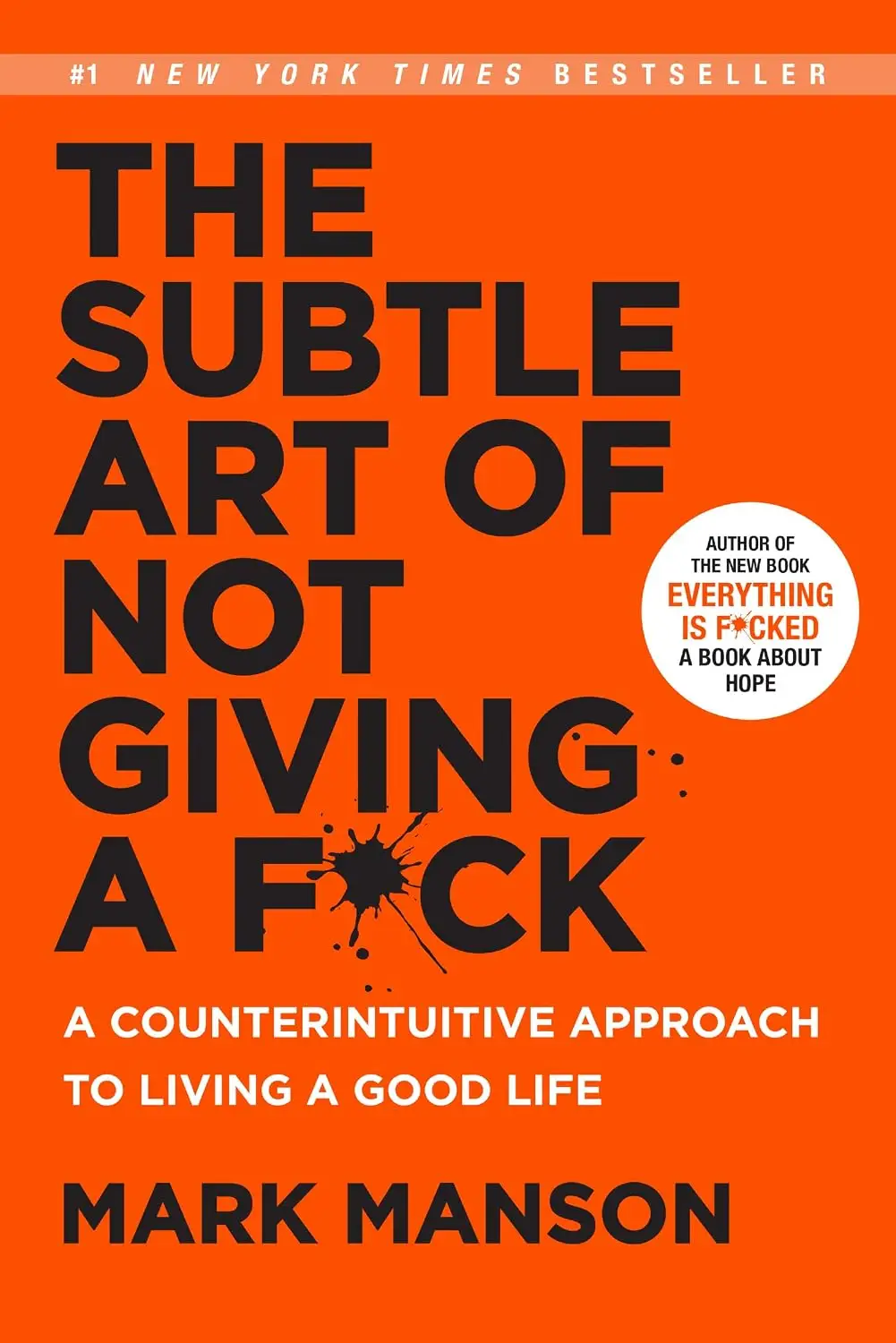
Mark Manson became one of the most-read authors of the last decade by saying what most self-help writers would not: that the relentless pursuit of positivity is itself a problem. His core argument, laid out in The Subtle Art of Not Giving a F*ck, is that life inevitably involves suffering, and the quality of your life depends not on avoiding pain but on choosing which pain is worth enduring. For traders, where pain is a daily operational reality, this is not philosophy. It is survival strategy.
Most trading psychology advice tells you to “stay positive” and “believe in yourself.” Manson would call this toxic positivity that sets you up for a harder fall. The better approach: accept that trading will hurt, choose to endure that specific pain because the outcome matters to you, and stop wasting emotional energy on things that do not deserve it.
Manson’s argument that you do not get to choose whether you have problems, only which problems you take on. That reframe is the spine of this article.
The Feedback Loop from Hell: Why “Trying to Feel Good” Destroys Trading
Manson describes what he calls the “feedback loop from hell”: you feel bad about a loss, then you feel bad about feeling bad, then you feel bad about feeling bad about feeling bad. The loop amplifies the original emotion into a crisis. In trading, this plays out daily. You take a valid loss. Then you feel anxious about your account. Then you feel frustrated that you are anxious, because “professionals do not feel this way.” Then you revenge trade to escape the spiral.
| Key Concept | Original Context | Trading Translation |
|---|---|---|
| System 1 vs System 2 | Fast intuitive thinking vs slow analytical thinking | System 1 drives revenge trading and FOMO. System 2 is your checklist and trading plan. |
| Loss aversion | Losses hurt 2x more than equivalent gains feel good | This is why traders hold losers and cut winners. Your plan must override this bias mechanically. |
| Anchoring bias | Over-reliance on the first piece of information received | Do not anchor to your entry price. Evaluate the trade based on current structure, not what you paid. |
| Overconfidence effect | People consistently overestimate their own abilities | Backtest data is more reliable than your feeling that “this setup is definitely going to work.” |
Manson’s solution is disarmingly simple: stop trying to feel good about losses. A loss is supposed to feel bad. It is money leaving your account. The goal is not to feel nothing. The goal is to feel the discomfort, acknowledge it, and then act correctly anyway. The professional trader does not enjoy losses. They simply refuse to let the discomfort alter their process.
This aligns precisely with what The Psychology of Losing teaches: the healthiest response to a loss is not positivity but accurate processing. Feel it, journal it, assess it, and move on. No amplification required.
Choose Your Struggle: The Question Every Trader Must Answer
Manson’s most powerful reframe: “Who you are is defined by what you’re willing to struggle for.” Everyone wants the result of being a profitable trader. The question that separates those who make it from those who quit is whether you want the struggle that produces it: the years of learning, the drawdowns, the emotional discipline, the loneliness of sitting in front of charts, the social pressure of pursuing an unconventional career.
If you only want the profits but not the process, you will quit. If you genuinely want the process, the profits become a matter of time. This is not motivational platitude. It is the mechanism by which consistency develops. The trader who has consciously chosen the struggle does not experience drawdowns as crises. They experience them as the price of the path they chose.
The Responsibility Paradox: It Is Not Your Fault, But It Is Your Problem
Manson draws a sharp distinction between fault and responsibility. The market moving against you is not your fault. A news event wiping out your setup is not your fault. Your broker’s spread widening during volatility is not your fault. But your response to all of these is your responsibility.
Fixed mindset traders spend energy on blame: the market is manipulated, the broker is hunting stops, the economic data was wrong. This is emotionally satisfying and strategically useless. Manson would say: even if all of that is true, it changes nothing about what you need to do next. Your responsibility is your risk management, your position sizing, your process adherence. Always. Regardless of what caused the loss.
This maps directly to the Stoic dichotomy of control applied to risk management. You cannot control what the market does. You can control what you do about it. Spending even one minute on blame is one minute not spent on the only thing that matters: your next correct decision.
Your Values Are Your Trading Plan
Manson argues that most problems come from bad values: valuing things that are outside your control, superficial, or socially defined rather than internally generated. He distinguishes between good values (honesty, process, learning, contribution) and bad values (being right, making money on every trade, impressing others, never losing).
Applied to trading:
Bad trading values: “I need to be profitable every day.” “I need to never take a loss.” “I need other traders to respect my calls.” “I need to prove my family wrong about trading.” Every one of these values is either outside your control or tied to ego, and every one will produce destructive behaviour when threatened.
Good trading values: “I will follow my process on every trade.” “I will be honest in my journal.” “I will learn something from every session.” “I will protect my capital as my primary obligation.” These values are entirely within your control, produce healthy behaviour, and compound into results over time.
Your trading plan is a document of values. If it is built on good values (process adherence, risk discipline, continuous improvement), it will guide you through difficult periods. If it is built on bad values (profit targets, win rates, external validation), it will collapse the first time the market refuses to cooperate.
The “Do Something” Principle Applied to Trading Ruts
Manson introduces the “Do Something” principle for breaking out of paralysis: action creates motivation, not the other way around. Most traders wait to “feel ready” before improving their process. They will start journalling “when they feel motivated.” They will work on their psychology “after they get through this losing streak.”
Manson would say: do something now. Open your journal and write one sentence about yesterday’s trade. That is enough. The action creates the momentum. The momentum creates the motivation. The motivation creates more action. This is the trading journal two-minute rule: start absurdly small, and let momentum carry you forward.
Death, Impermanence, and Your Trading Account
Manson dedicates his final chapter to mortality, arguing that confronting the finite nature of life clarifies what actually matters. For traders, the equivalent confrontation is with account mortality. Every account can go to zero. Every edge can stop working. Every winning streak ends.
The trader who has genuinely confronted this does not trade recklessly. They size conservatively, protect capital fiercely, and treat every session as though it might be the one where the market teaches them humility. This is not pessimism. It is the clear-eyed realism that produces proper position sizing and genuine risk respect.
Putting It All Together: Manson’s Framework for Traders

Accept that trading hurts. Stop trying to feel good about losses. Feel them, process them, and act correctly anyway.
Choose your struggle consciously. Decide that the pain of learning, drawdowns, and discipline is worth the outcome. Then stop being surprised when the pain arrives.
Take responsibility for everything in your control. Blame nothing. Not the market, not the broker, not the news. Your process is your responsibility, always.
Build your plan on good values. Process adherence, honesty, learning, capital protection. Not profit targets, win streaks, or external validation.
Do something now. Do not wait for motivation. Take one small action and let momentum build.
Remember that your account is mortal. Trade accordingly.
Manson’s message is uncomfortable because it strips away the comforting illusions that most people use to avoid doing hard things. But trading is a hard thing. And the traders who thrive are the ones who stop pretending otherwise and start choosing their struggle with open eyes. That is the Mind pillar at its most honest.
Continue Reading: The Inner Edge
▶ Tony Robbins & Trading Psychology
The Complete Trader’s Edge
This article is part of The Inner Edge series. The psychology principles explored here are covered across the Mind pillar in The Complete Trader’s Edge.
Frequently Asked Questions
How does The Subtle Art of Not Giving a F*ck apply to trading?
Manson’s core argument is that you cannot avoid pain, only choose which pain is worth enduring. For traders, this means accepting that losses, drawdowns, and emotional discomfort are not problems to eliminate but costs of a path worth pursuing. Choosing your struggle consciously prevents the shock and demoralisation that cause most traders to quit.
What does “choose your struggle” mean for traders?
It means consciously deciding that the difficulty of trading, including years of learning, financial drawdowns, emotional discipline, and social pressure, is worth the eventual outcome. Traders who have made this conscious choice experience adversity differently than those who expected trading to be easy. The struggle becomes the expected terrain rather than a crisis.
How can traders stop the feedback loop of negative emotions after losses?
Manson’s approach is to stop trying to feel good about losses. Instead, acknowledge the discomfort without amplifying it. A loss feels bad because money left your account. That is accurate. The problem starts when you feel bad about feeling bad, creating a spiral. Accept the original feeling, journal it, assess the trade objectively, and return to your process.
What are good values versus bad values in trading?
Good trading values are within your control and produce healthy behaviour: process adherence, honest journalling, continuous learning, and capital protection. Bad trading values are outside your control or ego-driven: daily profit targets, never taking losses, impressing other traders, and being right on every trade. Building your trading plan on good values creates resilience; building it on bad values creates fragility.
How does Mark Manson’s responsibility concept apply to trading losses?
Manson distinguishes between fault and responsibility. A loss caused by unexpected news is not your fault, but your response is always your responsibility. Blame, whether directed at the market, broker, or external events, wastes energy on things you cannot control. Taking full responsibility for your process, regardless of external circumstances, keeps your focus on the only variable that matters: your next correct decision.
 The Complete Trader's Edge
The full Mind · Method · Money framework. 70 chapters.
View on Amazon →
The Complete Trader's Edge
The full Mind · Method · Money framework. 70 chapters.
View on Amazon →
 Market Mayhem
400 years of bubbles, crashes, and the pattern that keeps repeating.
Buy on Amazon →
Market Mayhem
400 years of bubbles, crashes, and the pattern that keeps repeating.
Buy on Amazon →
 Greatest Companies
How the world's greatest companies were built — and what traders learn from them.
View on Amazon →
Greatest Companies
How the world's greatest companies were built — and what traders learn from them.
View on Amazon →
 Greatest Traders
Eighty-six lives that explain the markets — Livermore to Madoff, told with the losses left in.
View on Amazon →
Greatest Traders
Eighty-six lives that explain the markets — Livermore to Madoff, told with the losses left in.
View on Amazon →