GREATEST TRADERS · EPISODE 26
Howard Marks
From Citicorp Junior Analyst to Oaktree’s $205 Billion Distressed Debt Empire
▶ Watch on YouTube🎵 Listen on Spotify
Also available on Apple Podcasts · Amazon Music
Howard Stanley Marks
| Born | 23 April 1946, Queens, New York City |
| Education | Wharton 1967 (finance, cum laude); UChicago Booth MBA 1969 |
| Citicorp Investment Management | 1969–1985 (16 years), led high yield from 1978 |
| TCW Group | 1985–1995, distressed debt & high yield, CIO Domestic Fixed Income |
| First distressed debt fund | 1988, with Bruce Karsh at TCW |
| Oaktree Capital co-founded | 1995, Los Angeles, with Bruce Karsh + 3 others |
| 17 distressed debt funds CAGR | ~19% net annually long-term |
| 2008 distressed debt fund | $10.9B raised, largest in history at the time |
| Oaktree IPO | April 2012, NYSE, raised $380M |
| Books | 3, including The Most Important Thing (2011) |
| Memos | Public memos to Oaktree clients since 1990 |
| Net worth (2022) | $2.2 billion |
| Oaktree AUM | $205+ billion (largest distressed investor globally) |
| Famous quote | “It’s not what you buy, but what you pay for it.” |
In late September 2008, with Lehman Brothers having filed for bankruptcy, the global credit markets effectively closed, and the price of distressed debt securities collapsing toward levels that no rational analysis of recovery values could justify, a sixty-two year old Los Angeles-based investor named Howard Marks called every major institutional client of his firm and asked them to commit capital to a new distressed debt fund. Within months, Oaktree Capital Management had raised ten point nine billion dollars, the largest distressed debt fund ever created at that time. The fund deployed capital aggressively into bank loans, high yield bonds, and other distressed credit instruments throughout late 2008 and 2009. The deployment was contrarian to the prevailing market sentiment by every conventional measure. The position worked. The fund returned its capital with substantial gains, and the deployment marked Oaktree as the dominant institutional player in distressed credit globally.
What is most instructive about the 2008 deployment is not that Marks identified the opportunity. Many investors recognized that distressed credit was structurally cheap by late 2008. What is instructive is that Marks had spent the preceding three decades building an analytical framework, an institutional structure, and a client base that allowed him to deploy ten point nine billion dollars into the position when the opportunity emerged. The deployment was not a single decision. It was the culmination of thirty years of disciplined work that produced the structural capacity to act when the opportunity appeared.
Across the seventeen distressed debt funds Oaktree has operated since its 1995 founding, the firm has compounded capital at long-term net returns of as much as nineteen percent annually. The compounding is consistent with what Marks calls a contrarian, risk controlled approach to deeply researched credit investing in markets where conventional investors are forced sellers. Oaktree currently manages more than two hundred and five billion dollars in client assets globally, making it the largest investor in distressed securities in the world.
This is the story of how a Queens-born Wharton graduate built one of the most influential credit investment firms in modern financial history, what his investment framework looks like, and what his career means for working traders trying to think clearly about risk, value, and the cycles that drive markets.
Queens, Wharton, and the University of Chicago
Howard Stanley Marks was born on 23 April 1946 in Queens, New York City. He grew up in a middle class Jewish family in the borough’s predominantly residential neighborhoods. His parents emphasized education from an early age, and Marks was an exceptional student through public school. The cultural framework of his upbringing combined two features that would inform his subsequent investment career. First, the analytical rigor that academic excellence required of him. Second, the temperamental conservatism of a household that valued financial security and rejected speculation.
He enrolled at the Wharton School of the University of Pennsylvania, graduating in 1967 with a Bachelor of Science in Economics, cum laude, with a major in finance. Wharton in the mid-1960s was a highly competitive undergraduate finance program with a strong quantitative orientation. The training gave Marks the analytical foundation that would inform every subsequent stage of his career. Importantly, the Wharton training emphasized fundamental valuation analysis as the basis for investment decisions, an approach that was at the time being challenged by the emerging efficient markets hypothesis associated with the University of Chicago.
After Wharton, Marks moved to the University of Chicago Booth School of Business for his MBA, which he completed in 1969 with a concentration in accounting and marketing. The Chicago experience was intellectually formative in a different way than Wharton. The Booth School of Business in the late 1960s was the institutional home of the efficient markets hypothesis, the random walk theory of stock prices, and the broader academic framework that argued markets price securities accurately based on all available information. Marks would later describe the tension between what he learned at Chicago and what he subsequently observed in markets as one of the most important intellectual experiences of his career. He came to believe that markets are sometimes efficient and sometimes inefficient, that distinguishing between the two regimes is itself the central skill of an active investor, and that significant compounding returns are produced almost exclusively in the inefficient regime.
Sixteen years at Citicorp and the high yield specialization
Marks joined Citicorp Investment Management in 1969, immediately after completing his MBA. He spent sixteen years at the firm, the longest single tenure of his career. The early years at Citicorp were spent as an equity research analyst, eventually rising to Director of Research by the mid-1970s. The research role gave him exposure to the broad equity universe and forced him to develop the analytical capability to evaluate companies across multiple industries.
The decisive moment in his Citicorp career came in 1978, when he was appointed Vice President and senior portfolio manager in charge of convertible securities and high yield bonds. The high yield specialization was, in 1978, an unusual focus area for an institutional investor. The high yield bond market that would later become a major asset class was still in its formative period. Michael Milken at Drexel Burnham Lambert was developing the structural framework that would dominate the high yield market through the 1980s, but the asset class was widely viewed by institutional investors as too speculative for serious capital deployment.
Marks has subsequently described a meeting with Milken in 1978 as one of the most important formative experiences of his investment career. Milken’s central insight, which Marks adopted and would later articulate as one of his core principles, was that the question of whether a security was a good investment was not the same as the question of whether the underlying business was attractive. The relevant question was the relationship between the price paid and the underlying recovery value. A security from a structurally weak business could be a great investment if the price was low enough relative to recovery value. A security from a strong business could be a poor investment if the price was high enough relative to underlying value. The principle, which Marks would later compress into the formula “It’s not what you buy, but what you pay for it,” became the structural foundation of his entire investment framework.
TCW Group and the first distressed debt fund
In 1985, Marks left Citicorp to join TCW Group, where he led the groups responsible for investments in high yield bonds, convertible securities, and distressed debt. The TCW period was professionally transformative. Marks had the institutional support and capital base to operate at much larger scale than had been possible at Citicorp. He hired and trained a team of analysts that would become the core of what eventually became Oaktree. Most importantly, he and Bruce Karsh organized one of the first distressed debt funds from a major financial institution in 1988.
The 1988 distressed debt fund was structurally significant for two reasons. First, it institutionalized distressed debt as a discrete asset class for institutional investors. Before 1988, distressed credit investing was dominated by specialty firms with smaller capital bases. The TCW fund demonstrated that institutional capital could be deployed effectively into distressed credit through dedicated fund structures with appropriate analytical infrastructure. Second, the fund became the prototype for the seventeen distressed debt funds Oaktree would subsequently operate. The structure, the analytical framework, and the operational discipline that defined the TCW fund carried directly into Oaktree’s later operations.
By 1995, after ten years at TCW, Marks and Karsh had concluded that they wanted to operate independently, with full ownership of the management firm and the ability to structure their funds without TCW’s organizational constraints. They petitioned TCW to allow them to continue managing the funds they had built while transitioning to independent ownership. TCW refused. Marks, Karsh, and three other partners left TCW and founded Oaktree Capital Management in Los Angeles.
The 1995 founding of Oaktree
Oaktree was founded in April 1995 with a focused mandate. The firm would specialize in alternative credit strategies, particularly high yield bonds, distressed debt, and related fixed income instruments where Marks’s analytical capability provided structural edge. The firm explicitly rejected the conventional active management model of attempting to outperform broad market indices. Instead, Oaktree’s marketing emphasized risk control, transparency, and consistency of returns over speculative outperformance.
The decision to position the firm around risk control was strategically distinctive. The mid-1990s investment management industry was dominated by firms competing on the basis of headline returns. Marks argued, both in his early Oaktree memos and in his marketing materials, that long-term compounding success came not from extraordinary positive years but from the avoidance of negative years. The principle, which he later articulated as “if you avoid the losers, the winners take care of themselves,” became the structural feature that distinguished Oaktree from most of its competitors.
Oaktree grew rapidly through the late 1990s. The firm benefited from two structural conditions. First, the analytical capability Marks had built at TCW transferred directly to Oaktree, giving the new firm immediate operational competence in distressed credit. Second, the late 1990s produced multiple periods of credit market dislocation, particularly during the 1998 Russian financial crisis and the dot-com bubble, that created the kind of distressed credit opportunities Oaktree was structurally designed to exploit. The same structural opportunity that David Tepper exploited at Appaloosa through equity-focused distressed positioning, Oaktree exploited through fixed income-focused distressed positioning at substantially greater scale.
The memo tradition
One of the most distinctive features of Marks’s career, and one that has substantially extended his influence beyond Oaktree’s direct client relationships, is the memo tradition. Beginning in 1990, Marks has published periodic memos to Oaktree clients describing his views on markets, investment strategy, risk, and various structural features of how he thinks about investing. The memos are posted publicly on the Oaktree website and have built a readership across the global investment community that includes virtually every major institutional investor and most of the prominent active managers.
Warren Buffett has publicly stated that when he sees a Howard Marks memo in his email, it is the first item he opens. The endorsement is significant beyond its specific source. Buffett’s investment framework and Marks’s are structurally aligned on multiple dimensions, including the emphasis on margin of safety, the preference for value over growth, and the willingness to hold cash when the opportunity set is unattractive. The memos have functioned as a public articulation of an investment philosophy that, while not original to Marks, he has expressed with unusual clarity and consistency over more than three decades.
The memos are not just public relations. They are a discipline that forces Marks to articulate his views on markets in ways that can be evaluated against subsequent outcomes. The discipline of writing publicly about market positioning, risk assessment, and structural features of the investment environment has, over thirty-five years, produced an unusually transparent record of how Marks’s framework has evolved. The 2000 memo on the dot-com bubble, the 2007 memo on the unsustainable expansion of credit markets, and the 2022 memo on what Marks called the third major sea change in his career, are all part of a public record that subsequent investors can study.
The 2008 financial crisis and the largest distressed fund in history
The 2008 financial crisis was the moment that confirmed Oaktree’s structural advantage in distressed credit. Marks had been warning publicly through 2007 about the unsustainable expansion of credit markets, the deteriorating quality of underwriting standards, and the structural mispricing of credit risk across multiple asset classes. The 2007 memo warning about credit market excesses is one of the more prescient public documents in modern financial history. When the crisis materialized in 2008, Oaktree was structurally positioned to deploy substantial capital into the distressed credit opportunities that emerged.
The October 2008 fundraise produced the ten point nine billion dollar fund that would become the largest distressed debt fund in history at that time. The fund deployed capital aggressively through late 2008 and 2009 into bank loans, high yield bonds, and structured credit instruments at prices that, in many cases, would later be recognized as having been at the absolute lows of the crisis cycle. The deployment required two structural features that Oaktree had been building for thirteen years. First, the institutional client relationships that allowed Marks to raise ten point nine billion dollars in a matter of weeks during a period when most institutional investors were reducing risk exposures. Second, the analytical infrastructure to deploy that capital into hundreds of individual positions across multiple credit asset classes within months of the fund’s closing.
The fund returned capital with substantial gains over the following several years. More importantly, the 2008 deployment cemented Oaktree’s reputation as the dominant institutional player in distressed credit globally. The firm’s ability to act decisively during the crisis, when most of its competitors were either reducing exposure or unable to raise new capital, validated the structural framework Marks had built since 1995. The capacity to deploy capital aggressively when others cannot is one of the most reliable sources of structural alpha in financial markets, and Marks built Oaktree explicitly to exploit it.
The framework: second-level thinking and the price-value relationship
Marks’s investment framework rests on a small number of structural principles that, properly understood, translate into operational discipline working traders can adapt to their own scales of operation.
Price determines risk. The single most important principle in Marks’s framework is that the risk of an investment is determined primarily by the price paid relative to underlying value, not by the characteristics of the underlying asset. A high quality asset purchased at a high price is risky. A low quality asset purchased at a low price can be safe. The principle, which Marks adopted from his 1978 meeting with Michael Milken, is the structural foundation of his entire approach. Most investors evaluate risk based on the perceived quality of the underlying asset. Marks argues that this is wrong, that price is the primary determinant of risk, and that investors who do not internalize this distinction will systematically misprice risk across multiple cycles.
Second-level thinking. Marks distinguishes between first-level thinking and second-level thinking in investment decision making. First-level thinking is the surface analysis: this company has good prospects, therefore the stock will go up. Second-level thinking is the deeper analysis: this company has good prospects, but those prospects are already reflected in the current price, and the question is whether the price is high or low relative to those prospects. The distinction is structurally important because most investors operate at the first level, and the structural opportunities for active managers are concentrated in situations where second-level thinking produces conclusions that diverge from first-level consensus.
Cycles are inevitable, and timing them is impossible. Marks has written extensively about market cycles, including a full book on the topic, but his position is more nuanced than simple cyclical investing. He argues that cycles are an inevitable feature of markets driven by the oscillation of investor psychology between extremes of greed and fear. He also argues that timing cycles precisely is impossible. The right framework is to recognize where you are in a cycle, to position appropriately for the structural conditions of that environment, and to maintain the discipline to act counter to prevailing sentiment when the cycle reaches extremes.
Risk control over return maximization. The single most consistent operational discipline at Oaktree has been the prioritization of risk control over return maximization. Marks has frequently said that the primary determinant of long-term compounding success is not the height of the peaks but the depth of the troughs. The discipline to maintain risk control through difficult periods is what produces the consistency of returns that compounds over decades, rather than the volatile boom-and-bust pattern that destroys long-term wealth.
The 2012 IPO and the institutionalization of Oaktree
In April 2012, Oaktree Capital Management completed an initial public offering on the New York Stock Exchange, raising approximately three hundred and eighty million dollars by selling slightly more than eight million shares. The IPO was the formal institutionalization of what had been, since the 1995 founding, a private partnership. The decision to take the firm public was strategically significant. The IPO provided permanent capital for the firm’s operations, gave employees and partners a path to liquidity for their equity stakes, and positioned Oaktree to operate at a scale that exceeded what would have been possible as a private partnership.
The post-IPO period has seen Oaktree’s assets under management grow from approximately seventy-five billion dollars at the time of the IPO to more than two hundred and five billion dollars currently. The growth has come through both organic compounding of existing strategies and through the development of new strategies in adjacent credit asset classes. In 2019, Brookfield Asset Management acquired a sixty-two percent stake in Oaktree, integrating the firm into a larger global alternative asset management platform while preserving Marks’s role as co-founder and co-chairman.
What Marks means for your trading practice
Marks’s career maps onto Mind, Method, Money in ways that translate directly to retail traders, even though most retail traders cannot deploy capital at the institutional scale Oaktree operates.
Mind. Develop the temperamental capacity to think at the second level. The single most important psychological feature of how Marks operates is the discipline to ask not what the consensus view is, but what the consensus view has already priced in and how the consensus might be wrong. The trader who buys what is currently popular and sells what is currently unpopular is operating at the first level. The trader who systematically asks what is already priced in, and where the consensus might be structurally mispriced, has access to a different opportunity set. The probabilistic thinking that underlies second-level analysis is one of the hardest psychological frameworks for retail traders to internalize, and it is the structural foundation of how Oaktree has compounded capital for thirty years.
Method. Evaluate every position on the basis of price relative to underlying value, not on the basis of asset characteristics. The Marks framework requires that every investment decision be reduced to the question of whether the current price is high or low relative to the analytically determined intrinsic value. The trader who buys positions because the underlying business is attractive, without also evaluating whether the current price is high or low relative to that attractiveness, is operating on a partial framework. The trader who systematically evaluates the price-value relationship across every position has access to the structural insight that drove the entire Oaktree compounding curve.
Money. Maintain the structural capacity to act when the opportunity set is unusually attractive. The 2008 deployment was not enabled by Marks’s analytical insight alone. It was enabled by the structural infrastructure Oaktree had built over thirteen years that allowed the firm to deploy ten point nine billion dollars within months of the opportunity emerging. The retail equivalent is to maintain the cash reserves, the analytical preparation, and the operational discipline that allow you to deploy capital decisively when market dislocations create unusually attractive opportunities. Most retail traders deploy their full capital base across moderately attractive opportunities, leaving no capacity to act when the opportunity set becomes structurally exceptional.
The last word
Howard Marks is now in his late seventies. He continues to operate as co-founder and co-chairman of Oaktree, continues to publish memos that are read by virtually every institutional investor globally, and continues to articulate the investment framework that has defined his career. His personal net worth is estimated in the low billions. The thirty-year track record at Oaktree, the seventeen distressed debt funds with their long-term net annual returns of as much as nineteen percent, the 2008 deployment that defined the firm’s structural advantage, and the public memo tradition that has extended his influence across the global investment community, together constitute one of the most consequential careers in modern alternative credit investing.
What Marks leaves the working trader is a framework that, in its essential elements, depends not on Oaktree’s institutional infrastructure but on the analytical and temperamental disciplines that any trader can develop. Think at the second level. Evaluate every position on the basis of price relative to value. Recognize that risk is determined primarily by price, not by asset characteristics. Maintain risk control over return maximization. Be willing to act decisively when the opportunity set is structurally exceptional, and be willing to wait patiently when it is not. The compounding curve that produced two hundred and five billion dollars of client assets at Oaktree was built on these principles. The retail trader who internalizes them at smaller scale has access to the same structural insights that built the firm.
The most underappreciated feature of Marks’s career may be the consistency of the framework over time. The investment principles he was articulating in his 1990 memos are essentially the same principles he is articulating today. The market environments have varied dramatically. The asset classes Oaktree has operated in have evolved. The institutional structure of the firm has grown by orders of magnitude. The underlying analytical framework has remained, in its essential elements, unchanged. The consistency is itself the structural feature that working traders should study most carefully. The compounding came from applying the same framework across decades of varying market conditions, not from constantly evolving the framework in response to changing environments.
“It’s not what you buy, but what you pay for it.” — Howard Marks
Frequently Asked Questions
Who is Howard Marks?
Howard Stanley Marks is an American investor and writer, born on 23 April 1946 in Queens, New York City. He is the co-founder and co-chairman of Oaktree Capital Management, one of the largest alternative credit investment firms in the world and the largest investor in distressed securities globally. He earned a B.S. in Economics from Wharton in 1967 and an MBA from the University of Chicago Booth School of Business in 1969. He spent 16 years at Citicorp Investment Management, then 10 years at TCW Group, before co-founding Oaktree in 1995. He has published three books on investing and writes widely-read memos to Oaktree clients that are followed by virtually every major institutional investor globally.
What is Oaktree Capital Management?
Oaktree Capital Management is an American alternative investment management firm based in Los Angeles, founded by Howard Marks, Bruce Karsh, and three other partners in 1995. The firm specializes in alternative credit strategies including distressed debt, high yield bonds, convertible securities, real estate, and private equity. As of recent reporting, Oaktree manages more than $205 billion in client assets globally, making it the largest investor in distressed securities worldwide. The firm completed an IPO on the New York Stock Exchange in April 2012, raising approximately $380 million. In 2019, Brookfield Asset Management acquired a 62% stake in the firm.
What is second-level thinking?
Second-level thinking is a concept Howard Marks has articulated extensively in his memos and books. It refers to the analytical discipline of asking not just what the obvious view is on an investment, but what the consensus has already priced in and where the consensus might be wrong. First-level thinking concludes “this is a good company, so the stock will go up.” Second-level thinking concludes “this is a good company, but its prospects are already reflected in the current high price, so the question is whether the price is high or low relative to those prospects.” The distinction matters because most investors operate at the first level, and the structural opportunities for active managers are concentrated in situations where second-level analysis produces conclusions that diverge from first-level consensus.
What was the 2008 distressed debt fund?
In late 2008, during the global financial crisis, Oaktree raised approximately $10.9 billion for a new distressed debt fund. At the time, this was the largest distressed debt fund ever created. The fund deployed capital aggressively through late 2008 and 2009 into bank loans, high yield bonds, and structured credit instruments at prices that were, in retrospect, near the absolute lows of the crisis cycle. The fund returned capital with substantial gains over the following years. More importantly, the deployment cemented Oaktree’s reputation as the dominant institutional player in distressed credit globally, demonstrating the structural advantage the firm had built since its 1995 founding.
What are Howard Marks’s memos?
Howard Marks has written and published periodic memos to Oaktree clients since 1990. The memos describe his views on markets, investment strategy, risk, and structural features of the investment environment. They are published publicly on the Oaktree website and have built a readership across the global investment community that includes virtually every major institutional investor. Warren Buffett has publicly stated that when he sees a Howard Marks memo in his email, it is the first item he opens. The 2000 memo on the dot-com bubble, the 2007 memo on credit market excesses, and various other prescient memos have substantially extended Marks’s influence beyond Oaktree’s direct client relationships. The memos function as a public articulation of an investment philosophy that emphasizes risk control, second-level thinking, margin of safety, and contrarian discipline.
What books has Howard Marks written?
Howard Marks has published three books on investing. The Most Important Thing: Uncommon Sense for the Thoughtful Investor (2011) compiles and extends the framework articulated in his memos, focusing on second-level thinking, risk control, and market cycles. Mastering the Market Cycle: Getting the Odds on Your Side (2018) provides a deeper treatment of how investors should think about market cycles, including the cycles of investor psychology, credit availability, and economic activity. Mastering the Market Cycle particularly emphasizes the limits of cycle timing and the importance of recognizing structural conditions rather than attempting to predict turning points. The books are widely read across the global investment community and are considered essential reading for anyone interested in alternative credit investing.
What is the relationship between Howard Marks and Bruce Karsh?
Bruce Karsh is Howard Marks’s longtime business partner and co-founder of Oaktree Capital Management. The two first worked together at TCW Group in the late 1980s, where Karsh joined Marks’s high yield team. In 1988, they co-organized one of the first distressed debt funds from a major financial institution at TCW. When Marks, Karsh, and three other partners left TCW in 1995 to found Oaktree, Karsh became the firm’s Co-Chairman alongside Marks. Karsh has been the primary architect of Oaktree’s distressed debt strategy throughout the firm’s history, while Marks has focused more on overall firm direction, client relationships, and the public memo tradition. The Marks-Karsh partnership is widely viewed within the alternative credit industry as one of the most successful long-term investment partnerships of the past four decades.
What is the 1978 Michael Milken meeting?
In 1978, Howard Marks met Michael Milken, the head of high yield trading at Drexel Burnham Lambert and the central figure in the development of the modern high yield bond market. Marks has subsequently described the meeting as one of the most important formative experiences of his investment career. Milken’s central insight, which Marks adopted as the structural foundation of his entire approach, was that the question of whether a security is a good investment is not the same as the question of whether the underlying business is attractive. The relevant question is the relationship between the price paid and the underlying recovery value. Marks would later compress the principle into the formula “It’s not what you buy, but what you pay for it,” which became one of the most widely cited articulations of value-oriented credit investing.
Continue Learning
- David Tepper: From a Spare Bedroom to the $16 Billion Distressed Debt Empire · The same 2008 distressed credit opportunity, applied through a hedge fund structure rather than a permanent capital firm.
- Julian Robertson: Tiger Management, 31.7% for 18 Years, and the Hedge Fund Dynasty · The contemporary hedge fund framework, built on similar structural principles applied to long-short equity rather than distressed credit.
- Charlie Munger: The Latticework Mind That Built Berkshire · The intellectual humility that Marks credits as one of the foundations of clear thinking about markets.
- Allan Gray: South Africa’s Quiet Billionaire and Value Investing Legend · The same contrarian, price-below-value discipline, arrived at independently in South African equities and compounded across five decades.
- The Risk of Ruin: Mathematics Every Trader Must Understand · The arithmetic underneath the risk control discipline that defined Oaktree’s compounding curve.
Build Your Own Risk-First Framework
Marks compounded at approximately nineteen percent net annually across seventeen distressed debt funds for three decades on a single discipline: price determines risk, second-level thinking finds the mispricings, risk control matters more than return maximization. The Mind · Method · Money structure in The Complete Trader’s Edge codifies the same approach for retail traders: edge from disciplined price-value analysis, structural risk management, and the temperamental capacity to act decisively when others cannot.
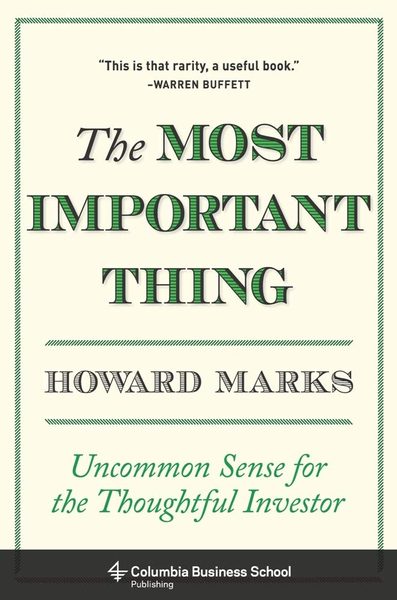
Marks turned the Oaktree memos into The Most Important Thing, the clearest short statement of second-level thinking and risk in print. Warren Buffett has publicly praised it, which is rare for a book written by a working money manager.
Our full review lands in February 2027. In the meantime it sits in the Trader’s Library alongside seventy-nine others we rate.
 The Complete Trader's Edge
The full Mind · Method · Money framework. 70 chapters.
View on Amazon →
The Complete Trader's Edge
The full Mind · Method · Money framework. 70 chapters.
View on Amazon →
 Market Mayhem
400 years of bubbles, crashes, and the pattern that keeps repeating.
Buy on Amazon →
Market Mayhem
400 years of bubbles, crashes, and the pattern that keeps repeating.
Buy on Amazon →
 Greatest Companies
How the world's greatest companies were built — and what traders learn from them.
View on Amazon →
Greatest Companies
How the world's greatest companies were built — and what traders learn from them.
View on Amazon →