GREATEST TRADERS · EPISODE 29
T. Boone Pickens
Mesa Petroleum, the Gulf Oil Raid, and the $2.7 Billion BP Capital Comeback
▶ Watch on YouTube🎵 Listen on Spotify
Also available on Apple Podcasts · Amazon Music
Thomas Boone Pickens Jr.
| Born | 22 May 1928, Holdenville, Oklahoma |
| Died | 11 September 2019, Dallas, age 91 |
| Education | Oklahoma A&M (now OSU) 1951, geology |
| First job | Phillips Petroleum geologist, 1951–1954 |
| First business | Petroleum Exploration, 1954, $2,500 cash + $100,000 borrowed |
| Mesa Petroleum founded | 1956, $5,000 starting capital; public 1964 |
| First major takeover | 1969, Hugoton Production (30x Mesa’s size) |
| Gulf Oil bid | 1983, $750M+ profit on Gulf-Chevron sale |
| Time magazine cover | March 1985, during Gulf takeover |
| Removed from Mesa | 1996, age 68, sold to Richard Rainwater |
| BP Capital Management founded | 1997, energy hedge fund |
| 2005 income | ~$1.5 billion (incl. $279M tax) |
| 2007 income | $2.7 billion (Equity +24%, Commodity +40%) |
| Pickens Plan launched | 2008, $100M of own money for energy independence |
| BP Capital closed | January 2018, declining health |
| Lifetime philanthropy | $1+ billion given away |
| Famous quote | “For most people, that would have been the end. For me, it was halftime.” |
In 1969, a forty-one year old wildcatter from the Texas Panhandle named Boone Pickens looked at a small Kansas natural gas company called Hugoton Production and concluded that its underlying gas reserves were worth substantially more than the market value the company’s stock implied. He approached Hugoton with a takeover proposal. Hugoton was approximately thirty times the size of Mesa Petroleum, the company Pickens controlled. The mismatch in scale would have been disqualifying for most independent oil operators. For Pickens, the asymmetry between the size of his company and the value he saw in Hugoton’s reserves was an opportunity rather than a barrier.
The Hugoton takeover succeeded. The transaction roughly doubled Mesa’s reserves and established Pickens as one of the most analytically sophisticated independent oil operators in the United States. More importantly, it established the operational template Pickens would deploy across the next two decades. Identify a target company whose underlying asset value substantially exceeded its market capitalization. Build a position aggressively. Use shareholder rights to force either a friendly transaction at a substantial premium or a hostile takeover at full asset value. Exit at the higher valuation and redeploy the capital into the next undervalued target.
The 1980s would test the template at scale. Pickens launched takeover bids against Cities Service, Gulf Oil, Phillips Petroleum, and Unocal, among others. The Gulf Oil campaign of 1983 produced a profit of more than seven hundred and fifty million dollars when Gulf was eventually acquired by Standard Oil of California. The Time magazine cover of March 1985, taken during the Gulf takeover, established Pickens as the most recognizable face of 1980s corporate raiding alongside Carl Icahn. The campaigns made Pickens one of the wealthiest oilmen in America. They also reshaped American corporate governance in ways whose effects are still visible four decades later.
What followed across the next thirty years was one of the more remarkable second and third acts in American business history. Forced out of Mesa Petroleum in 1996 at the age of sixty-eight, with his fortune diminished and his health beginning to show the strain of fifty years of aggressive operation, Pickens founded BP Capital Management in 1997 as an energy-focused hedge fund. The hedge fund produced returns through the 2000s commodity supercycle that exceeded almost any of his earlier achievements. In 2005, his combined income from BP Capital was approximately one and a half billion dollars. In 2007, the figure was two point seven billion dollars. The “halftime” framing he later applied to the Mesa exit, “For most people, that would have been the end. For me, it was halftime,” captures the structural feature of his career that distinguished him from most of his contemporaries.
This is the story of how an Oklahoma-born wildcatter became one of the most consequential corporate raiders of the 1980s, what he built across the BP Capital era from 1997 onward, the Pickens Plan campaign for American energy independence, and what his career means for working traders trying to think structurally about the gap between asset value and market price.
Holdenville, Amarillo, and the geology degree
Thomas Boone Pickens Jr. was born on 22 May 1928 in Holdenville, Oklahoma, a small town in the central part of the state. His father, Thomas Boone Pickens Sr., was an oil and mineral landman, the person responsible for negotiating leases for petroleum exploration rights with rural landowners. The work was inherently financial in character, requiring detailed knowledge of geology, property law, and negotiation tactics. The household was modest in scale but intellectually engaged with the oil industry from the beginning of Pickens’s life.
His mother, Grace Marcaline Molonson Pickens, ran the local Office of Price Administration during World War II, rationing gasoline and other goods across three Oklahoma counties. The wartime administrative role gave the household direct exposure to the operational complexity of regional resource allocation, and Pickens has subsequently described his mother as one of the most important formative influences on his career. She taught him fiscal discipline. She also modeled, from an early age, the proposition that a Holdenville woman could operate consequentially within complex regulatory systems if she understood the underlying mechanics.
Pickens has frequently described his early entrepreneurial activities, particularly the expansion of his newspaper delivery route through the acquisition of competing routes in his neighborhood, as the formative experiences of his commercial education. The pattern, identifying smaller competing operations and absorbing them through negotiated acquisition, would become the operational signature of his subsequent career across both the oil patch and the New York Stock Exchange.
The family moved to Amarillo in the Texas Panhandle when Pickens was in high school. He graduated from Amarillo High School and enrolled at Texas A&M University on a basketball scholarship in 1945. The basketball scholarship was lost when Pickens broke his elbow during a game, and he transferred to Oklahoma A&M College, now Oklahoma State University. He majored in geology, joined the Sigma Alpha Epsilon fraternity, and graduated in 1951 with a Bachelor of Science in geology.
Phillips Petroleum and the wildcatter years
After graduation, Pickens took a position as a well-site geologist at Phillips Petroleum, where his father had worked as a lawyer. The Phillips experience was professionally formative for two reasons. First, it gave Pickens detailed exposure to the operational mechanics of large integrated oil company petroleum exploration. Second, it gave him a direct view of what Pickens later described as the “waste and inefficiency” that he believed plagued large oil companies. The combination of analytical training and structural disillusionment would inform every subsequent decision he made through the 1980s takeover campaigns.
Pickens left Phillips in 1954 and spent two years as a freelance consultant to wildcatters, traveling from drilling site to drilling site in the Texas Panhandle. He has subsequently described the period as economically marginal but professionally formative. He charged seventy-five dollars per day for his consulting services. He lived out of his car. He learned the operational mechanics of independent oil production from the inside, in a way that the Phillips employment had not provided.
In 1956, Pickens scraped together enough capital to found Petroleum Exploration, the company that would later become Mesa Petroleum. The starting capital was approximately two thousand five hundred dollars in cash plus one hundred thousand dollars in borrowed money. He took the company public in 1964 under the Mesa Petroleum name. By the late 1960s, Mesa had become one of the most analytically rigorous independent oil and gas exploration companies in the United States, primarily through a combination of disciplined geological analysis and aggressive capital deployment in attractive Texas Panhandle and Oklahoma fields.
The 1969 Hugoton takeover and the corporate raider template
The 1969 takeover of Hugoton Production established the operational template Pickens would deploy across the next twenty-five years. Hugoton was a Kansas-based natural gas producer with substantial reserves in the Hugoton gas field. The company was approximately thirty times the size of Mesa Petroleum by market capitalization. Pickens’s analysis indicated that Hugoton’s underlying gas reserves were substantially more valuable than the market price of its stock implied.
The takeover required Pickens to convince Hugoton shareholders that Mesa would manage the underlying assets more productively than Hugoton’s incumbent management. The argument was structural. Hugoton’s management was conservative in capital deployment. Pickens proposed more aggressive development of the gas reserves, which would produce higher returns to shareholders. The Hugoton board eventually agreed to the merger in 1969. The transaction roughly doubled Mesa’s reserves and established Pickens as a serious operator in independent oil and gas.
The structural insight underneath the Hugoton takeover would become the foundation of Pickens’s subsequent career. Markets systematically undervalue oil and gas companies whose management is not deploying the underlying reserves productively. The gap between the market value of the equity and the underlying asset value of the reserves can be substantial and persistent. The activist investor who can identify the gap, build a position large enough to force change, and then deploy the underlying assets more productively can capture the gap. The same structural framework that Carl Icahn applied to industrial conglomerates, Pickens applied to oil and gas companies, with the analytical advantage that he understood the underlying assets at a geological level that most generalist activist investors did not.
The 1980s: Cities Service, Gulf Oil, and the Time cover
The 1980s were the most aggressive and consequential period of Pickens’s career. The decade combined three structural conditions that were unusually favorable for energy-focused activist investing. First, the integrated oil companies of the 1970s had developed conglomerate structures with substantial hidden reserves value. Second, the development of high-yield debt markets through Drexel Burnham Lambert and Michael Milken gave activist investors access to financing for hostile takeovers at unprecedented scale. Third, the regulatory environment under the Reagan administration was relatively permissive of hostile takeovers in industries where activist intervention was perceived as enhancing shareholder value.
Pickens deployed capital aggressively across this environment. The campaigns of the 1980s included Cities Service in 1982, where Mesa initially succeeded with a hostile bid before being outbid by Occidental Petroleum, but Pickens still walked away with substantial profits. Gulf Oil in 1983 was the most consequential. Pickens led an investor group that built a thirteen percent position in Gulf and pressured the company toward restructuring or sale. The campaign ultimately produced a defensive sale of Gulf to Standard Oil of California in early 1984, generating profits of more than seven hundred and fifty million dollars for Pickens’s Gulf Investment Group.
The 1985 Time magazine cover, published during the Gulf takeover battle, established Pickens as the most recognizable face of 1980s corporate raiding in the energy sector. The cover treatment was, in retrospect, the high point of his public profile during the activist era. The campaigns continued through the mid and late 1980s with bids on Phillips Petroleum, Unocal, and Newmont Mining, none of which produced control of the target companies but most of which produced substantial profits when Pickens exited his positions at premium prices.
The greenmail controversy and the United Shareholders Association
The 1980s campaigns included episodes that would later be classified as “greenmail,” where target companies bought back Pickens’s shares at premium prices to make him exit the campaign. The greenmail payments were legal at the time but became one of the most controversial features of 1980s corporate raiding. Critics argued that greenmail amounted to extracting value from target companies for the benefit of the raider rather than for the benefit of all shareholders. Pickens consistently rejected the framing, arguing that his campaigns benefited target shareholders by forcing management to address structural undervaluation, even in cases where the campaigns ended with greenmail rather than completed transactions.
In 1986, Pickens founded the United Shareholders Association, a nonprofit organization to defend shareholder rights against entrenched corporate management. The organization eventually grew to approximately sixty-five thousand members and operated for eight years. The USA was one of the more substantive institutional contributions Pickens made to American corporate governance. The organization advocated for changes to corporate proxy rules, board independence requirements, and shareholder voting procedures that have, in various forms, become standard features of contemporary American corporate governance.
The episode is part of the public record and is worth engaging with honestly. Pickens’s takeover campaigns produced substantial profits for him and for the shareholders who participated in his investor groups. They also produced substantial costs to other stakeholders, including employees, retirees, and the long-term competitive position of target companies. The structural lesson for working traders is that the same arithmetic that produces extraordinary returns from activist campaigns also produces externalities that the financial returns do not capture. The trader who ignores the externalities is making a moral choice, not just an analytical one.
The 1996 Mesa exit and the personal collapse
The mid-1990s were the most difficult period of Pickens’s career. Natural gas prices declined through the early 1990s. Mesa Petroleum had loaded substantial debt during the 1980s campaigns. By 1996, the company was carrying approximately one point two billion dollars in debt, and Mesa itself had become a target of corporate raiders, including David Batchelder, a former Mesa executive who had trained under Pickens during the 1980s campaigns.
Pickens blocked Batchelder’s takeover attempt by arranging for Richard Rainwater, the former Bass family financial executive, to invest as much as two hundred and sixty-five million dollars on preferential terms that gave Rainwater effective control of Mesa. The arrangement was intended to preserve Pickens’s role as Mesa’s operational head. The arrangement did not work out as Pickens had intended. In May 1996, Rainwater invited Pickens to his Santa Barbara estate and arranged a meeting that effectively communicated to Pickens that he would be removed from his role at Mesa. The removal was finalized later that year. Pickens was sixty-eight years old and had built Mesa from a five thousand dollar starting capital base over forty years.
The personal circumstances during the same period were equally difficult. Pickens’s second marriage to Beatrice Carr ended in divorce. His personal fortune had declined substantially from the peaks of the late 1980s. He started BP Capital Management in 1997, but the early years of the hedge fund were unprofitable. By the late 1990s, in his early seventies, Pickens was broadly described in the financial press as a “has-been,” with younger investors viewing his earlier achievements as belonging to a different era.
BP Capital and the 2005–2007 commodity supercycle
BP Capital Management was founded in 1997, the year after Pickens was forced out of Mesa. The “BP” stood for Boone Pickens, not for British Petroleum, despite the obvious confusion the name created. The fund was structured as an energy-focused hedge fund, taking positions in the equities and commodities of oil, natural gas, and related sectors. The early years of the fund were unprofitable. Pickens has subsequently described the period as one of the most difficult of his life, both professionally and personally.
The commodity supercycle that began in the early 2000s and accelerated through 2005 to 2007 transformed BP Capital from a struggling boutique into one of the most consequential energy-focused hedge funds in the world. Pickens’s analysis of long-term oil supply constraints proved increasingly accurate as Chinese demand growth, declining production from mature North American basins, and accelerating geopolitical tensions drove energy prices substantially higher.
The 2005 financial year produced returns that vindicated Pickens’s framework on the largest scale of his career. BP Capital’s hedge fund was up approximately one point three billion dollars, and a second BP Capital fund that invested in energy company equities was up approximately five hundred and thirty-two million dollars. At the Christmas luncheon that year, Pickens distributed fifty million dollars in bonus checks to BP Capital employees. His combined income for 2005, including investment returns and fees, was approximately one and a half billion dollars, on which he paid approximately two hundred and seventy-nine million dollars in taxes.
The 2007 results were even more spectacular. The BP Capital Equity Fund grew by twenty-four percent after fees. The five hundred and ninety million dollar Capital Commodity fund grew by forty percent, primarily through positions in Suncor Energy, ExxonMobil, and Occidental Petroleum. Pickens’s combined income for 2007 was approximately two point seven billion dollars. The “halftime” he had described after his Mesa exit had produced returns substantially exceeding what he had built across the entire forty-year Mesa era.
The 2008 Pickens Plan and the alternative energy advocacy
In 2008, at the age of eighty, Pickens launched the Pickens Plan, a public advocacy campaign for American energy independence. The plan combined natural gas as a transportation fuel, large-scale wind power development across the U.S. Great Plains, and various other measures to reduce American dependence on imported oil. Pickens spent approximately one hundred million dollars of his own money funding the campaign through television advertising, public appearances, and policy advocacy with both political parties.
The Pickens Plan was structurally significant for two reasons. First, it represented Pickens’s evolution from a corporate raider focused on extracting value from existing oil and gas companies to a public advocate for the structural transformation of American energy infrastructure. The shift was unusual for someone who had built a fortune through aggressive deployment of capital in conventional oil and gas. Second, the plan combined commercial interests, particularly the natural gas-as-vehicle-fuel component that aligned with BP Capital’s energy positions, with public policy advocacy in a way that critics viewed as conflicted.
The Pickens Plan came at structurally unfortunate timing. Both oil and natural gas prices declined through the 2008 to 2010 period, weakening the economic case for the natural gas vehicle fuel component. The simultaneous explosion in hydraulic fracturing and horizontal drilling, which Pickens later acknowledged he had not fully anticipated, transformed the U.S. oil and natural gas supply picture in ways that reduced the urgency of the energy independence argument the plan was built around. The plan continued to operate through the 2010s but with progressively reduced commercial and political prominence.
The framework: structural arbitrage between asset value and market price
Pickens’s career rests on a small number of structural insights that, properly understood, translate into a framework working traders can adapt to their own scales of operation.
Markets systematically undervalue companies with poor capital deployment. The most reliable source of mispricing in oil and gas equities is the gap between the underlying value of reserves and the market value of the equity, created when management is not deploying the reserves productively. Conservative management, family-dominated boards, and dispersed shareholders create conditions where this gap can persist for years. The activist investor’s edge is the willingness to identify the gap, build a position large enough to force change, and then push for the changes that will close the gap.
Operational expertise creates analytical edge. Pickens’s edge against generalist activist investors was that he understood the underlying oil and gas reserves at a geological level. He could evaluate the productivity of a given field more accurately than financial analysts who were not geologists. The retail equivalent is to develop deep operational knowledge in whatever you trade. The trader who understands the underlying mechanics of the assets being traded has an analytical edge over the trader who is operating on price action alone.
Reserves are structural patience. Pickens’s most consequential discipline was the willingness to hold positions through extended takeover battles, even when individual quarters or years produced apparent setbacks. The takeovers required years of sustained pressure to produce results. The investor who deployed capital and demanded immediate results could not have produced the long-term outcomes Pickens delivered. The discipline to maintain positions through extended periods of apparent disagreement with the market is the structural feature that distinguishes long-term great investors from those who produced one or two great years.
Reinvention is structural option value. The Pickens career arc, from Mesa to BP Capital to the Pickens Plan, demonstrates the structural value of being willing to reinvent the operational framework when the underlying conditions change. The corporate raider framework that worked in the 1980s did not work in the same form in the 1990s. Pickens reinvented himself as an energy hedge fund manager, then as a public advocate for energy independence, before declining health forced him to close BP Capital in 2018. The retail equivalent is to remain analytically flexible about the framework you are applying, willing to evolve as market conditions change rather than mechanically applying the same approach across all environments.
The 2018 closure and the final years
Pickens suffered a series of strokes beginning in 2016 and a serious fall in 2017 that required hospitalization. In late 2017, he put his sprawling 100-square-mile Mesa Vista Ranch in the Texas Panhandle on the market for two hundred and fifty million dollars. In January 2018, BP Capital Management closed to outside investors, with Pickens citing his declining health. The fund had been operating for twenty-one years.
The final years of Pickens’s life were spent in Dallas, surrounded by family and friends, continuing his philanthropic activities through the T. Boone Pickens Foundation. His public communication continued primarily through Twitter, where he maintained an active presence advocating for various energy independence and shareholder rights causes. He died on 11 September 2019 at the age of ninety-one. At the time of his death, his net worth had declined to approximately five hundred million dollars, after he had given away more than one billion dollars to philanthropic causes during his lifetime.
What Pickens means for your trading practice
Pickens’s career maps onto Mind, Method, Money in ways that translate directly to retail traders, even though most retail traders cannot deploy capital at the scale of the 1980s corporate takeover campaigns.
Mind. Develop the temperamental capacity to operate on long-term thesis rather than short-term price action. Pickens’s most consequential campaigns took years to play out. The investor who needed quarterly validation could not have operated within his framework. The retail equivalent is to evaluate positions based on whether the underlying analytical thesis remains valid, not based on short-term price action. The temperamental capacity to hold positions through extended periods of apparent disagreement, when the analysis is unchanged, is one of the most underappreciated disciplines in active trading.
Method. Build operational understanding deep enough to identify mispricings the market has missed. The intellectual humility to acknowledge where your operational expertise actually lies, and to focus your capital deployment within that domain, is the structural feature that distinguished Pickens’s career. He operated almost exclusively in oil and gas, where his geological training gave him analytical edge. He did not deploy capital aggressively into industries where he did not have operational understanding. The retail equivalent is to focus your capital deployment within the asset classes where your knowledge actually produces analytical edge, rather than spreading capital across all available markets.
Money. Maintain the structural capacity to deploy capital aggressively when opportunities emerge. The 2005 to 2007 commodity supercycle produced opportunities that Pickens could deploy BP Capital’s resources against because the fund had built the analytical infrastructure and the capital base to act when the opportunity emerged. The retail equivalent is to maintain capital reserves and analytical preparation that allow decisive deployment when structural opportunities appear, rather than being fully deployed in marginal positions when the major opportunity arrives.
The last word
T. Boone Pickens died in September 2019 at the age of ninety-one. His career spanned six decades of active oil and gas operation, from the Phillips Petroleum geologist position in 1951 through the BP Capital closure in 2018. The arc included the founding of Mesa Petroleum, the corporate raider campaigns of the 1980s, the personal and professional collapse of the mid-1990s, the BP Capital era through the commodity supercycle, the Pickens Plan advocacy, and the philanthropic commitments of his final years.
The combined returns across the career, measured by accumulated wealth less philanthropic distributions, were substantial without being among the largest of his generation. His net worth at peak was approximately three billion dollars in the mid-2000s. The lifetime philanthropic giving of more than one billion dollars, including more than three hundred million dollars to Oklahoma State University alone, established him as one of the most significant individual philanthropists in modern American higher education.
What Pickens leaves the working trader is a framework that, in its essential elements, depends not on Texas Panhandle landholdings or geological credentials but on the analytical and temperamental disciplines that any trader can develop. Develop deep operational understanding in your chosen asset class. Identify gaps between asset value and market price. Hold positions through extended periods of apparent disagreement when the underlying thesis remains valid. Maintain the structural capacity to deploy capital aggressively when opportunities emerge. Reinvent your framework when the underlying conditions change rather than mechanically applying the same approach across all market environments. None of these requirements depend on Pickens’s particular Oklahoma-to-Texas-Panhandle trajectory. They depend on disciplined application of analytical work to specific opportunities, sized in proportion to the conviction the analysis supports.
The most underappreciated feature of Pickens’s career may be the consistency of the framework across the six-decade arc. The geological analysis he learned at Oklahoma A&M in the late 1940s and applied at Phillips Petroleum in the early 1950s was, in its essential elements, the same framework he applied through the Mesa era, the BP Capital era, and the Pickens Plan advocacy. The market environments varied dramatically. The asset classes evolved. The institutional structures changed. The underlying analytical framework, deep operational understanding combined with the willingness to deploy capital where the analysis supported the deployment, remained unchanged.
“For most people, that would have been the end. For me, it was halftime.” — T. Boone Pickens
Frequently Asked Questions
Who was T. Boone Pickens?
Thomas Boone Pickens Jr. was an American business magnate, financier, and philanthropist born on 22 May 1928 in Holdenville, Oklahoma. He founded Mesa Petroleum in 1956, which grew to become one of the largest independent oil and gas companies in the United States. He became one of the most prominent corporate raiders of the 1980s, leading takeover campaigns against Cities Service, Gulf Oil, Phillips Petroleum, Unocal, and other major oil companies. He founded BP Capital Management in 1997 as an energy-focused hedge fund, which produced extraordinary returns during the 2000s commodity supercycle. He launched the Pickens Plan for American energy independence in 2008. He died on 11 September 2019 at the age of 91.
What was Mesa Petroleum?
Mesa Petroleum was the oil and gas exploration and production company T. Boone Pickens founded in 1956, originally under the name Petroleum Exploration. The company was taken public in 1964 under the Mesa Petroleum name. Through aggressive geological work in the Texas Panhandle and Oklahoma fields, plus the 1969 takeover of Hugoton Production, Mesa grew to become one of the largest independent oil and gas companies in the United States by the early 1980s. The company struggled in the early 1990s as natural gas prices declined and accumulated debt grew. In 1996, Mesa was sold to financier Richard Rainwater, and Pickens was removed from his role. Mesa merged with Parker & Parsley Petroleum in 1997 to form Pioneer Natural Resources.
What was the Gulf Oil takeover?
In 1983, Pickens led Gulf Investment Group in a hostile takeover bid for Gulf Oil, then the seventh-largest oil company in the United States. The campaign built a 13% position in Gulf and pressured the company toward restructuring or sale. Although Pickens did not gain control of Gulf, the campaign ultimately produced a defensive sale of Gulf to Standard Oil of California (Chevron) in early 1984 for approximately $13.2 billion, then the largest corporate acquisition in American history. Gulf Investment Group netted more than $750 million in profits from the campaign. The takeover battle established Pickens as one of the most prominent corporate raiders of the 1980s and led to his March 1985 Time magazine cover.
What is BP Capital Management?
BP Capital Management was the energy-focused hedge fund T. Boone Pickens founded in 1997, the year after he was removed from Mesa Petroleum. The “BP” stood for Boone Pickens, not for British Petroleum. The fund operated as two related vehicles: BP Capital Equity Fund (focused on energy company equities) and BP Capital Commodity Fund (focused on energy commodities). The fund struggled in its early years but produced extraordinary returns during the 2000s commodity supercycle. In 2005, the funds produced gains of approximately $1.8 billion. In 2007, the Equity Fund grew 24% after fees and the Commodity Fund grew 40%. Pickens closed BP Capital to outside investors in January 2018 due to declining health.
What was the Pickens Plan?
The Pickens Plan was a public advocacy campaign T. Boone Pickens launched in 2008, at the age of 80, for American energy independence. The plan combined natural gas as a transportation fuel, large-scale wind power development across the U.S. Great Plains, and other measures to reduce American dependence on imported oil. Pickens spent approximately $100 million of his own money funding the campaign through television advertising and policy advocacy. The plan came at structurally unfortunate timing: oil and natural gas prices declined after 2008, and the simultaneous explosion in hydraulic fracturing and horizontal drilling transformed U.S. supply in ways that reduced the urgency of the energy independence argument. The plan continued to operate through the 2010s with progressively reduced prominence.
What was Pickens’s relationship with Carl Icahn?
T. Boone Pickens and Carl Icahn were the two most prominent corporate raiders of the 1980s and operated in overlapping spaces, particularly in oil and gas company takeover campaigns. The two were professionally competitive but personally cordial. After Pickens’s death in 2019, Icahn publicly recalled Pickens’s “charm and wit” and shared anecdotes from their joint experiences during the 1980s. Both Pickens and Icahn targeted Phillips Petroleum, Pickens first in 1985 and Icahn subsequently. Icahn has frequently described Pickens as one of the most analytically sophisticated activist investors of the era, particularly given Pickens’s deep operational knowledge of the oil and gas industry.
What was Pickens’s net worth?
Pickens’s net worth peaked at approximately $3 billion in the mid-2000s, primarily through the BP Capital returns during the commodity supercycle. By the time of his death in September 2019, his net worth had declined to approximately $500 million, after he had given away more than $1 billion to philanthropic causes during his lifetime. The decline reflected both his philanthropic commitments and the more difficult market environment for energy investments after the 2014 oil price collapse. Forbes had previously listed his net worth at $1.2 billion in 2013.
How much did Pickens give to charity?
T. Boone Pickens gave away more than $1 billion to philanthropic causes during his lifetime, making him one of the most significant individual philanthropists in modern American history. His largest single donation was a 2005 gift of $165 million to Oklahoma State University, his alma mater, to fund the renovation of the football stadium and broader athletic facilities. The stadium was subsequently renamed Boone Pickens Stadium. He gave additional substantial donations to OSU, the University of Texas M.D. Anderson Cancer Center, the University of Texas Southwestern Medical Center, and various other educational and medical research institutions. He founded the T. Boone Pickens Foundation in 2006 to coordinate his philanthropic activities.
Continue Learning
- Carl Icahn: From Princeton Philosophy to TWA, Apple, and the $20 Billion Activist Empire · The contemporary corporate raider who operated in overlapping spaces with Pickens, particularly in oil and gas company takeover campaigns.
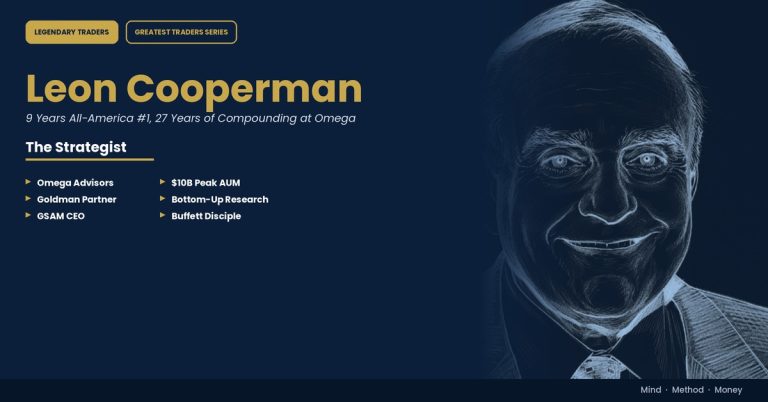
- Leon Cooperman: From the South Bronx to Goldman Partner to the $10 Billion Omega Empire · The contemporary value investor who built a hedge fund through bottom-up analysis after a long Wall Street institutional career.
- Charlie Munger: The Latticework Mind That Built Berkshire · The intellectual humility about expertise boundaries that runs through every great structural investor’s framework.
- The Risk of Ruin: Mathematics Every Trader Must Understand · The arithmetic underneath the position sizing discipline that compounded Pickens’s returns across multiple decades.
Build Your Own Activist Framework
Pickens compounded across six decades through a single discipline: deep operational understanding combined with the willingness to deploy capital where the analysis supported the deployment, sustained through extended periods of apparent disagreement when the underlying thesis remained valid. The Mind · Method · Money structure in The Complete Trader’s Edge codifies the same approach for retail traders: edge from operational expertise, discipline from systematic risk management, and the temperamental capacity to operate on long-term thesis rather than short-term price action.
 The Complete Trader's Edge
The full Mind · Method · Money framework. 70 chapters.
View on Amazon →
The Complete Trader's Edge
The full Mind · Method · Money framework. 70 chapters.
View on Amazon →
 Market Mayhem
400 years of bubbles, crashes, and the pattern that keeps repeating.
Buy on Amazon →
Market Mayhem
400 years of bubbles, crashes, and the pattern that keeps repeating.
Buy on Amazon →
 Greatest Companies
How the world's greatest companies were built — and what traders learn from them.
View on Amazon →
Greatest Companies
How the world's greatest companies were built — and what traders learn from them.
View on Amazon →