
GREATEST TRADERS · EPISODE 7
Stanley Druckenmiller
30 Years Without a Losing Year
▶ Watch on YouTube🎵 Listen on Spotify
Also available on Apple Podcasts · Amazon Music
Last updated: 15 August 2026
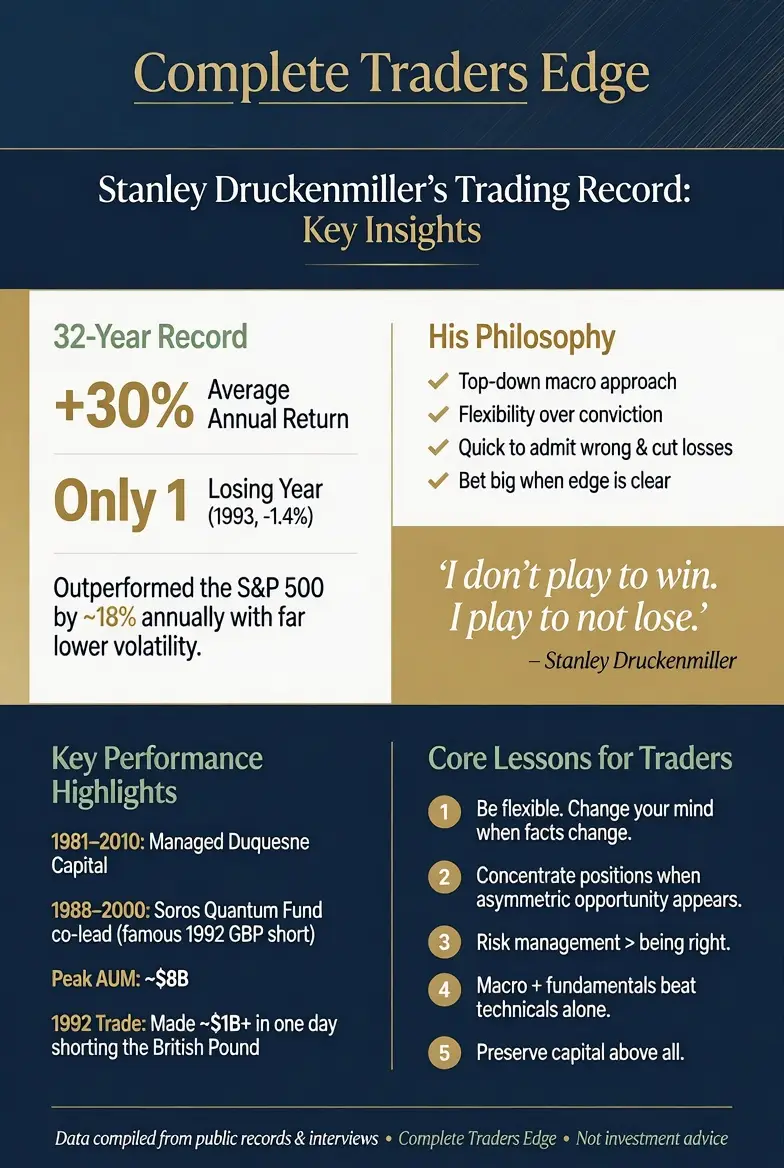
Stanley Druckenmiller compiled the most consistent track record in the history of macro investing. Thirty consecutive years of positive returns, averaging approximately 30% per year. No down year. Not one. While other legendary traders had spectacular wins punctuated by devastating losses, Druckenmiller simply made money, year after year, in every market environment imaginable.
That kind of consistency does not come from luck, and it does not come from one brilliant idea. It comes from a framework that combines deep macro analysis with technical timing, ruthless risk management, and the psychological discipline to change your mind when the market tells you that you are wrong. Druckenmiller is the trader who best embodies what happens when Mind, Method, and Money operate in genuine alignment.
This is his story, his methodology, and the lessons that every trader at every level can extract from the most complete track record in modern finance.
From Pittsburgh to Wall Street
Druckenmiller grew up in a middle-class family in Pittsburgh, Pennsylvania. He studied English and economics at Bowdoin College, then briefly attended the University of Michigan’s PhD programme in economics before dropping out to take a job as an oil analyst at Pittsburgh National Bank. The academic world felt too slow. He wanted to be where the decisions were being made.
| Principle | What It Means | Trading Application |
|---|---|---|
| Concentrate when right | Increase size on highest-conviction setups | Differentiate A-grade from C-grade setups. Full size on A-grade only. |
| Liquidity drives markets | Central bank policy matters more than earnings | Check whether the macro environment supports your trade direction before entering. |
| Capital preservation first | Never lose big, regardless of conviction | 1% risk per trade. Daily loss limits. Drawdown protocol. No exceptions. |
| Flexibility over ego | Change your mind instantly when evidence changes | If the market invalidates your thesis, exit. Do not hold and hope to be vindicated. |
| 30 years, zero losing years | The ultimate proof that defence plus concentration works | Defence (small losses) + offence (concentrated winners) = the most consistent record in history. |
Within a year at Pittsburgh National, he was named head of the bank’s equity research group. By 28, he was running their investment portfolio. The ascent was remarkably fast, driven not by pedigree or connections but by an ability to synthesise complex macro information and translate it into clear, actionable investment theses.
In 1981, at age 28, Druckenmiller founded his own fund, Duquesne Capital Management. The firm would become one of the most successful hedge funds in history, but Druckenmiller’s profile truly exploded when George Soros recruited him to manage the Quantum Fund in 1988.
The Soros Partnership: Learning to Size Up
Working with Soros from 1988 to 2000 was a defining period in Druckenmiller’s career. The partnership produced some of the most profitable trades in hedge fund history, including the famous short of the British pound in 1992 that earned the Quantum Fund over $1 billion in a single day.
What most people do not realise is that it was Druckenmiller, not Soros, who identified the opportunity. Druckenmiller saw the structural imbalance: Britain had entered the European Exchange Rate Mechanism at an overvalued rate, the economy was weakening, interest rates needed to fall, but ERM membership required maintaining the pound within a tight band against the Deutsche Mark. The contradiction was unsustainable.
Druckenmiller built an initial short position. When he presented the thesis to Soros, expecting approval, Soros responded with a question that would reshape Druckenmiller’s entire approach to trading. Soros asked why the position was so small. If the thesis was right, and the asymmetry was this extreme, the position should be much, much larger.
That single moment taught Druckenmiller the lesson he considers the most important of his career: when you are right and the setup is asymmetric, size matters more than anything else. A correct thesis held at insufficient size is merely an intellectual achievement. Sizing it appropriately is what turns analysis into generational returns.
The Quantum Fund shorted over $10 billion worth of sterling. When Black Wednesday hit on September 16, 1992, and the Bank of England was forced to withdraw from the ERM, the fund made approximately $1 billion in profit. Soros became “the man who broke the Bank of England.” Druckenmiller was the architect behind the trade.
The Berlin Wall Trade
Before the pound trade made headlines, Druckenmiller had already demonstrated his macro instincts with a trade around the fall of the Berlin Wall in November 1989. As reunification became inevitable, Druckenmiller reasoned that massive investment would flow into East Germany, the German economy would boom, and the Bundesbank would raise interest rates to control the resulting inflation. All of this was bullish for the Deutsche Mark.
He built a substantial long position in the Deutsche Mark. The trade generated hundreds of millions in profits and confirmed a pattern that would define his career: identify the big macro theme before the consensus catches up, position aggressively, and hold through the noise until the thesis plays out.
What made this trade instructive was not just the analysis but the process. Druckenmiller started with a modest position, built conviction as the evidence accumulated, and then sized up decisively when the thesis strengthened. He did not go all-in on day one. He built the position as his confidence grew. This is the kind of disciplined aggression that separates good macro traders from great ones.
The Druckenmiller Method: Macro Vision, Technical Timing
Druckenmiller’s methodology is a blend of top-down macro analysis and bottom-up technical timing. He does not fit neatly into any single category. He is not a pure fundamentalist waiting for value to converge. He is not a pure technician reading chart patterns. He uses both in service of each other, and the combination is what produces his edge.
Macro First: Identify the Big Theme
Druckenmiller spends the majority of his analytical time identifying large-scale macroeconomic themes. He studies monetary policy, fiscal policy, currency dynamics, economic cycles, and geopolitical events. He looks for structural imbalances, situations where government policy contradicts economic reality, or where market pricing reflects a consensus that the data does not support.
His approach is not to predict what will happen next quarter. It is to understand the dominant forces driving capital flows across the globe and to position in the direction of those forces. He is looking for the “big picture” that most market participants are either ignoring or misinterpreting.
This is fundamentally different from the approach of most retail traders, who start with a chart and try to extract meaning from price alone. Druckenmiller starts with the world and then uses the chart to time his entry. The macro thesis gives him conviction. The technical analysis gives him precision.
Liquidity Is the Driver
One of Druckenmiller’s most powerful analytical tools is his focus on liquidity. He has said repeatedly that the single most important factor driving asset prices is not earnings, not valuations, not GDP growth. It is central bank liquidity. When central banks are injecting money into the system, assets rise. When they are withdrawing it, assets fall. The direction of liquidity explains more about market behaviour than any other single variable.
For retail traders, this insight is directly applicable. Understanding where we are in the monetary policy cycle, whether central banks are tightening or easing, gives you a macro tailwind or headwind that should inform your bias. Trading long in a tightening cycle is swimming against the current. Trading long in an easing cycle is swimming with it. Druckenmiller never fights the liquidity tide.
This principle connects directly to understanding the economic calendar and how major releases, particularly central bank decisions, shift the landscape that every trade operates within.
Technical Timing: Let Price Confirm the Thesis
Where many macro investors fail is in timing. They identify the correct theme but enter too early or too late. Druckenmiller avoids this trap by using technical analysis as his timing mechanism. He waits for price to confirm his macro thesis before committing significant capital.
He has described looking for “technical breakouts that align with macro fundamentals.” If his analysis says the dollar should weaken, he does not short the dollar on the day the analysis is complete. He watches the charts, waits for a technical breakdown through key support, and then enters with the conviction that both the macro thesis and the price action are aligned.
This is the blended approach that The Complete Trader’s Edge framework teaches: higher timeframe bias established through fundamental or macro analysis, with entries triggered by technical signals on lower timeframes. Druckenmiller was doing this decades before the concept had a name in retail trading education.
Flexibility Above All
Perhaps Druckenmiller’s most underrated quality is his willingness to change his mind. He does not marry his positions. If the market moves against him and the price action is telling him something his thesis has not accounted for, he exits first and analyses second. He has described cutting large positions the same day he put them on when the initial price action suggested the thesis was wrong.
This is the opposite of the “conviction at all costs” mentality that destroys most traders. Druckenmiller’s conviction is strong, but it is never stronger than the evidence. When price disagrees with the thesis, price wins. Every time.
He has explicitly said: “I have no loyalty to my positions. None. Zero.” This psychological flexibility, the ability to separate ego from analysis, is what allowed him to maintain 30 years without a loss. He never dug into a losing thesis and waited for vindication. He adapted.
Position Sizing: The Concentration Principle
Druckenmiller is one of the strongest advocates for concentrated positioning in the history of professional trading. His view, influenced heavily by Soros, is that diversification for its own sake is overrated. When you have a high-conviction setup with asymmetric risk-reward, you should size it meaningfully.
His famous quote captures this perfectly: “The way to build long-term returns is through preservation of capital and home runs.” He is not looking for a portfolio of slightly positive bets. He is looking for a few setups per year where his conviction is highest and the asymmetry is greatest, and then he sizes those trades to make a meaningful impact on his returns.
This does not mean recklessness. Druckenmiller is fanatical about position sizing in both directions. When conviction is low, he trades small or not at all. When conviction is high, he sizes up aggressively. The common retail mistake is trading the same size regardless of conviction level. Druckenmiller treats size as a variable that should fluctuate dramatically based on the quality of the setup.
For retail traders with smaller accounts, the principle translates directly: your best setups deserve your largest position sizes (within your risk parameters). Your marginal setups deserve smaller sizes or no trade at all. Risk-reward thinking should scale with conviction.
The 2000 Tech Bubble: The Only Real Stumble
Every great trader has at least one instructive failure, and Druckenmiller’s came during the dot-com bubble. In early 2000, he had correctly identified that technology stocks were in a massive bubble. His analysis was right. His initial positioning was short tech. And then he did something that contradicts everything else in his career: he reversed course and went long.
Watching tech stocks continue to surge in late 1999 and early 2000, Druckenmiller abandoned his bearish thesis and bought into the rally. He reportedly invested $6 billion in technology stocks near the peak. When the bubble burst, Duquesne lost approximately $3 billion in a matter of weeks.
Druckenmiller has been remarkably candid about this mistake. He has called it the worst trade of his career and attributed it to a violation of his own principles. He let the fear of missing out override his analytical conviction. He chased performance. He abandoned his macro framework because short-term price action made him doubt a thesis that was fundamentally correct.
The lesson he drew from it is one of the most valuable in all of trading psychology: “I didn’t lose money because I was stupid. I lost money because I let the emotional pressure of watching others make money override my own analysis.” It is the revenge trading dynamic applied at a billionaire scale, and it proves that no one is immune to psychological error.
Crucially, even after this loss, 2000 was still only a modest down year for Duquesne. He recovered the majority of the losses before year end. The fact that a $3 billion drawdown did not produce a losing year speaks to the cushion that his earlier gains had built and the speed of his recovery.
Why Druckenmiller Closed Duquesne Capital
In August 2010, Druckenmiller made the surprising decision to close Duquesne Capital and return all outside capital to investors. He was 57 years old, his fund managed approximately $12 billion, and his track record was unmatched. He was not forced out by losses. He was not retiring from investing. He simply did not want the pressure of managing other people’s money anymore.
His explanation was characteristically honest: the pressure of maintaining his track record had begun to feel like a burden rather than a challenge. He felt that the increased correlation across asset classes in the post-2008 world made generating his historical returns more difficult, and he was not willing to compromise his standards. He would rather close the fund than deliver returns that fell short of his own expectations.
Since closing Duquesne, Druckenmiller has continued to manage his personal fortune through his family office, and by all accounts, his returns have continued to be exceptional. He remains one of the most closely watched macro investors in the world. His quarterly portfolio disclosures through SEC 13-F filings are analysed by thousands of traders looking for clues about his current macro positioning.
Druckenmiller’s Rules for Traders
Across decades of interviews, speeches, and rare public appearances, Druckenmiller has articulated a set of principles that any trader can adopt.
Preserve Capital Above Everything
The number one priority is not making money. It is not losing money. Capital preservation is the foundation on which everything else is built. If you lose 50% of your account, you need a 100% gain just to get back to breakeven. Managing drawdowns is more important than chasing gains.
Size for Conviction
Do not trade the same size on every trade. Your best ideas deserve your biggest positions. Your mediocre ideas deserve small positions or no position at all. The discipline to differentiate between A-grade setups and C-grade setups is what separates professionals from amateurs.
Stay Flexible
Never fall in love with a position. Never let ego prevent you from cutting a loss. If the market tells you that you are wrong, listen. The cost of being wrong is small when you cut quickly. The cost of being stubborn is your account.
Follow Liquidity
The direction of central bank policy is the single most important variable in determining the direction of asset prices. Do not fight the Fed, the ECB, or any other central bank that is actively inflating or deflating the money supply. Trade in the direction of liquidity.
Think Asymmetrically
Every trade should be evaluated in terms of its asymmetry: what you stand to lose relative to what you stand to gain. The best trades are those where the downside is clearly defined and limited, while the upside is large and driven by a macro thesis that most of the market has not yet priced in.
Do Not Chase
The dot-com experience reinforced what Druckenmiller already knew intellectually: chasing performance is the most dangerous thing a trader can do. If you miss a move, you miss it. There will always be another trade. There will not always be another account to trade with.
Druckenmiller and the Mind · Method · Money Framework
Mind: Druckenmiller’s psychological edge was his flexibility. He combined deep conviction with the willingness to abandon a thesis the moment price contradicted it. He never let ego drive his decisions. His one significant deviation from this discipline, the tech bubble chase, produced the only meaningful drawdown of his career and reinforced the principle permanently.
Method: His method is the integration of macro analysis with technical timing. He identifies the big themes, waits for price to confirm them, and then enters with precision. This top-down approach is directly applicable to the market structure analysis and multi-timeframe approach that forms the backbone of sound trading practice.
Money: Druckenmiller’s approach to capital management is a masterclass. Variable position sizing based on conviction. Aggressive cutting of losses. Concentrated bets when the asymmetry is favourable. And above all, preservation of capital as the non-negotiable foundation. His track record proves that position sizing and risk-reward discipline are the ultimate competitive advantages.
Listen to the Full Episode
Druckenmiller is Episode 7 of the Greatest Traders podcast, covering Pittsburgh, the Soros years, the Berlin Wall trade and the one year he broke his own rules. Players are at the top of this page.
What You’ll Hear in the Episode
▶ How he ran a bank’s equity research group within a year of joining as an analyst
▶ The Soros question about position size that reshaped his entire career
▶ Why the Berlin Wall trade mattered more to his method than the pound trade
▶ Liquidity as the single most important driver of asset prices
▶ The $3 billion dot-com mistake and what caused it
▶ Why he closed a $12 billion fund at the top of his game
Frequently Asked Questions
Did Druckenmiller or Soros make the Bank of England trade?
Both, in different roles. Druckenmiller identified the structural imbalance and built the initial short. Soros pushed him to size it far larger than he had planned. The public credit went to Soros as “the man who broke the Bank of England”, but the thesis was Druckenmiller’s and he has said as much. See the Soros profile for the other side of the same trade.
What is Stanley Druckenmiller’s track record?
Thirty consecutive years of positive returns, averaging roughly 30% a year, with no down year. That covers his time running Duquesne Capital from 1981 and the Quantum Fund from 1988 to 2000, through bull markets, bear markets, currency crises and the dot-com collapse.
What was Druckenmiller’s worst trade?
The dot-com reversal in early 2000. He had correctly called the bubble and was positioned short, then abandoned the thesis and bought roughly $6 billion of technology stocks near the peak. Duquesne lost around $3 billion in weeks. He has been open that the cause was watching other people make money, not a failure of analysis.
Why did he close Duquesne Capital?
In August 2010, at 57, with roughly $12 billion under management and an unbroken record, he returned all outside capital. His stated reason was that the pressure of protecting the track record had become a burden rather than a challenge, and he would rather close than deliver returns below his own standard. He still trades his own capital through a family office.
What does Druckenmiller mean by “follow liquidity”?
That central bank policy moves asset prices more than earnings, valuations or GDP. When central banks add liquidity, assets rise. When they withdraw it, assets fall. For a retail trader the practical version is simple: know whether you are trading with the monetary tide or against it before you take a directional bias.
The Druckenmiller Legacy
Stanley Druckenmiller is not the most famous trader in history. He does not have the public profile of Warren Buffett or the dramatic narrative of Jesse Livermore. But his track record is arguably the most impressive: 30 years, no losing year, approximately 30% annual returns, across every imaginable market condition. Bull markets, bear markets, financial crises, currency collapses, pandemic shocks. He made money through all of them.
The reason he succeeded where so many others eventually stumbled is that he combined every element that trading requires. Deep analysis. Technical precision. Psychological flexibility. Risk discipline. And the courage to size up when everything aligned. He is the complete trader in the truest sense of the phrase.
For every trader reading this, the lesson is not to become a macro investor managing billions. It is to adopt the principles that produced the results. Think about what is driving the market, not just what the chart looks like. Size your best trades meaningfully. Cut your worst trades immediately. And never, ever let the fear of missing out override the analysis that makes you profitable.
That is how you build a track record that survives 30 years. One disciplined decision at a time.
Key Takeaways from Stanley Druckenmiller
📊 Liquidity drives asset prices more than any other variable. Follow central bank policy, not headlines.
🧠 Flexibility is the ultimate psychological edge. Cut when wrong, hold when right, and never let ego make the decision.
📐 Size positions based on conviction level. Your best setups deserve your largest risk allocation.
🎯 Combine macro analysis with technical timing. The thesis gives you conviction; the chart gives you entry.
🛡️ Preservation of capital is the foundation. You cannot compound what you have already lost.
Explore the Full Legendary Traders Series
Learn from history’s greatest market minds.
George Soros ·
Paul Tudor Jones ·
Jesse Livermore ·
Ed Seykota ·
All Traders
Druckenmiller was interviewed for The New Market Wizards, Schwager’s 1992 follow-up. It is the fullest first-hand account of the concentration-plus-flexibility approach that produced the record.
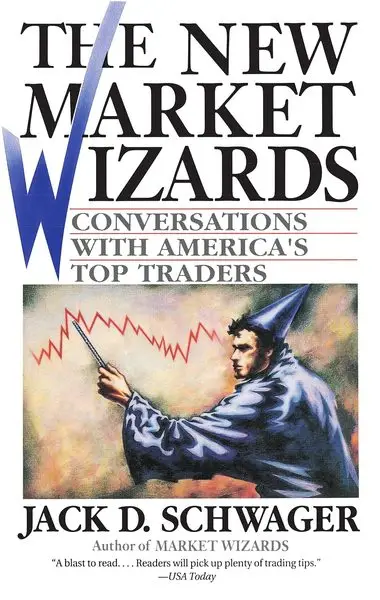
See also our review of the original Market Wizards.
 The Complete Trader's Edge
The full Mind · Method · Money framework. 70 chapters.
View on Amazon →
The Complete Trader's Edge
The full Mind · Method · Money framework. 70 chapters.
View on Amazon →
 Market Mayhem
400 years of bubbles, crashes, and the pattern that keeps repeating.
Buy on Amazon →
Market Mayhem
400 years of bubbles, crashes, and the pattern that keeps repeating.
Buy on Amazon →
 Greatest Companies
How the world's greatest companies were built — and what traders learn from them.
View on Amazon →
Greatest Companies
How the world's greatest companies were built — and what traders learn from them.
View on Amazon →
 Greatest Traders
Eighty-six lives that explain the markets — Livermore to Madoff, told with the losses left in.
View on Amazon →
Greatest Traders
Eighty-six lives that explain the markets — Livermore to Madoff, told with the losses left in.
View on Amazon →